
Boats Market Outlook: Size, Share, Trends, Growth Analysis, Competitive Landscape & Forecast, 2026-2033

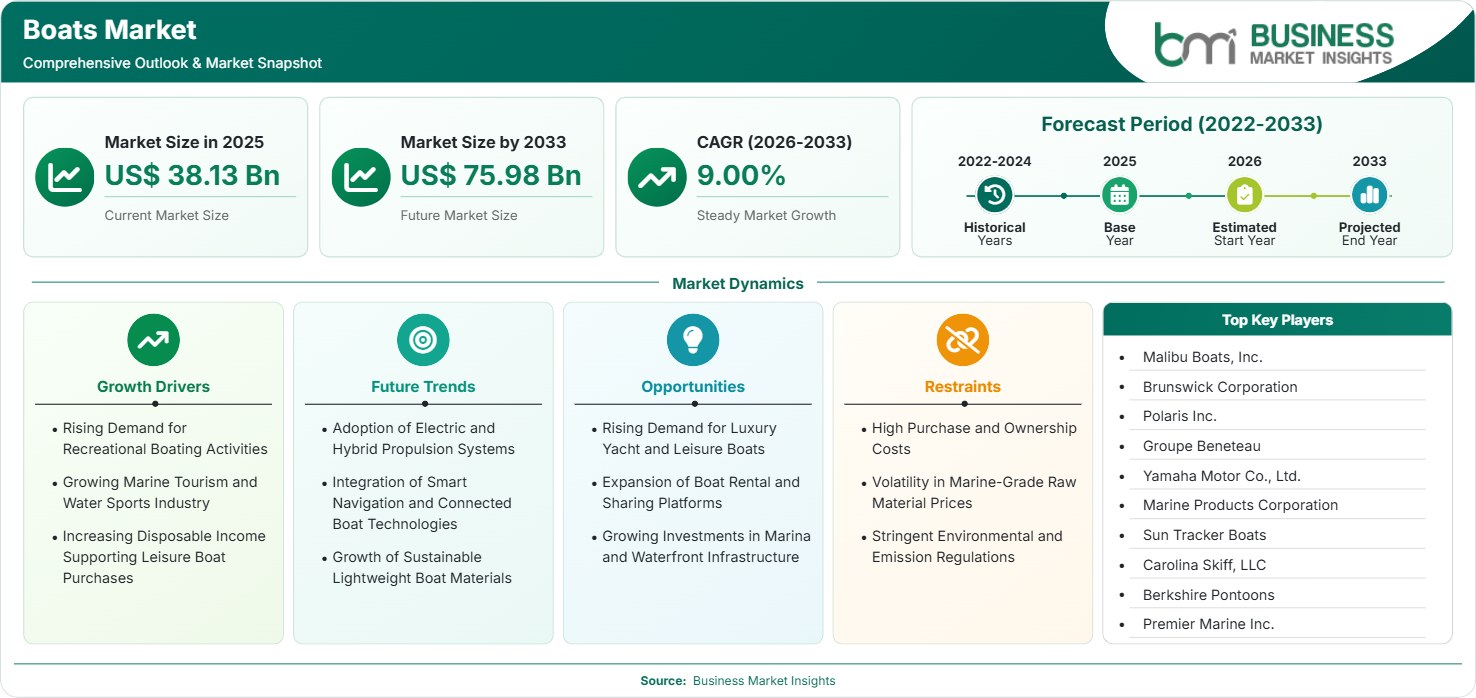
The Boats Market size was valued at US$ 38.13 Billion in 2025 and is projected to reach US$ 75.98 Billion by 2033, growing at a CAGR of 9.00% during 2026–2033. Rising participation in recreational boating activities, increasing marine tourism, growing investments in electric propulsion technologies, and expanding demand for premium leisure vessels are supporting market growth worldwide.

Report Coverage
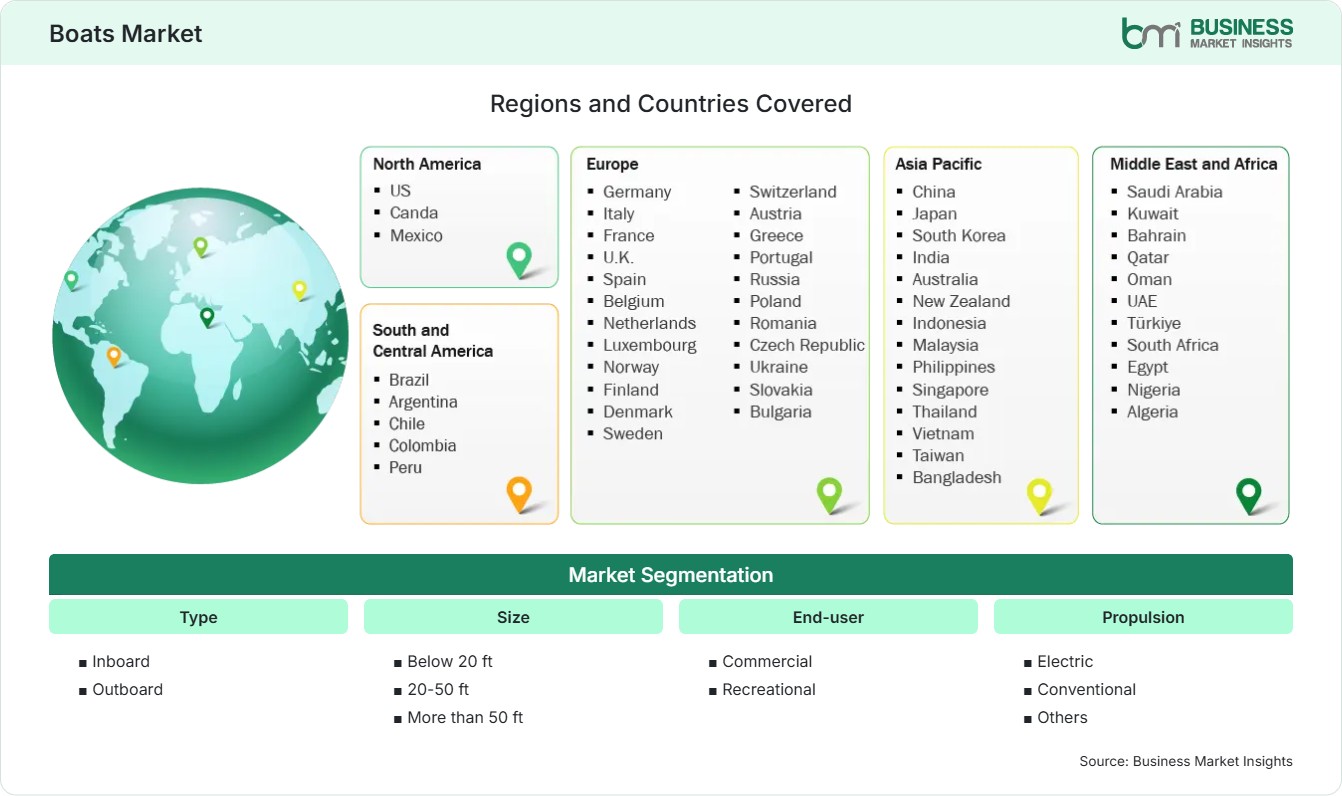
  • Type: Inboard, Outboard
  • Size: Below 20 ft, 20-50 ft, More than 50 ft
  • End-user: Commercial, Recreational
  • Propulsion: Electric, Conventional, Others
  • Hull: Wood, GRP, Aluminum, Steel, Others
US$ 38.13 Bn Market size in 2025
US$ 75.98 Bn Market Size by 2033
9.00% CAGR, 2026 - 2033
2026-2033 Forecast Period

01 AI Overview

Boats Market Summary

  • North America Region: North America holds a boats market share of 36%–39% in 2025, growing with a CAGR of 8.2%–8.8% during 2026–2033. Strong recreational boating culture, high disposable incomes, expanding marina infrastructure, and increasing demand for fishing and leisure boats continue supporting regional leadership. The U.S. market is expected to register a CAGR of 8.3%–8.9%.
  • Fastest Growing Region: Asia Pacific accounts for 22%–25% share in 2025 and is projected to grow at a CAGR of 10.4%–11.0% through 2033. Rising marine tourism activities, increasing coastal recreation, growing middle-class income levels, and expanding water sports participation continue supporting regional expansion.
  • Leading Segment: Outboard Boats represent 61%–64% share in 2025 and are expected to grow at a CAGR of 9.1%–9.7% through 2033. Ease of maintenance, fuel efficiency, lower ownership costs, and widespread adoption across recreational applications continue supporting segment leadership.
  • High Growth Segment: Electric Propulsion accounts for 12%–15% share in 2025 and is forecast to grow at a CAGR of 13.8%–14.5% during 2026–2033. Expanding sustainability initiatives, stricter emission regulations, and advancements in marine battery technologies are accelerating adoption.
  • Key Market Opportunity: Growing development of smart boats incorporating connected navigation systems, electric propulsion technologies, and autonomous assistance features is creating significant opportunities for manufacturers.
  • Major Market Players: Malibu Boats, Inc., Brunswick Corporation, Polaris Inc., Groupe Beneteau, Yamaha Motor Co., Ltd., Marine Products Corporation, Sun Tracker Boats, Carolina Skiff, LLC, Berkshire Pontoons, Premier Marine Inc.
02 Strategic Insights

Boats Market: Strategic Insights

Boats Market Strategic Framework
FREE PDF
Request your free sample
Request free sample
03 Stakeholder View

Key Takeaways

  • Recreational boating remains the primary driver of global demand as consumers increasingly prioritize outdoor leisure experiences.
  • Outboard-powered boats continue dominating the boats market due to versatility, affordability, and ease of maintenance.
  • Electric propulsion technologies are emerging as a major growth area supported by environmental sustainability initiatives.
  • Asia Pacific offers substantial long-term opportunities due to growing marine tourism and coastal recreation activities.
  • Smart navigation systems and connected boating technologies are becoming increasingly important purchasing factors.
  • Manufacturers continue focusing on fuel efficiency, lightweight construction, and premium onboard experiences to strengthen competitiveness.
04 Geographic Outlook

Boats Market Regional Highlights

North America Boats Market

North America accounts for 36%–39% Boats Market share in 2025 and is projected to grow at a CAGR of 8.2%–8.8% through 2033. A strong boating culture, extensive coastal and inland waterways, well-developed marina networks, and high recreational spending continue supporting regional leadership. Consumers increasingly view boating as a lifestyle activity associated with leisure, fishing, family recreation, and tourism.

  • Recreational boating participation continues rising as consumers increasingly seek outdoor activities that combine travel, entertainment, and social experiences.
  • Demand remains particularly strong for fishing boats, pontoon boats, personal leisure vessels, and water sports-focused models.
  • Manufacturers are focusing on premium boat features including smart navigation, digital controls, enhanced comfort, and integrated entertainment systems.
  • Growing environmental awareness is encouraging interest in fuel-efficient and electric-powered boat options.
  • Marina infrastructure improvements and expanding waterfront developments continue enhancing boating accessibility.
  • Boat rental and subscription models are helping attract first-time users and younger demographics to the boating ecosystem.

US Boats Market

The United States contributes approximately 84%–88% of North American revenue and is expected to register a CAGR of 8.3%–8.9% through 2033. Strong recreational participation, substantial marine infrastructure, and high consumer spending continue supporting boats market expansion.

  • Fishing and leisure boating remain among the most popular categories driving vessel sales.
  • Premium boat manufacturers continue launching models designed for comfort, connectivity, and performance.
  • Water sports activities are supporting demand for specialized recreational boats.
  • Technological advancements continue driving consumer upgrades and replacement purchases.
  • Growing interest in sustainable boating solutions is supporting adoption of electric propulsion alternatives.

Europe Boats Market

Europe represents 27%–30% of global revenue in 2025 and is anticipated to expand at a CAGR of 8.6%–9.2% through 2033. Strong marine tourism activity, established boating traditions, and increasing demand for sustainable marine transportation continue supporting regional growth. France remains the leading boats market while Poland demonstrates stronger growth momentum.

  • France continues leading regional demand due to extensive coastal tourism, leisure boating culture, and strong marine manufacturing capabilities.
  • Poland is among the fastest-growing markets and is expected to register a CAGR of 9.5%–10.1% during the forecast period.
  • Growing demand for eco-friendly marine solutions is encouraging adoption of electric and hybrid propulsion technologies.
  • Consumers increasingly prefer premium vessels featuring advanced comfort and navigation capabilities.
  • Expanding yachting and marine tourism industries continue supporting boat sales across coastal regions.
  • Strong regulatory emphasis on environmental sustainability is driving innovation in propulsion and hull technologies.

Asia Pacific Boats Market

Asia Pacific accounts for 22%–25% of global revenue in 2025 and is expected to achieve the fastest CAGR of 10.4%–11.0% through 2033. Rising disposable incomes, expanding tourism activities, increasing marine recreation, and growing coastal development projects continue supporting strong regional growth.

  • China remains the largest regional boats market due to increasing leisure tourism investments and expanding marine recreation infrastructure.
  • India is projected to achieve approximately 11.1%–11.8% CAGR, supported by coastal tourism development and growing recreational boating awareness.
  • Increasing participation in water sports activities is generating demand for specialized recreational vessels.
  • Government investments in waterfront and tourism infrastructure are improving market accessibility.
  • Growing popularity of luxury travel and marine tourism experiences is supporting premium boat sales.
  • Boat rental operators are expanding fleets to meet increasing demand from domestic and international tourists.

Rest of World Boats Market

Rest of World accounts for 8%–11% of global revenue in 2025 and is projected to expand at a CAGR of 8.8%–9.4% through 2033. Growing marine tourism activities, waterfront development projects, and increasing recreational boating participation continue supporting market development.

  • Brazil continues generating demand due to favorable coastal conditions and increasing recreational boating interest.
  • The UAE is witnessing strong growth in luxury boating and marine tourism activities.
  • Saudi Arabia is expected to achieve approximately 9.6%–10.2% CAGR through 2033, supported by tourism diversification and coastal development initiatives.
  • Investments in marinas and marine recreation facilities are improving boating accessibility.
  • Premium tourism projects continue creating demand for modern recreational vessels.
  • Rising interest in water-based leisure activities is expanding the potential consumer base.
Global Market Geography
FREE PDF
Request your free sample
Request free sample
05 Segment Analysis

Boats Market Segmentation

Type

The type segment represents one of the most important classifications within the boating industry, influencing vessel performance, maintenance requirements, fuel efficiency, ownership costs, and application suitability. The segment accounts for approximately 61%–64% share in 2025 and is projected to grow at a CAGR of 9.1%–9.7% through 2033. The expanding Boats Market scope is being driven by rising recreational boating participation, increasing marine tourism activities, expanding water sports engagement, and growing consumer demand for technologically advanced and fuel-efficient vessels.

  • Inboard: Inboard boats remain popular for larger recreational boats, luxury vessels, touring applications, and commercial operations where stability, power, and long-distance capabilities are important. These boats often provide enhanced performance and additional onboard space for passengers and equipment.
  • Outboard: Outboard boats continue dominating the market due to lower maintenance requirements, improved fuel efficiency, ease of replacement, flexibility of operation, and broad suitability across fishing, tourism, and recreational applications. Continuous advancements in outboard engine technologies are further strengthening segment growth.

Size

Boat size significantly influences ownership patterns, intended usage, purchase costs, operating expenses, and consumer demographics. This segment accounts for approximately 35%–38% share in 2025 and is expected to grow at a CAGR of 9.0%–9.6% through 2033. Current Boats Market trends indicate increasing demand across multiple size categories as consumers pursue diverse recreational, tourism, and commercial boating experiences.

  • Below 20 ft: Smaller boats remain popular for entry-level ownership, fishing activities, personal recreation, and inland waterway applications due to affordability and operational convenience.
  • 20-50 ft: This segment represents the largest category owing to its versatility, broad recreational appeal, family-oriented usage, and suitability for leisure cruising, water sports, and coastal tourism.
  • More than 50 ft: Larger vessels continue witnessing growing demand among luxury consumers, tourism operators, and premium charter businesses seeking enhanced comfort, performance, and onboard amenities.

End-user

End-user demand patterns continue shaping innovation, product development, and investment decisions within the boating industry. This segment accounts for approximately 58%–61% share in 2025 and is forecast to expand at a CAGR of 9.2%–9.8% through 2033. Consumer spending on leisure experiences and increasing marine-based tourism activities remain major factors supporting long-term growth.

  • Commercial: Commercial vessels are utilized for tourism operations, passenger transportation, fishing activities, marine surveys, and various service-related applications. Growing marine tourism investments continue supporting demand.
  • Recreational: Recreational users represent the dominant segment due to increasing participation in leisure boating, family outings, coastal tourism, water sports, and lifestyle-oriented marine activities.

Propulsion

Propulsion technologies are evolving rapidly as environmental regulations, sustainability concerns, and technological innovation reshape the marine transportation industry. This segment accounts for approximately 41%–44% share in 2025 and is projected to grow at a CAGR of 9.5%–10.1% through 2033.

  • Electric: Electric propulsion represents the fastest-growing category driven by emission reduction goals, advances in battery technology, lower operating costs, and consumer interest in sustainable boating solutions.
  • Conventional: Conventional propulsion systems continue generating the majority of revenue due to widespread availability, established infrastructure, and suitability for long-distance operations.
  • Others: Additional propulsion solutions include hybrid systems and emerging alternative fuel technologies aimed at improving efficiency and environmental performance.

Hull

The hull segment is critical to vessel durability, performance, maintenance requirements, manufacturing costs, and overall boating experiences. This segment accounts for approximately 32%–35% share in 2025 and is expected to grow at a CAGR of 8.8%–9.4% through 2033.

  • Wood: Wooden hulls continue serving niche premium and heritage boat categories appreciated for craftsmanship and aesthetics.
  • GRP: Glass-reinforced plastic (GRP) remains the dominant hull material due to its favorable balance of durability, cost efficiency, corrosion resistance, and manufacturing flexibility.
  • Aluminum: Aluminum hulls are increasingly preferred for commercial applications and recreational boats requiring lightweight construction and operational durability.
  • Steel: Steel hulls continue serving larger vessels where strength, load-bearing capacity, and structural integrity are critical priorities.
  • Others: Other hull materials include composite constructions and advanced lightweight materials developed to improve efficiency and performance.

Application

Application-based demand continues influencing boat design, technology integration, and purchasing behaviors across global markets. This segment accounts for approximately 36%–39% share in 2025 and is projected to register a CAGR of 9.4%–10.0% through 2033.

  • Fishing: Fishing remains one of the largest applications owing to strong recreational participation, commercial fishing activities, and growing interest in marine outdoor experiences.
  • Water Sports: Water sports boats continue benefiting from rising consumer participation in wakeboarding, waterskiing, and related recreational activities.
  • Sailing: Sailing applications remain important among enthusiasts seeking recreational cruising, sport participation, and marine tourism experiences.
  • Tourism: Tourism represents one of the fastest-growing applications due to increasing investments in coastal recreation, marine sightseeing, and boating excursions.
  • Surveys: Survey boats support marine research, environmental monitoring, offshore inspections, and infrastructure assessment activities.
  • Others: Additional applications include transportation, security patrols, rescue operations, and specialized marine services.
06 Market Forces

Boats Market Dynamics

Key Market Drivers

Rising Demand for Recreational Boating Activities

Rising interest in outdoor recreation and experience-based leisure activities will continue to create significant demand for recreational boats on a global level. Consumers are becoming more inclined towards recreation that offers a combination of leisure, adventure, socialization, and traveling experience. Boating is an activity that provides unique possibilities in the areas of family recreation, fishing, watersports, sightseeing, and lifestyle-based tourism. Growing disposable income levels, increased availability of financing options, and rising number of marinas are fueling the trend of boat ownership among various consumer segments. The advancements in technology, safety measures, and navigation systems make it easy to own boats now.

Growing Marine Tourism and Water Sports Industry

Tourism in the marine environment has become a more prominent player in the international boating sector as tourists look for unique opportunities to explore the sea. There is an increase in the number of boats used for touring activities, luxury cruising, water sports, and general leisure experiences. On the other hand, there has been an increase in the number of people engaging in water activities like skiing, wakeboarding, scuba diving, and recreational fishing among others. This trend is generating a growing need for both leisure and commercial boats that can meet different demands in tourism.

Increasing Disposable Income Supporting Leisure Boat Purchases

Higher incomes in both developed and emerging countries are motivating higher spending on recreation assets and lifestyle. People are now considering boats as luxury leisure buys with recreational benefits for extended periods. Growing middle classes, especially in emerging countries, are generating fresh demand for boating. Increased options in financing, flexible ownership, and joint ownership are some other factors reducing barriers for prospective buyers. Luxury boats with improved amenities and comfort are still being purchased by premium customers. Increased capability of people to spend on discretionary items is likely to help drive the growth of global boats' sales in the coming years.

Key Market Opportunities

Rising Demand for Luxury Yacht and Leisure Boats

There remain ample opportunities in the luxury boating industry due to rich consumers increasingly spending on quality leisure activities and personalized travels. The luxury boats and yachts provide state-of-the-art technology, superior comfort, high-end interiors, and unique recreation possibilities. Wealth creation in the world’s leading economies will add up to the number of potential customers in the premium marine industry. Luxury marine tourism and charters will also contribute to this growth. These developments are predicted to create considerable revenue-generating opportunities for boat manufacturers catering to their premium clients.

Expansion of Boat Rental and Sharing Platforms

Platforms for boat rentals and sharing are revolutionizing the way markets are accessed by allowing consumers to engage in boating without having to own the boats fully. Platforms appeal to the younger generation, casual customers, tourists, and value-sensitive customers. The use of digital technology is making it easier to book, manage, and pay for boats while reaching out to larger markets. Fleet owners are still working on growing their fleets to meet increasing customer needs for short-term marine activities. Boat renting is contributing to wider participation and recurrent income sources for fleet owners and boat makers.

Growing Investments in Marina and Waterfront Infrastructure

Governments and private developers are increasingly investing in marina facilities, waterfront communities, boating access points, and coastal tourism infrastructure. These investments improve convenience, vessel storage options, maintenance services, and overall consumer experiences. Enhanced infrastructure encourages boat ownership and increases participation in marine recreational activities. Many regions are integrating marina developments with tourism hubs, hospitality projects, and mixed-use waterfront destinations. Long-term Boats Market Forecasts remain favorable as infrastructure expansion continues creating supportive environments for boating industry growth and broadening market accessibility.

Market Restraints and Challenges

High Purchase and Ownership Costs

Factor: Boat ownership involves substantial expenses beyond the initial purchase price, including maintenance, storage, insurance, fuel, repairs, docking fees, and regulatory compliance costs. Premium and larger vessels require particularly significant long-term financial commitments. These ownership expenses can limit adoption among price-sensitive consumers and reduce upgrade frequency. Impact: High ownership costs may constrain market penetration and influence purchasing decisions, particularly during periods of economic uncertainty. Manufacturers and service providers must continue exploring financing solutions and access-based models to improve affordability and attract new consumers.

Volatility in Marine-Grade Raw Material Prices

Factor: Boat manufacturing relies heavily on materials such as fiberglass, aluminum, steel, resins, composites, and specialty marine-grade components. Price fluctuations within global supply chains can significantly affect production costs and manufacturing profitability. In addition, logistics disruptions and commodity price volatility can increase procurement challenges for manufacturers. Impact: Rising material costs may increase vessel prices, affect profit margins, and slow purchasing activity among consumers. Manufacturers must continuously optimize sourcing strategies and production efficiency to maintain competitiveness while managing cost pressures effectively.

07 Company Analysis

Competitive Landscape

The Boats Market analysis is characterized by strong competition among recreational boat manufacturers, marine equipment providers, luxury yacht builders, and watercraft innovation companies. Market participants are focusing on product diversification, electric propulsion technologies, lightweight construction materials, smart navigation systems, premium onboard experiences, and sustainability initiatives to strengthen market positioning. Growing consumer demand for recreational boating, marine tourism, and luxury watercraft is encouraging continuous innovation across vessel categories. Strategic investments in dealer networks, marine infrastructure partnerships, rental fleet solutions, and digital boating technologies continue supporting competitive growth across global markets.

Company Name

Overview

Products and Services relevant to this market

Malibu Boats, Inc.

Recreational boat manufacturer specializing in performance-oriented leisure and water sports vessels.

Wake boats, sport boats, luxury recreational vessels, water sports boats, and premium marine products.

Brunswick Corporation

Global marine manufacturer with a broad portfolio of boats, marine engines, and boating technologies.

Recreational boats, marine propulsion systems, navigation technologies, fishing boats, and marine services.

Polaris Inc.

Powersports and recreational vehicle company with marine industry participation through specialized watercraft offerings.

Recreational marine products, pontoon boats, utility vessels, and outdoor recreation solutions.

Groupe Beneteau

International boat manufacturer serving sailing, motorboat, yacht, and luxury leisure markets.

Sailing yachts, motorboats, luxury leisure boats, recreational vessels, and marine tourism solutions.

Yamaha Motor Co., Ltd.

Global manufacturer of marine engines, watercraft, and recreational boating solutions.

Outboard engines, recreational boats, marine propulsion systems, fishing boats, and boating technologies.

Marine Products Corporation

Recreational boat manufacturer focused on sport boats, family boats, and leisure marine products.

Sport boats, recreational vessels, family-oriented watercraft, and leisure boating solutions.

Sun Tracker Boats

Manufacturer specializing in pontoon boats designed for leisure, fishing, and recreational applications.

Pontoon boats, fishing boats, family leisure vessels, and recreational marine products.

Carolina Skiff, LLC

Boat manufacturer recognized for utility-focused recreational and fishing vessels.

Fishing boats, utility boats, recreational watercraft, and coastal boating solutions.

Berkshire Pontoons

Pontoon boat manufacturer serving recreational boating and leisure markets.

Luxury pontoon boats, recreational vessels, family boating platforms, and leisure marine products.

Premier Marine Inc.

Premium pontoon boat manufacturer focused on comfort, innovation, and recreational experiences.

Premium pontoon boats, luxury recreational vessels, leisure marine solutions, and boating accessories.

10 Trust & Transparency

Research Methodology

The market analysis combines proprietary research with secondary data from government agencies, company disclosures, regulatory filings, industry databases and expert interviews. Market estimates are validated through data triangulation, cross-market benchmarking and analyst review.

View Full Research Methodology

11 Questions Answered

Frequently Asked Questions

How are technological advancements shaping the boating industry?

Manufacturers are increasingly integrating smart navigation systems, digital controls, connected marine technologies, electric propulsion platforms, and enhanced safety features to improve user experiences and operational efficiency.

What does this Boats Market Report cover?

This report covers type analysis, size segmentation, end-user assessment, propulsion technologies, hull materials, application analysis, regional opportunities, competitive landscape evaluation, and market dynamics through 2033.

Why is electric propulsion experiencing strong growth?

Electric propulsion systems are gaining popularity because of environmental sustainability benefits, lower operating costs, reduced emissions, quieter operation, and ongoing improvements in battery technology.

Which type segment dominates the market?

Outboard boats represent the largest segment due to their lower maintenance requirements, fuel efficiency, affordability, and broad suitability across recreational and fishing applications.

What is driving growth in the boats market?

Rising participation in recreational boating activities, expanding marine tourism, increasing disposable incomes, growing popularity of water sports, and continuous advancements in boat technologies are major factors supporting market growth.

Access the Full Boats Market Report

Get segment-level forecasts, regional estimates, competitive benchmarking, company profiles and downloadable Excel datasets.

Access the full Boats Market Report
350 pages PDF & Excel | 2026-08-12