
Charging As A Service Market Outlook: Size, Share, Trends, Growth Analysis, Competitive Landscape & Forecast, 2026–2033

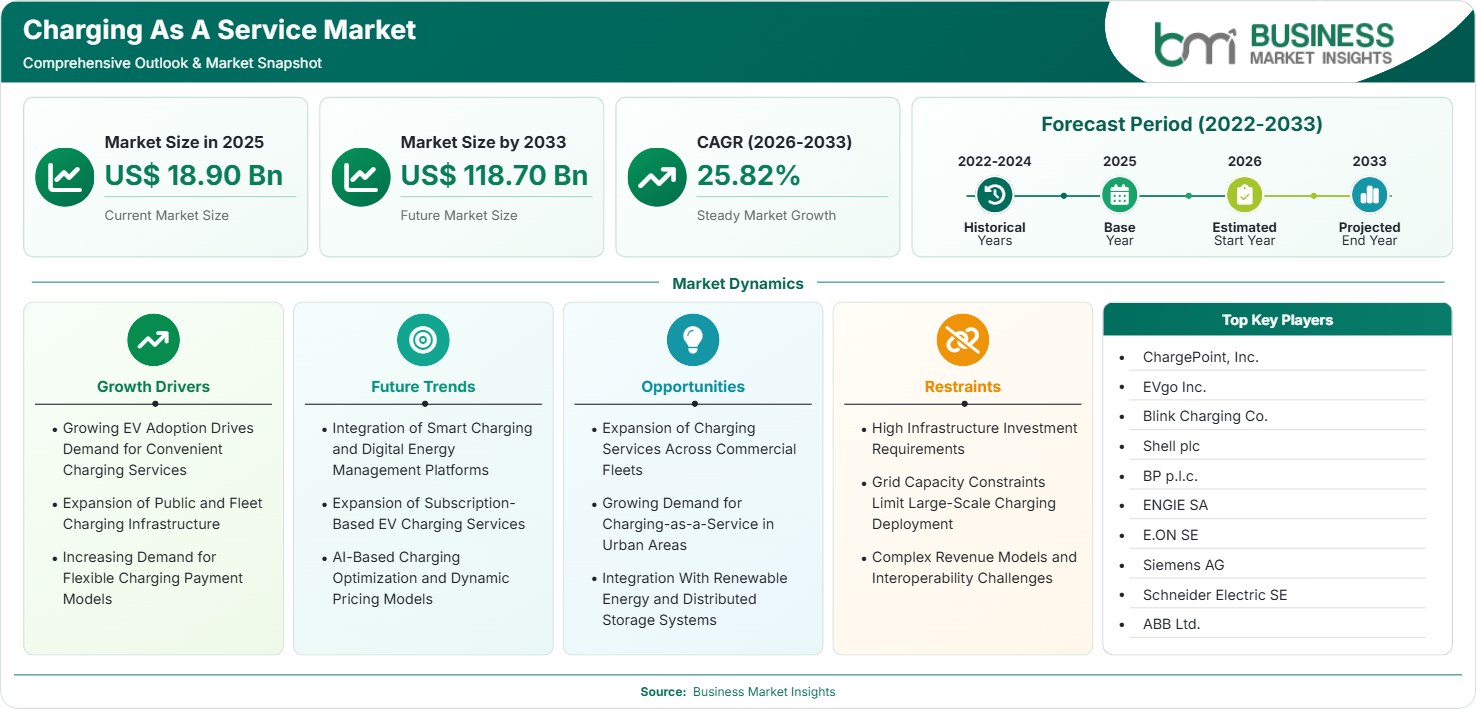
The Charging as a Service Market size was valued at US$ 18.90 Billion in 2025 and is projected to reach US$ 118.70 Billion by 2033, growing at a CAGR of 25.82% during 2026–2033, driven by EV adoption, fleet electrification, scalable charging infrastructure, flexible payment models, and renewable-energy integration.

Report Coverage
  • Service: Usage-Based, Subscription, Others
  • Application: Commercial, Residential
  • Charging point: Fast, slow
US$ 18.90 Bn Market size in 2025
US$ 118.70 Bn Market Size by 2033
25.82% CAGR, 2026 - 2033
2026-2033 Forecast Period

01 AI Overview

Charging As A Service Market Summary

  • North America Region: North America holds a modeled 31%–34% Charging as a Service Market share in 2025 and expands at a 24.8%–26.1% CAGR, supported by fleet electrification, public charging expansion, and demand for lower upfront infrastructure costs. The US remains the dominant regional market, expanding at a 25.0%–26.3% CAGR through 2033 as fleets, workplaces, retailers, and property operators outsource charging infrastructure and management.
  • Fastest Growing Region: Asia Pacific holds a modeled 27%–31% share in 2025 and expands at a 28.0%–29.5% CAGR, supported by rapid EV adoption, urban mobility electrification, commercial fleet deployment, charging-network expansion, digital payment adoption, and increasing investment in managed charging infrastructure.
  • Leading Segment: Commercial application holds a modeled 66%–70% share in 2025 and expands at a 25.8%–27.0% CAGR, supported by fleet electrification, workplace charging, retail charging, logistics operations, and demand for infrastructure models that reduce capital expenditure.
  • High Growth Segment: Fast charging holds a modeled 58%–62% share in 2025 and expands at a 27.0%–28.5% CAGR, supported by commercial fleet utilization, shorter charging windows, highway charging requirements, urban mobility, and increasing requirements for higher vehicle availability.
  • Key Market Opportunity: Service providers can capture recurring revenue through fleet charging contracts, managed charging, subscription models, renewable-energy integration, storage, software platforms, and bundled infrastructure services for commercial customers.
  • Major Market Players: ChargePoint, Inc., EVgo Inc., Blink Charging Co., Shell plc, BP p.l.c., ENGIE SA, E.ON SE, Siemens AG, Schneider Electric SE, ABB Ltd.
02 Strategic Insights

Charging As A Service Market: Strategic Insights

Charging As A Service Market Strategic Framework
FREE PDF
Request your free sample
Request free sample
03 Stakeholder View

Key Takeaways

  • The value chain is moving from one-time charger sales toward recurring service relationships encompassing financing, installation, energy management, software, maintenance, payment processing, and asset optimization.
  • Commercial fleets offer the strongest addressable opportunity because high vehicle utilization creates recurring charging demand and makes uptime, predictable costs, and centralized infrastructure management commercially important.
  • Service differentiation is shifting toward intelligent load management, automated billing, remote diagnostics, utilization analytics, renewable-energy integration, and software-enabled optimization rather than charger hardware alone.
  • Asia Pacific provides the strongest expansion opportunity as urban EV adoption, fleet electrification, commercial charging requirements, and infrastructure investment create demand for scalable outsourced charging models.
  • Partnerships between charging providers, utilities, energy companies, fleet operators, property owners, and technology providers are becoming strategically important because service delivery increasingly depends on coordinated infrastructure and energy management.
  • Providers that combine financing flexibility with reliable charging availability, software management, energy optimization, and long-term maintenance can build recurring revenue streams while reducing infrastructure ownership barriers for customers.
04 Geographic Outlook

Charging As A Service Market Regional Highlights

North America Charging as a Service Market

North America holds a modeled 31%–34% share in 2025 and North America Charging as a Service Market forecast to grow at a 24.8%–26.1% CAGR through 2033. The region benefits from growing EV penetration, commercial fleet electrification, public charging development, and increasing interest in outsourced infrastructure models. The US represents the principal regional market, while Canada contributes through commercial, residential, and public charging deployment.

  • Fleet operators are increasingly evaluating charging as an operating service because centralized management can simplify deployment, maintenance, energy monitoring, payment administration, and network oversight.
  • Commercial property owners can use managed charging services to provide EV infrastructure without developing internal expertise for charger operations, software administration, energy management, and maintenance.
  • Workplace and destination charging creates recurring demand where businesses need reliable infrastructure but want service providers to manage access, billing, maintenance, and network performance.

US Charging as a Service Market

The US Charging as a Service Market represents a modeled 89%–92% share of North American demand in 2025 and expands at a 25.0%–26.3% CAGR through 2033. Demand is supported by fleet electrification, commercial charging, public infrastructure development, workplace charging, and growing interest in infrastructure-as-a-service models. Large fleet operators and commercial property owners increasingly seek solutions that reduce operational complexity.

  • Commercial fleets represent an important growth pool because centralized charging services can coordinate multiple vehicles, locations, energy loads, payment requirements, and maintenance activities.
  • Retail and workplace locations can benefit from managed charging because service providers assume responsibility for network operation while property owners retain flexibility over customer access and pricing.
  • Fast charging is gaining strategic importance where fleet productivity depends on minimizing vehicle downtime and maintaining predictable operating schedules.

Europe Charging as a Service Market

Europe Charging as a Service Market holds a modeled 24%–27% share in 2025 and expands at a 24.0%–25.5% CAGR through 2033. Germany, the United Kingdom, France, the Netherlands, and the Nordic markets represent major demand centers, while Southern and Central Europe provide additional expansion opportunities. Germany remains a leading market, while the Netherlands and selected Southern European markets offer strong growth potential as charging networks become increasingly integrated with broader mobility ecosystems.

  • Germany supports substantial commercial charging demand through corporate fleets, logistics operations, workplace infrastructure, and mobility services requiring dependable charging availability and managed operations.
  • The United Kingdom and France provide opportunities through public, workplace, fleet, and destination charging, with service models helping customers manage infrastructure without assuming full operational responsibility.
  • Nordic markets favor integrated energy solutions, creating opportunities for charging services linked with renewable electricity, smart energy management, storage, and flexible demand management.
  • Southern European markets provide expansion opportunities as tourism, urban mobility, commercial fleets, and public charging requirements increase the need for professionally managed infrastructure.

Asia Pacific Charging as a Service Market

Asia Pacific Charging as a Service Market holds a modeled 27%–31% share in 2025 and expands at a 28.0%–29.5% CAGR through 2033, making it the fastest-growing regional market. China, Japan, South Korea, India, and Australia represent important demand centers, while Southeast Asia provides additional expansion potential. High-density urban mobility, commercial fleets, expanding EV manufacturing ecosystems, and charging infrastructure investment are supporting demand.

  • China provides broad opportunities across public charging, commercial fleets, urban mobility, and destination charging, supported by a large EV ecosystem and expanding network requirements.
  • India offers high-growth potential as electric mobility expands across commercial fleets, urban transportation, logistics, workplaces, and commercial properties requiring scalable charging services.
  • Japan and South Korea favor technology-intensive charging solutions where software management, energy optimization, reliability, and integration with sophisticated mobility systems are important.
  • Southeast Asia provides emerging opportunities as EV adoption, urbanization, logistics activity, and commercial infrastructure development create requirements for professionally managed charging networks.

Rest of World Charging as a Service Market

Rest of World holds a modeled 13%–17% share in 2025 and expands at a 25.5%–27.5% CAGR through 2033. South and Central America are developing charging opportunities through urban EV adoption, commercial mobility, logistics, and fleet electrification. Brazil and Mexico represent important markets because of their expanding mobility ecosystems and commercial infrastructure. The Middle East and Africa provide additional opportunities through urban mobility, commercial fleets, logistics, hospitality, real estate, and sustainability-focused infrastructure development. The United Arab Emirates, Saudi Arabia, and South Africa represent key markets.

  • Brazil offers opportunities across commercial mobility, fleet charging, retail destinations, and urban charging where service providers can simplify infrastructure deployment and ongoing network management.
  • Mexico benefits from commercial and logistics activity, creating demand for managed charging services that can support fleet operations without requiring extensive internal charging expertise.
  • Saudi Arabia and the United Arab Emirates provide opportunities through large-scale urban development, commercial properties, mobility programs, and sustainability-oriented infrastructure investment.
  • South Africa represents an emerging market for fleet and destination charging, with service providers able to address operational complexity through managed infrastructure and centralized network platforms.
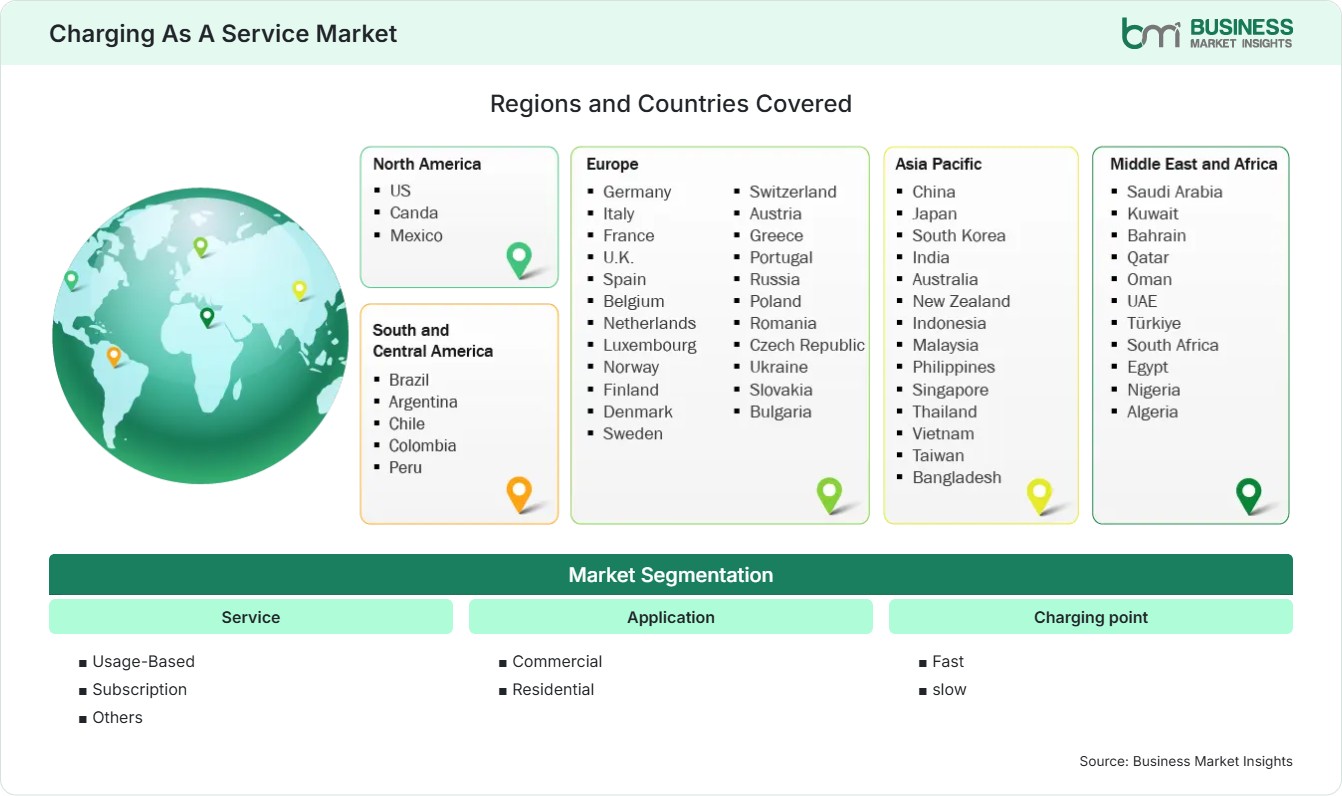
Global Market Geography
FREE PDF
Request your free sample
Request free sample
05 Segment Analysis

Charging As A Service Market Segmentation

Service

Usage-Based services hold a modeled 39%–43% Charging as a Service Market share in 2025 and expand at a 25.0%–26.5% CAGR through 2033, supported by variable charging demand and customers seeking payment flexibility. Subscription models are gaining importance where utilization is recurring and predictable. Service differentiation increasingly depends on pricing transparency, software integration, network reliability, customer access, maintenance, and energy management.

  • Usage-Based: Charges customers according to actual charging activity, supporting variable utilization environments and reducing commitment barriers for customers with fluctuating EV charging requirements.
  • Subscription: Provides recurring access under predictable commercial terms, supporting fleets, workplaces, and property operators with consistent charging requirements and preference for controlled operating expenditure.

Application

Commercial applications hold a modeled 66%–70% share in 2025 and expand at a 25.8%–27.0% CAGR through 2033, supported by fleet electrification, workplace charging, retail infrastructure, logistics operations, and commercial property development. Residential applications remain important where households prefer managed charging without purchasing and maintaining all infrastructure independently.

  • Commercial: Supports fleets, workplaces, retailers, logistics operators, and commercial properties requiring managed infrastructure, centralized software, maintenance, energy control, and reliable charging availability.
  • Residential: Provides homeowners and residential property operators with managed charging, subscription options, maintenance support, and simplified access to charging infrastructure without extensive operational responsibilities.

Charging point

Fast charging holds a modeled 58%–62% share in 2025 and expands at a 27.0%–28.5% CAGR through 2033, supported by commercial fleets, public mobility, highway travel, and applications where charging speed influences vehicle utilization. Slow charging remains important for workplaces, residential locations, and long-duration parking environments.

  • Fast: Supports high-utilization vehicles and locations where reduced charging time improves fleet availability, requiring stronger power management, reliable equipment, maintenance, and grid coordination.
  • Slow: Suits residential, workplace, and long-duration parking environments where vehicles remain connected longer and lower infrastructure requirements can support economical charging deployment.
06 Market Forces

Charging As A Service Market Dynamics

Key Market Drivers

Growing EV Adoption Drives Demand for Convenient Charging Services

The growing adoption of electric vehicles (EVs) is driving the need for a robust and professional charging infrastructure in public, commercial, workplace, fleet, and residential spaces. As number of charging users rises, the customers become interested in easy access, reliable chargers, transparent prices, and convenient payment systems. This helps create service models based on charging technology, software solutions, maintenance services, user management, and energy management. Charging service providers meeting all these demands without having each customer develop corresponding capabilities. This also reinforces Charging as a Service Market trend toward software-enabled operations, and integrated infrastructure services.

Expansion of Public and Fleet Charging Infrastructure

Public and fleet charging infrastructures need constant oversight since the distributed chargers need to be available, connected, serviced, and financially viable. The inclusion of fleet operations adds additional layers of complexity to the process since the charging process needs to be scheduled according to the time required by the vehicle, the capacity for electricity generation, and various other considerations. Service providers can address with all these concerns using software management, service agreements, energy management, financial management, and funding for the infrastructure.

Increasing Demand for Flexible Charging Payment Models

Customers that usage charging stations exhibit different usage patterns; hence, it is not viable to charge them using a one-size-fits-all model since the needs of customers may vary from one location to another within the fleet, workplace, public, and residence areas. The usage-based model caters to flexible demand, whereas subscriptions offer a reliable way of ensuring predictability in charges for customers with ongoing charging needs. The flexibility in payment methods can enhance accessibility to the service by minimizing the initial investment in infrastructure. For commercial operators, predictable costs of services will be easier to budget and reduce large upfront infrastructure commitments.

Key Market Opportunities

Expansion of Charging Services Across Commercial Fleets

Commercial fleets offer one of the strongest opportunities since high utilization of the vehicles implies an ongoing need for charging and the need for dependable infrastructure. Fleet operators will have to consider issues such as scheduling of the charge and vehicle maintenance together with the availability of charging stations, the cost of energy and how energy is used by the vehicle. Charging as a service companies may help in addressing these needs via financed infrastructure, central software management of energy usage and maintenance. The opportunity extends across logistics, mobility services, corporate transportation, delivery operations, and other commercial applications.

Growing Demand for Charging-as-a-Service in Urban Areas

Urban charging environments create specific infrastructure challenges because parking availability, electrical capacity, property ownership, traffic patterns, and charging demand vary considerably between locations. These conditions make managed charging services attractive for commercial properties, retailers, parking operators, workplaces, and mobility providers that need infrastructure without developing specialized operational teams. Service providers can offer installation, financing, network management, maintenance, payment processing, and energy optimization under a unified contract. Urban locations also provide opportunities to deploy different charging speeds according to dwell time and user requirements.

Integration with Renewable Energy and Distributed Storage Systems

Charging infrastructure is increasingly intersecting with broader energy-management requirements as customers seek greater control over electricity costs, site demand, and renewable-energy utilization. Combining charging with onsite renewable generation and distributed storage can allow commercial customers to manage charging loads more strategically and potentially reduce dependence on conventional grid supply during selected operating periods. Service providers can capture additional value by integrating energy monitoring, load management, storage controls, and charging software within one platform. This creates opportunities to move beyond charging transactions toward broader energy services.

Market Restraints and Challenges

High Infrastructure Investment Requirements

Factor: The cost of charging infrastructure involves significant investment in the form of costs incurred in installing, configuring, and maintaining the hardware and software components of the system. Impact: Significant investments can hinder the market adoption by customers who may not have much financial capacity or the need to use the system. Charging services as a solution provider may be able to help alleviate this issue by spreading out the cost of the infrastructure through services.

Grid Capacity Constraints Limit Large-Scale Charging Deployment

Factor: High-power charging sites can require substantial electrical capacity, and available grid infrastructure may not always support rapid deployment at commercially attractive locations. Impact: Grid limitations can extend project timelines, increase connection costs, restrict charging capacity, or require additional energy-management infrastructure before service operations can begin. This challenge is particularly important for fleet depots and fast-charging locations where multiple vehicles may require high-power charging within concentrated periods.

07 Company Analysis

Competitive Landscape

Charging as a Service Market analysis suggests that competitive positioning will be largely influenced by factors such as network size, reliability of chargers, software capabilities, energy management, finance options, site development, maintenance provision, and fleet management. The competition consists of charging network providers, energy firms, electrical equipment providers, and infrastructure companies.

Company Name

Overview

Products and Services relevant to this market

ChargePoint, Inc.

EV charging network and technology provider focused on connected charging infrastructure and digital management capabilities.

EV charging stations, cloud software, network management, fleet charging, commercial charging, and charging management services.

EVgo Inc.

Charging-network operator focused on public fast charging and expanding managed EV charging infrastructure.

Fast charging, public charging networks, charging subscriptions, fleet solutions, digital access, and network services.

Blink Charging Co.

EV charging company providing charging equipment, network software, and charging services across commercial and public locations.

EV chargers, charging networks, cloud management, fleet charging, payment services, and managed charging solutions.

Shell plc

Global energy company expanding EV charging through public, fleet, workplace, and integrated energy infrastructure.

EV charging networks, fleet charging, charging services, energy management, payment solutions, and integrated mobility services.

BP p.l.c.

Energy company developing EV charging infrastructure through its mobility and electrification activities.

EV charging, fast charging, fleet services, charging management, energy solutions, and mobility infrastructure.

ENGIE SA

Energy and infrastructure provider offering integrated mobility and energy solutions for commercial customers.

EV charging infrastructure, managed charging, energy management, fleet solutions, and charging-related services.

E.ON SE

European energy company providing charging infrastructure and integrated energy solutions for mobility customers.

EV charging stations, charging services, energy management, fleet charging, and mobility solutions.

Siemens AG

Technology and infrastructure company providing electrification and intelligent charging technologies.

EV charging hardware, charging software, fleet solutions, energy management, and intelligent charging infrastructure.

Schneider Electric SE

Energy-management and electrification specialist integrating EV charging with broader electrical infrastructure.

EV charging systems, energy management, load management, charging software, electrical infrastructure, and commercial solutions.

ABB Ltd.

Electrification and automation company supplying charging infrastructure and connected solutions for transport and commercial applications.

Fast chargers, charging systems, charging software, fleet infrastructure, energy management, and connected charging solutions.

10 Trust & Transparency

Research Methodology

The market analysis combines proprietary research with secondary data from government agencies, company disclosures, regulatory filings, industry databases and expert interviews. Market estimates are validated through data triangulation, cross-market benchmarking and analyst review.

View Full Research Methodology

11 Questions Answered

Frequently Asked Questions

What role can renewable energy play in Charging as a Service Market report?

Renewable generation and storage can be integrated with charging infrastructure to support energy management and create broader energy-service offerings beyond the underlying charging transaction.

Why is software becoming important in managed charging?

Software coordinates user access, payments, charger monitoring, energy consumption, maintenance, utilization, and reporting.

How does charging-as-a-service support customers with limited capital?

Service structures can distribute infrastructure costs through subscriptions, usage-based payments, or long-term contracts, reducing the need for customers to fund the complete charging installation upfront.

Why are commercial fleets particularly suitable for charging-as-a-service models?

Fleet operators have recurring charging requirements and must coordinate charging availability with vehicle schedules.

What makes Charging as a Service different from conventional charger ownership?

Charging as a Service shifts responsibility from direct equipment ownership toward a managed service arrangement covering infrastructure deployment, and operational support under defined commercial terms.

Access the Full Charging As A Service Market Report

Get segment-level forecasts, regional estimates, competitive benchmarking, company profiles and downloadable Excel datasets.

Access the full Charging As A Service Market Report
350 pages PDF & Excel | 2026-08-20