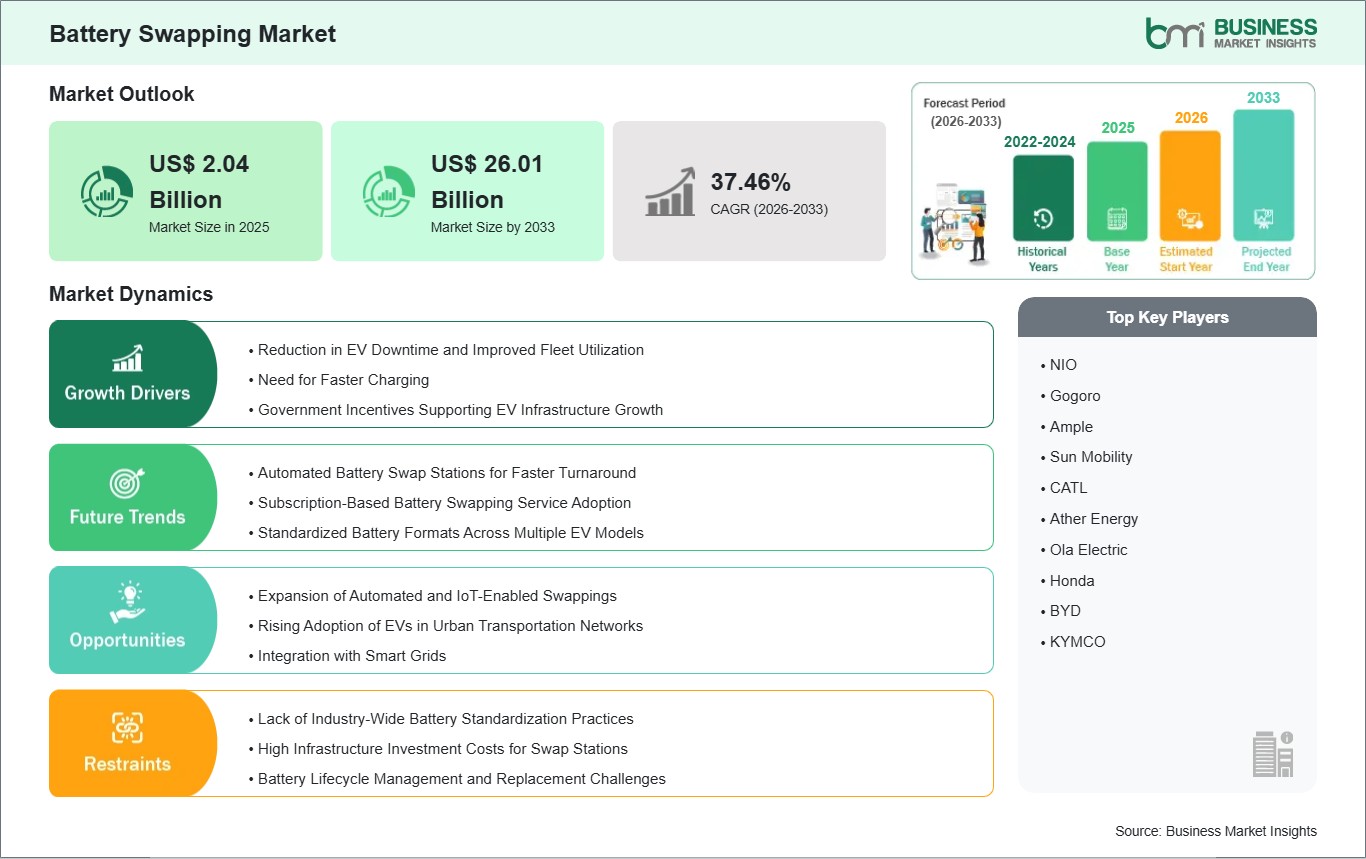
The Battery Swapping Market size is expected to reach US$ 26.01 Billion by 2033 from US$ 2.04 Billion in 2025.The market is estimated to record a CAGR of 37.46% from 2026 to 2033.
Battery swapping market represents one of the fastest-growing segments within the electric mobility ecosystem, driven by the increasing adoption of electric vehicles (EVs), rising concerns over charging time limitations, and supportive government initiatives promoting sustainable transportation. Battery swapping technology allows EV users to exchange depleted batteries with fully charged ones within minutes, significantly reducing vehicle downtime and enhancing operational efficiency, particularly for commercial fleets and high-utilization vehicles.
The growing penetration of electric two-wheelers and three-wheelers in densely populated urban regions has accelerated demand for battery swapping infrastructure. Fleet operators, ride-hailing services, logistics providers, and delivery companies are increasingly adopting swapping solutions to maximize vehicle uptime and improve operational economics. The market has gained significant traction in countries such as China and India, where governments actively support EV adoption through subsidies, incentives, and infrastructure development programs.
Technological advancements are further strengthening market expansion. Automated swapping stations, IoT-enabled battery management systems, and cloud-based monitoring platforms are improving operational efficiency and enhancing user convenience. Standardization initiatives by automakers and battery manufacturers are also contributing to ecosystem development by improving compatibility across vehicle platforms. Subscription-based battery services are emerging as a preferred business model, enabling users to reduce upfront EV ownership costs by separating battery ownership from vehicle purchase.
The growing focus on battery-as-a-service (BaaS) models is expected to improve affordability and encourage wider EV adoption across emerging economies. Despite strong growth prospects, the market faces several challenges. The lack of universal battery standardization across manufacturers limits interoperability and slows infrastructure scalability. High capital investment requirements for swap stations, battery inventory management, and grid connectivity create financial barriers for new entrants. In addition, battery lifecycle management, safety concerns, and regulatory uncertainties remain key operational challenges for market participants.

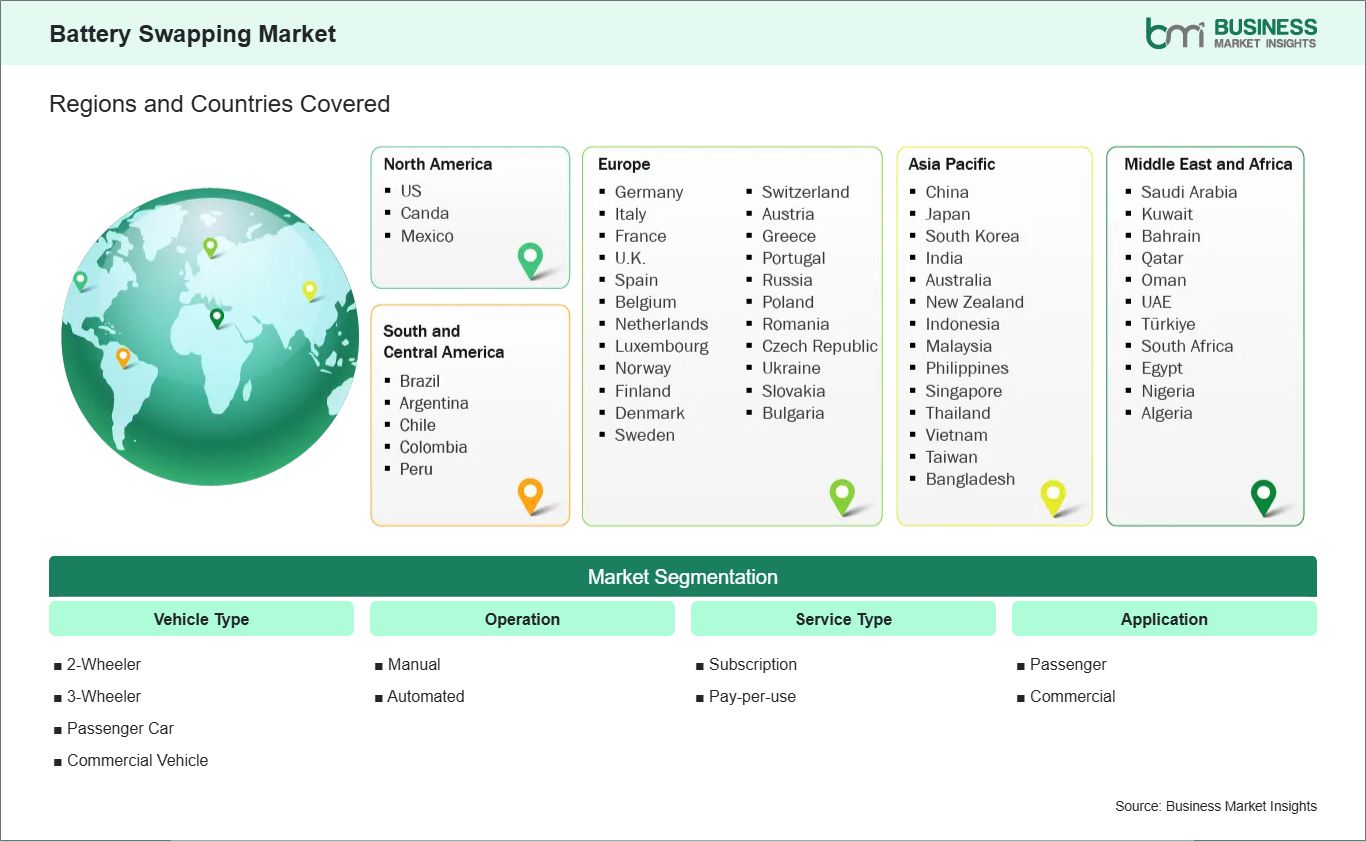
The battery swapping market is segmented based on vehicle type, operation, service type, and application, reflecting the growing adoption of electric mobility solutions and the increasing need for efficient battery charging alternatives across transportation sectors.
As the need to minimise EV downtime and boost fleet utilisation rates continues to grow, so does the Battery Swapping market. Long charging times with traditional EV charging solutions negatively impact vehicle uptime and productivity and operational efficiency. Battery swapping solves this problem by allowing drivers to exchange discharged batteries for fully-charged ones in less than a few minutes.
In addition to e-commerce delivery providers, ride-hailing services and public transport companies are using battery swapping technology to keep operations running smoothly. Battery swapping has proven to be an excellent solution for urban mobility applications, where high vehicle utilisation is needed for profit.
In conjunction with clean mobility initiatives, governments and municipalities are increasingly encouraging the development of battery swapping infrastructure through incentive programs, subsidies for consumers purchasing EVs and funding for building infrastructure. The rise of electric two-wheeled and three-wheeled vehicles in emerging markets will continue to drive the demand for battery swap networks.
The continued growth of automated battery swapping stations and IoT-enabled systems will provide significant opportunities for expansion within this market. Advanced automated stations may include robotic systems, cloud-based analytic tools, and real-time monitoring applications that increase operational efficiency, maximize battery usage through optimized operations, and provide additional convenience to customers.
Battery Swap Operators are beginning to utilize advanced smart energy management systems to provide predictive maintenance capabilities, remote diagnostics, and battery health management. Additionally, IoT connected technologies allow Operators to monitor their batteries' performance, charge cycles and inventory levels across multiple Stations, which will help to improve Scalability and reduce Operating Costs.
Increased urban EV adoption patterns along with increased investments in Smart City infrastructure are also expected to drive global demand for Intelligent Battery Swapping Stations. Cooperation among EV Manufacturers, Energy Companies and Battery Technology Suppliers will continue to support overall ecosystem growth and improve interoperability.
The Battery Swapping Market is projected to grow from US$ 2.04 Billion in 2025 to US$ 26.01 Billion by 2033 , registering a CAGR of 37.46% from 2026 to 2033.
By vehicle type, 2-wheelers account for a significant share as battery swapping provides quick turnaround times, lower operational costs, and high convenience for urban commuters and delivery services. The 3-wheeler segment continues to grow with increasing adoption in electric rickshaws and cargo transport applications, particularly in emerging economies where fleet efficiency and reduced downtime are critical. Passenger cars are gaining traction with the expansion of battery swapping infrastructure and rising consumer demand for faster charging alternatives, while commercial vehicles are witnessing steady growth due to the need for uninterrupted fleet operations in logistics, public transportation, and last-mile delivery services.
By operation, manual battery swapping systems dominate adoption as they offer cost-effective deployment and operational simplicity, especially for small-scale stations and 2-wheeler applications. Automated battery swapping systems are experiencing strong growth due to advancements in robotics and smart infrastructure, enabling faster, safer, and contactless battery exchange processes. Increasing investments in automated swapping stations by mobility service providers and fleet operators are further supporting market expansion.
By service type, subscription-based services hold a notable share as they provide predictable costs, battery maintenance support, and convenience for frequent users and commercial fleet operators. Pay-per-use services are expanding steadily due to their flexibility and affordability, allowing occasional users to access battery swapping infrastructure without long-term commitments.
By application, the passenger segment dominates the market owing to the increasing adoption of electric scooters, motorcycles, and passenger vehicles for daily urban mobility. The commercial segment is witnessing rapid growth driven by the rising electrification of logistics fleets, ride-hailing services, public transportation, and delivery operations that require high vehicle uptime and efficient energy management.
| Report Attribute | Details |
|---|---|
| Market size in 2025 | US$ 2.04 Billion |
| Market Size by 2033 | US$ 26.01 Billion |
| Global CAGR (2026 - 2033) | 37.46% |
| Historical Data | 2022-2024 |
| Forecast period | 2026-2033 |
| Segments Covered | By Vehicle Type
|
|
Regions and Countries Covered
| |
| North America | US, Canada, Mexico |
| Europe | Germany, Italy, France, U.K., Spain, Belgium, Netherlands, Luxembourg, Norway, Finland, Denmark, Sweden, Switzerland, Austria, Greece, Portugal, Russia, Poland, Romania, Czech Republic, Ukraine, Slovakia, Bulgaria |
| Asia-Pacific | China, Japan, South Korea, India, Australia, New Zealand, Indonesia, Malaysia, Philippines, Singapore, Thailand, Vietnam, Taiwan, Bangladesh |
| South and Central America | Brazil, Argentina, Chile, Colombia, Peru |
| Middle East and Africa | Saudi Arabia, United Arab Emirates, Kuwait, Bahrain, Qatar, Oman, Turkiye, South Africa, Egypt, Nigeria, Algeria |
| Market leaders and key company profiles |
|
The "Battery Swapping Market Size and Forecast (2022 - 2033)" report provides a detailed analysis of the market covering below areas:
Battery swapping is growing rapidly as a result of various things around the world - like the massive growth in electric mobility; increased investment into charging infrastructure; and conducive regulations issued by governments all encourage greater use of clean transportation.
North America has significant numbers of electric vehicle manufacturers, energy network suppliers, mobility technologies companies, etc., so it’s expected that North America will also continue to build the electric mobility market through continued investment in infrastructure related to electric mobility (e. g., electric vehicle charging stations), smart battery management systems, automated battery-swapping systems, etc. The use of batteries in combination with battery-swap networks will allow users of large fleets to reduce time needed for charging, improve overall productivity of their electric fleets, and use more advanced automation techniques to connect battery-swap stations with other vehicle networks -- thereby creating an even broader level of support to foster further adoption of battery-swap networks throughout the entire North American automotive and energy marketplace across electric passenger cars, commercial vehicles, ride-hailing businesses, and delivery operations to/from the last mile.
The Asia-Pacific region is experiencing tremendous growth due to the rapid expansion of electric vehicle (EV) adoption, urbanization, and significant government support for clean transportation. The region includes some of the largest countries in the world, including China, India, Japan and South Korea. Manufacturers and mobility service providers are making large investments in battery swapping platforms across 2-wheelers, 3-wheelers, passenger vehicles, and commercial vehicles. Energy efficiency, charging downtime reduction, and large-scale deployment of electric mobility are important areas of focus in the region. In addition, the rapid expansion of shared mobility, logistics and public transportation electrification all contribute to the rapid ramp-up of the battery swapping market, along with increasing investments in smart grid technologies, renewable energy integration and advanced battery technologies.
The battery swapping market is also consistently growing throughout Europe as a result of increased environmental regulations, increased adoption of electric vehicles, and an increasing focus on sustainable transportation infrastructure. Countries such as Germany, France, the Netherlands and the Nordic countries are investing heavily into creating an advanced ecosystem for EVs and developing automated battery swapping technology for supporting urban mobility and fleet electrification. A reduction in carbon emissions and an increase in energy efficiency through innovative mobility solutions and smart transportation systems are the primary driver for sustainable transportation in Europe.

The battery swapping market is evaluated by gathering qualitative and quantitative data post primary and secondary research, which includes important corporate publications, association data, and databases. A few of the key developments in the battery swapping market are:
The Battery Swapping Market is valued at US$ 2.04 Billion in 2025, it is projected to reach US$ 26.01 Billion by 2033.
As per our report Battery Swapping Market, the market size is valued at US$ 2.04 Billion in 2025, projecting it to reach US$ 26.01 Billion by 2033. This translates to a CAGR of approximately 37.46% during the forecast period.
The Battery Swapping Market report typically cover these key segments-
The historic period, base year, and forecast period can vary slightly depending on the specific market research report. However, for the Battery Swapping Market report:
The Battery Swapping Market is populated by several key players, each contributing to its growth and innovation. Some of the major players include:
The Battery Swapping Market report is valuable for diverse stakeholders, including:
Essentially, anyone involved in or considering involvement in the Battery Swapping Market value chain can benefit from the information contained in a comprehensive market report.
Please tell us your area of interest
(Market Segments/ Regions and Countries/ Companies)