Market Summary
Executive Summary and Global Market Analysis
The Green Tires Market represents the transition toward tire products designed with lower rolling resistance, sustainable materials, and improved fuel efficiency. These tires support reduced vehicle emissions while maintaining traction, durability, and driving stability across different transportation environments. Manufacturers continue refining tire composition to align environmental considerations with long-term operational performance. Automotive producers and fleet operators are placing greater emphasis on energy-efficient mobility solutions. Environmental policies related to vehicle emissions and resource utilization are influencing procurement decisions across passenger and commercial transportation sectors. Consumer awareness regarding eco-conscious automotive products has also strengthened interest in tires containing recycled and renewable materials.
Material innovation continues differentiating product positioning among manufacturers. Advancements in silica-based compounds, bio-based polymers, and recycled-content integration are reshaping tire development strategies. Tire producers are improving tread patterns and material combinations to support lower energy loss and enhanced road performance. Digital retail channels are also influencing purchasing behavior by improving product comparison, accessibility, and distribution efficiency across multiple regions. Automotive producers and fleet operators are placing greater emphasis on energy-efficient mobility solutions. Environmental policies related to vehicle emissions and resource utilization are influencing procurement decisions across passenger and commercial transportation sectors.
Segment Analysis
Green Tires Market Segmentation
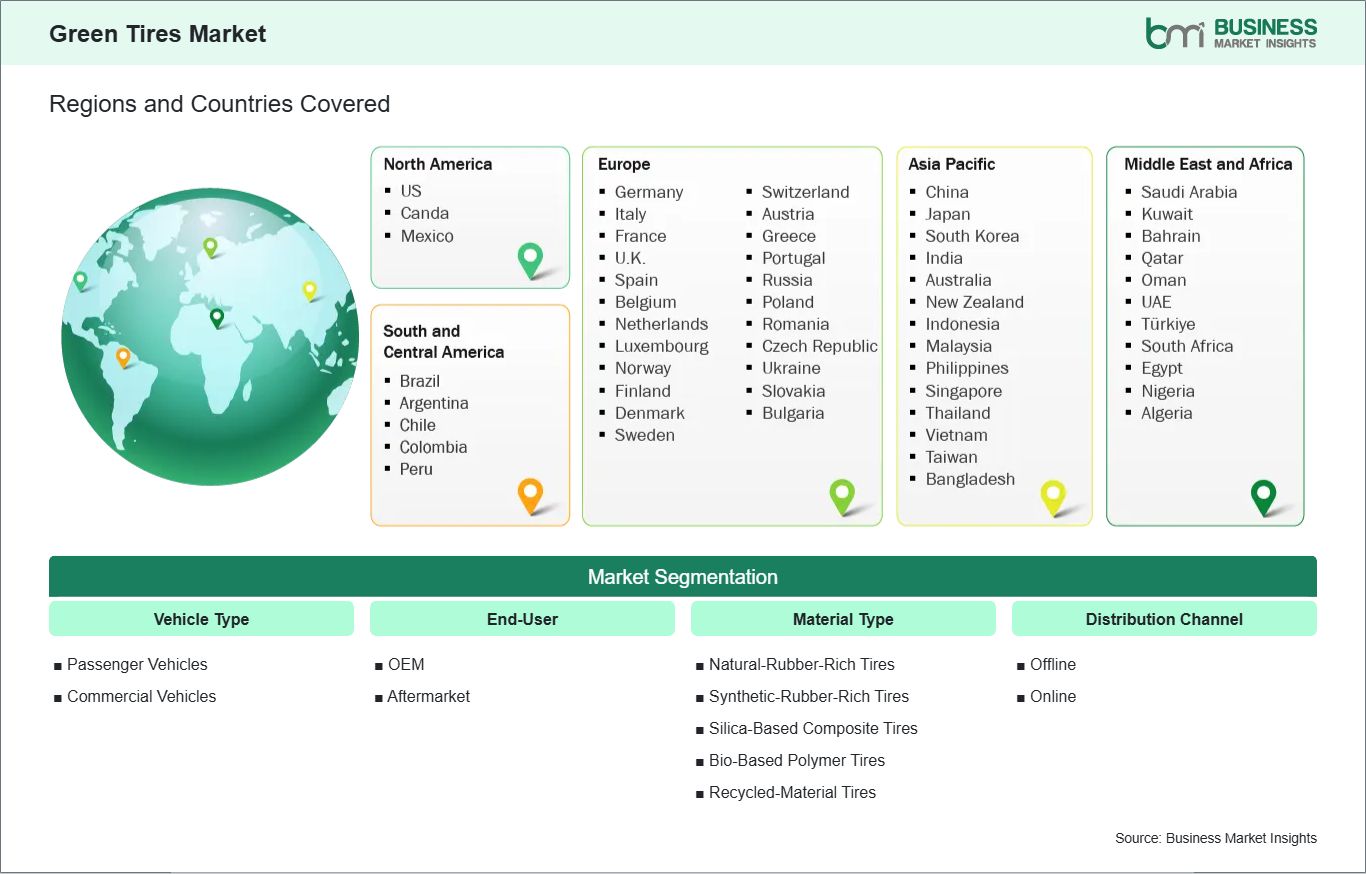
Key segments that contributed to the derivation of the Green Tires market analysis are vehicle type, end user, material type and distribution channel.
By Vehicle Type
- Passenger Vehicles: The Passenger Vehicles segment dominated the market in 2025, driven by rising personal mobility electrification trends, increasing environmental awareness, and growing demand for fuel-efficient and low-emission transportation solutions.
- Commercial Vehicles: The Commercial Vehicles segment is expanding due to increasing logistics activity, fleet modernization, and adoption of sustainable mobility solutions across transportation and industrial sectors.
By End-User
- OEM: The OEM segment held the largest share in 2025 due to strong integration of green tire technologies in new vehicle production and increasing collaboration between tire manufacturers and automotive OEMs to meet sustainability targets.
- Aftermarket: The Aftermarket segment is growing steadily driven by replacement demand, rising vehicle parc, and increasing consumer preference for eco-friendly tire alternatives.
By Material Type
- Natural-Rubber-Rich Tires: Adoption is supported by sustainable sourcing initiatives and improved biodegradability characteristics.
- Synthetic-Rubber-Rich Tires: Accounted for the largest market share in 2025 due to strong performance, durability, cost efficiency, and widespread manufacturing availability.
- Silica-Based Composite Tires: Gaining traction due to improved fuel efficiency, reduced rolling resistance, and enhanced wet grip performance.
- Bio-Based Polymer Tires: Expanding due to rising innovation in sustainable materials and increasing regulatory push for low-carbon mobility solutions.
- Recycled-Material Tires: Growing due to circular economy initiatives and increasing focus on waste reduction and material reuse in tire manufacturing.
By Distribution Channel
- Offline: Held the largest share in 2025 due to strong reliance on dealerships, tire retail stores, and service centers for installation and maintenance services.
- Online: Growing steadily due to increasing digital retail adoption, e-commerce penetration, and convenience-driven purchasing behavior.
Market Forces
Green Tires Market Drivers and Opportunities
Stricter CO2 and tire-labelling regulations globally
The rapid growth of global eCommerce has emerged as a pivotal factor positively driving the Green Tires market. With the global e-Government-mandated fuel efficiency standards across North America, Europe, and Asia have made rolling resistance a procurement criterion rather than a secondary specification. Automakers integrating green tires into OEM build sheets respond to both fleet-average CO2 targets and consumer-facing sustainability reporting requirements. The direct link between tire compound choice and measurable emissions output has elevated purchasing decisions from cost-driven to compliance-driven, structurally broadening the addressable base across vehicle segments.
Tire labeling frameworks — particularly the EU's mandatory grading system — create transparent market signals that influence consumer behavior at the point of sale. Manufacturers achieving top-tier efficiency ratings gain preferential positioning in retail and fleet channels. These regulatory instruments effectively raise the performance floor across the industry, compelling mid-tier producers to invest in advanced compound development to remain commercially viable in regulated markets.
Circular Economy and End-of-Life Material Recovery Creating Long-Term Value
Recovered carbon black derived from end-of-life tire pyrolysis has emerged as a commercially viable feedstock for new tire compound production. This closed-loop approach reduces raw material dependency, lowers production costs over time, and allows manufacturers to substantiate sustainability claims with measurable recycled content metrics. Brands early to integrate recovered materials gain supply chain resilience alongside environmental credibility with procurement-driven fleet customers.
The long-term potential of bio-based polymer development extends beyond existing silica substitution. Agricultural byproducts — including rice husk ash, dandelion root latex, and guayule-derived rubber — represent scalable feedstock alternatives that reduce competition with food-use commodities. As bio-refinery infrastructure matures globally, these material pathways will enable manufacturers to decouple production economics from petroleum-linked synthetic rubber price cycles.
Size and Share Analysis
Green Tires Market Size and Share Analysis
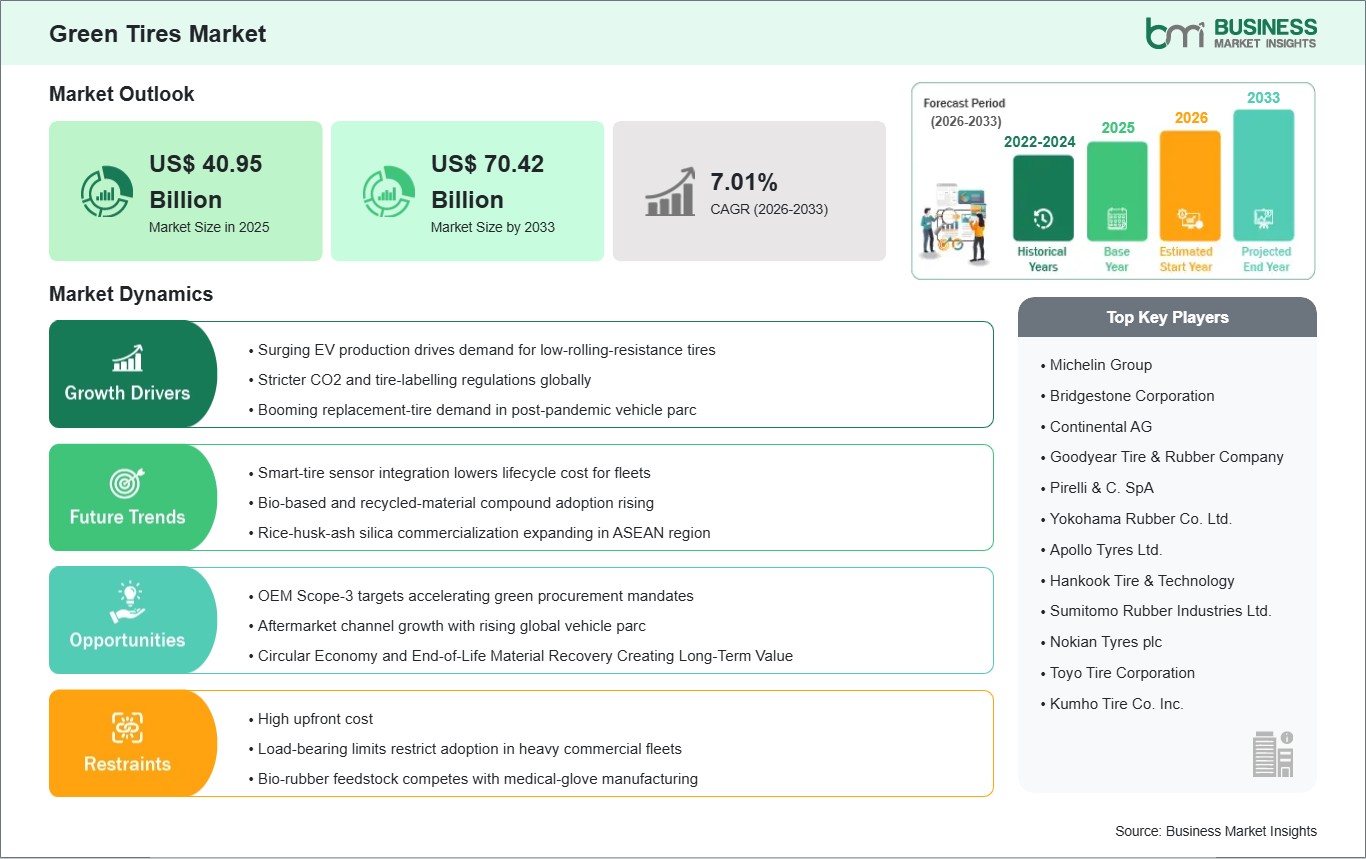
The Green Tires Market is projected to grow from US$ 40.95 Billion in 2025 to US$ 70.42 Billion by 2033 , registering a CAGR of 7.01% from 2026 to 2033.
By vehicle type, the Green Tires market is divided into Passenger Vehicles and Commercial Vehicles. The Passenger Vehicles segment dominated the market in 2025, supported by expanding electric passenger car production and changing consumer preference toward fuel-efficient mobility solutions.
By End-User, the market is divided into OEM and Aftermarket. OEM held the largest share in 2025 due to increasing integration of sustainable tire technologies into newly manufactured vehicles.
By Material Type, the market is segmented into Natural-Rubber-Rich Tires, Synthetic-Rubber-Rich Tires, Silica-Based Composite Tires, Bio-Based Polymer Tires, and Recycled-Material Tires. The Synthetic-Rubber-Rich Tires segment accounted for the largest market share in 2025 because of its durability, temperature resistance, and compatibility with high-performance tire manufacturing requirements.
By Distribution Channel, the market is divided into Offline and Online. Offline held the largest share in 2025, supported by established dealership networks, tire retailers, and service centers offering installation and maintenance support.
Report Coverage
Green Tires Market Report Coverage and Deliverables
The "Green Tires Market Size and Forecast (2022–2033)" report provides a detailed analysis of the market covering:
- Green Tires market size and forecast at global, regional, and country levels for all the key market segments covered under the scope
- Green Tires market trends, as well as market dynamics such as drivers, restraints, and key opportunities
- Industry landscape and competition analysis covering market concentration, heat map analysis, prominent players, and recent developments
- Detailed company profiles, including SWOT analysis
Geographic Insights
Green Tires Market Geographic Insights
The Green Tires market is divided into geographic segments, which include North America, Asia Pacific, Europe, Middle East & Africa, and South & Central America. The Asia Pacific market is anticipated to be the leading region for such substantial growth throughout the forecast period because of its regulatory maturity, vehicle electrification pace, and raw material availability.
North America presents a market shaped by federal corporate average fuel economy standards and state-level zero-emission vehicle mandates, particularly in the United States and Canada. OEM fitment programs have progressed furthest in the passenger vehicle category, where Detroit-based and transplant manufacturers specify low-resistance compounds as standard across multiple model lines. The United States aftermarket is maturing in parallel, with retail channels increasingly stocking labeled eco-tire options in response to consumer awareness built through vehicle-level sustainability marketing.
Asia-Pacific represents the most dynamic regional growth environment, anchored by China's position as both the world's largest vehicle manufacturing base and its most aggressive policy adopter for new energy vehicles. Japan and South Korea contribute through their global OEM export platforms, where green tire specifications are embedded at the design stage. India presents an expanding opportunity as domestic automakers align with Bharat Stage emission norms and EV adoption accelerates in urban mobility categories. The region's scale in silica production also provides a material supply advantage for domestic compound manufacturers.
Industry Activity
Recent Developments
The Green Tires market is evaluated by gathering qualitative and quantitative data post primary and secondary research, which includes important corporate publications, association data, and databases. A few of the key developments in the Green Tires market are:
- In October 2025, Continental AG and Bridgestone Corporation independently disclosed integration of recovered carbon black sourced from end-of-life tire pyrolysis operations into production-grade tire compounds, marking a transition from pilot-stage trials to commercial volume application and validating the viability of circular material sourcing at manufacturing scale.
- In April 2024, Michelin announced the commercial scale-up of its bio-sourced and recycled-material compound program, committing to achieve 40% sustainable material content across its tire portfolio by 2030, with several passenger vehicle OEM platforms already transitioned to silica-composite formulations using partially recycled feedstock.
Trust & Transparency
Research Methodology
The market analysis combines proprietary research with secondary data from government agencies, company disclosures, regulatory filings, industry databases and expert interviews. Market estimates are validated through data triangulation, cross-market benchmarking and analyst
review.
View Full Research Methodology
Key Sources Referred:
Industry reports on sustainable tire manufacturing and automotive mobility
Government transportation and environmental policy publications
Automotive trade journals and tire technology periodicals
Company annual reports and sustainability disclosures
Academic studies on bio-based polymers and recycled materials
International automotive production and mobility assessments
Research publications covering tire material innovation and efficiency trends
Company website
Company annual reports
Company investor presentations