Market Summary
Executive Summary and Global Market Analysis
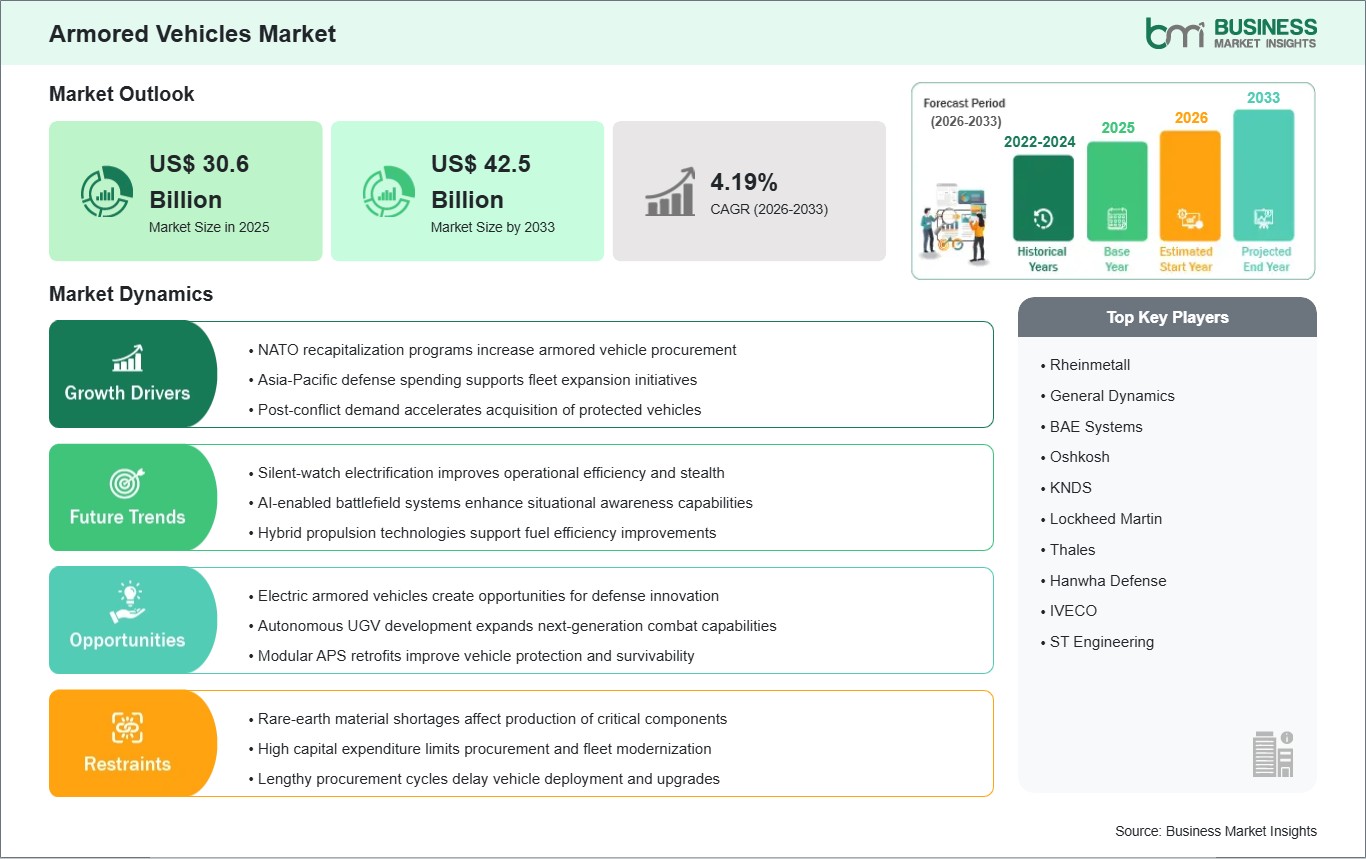
Armored vehicles are military platforms designed to provide protection, mobility, and combat capabilities in challenging operational environments. Common types include armored personnel carriers, infantry fighting vehicles, main battle tanks, and mine-resistant ambush-protected vehicles. These vehicles are used for troop transportation, reconnaissance, border security, peacekeeping missions, and battlefield operations. The market is growing as countries continue to modernize defense forces, strengthen border protection, and improve military readiness. Increasing focus on vehicle survivability, advanced armor systems, digital communication technologies, and enhanced mobility solutions is supporting demand for modern armored platforms.
There are some challenges that could affect market growth. Armored vehicles require significant investment for procurement, maintenance, and upgrades, which can place pressure on defense budgets. Development and integration of advanced protection systems, sensors, and communication equipment can increase overall program costs. In some regions, lengthy procurement procedures and regulatory approvals may delay vehicle modernization projects. Maintaining large armored fleets also requires specialized infrastructure, trained personnel, and long-term logistical support. These factors can increase operational complexity and influence purchasing decisions.
Even with these challenges, the market is expected to grow as defense organizations adopt more advanced and adaptable vehicle platforms. New opportunities are emerging through electric and hybrid propulsion technologies, autonomous vehicle capabilities, and artificial intelligence-based battlefield systems. There is increasing interest in modular vehicle designs that can support multiple mission requirements while allowing future upgrades. Growing investments in smart defense technologies, unmanned systems integration, and enhanced situational awareness solutions are expected to create new growth opportunities. Continued focus on military modernization and operational efficiency is likely to support long-term expansion of the Armored Vehicles Market.
Segment Analysis
Armored Vehicles Market Segmentation
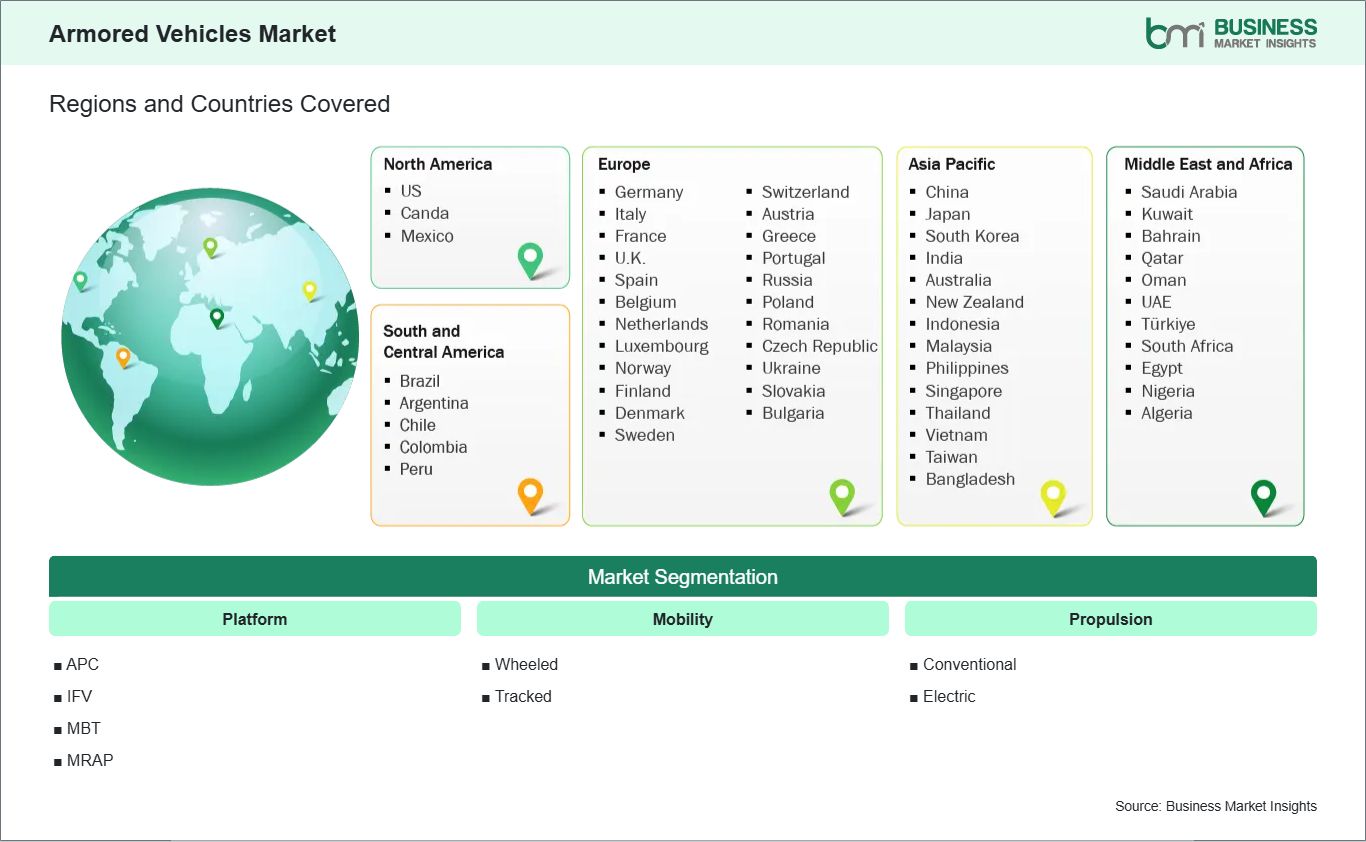
The Armored Vehicles Market is segmented based on platform, mobility, and propulsion. These segments address varying operational requirements across defense and security applications.
By Platform
- APC: Widely used for protected troop transportation and tactical mobility.
- IFV: Supports infantry operations with enhanced firepower and battlefield protection.
- MBT: Designed for frontline combat missions with advanced armor and weapon systems.
- MRAP: Provides protection against mines, improvised explosive devices, and ambush attacks.
By Mobility
- Wheeled: Preferred for rapid deployment, road mobility, and lower operating costs.
- Tracked: Suitable for difficult terrain and heavy combat operations requiring superior traction.
By Propulsion
- Conventional: Dominates military fleets due to mature technology and established logistics support.
- Electric: Emerging segment focused on efficiency, reduced acoustic signatures, and future battlefield requirements.
Market Forces
Armored Vehicles Market Drivers and Opportunities
Rising Defense Modernization and Security Investments
The Armored Vehicles Market is being driven by increasing defense modernization initiatives across many countries. Governments are investing in upgrading military fleets to improve mobility, protection, and operational effectiveness in response to evolving security challenges. Modern military operations require vehicles capable of operating in complex environments while providing enhanced protection against ballistic threats, mines, and improvised explosive devices. Defense organizations are also emphasizing network-centric warfare capabilities, which require armored vehicles to support advanced communication systems, surveillance technologies, and battlefield data integration. This has encouraged the adoption of next-generation vehicle platforms equipped with digital technologies and modular designs.
In addition, border security concerns, regional conflicts, and peacekeeping missions are creating sustained demand for armored platforms. Procurement programs increasingly prioritize survivability, mobility, and adaptability to multiple mission profiles. Regulatory requirements related to defense preparedness and military capability enhancement further support investment in advanced armored vehicle fleets. As military forces continue to replace aging platforms with technologically advanced alternatives, the Armored Vehicles Market is expected to experience steady growth.
Emergence of Electric and Autonomous Military Vehicle Technologies
The future growth potential of the Armored Vehicles Market is closely linked to advancements in electric propulsion, autonomous technologies, and intelligent battlefield systems. Defense agencies are exploring electric and hybrid propulsion solutions to improve operational efficiency, reduce fuel dependence, and lower vehicle signatures during missions. These technologies have the potential to enhance stealth capabilities and support extended operational endurance. Autonomous navigation, artificial intelligence, and advanced sensor integration are also creating new opportunities for armored vehicle development. Unmanned and optionally manned vehicle concepts are gaining attention as military organizations seek to reduce personnel risk in hazardous environments. Improved situational awareness systems and predictive maintenance technologies are further enhancing vehicle performance and mission effectiveness.
Growing investments in smart defense technologies are encouraging the development of modular armored platforms capable of integrating future upgrades. Emerging requirements for rapid deployment, urban warfare operations, and multi-domain missions are expected to create additional demand for innovative armored vehicle solutions. These technological developments are likely to open new opportunities across both established and emerging defense markets.
Size and Share Analysis
Armored Vehicles Market Size and Share Analysis
The Armored Vehicles Market size is expected to reach US$ 42.5 billion by 2033 from US$ 30.6 billion in 2025. The market is estimated to record a CAGR of 4.19% from 2026 to 2033.
By platform, APCs and IFVs account for a significant share of the market due to their broad deployment across military transportation and combat support operations. Main battle tanks continue to represent an important segment because of their critical role in frontline defense capabilities, while MRAP vehicles remain relevant for force protection and security missions.
By mobility, wheeled armored vehicles hold a notable position owing to their operational flexibility, strategic mobility, and lower maintenance requirements. Tracked vehicles continue to be essential for heavy combat operations and missions conducted in challenging terrain conditions.
Report Coverage
Armored Vehicles Market Report Coverage and Deliverables
The "Armored Vehicles Market Size and Forecast (2022-2033)" report provides a detailed analysis of the market covering below areas:
- Market size and forecast at global, regional, and country levels for all the key market segments covered under the scope
- Market trends, as well as market dynamics such as drivers, restraints, and key opportunities
- Market analysis covering key market trends, global and regional framework, major players, regulations, and recent market developments
- Industry landscape and competition analysis covering market concentration, heat map analysis, prominent players, and recent developments for the market
- Detailed company profiles, including SWOT analysis
Geographic Insights
Armored Vehicles Market Geographic Insights
The Armored Vehicles Market shows diverse regional adoption patterns influenced by defense modernization programs, military readiness requirements, and investments in advanced land combat capabilities.
North America, being a developed region, has a well-established defense industry and a high level of investment in advanced military vehicle technologies. The region comprises the United States and Canada, where modernization of armored fleets remains a strategic priority. Defense agencies focus on improving vehicle survivability, battlefield connectivity, and operational mobility. The region benefits from advanced manufacturing infrastructure, strong research capabilities, and long-term procurement programs that support the adoption of next-generation armored platforms. Demand is also influenced by border security requirements, expeditionary operations, and the integration of digital combat systems into military vehicles.
Asia Pacific is growing significantly, driven by increasing defense spending, regional security concerns, and military modernization initiatives. The region comprises countries such as China, India, Japan, and South Korea, where governments are investing in advanced land warfare capabilities. Military organizations are focusing on enhancing mobility, protection, and operational effectiveness through fleet expansion and technology upgrades. Growing domestic defense manufacturing capabilities and infrastructure development are supporting market growth. The region is also witnessing increasing demand for armored vehicles suitable for diverse terrain conditions and evolving operational requirements.
Both regions are contributing significantly to the growth of the Armored Vehicles Market, focusing on military modernization, technological advancement, and the development of advanced combat and protection capabilities.
Industry Activity
Recent Developments
The Armored Vehicles Market is analyzed using a mix of primary and secondary research sources, including corporate publications, industry associations, and verified databases. This approach ensures accurate tracking of innovation trends and strategic developments influencing the market.
- In January 2026, BAE Systems secured a $184 million full-rate production contract modification from the U.S. Marine Corps for 30 additional Amphibious Combat Vehicles (ACVs). The initiative focuses on enhancing vehicle protection, mobility, and mission effectiveness for defense operations. The development highlights ongoing demand for modern armored vehicle solutions across military forces.
- In October 2025, Germany and the Netherlands finalized a €3.4 billion ($4 billion) contract with Rheinmetall to procure 222 newly developed Jackal (Schakal) wheeled infantry fighting vehicles. The cross-border defense initiative delivers 150 of the 8×8 vehicles to the German Bundeswehr and 72 to the Dutch armed forces, integrating a modular Boxer chassis with the heavier 30mm Puma turret system. The development further cements the structural tactical shift toward highly mobile, heavily armed wheeled vehicle architectures and highlights deep multinational cooperation within the European defense industrial base.
Trust & Transparency
Research Methodology
The market analysis combines proprietary research with secondary data from government agencies, company disclosures, regulatory filings, industry databases and expert interviews. Market estimates are validated through data triangulation, cross-market benchmarking and analyst
review.
View Full Research Methodology
Key Sources Referred:
World Bank - Global Trade IndicatorsWorld Trade Organization (WTO)International Monetary Fund (IMF)International Trade Administration (ITA)Company WebsitesCompany Annual ReportsCompany Investor Presentations