
Fast Charging Ev Battery Chemistries Market Outlook: Size, Share, Trends, Growth Analysis, Competitive Landscape & Forecast, 2026-2033

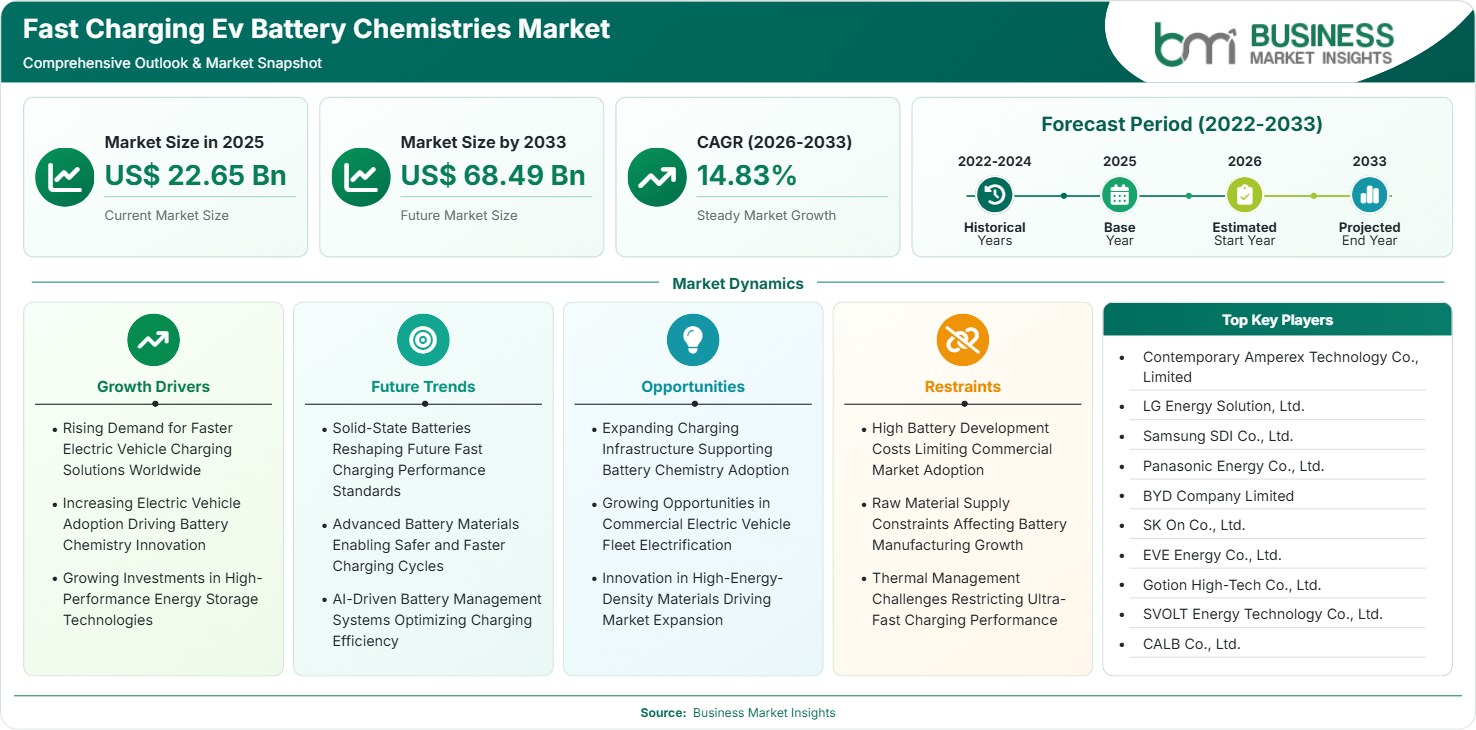
The Fast Charging EV Battery Chemistries market size was valued at US$ 22.65 billion in 2025 and is projected to reach US$ 68.49 billion by 2033, growing at a CAGR of 14.83% during 2026–2033, driven by faster charging demand, EV adoption, battery innovation, charging infrastructure expansion, high-performance materials, and commercial fleet electrification.

Report Coverage
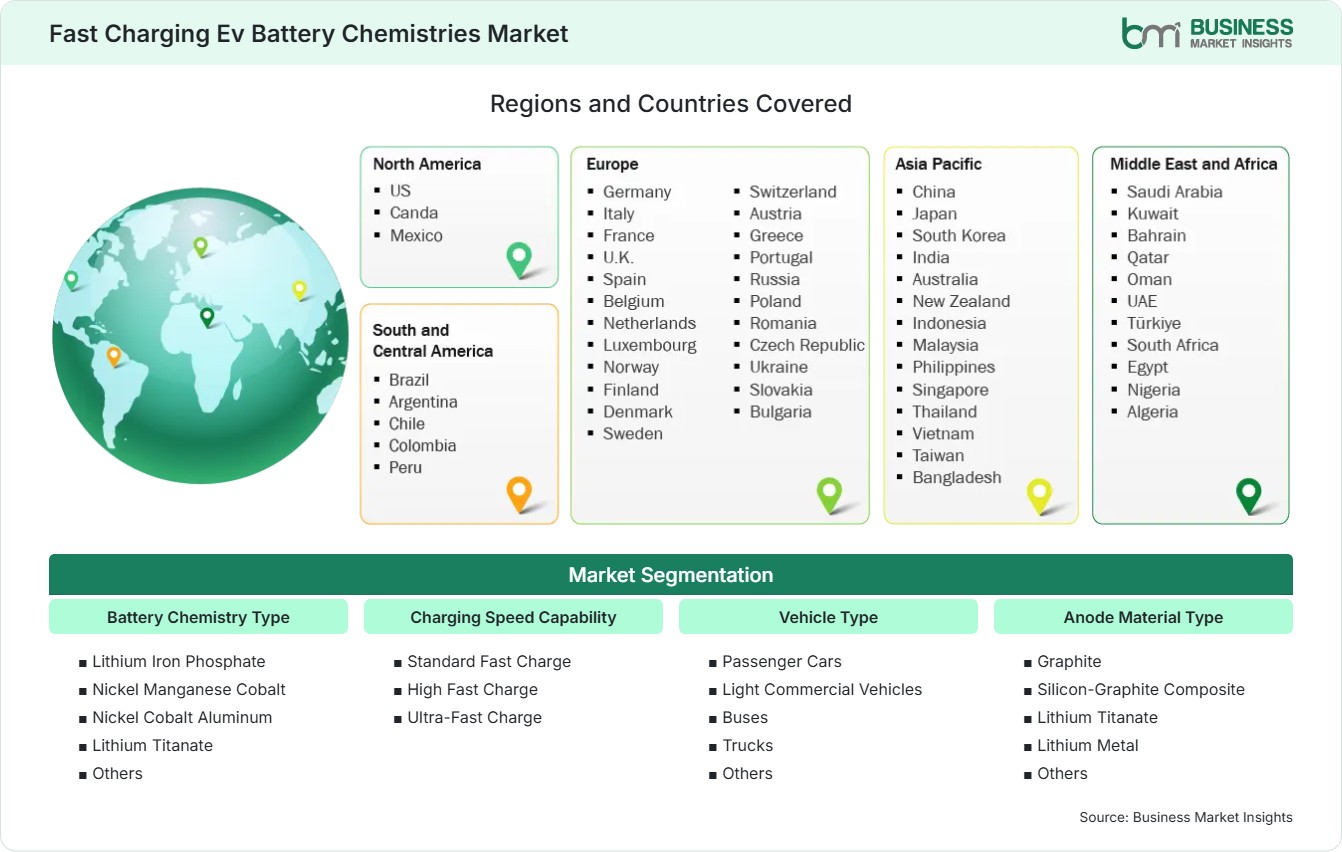
  • Battery Chemistry Type: Lithium Iron Phosphate, Nickel Manganese Cobalt, Nickel Cobalt Aluminum, Lithium Titanate, Others
  • Charging Speed Capability: Standard Fast Charge, High Fast Charge, Ultra-Fast Charge
  • Vehicle Type: Passenger Cars, Light Commercial Vehicles, Buses, Trucks, Others
  • Anode Material Type: Graphite, Silicon-Graphite Composite, Lithium Titanate, Lithium Metal, Others
US$ 22.65 Bn Market size in 2025
US$ 68.49 Bn Market Size by 2033
14.83% CAGR, 2026 - 2033
2026-2033 Forecast Period

01 AI Overview

Fast Charging Ev Battery Chemistries Market Summary

  • North America Region: North America holds a 23%–27% share in 2025, growing with a CAGR of 14.0%–16.0%, influenced by EV adoption, charging infrastructure investment, battery manufacturing expansion, and demand for high-performance energy storage. The US market is growing at a CAGR of 14.5%–16.5%, supported by domestic battery investments, electric vehicle production, and faster charging technology development.
  • Fastest Growing Region: Asia Pacific holds a 47%–51% share in 2025, growing with a CAGR of 16.0%–18.0%, supported by high EV production, battery manufacturing scale, charging infrastructure expansion, domestic supply chains, and continued investment in advanced battery materials and fast-charging technologies.
  • Leading Segment: Lithium Iron Phosphate (LFP) holds a 38%–42% share in 2025, growing with a CAGR of 15.0%–17.0%, driven by thermal stability, cost advantages, longer cycle life, and increasing adoption across mass-market electric vehicles.
  • High Growth Segment: Silicon-Graphite Composite holds a 7%–11% share in 2025, growing with a CAGR of 21.0%–24.0%, supported by higher theoretical capacity, energy-density improvement, fast-charging research, and growing investment in next-generation anode technologies.
  • Key Market Opportunity: Expansion of high-power charging networks, commercial fleet electrification, and advanced anode materials creates opportunities for battery manufacturers developing chemistry platforms optimized for shorter charging times and longer operational life.
  • Major Market Players: Contemporary Amperex Technology Co., Limited, LG Energy Solution, Ltd., Samsung SDI Co., Ltd., Panasonic Energy Co., Ltd., BYD Company Limited, SK On Co., Ltd., EVE Energy Co., Ltd., Gotion High-Tech Co., Ltd., SVOLT Energy Technology Co., Ltd., and CALB Co., Ltd.
02 Strategic Insights

Fast Charging Ev Battery Chemistries Market: Strategic Insights

Fast Charging Ev Battery Chemistries Market Strategic Framework
FREE PDF
Request your free sample
Request free sample
03 Stakeholder View

Key Takeaways

  • The competitive value chain is becoming increasingly integrated, with battery manufacturers investing across cathode materials, anodes, cell production, battery management systems, thermal technologies, and charging partnerships.
  • LFP provides strong volume opportunities because of cost competitiveness and safety characteristics, while silicon-graphite and other advanced anode technologies offer greater upside for high-energy-density and fast-charging applications.
  • Battery innovation is moving toward higher silicon content, improved electrolyte formulations, advanced electrode structures, thermal management, and cell-to-pack designs that reduce charging time without accelerating degradation.
  • China remains the most compelling manufacturing ecosystem, while India, Southeast Asia, and North America offer growing investment opportunities as governments and automakers seek localized EV and battery supply chains.
  • Battery manufacturing capacity is expanding through strategic partnerships, joint ventures, and large-scale facility investments as companies compete to secure production scale and strengthen positions in regional EV supply chains.
  • Commercial fleets offer an attractive application opportunity because rapid charging can increase vehicle utilization, reduce downtime, and improve operating economics for high-frequency transportation services.
04 Geographic Outlook

Fast Charging Ev Battery Chemistries Market Regional Highlights

North America Fast Charging EV Battery Chemistries Market

North America accounted for a 23%–27% share in 2025 and is projected to grow at a 14.0%–16.0% CAGR during 2026–2033. The US dominates regional demand through EV manufacturing expansion, battery investments, and charging infrastructure development. Canada contributes through battery materials and EV supply chain initiatives. Fast Charging Ev Battery Chemistries market share is supported by domestic battery capacity expansion and automaker efforts to improve charging performance across new electric vehicle platforms.

  • Battery manufacturing investments are increasing regional production capabilities, supporting demand for advanced chemistries, anode materials, cell components, and technologies designed for high-volume EV production.
  • Automakers are prioritizing faster charging as a competitive differentiator, increasing collaboration with battery suppliers developing high-rate charging chemistries and improved thermal management systems.
  • Commercial fleet electrification is creating demand for batteries capable of frequent charging cycles, supporting opportunities for chemistries optimized for durability and high utilization.

US Fast Charging EV Battery Chemistries Market

The US Fast Charging EV Battery Chemistries Market represented a 19%–23% share in 2025 and is expected to expand at a 14.5%–16.5% CAGR through 2033. Demand is supported by EV manufacturing investment, domestic battery production, charging infrastructure development, and growing interest in supply chain resilience. Automakers and battery manufacturers are investing in large-scale production facilities and technology development. Fast-charging performance is increasingly important as manufacturers seek to reduce charging inconvenience and improve EV adoption.

  • Domestic battery manufacturing expansion is increasing demand for localized material processing, advanced cell technologies, and chemistry innovation supporting next-generation electric vehicle production.
  • Automakers are evaluating LFP and high-nickel chemistries alongside emerging anode technologies to balance charging speed, vehicle range, cost, safety, and durability.
  • Public fast-charging network expansion is improving the commercial case for battery technologies capable of accepting higher charging rates without excessive degradation.

Europe Fast Charging EV Battery Chemistries Market

Europe held a 19%–23% share in 2025 and Europe Fast Charging EV Battery Chemistries Market forecast to register a 13.0%–15.0% CAGR through 2033. Germany leads regional demand through automotive manufacturing and battery technology investment. France and the UK remain significant markets, while Hungary is projected to grow at a 16.0%–18.0% CAGR as battery production capacity expands. European automakers are increasing EV production and seeking battery chemistries that deliver shorter charging times, and adequate driving range.

  • Battery production investments in Central and Eastern Europe are strengthening regional manufacturing capacity while creating demand for advanced cell materials and chemistry technologies.
  • Sustainability requirements are encouraging battery manufacturers to improve material efficiency, recycling processes, traceability, and supply chain transparency across the battery lifecycle.
  • Commercial vehicle electrification is creating demand for high-utilization battery systems capable of supporting rapid charging across buses, delivery vehicles, and logistics fleets.

Asia Pacific Fast Charging EV Battery Chemistries Market

Asia Pacific Fast Charging EV Battery Chemistries market captured a 47%–51% share in 2025 and is expected to achieve a 16.0%–18.0% CAGR through 2033, making it the fastest-growing major region. China leads regional demand through dominant battery production and EV manufacturing. South Korea and Japan maintain strong technology positions, while India is projected to grow at a 19.0%–21.0% CAGR as EV manufacturing and battery localization expand. Southeast Asia is emerging as an additional production hub.

  • China's extensive battery manufacturing ecosystem supports rapid commercialization of LFP, NMC, sodium-ion alternatives, silicon-enhanced anodes, and other advanced chemistry technologies.
  • South Korean and Japanese manufacturers continue investing in high-energy-density materials, advanced anodes, solid-state technologies, and charging performance improvements for next-generation EV batteries.
  • India's expanding EV market and localization initiatives are encouraging investment in domestic battery manufacturing, charging infrastructure, and technology development.
  • Southeast Asian countries are attracting battery and EV investments, creating opportunities for localized manufacturing and regional supply chains supporting electric mobility expansion.

Rest of World Fast Charging EV Battery Chemistries Market

South and Central America Fast Charging EV Battery Chemistries market represented a 5%–8% share in 2025 and are expected to grow at a 12.0%–14.0% CAGR through 2033, supported by increasing EV adoption and fleet electrification. Middle East and Africa accounted for a 4%–7% share and are projected to expand at a 13.0%–15.0% CAGR. Brazil leads regional adoption, while the UAE and Saudi Arabia provide opportunities through charging infrastructure and electric mobility investments.

  • Brazil's expanding electric mobility ecosystem is creating opportunities for battery suppliers as passenger vehicles, buses, and commercial fleets gradually increase electrification.
  • Electric bus deployment is creating demand for batteries capable of frequent charging, high utilization, and reliable performance under demanding operating conditions.
  • The UAE and Saudi Arabia are investing in electric mobility infrastructure, supporting opportunities for fast-charging technologies and battery platforms optimized for regional transportation requirements.
Global Market Geography
FREE PDF
Request your free sample
Request free sample
05 Segment Analysis

Fast Charging Ev Battery Chemistries Market Segmentation

Battery Chemistry Type

LFP accounted for a 38%–42% share in 2025 and is projected to grow at a 15.0%–17.0% CAGR during 2026–2033. NMC remains important for energy-density-focused applications, while NCA supports selected long-range platforms. LTO offers exceptional charging performance but faces cost limitations.

  • Lithium Iron Phosphate (LFP): LFP offers strong thermal stability, long cycle life, and lower material costs, supporting mass-market EVs and applications where durability and affordability are priorities.
  • Nickel Manganese Cobalt (NMC): NMC provides high energy density and balanced performance, supporting EV applications requiring longer driving range and efficient packaging within limited battery space.
  • Nickel Cobalt Aluminum (NCA): NCA supports high energy density and long-range vehicle applications, while manufacturers continue improving thermal management, safety, and charging performance.
  • Lithium Titanate (LTO): LTO enables rapid charging and exceptional cycle durability, making it suitable for high-utilization applications despite lower energy density and higher material costs.
  • Others: Emerging chemistries and alternative material systems are being evaluated to improve charging speed, energy density, safety, cost, and sustainability across future electric mobility applications.

Charging Speed Capability

High Fast Charge accounted for a 27%–31% share in 2025 and is projected to grow at a 17.0%–19.0% CAGR through 2033. Standard fast charging remains widely deployed, while ultra-fast charging represents a rapidly advancing technology area. Fast Charging EV Battery Chemistries market trends increasingly emphasize electrode engineering, thermal control, and battery management systems.

  • Standard Fast Charge: Standard fast charging provides practical charging improvements for mainstream EV users while maintaining manageable battery stress and infrastructure requirements.
  • High Fast Charge: High fast charging enables shorter charging sessions for passenger and commercial vehicles, increasing demand for chemistries and cell designs capable of accepting higher power.
  • Ultra-Fast Charge: Ultra-fast charging targets charging times approaching conventional refueling convenience, driving research into advanced electrodes, thermal management, electrolyte systems, and high-power charging infrastructure.

Vehicle Type

Passenger Cars accounted for a 68%–72% share in 2025 and are projected to grow at a 14.0%–16.0% CAGR through 2033. Commercial applications are gaining importance as fleet electrification expands. Buses and trucks require high-utilization batteries with rapid charging and long cycle life.

  • Passenger Cars: High production volumes and consumer demand for shorter charging times are driving battery innovation focused on energy density, charging speed, safety, cost, and durability.
  • Light Commercial Vehicles (LCVs): Delivery and logistics fleets require batteries supporting frequent operation and rapid charging, creating demand for durable chemistry platforms optimized for high daily utilization.
  • Buses: Electric buses benefit from fast-charging systems that minimize route downtime, increasing interest in durable batteries capable of frequent high-power charging cycles.
  • Trucks: Electric trucks require high-capacity batteries with strong charging performance, long cycle life, and thermal management capabilities suitable for demanding commercial transportation operations.
  • Others: Two-wheelers, specialty vehicles, and emerging electric mobility applications provide additional opportunities for compact battery systems balancing charging speed, cost, energy density, and durability.

Anode Material Type

Graphite accounted for a 72%–76% share in 2025 and remains the dominant anode material due to established manufacturing infrastructure and performance characteristics. Silicon-graphite composites are gaining momentum because of higher capacity potential. Lithium titanate supports rapid charging and long cycle life, while lithium metal remains a longer-term technology opportunity.

  • Graphite: Graphite remains widely used because of established supply chains, manufacturing maturity, predictable performance, and compatibility with high-volume lithium-ion battery production.
  • Silicon-Graphite Composite: Silicon-graphite composites offer higher capacity potential than conventional graphite, supporting research into greater energy density and faster charging for advanced EV batteries.
  • Lithium Titanate: Lithium titanate enables rapid charging and high cycle durability, making it attractive for buses, commercial fleets, and high-frequency transportation applications.
  • Lithium Metal: Lithium metal offers substantial theoretical capacity advantages and remains a promising next-generation anode technology, although manufacturing stability and safety challenges require further development.
  • Others: Emerging anode materials are being evaluated to improve capacity, charging speed, cycle life, safety, and resource efficiency for future electric vehicle battery systems.
06 Market Forces

Fast Charging Ev Battery Chemistries Market Dynamics

Key Market Drivers

Rising Demand for Faster Electric Vehicle Charging Solutions Worldwide

Charging time continues to be an important factor affecting consumer satisfaction and fleet economics, thereby increasing the need for battery solutions with increased ability to take in more charging power. The charging of conventional electric vehicles takes significantly longer than the fueling of internal combustion engines, especially with large batteries. Vehicle manufacturers and battery suppliers are making investments in technologies and techniques related to batteries that could help reduce charging time while maintaining the longevity of the battery. Lithium Ferro Phosphate enhancements, high nickel chemistry advances, silicon-based anode improvements, and better battery management systems are some of the advancements in this direction. Fast Charging EV Battery Chemistries market growth is increasingly linked to the ability of battery systems to combine rapid energy replenishment with safety, durability, and predictable long-term performance across varied operating conditions.

Increasing Electric Vehicle Adoption Driving Battery Chemistry Innovation

The fast growth of electric cars is raising the need for battery technology solutions that will work best depending on the type of vehicle, climate, range, and chargeability needs. While passenger cars focus on range and convenience, the commercial ones may be more interested in durability and charge speed. This diversity is leading manufacturers to consider solutions beyond one chemistry approach. As the number of EVs grows, manufacturers can afford to invest into the optimization of the chemistry, materials, cells, and manufacturing processes for fast chargeability.

Growing Investments in High-Performance Energy Storage Technologies

Battery manufacturers, car makers, tech firms, and governments are making greater investments in advanced energy storage technology to improve the performance of electric cars and ensure security within their domestic supply chain. Scientists are now paying more attention to the development of high silicon anode technology, solid-state batteries, better electrolytes, better cathode structures, and thermal management. All of these innovations are meant to enhance energy density and the speed of charging while minimizing the dangers of degradation and safety. Thus, investment in battery science is contributing to both evolutionary and revolutionary advancements in this area.

Key Market Opportunities

Expanding Charging Infrastructure Supporting Battery Chemistry Adoption

An increase in the availability of high-power charging networks would increase the need for batteries that can handle faster charging rates. As there is increased availability of the charging networks, it provides strong motivation to vehicle manufacturers to design platforms which will take advantage of higher power charging stations. There will be possibilities of designing battery chemistries and cells in a way that there would be fast energy transfer. Charging infrastructure developers and battery manufacturers can also collaborate on charging profiles that reduce thermal stress and improve battery longevity.

Growing Opportunities in Commercial Electric Vehicle Fleet Electrification

There are ample opportunities in commercial vehicle fleets since the machines run continuously and downtime leads to a loss in earning revenues. Delivery vans, buses, trucks, and logistic vehicles will be highly suitable for fast charging technology which helps to cover greater operating hours in a fixed schedule. The battery manufacturer can create the platform for the chemistry in the form of fast charging, cycle life, and costs. LTO is most appropriate in case of fast charging, and LFP in terms of robustness and cost. LTO is particularly relevant for high-frequency charging applications, while LFP offers an attractive combination of durability and cost.

Innovation in High-Energy-Density Materials Driving Market Expansion

Advanced materials provide an important opportunity to improve both energy density and charging performance. Silicon-graphite composites can increase anode capacity compared with conventional graphite, potentially allowing manufacturers to achieve greater vehicle range without proportionally increasing battery size. Research into lithium metal, solid-state electrolytes, advanced cathodes, and engineered electrode structures could further improve battery performance. Commercialization depends on solving challenges related to cycle stability, manufacturing scalability, safety, and cost.

Market Restraints and Challenges

High Battery Development Costs Limiting Commercial Market Adoption

Factor: Battery production involves raw material extraction on a global level, which includes but is not limited to the use of lithium, nickel, cobalt, graphite, manganese, and many more. Impact: Scarcity of resources, geopolitical issues, processing capability, and logistical problems can have an effect on production costs and the availability of batteries. Battery manufacturers have addressed these problems by using alternative materials, recycling, localizing processing, and diversifying their suppliers.

Raw Material Supply Constraints Affecting Battery Manufacturing Growth

Factor: The manufacture of batteries relies on the global sourcing of components such as lithium, nickel, cobalt, graphite, manganese, and others. This factor creates an exposure to material concentration and fluctuations in cost. Impact: Shortages of raw materials, geopolitical events, process capacity issues, and logistics could impact cost and availability. This issue is being countered by diversified sourcing, process localization, recycling initiatives, and alternate chemistries.

07 Company Analysis

Competitive Landscape

The Fast Charging EV Battery Chemistries market analysis points out a highly competitive environment amongst various battery makers worldwide seeking to achieve improved charging performance, energy density, safety, longevity, and production economics. The key differentiators in the competition include chemistry expertise, cell design, production economies, anode expertise, thermal management, and partnerships with automobile manufacturers. The LFP chemistry is ideal for cost-sensitive volume applications whereas high-nickel and anode chemistries cater to high-end applications.

Company Name

Overview

Products and Services relevant to this market

Contemporary Amperex Technology Co., Limited

Major global battery manufacturer with extensive EV cell production and advanced chemistry development capabilities.

LFP and NMC batteries, fast-charging technologies, battery systems, energy storage, and advanced cell architectures.

LG Energy Solution, Ltd.

Global battery manufacturer supplying automotive, mobility, and energy storage customers worldwide.

NMC and advanced lithium-ion batteries, high-performance cells, battery management, and next-generation battery technologies.

Samsung SDI Co., Ltd.

Advanced battery manufacturer focused on high-performance cells and next-generation energy storage technologies.

EV batteries, high-energy-density cells, advanced materials, fast-charging technologies, and next-generation battery development.

Panasonic Energy Co., Ltd.

Major battery technology company supplying high-performance cells for electric mobility applications.

Cylindrical EV batteries, high-energy-density cells, advanced materials, battery technology, and fast-charging development.

BYD Company Limited

Vertically integrated EV and battery manufacturer with strong expertise in LFP battery technology.

Blade Battery, LFP cells, EV battery systems, energy storage, and integrated electric mobility solutions.

SK On Co., Ltd.

Global EV battery manufacturer specializing in high-performance battery technologies and automotive partnerships.

High-nickel batteries, fast-charging technologies, EV cells, battery systems, and advanced material development.

EVE Energy Co., Ltd.

Battery manufacturer expanding across passenger vehicles, commercial mobility, and energy storage applications.

Lithium-ion cells, LFP batteries, cylindrical cells, fast-charging technologies, and energy storage systems.

Gotion High-Tech Co., Ltd.

Battery technology company developing lithium-ion solutions for electric mobility and energy storage markets.

LFP and ternary batteries, battery systems, advanced materials, and fast-charging battery technologies.

SVOLT Energy Technology Co., Ltd.

Battery manufacturer focused on automotive power batteries and advanced chemistry development.

LFP, high-nickel cells, short-blade batteries, fast-charging technologies, and battery system solutions.

CALB Co., Ltd.

Battery manufacturer supplying electric vehicles and energy storage systems with growing global production capabilities.

LFP and ternary batteries, EV cells, battery systems, fast-charging solutions, and energy storage technologies.


10 Trust & Transparency

Research Methodology

The market analysis combines proprietary research with secondary data from government agencies, company disclosures, regulatory filings, industry databases and expert interviews. Market estimates are validated through data triangulation, cross-market benchmarking and analyst review.

View Full Research Methodology

11 Questions Answered

Frequently Asked Questions

How do raw material risks affect Fast Charging Ev Battery Chemistries Market development?

Manufacturers are responding through supplier diversification, recycling, localized processing, alternative chemistries, and reduced dependence on constrained materials.

Which vehicles will benefit most from fast-charging batteries?

Commercial vehicles such as buses, delivery vans, and trucks can benefit substantially because rapid charging reduces downtime and increases daily utilization.

What technology could improve EV charging speed most significantly?

Silicon-enhanced anodes, advanced electrolytes, improved electrode structures, and solid-state battery technologies are among the leading areas of development.

Why is LFP gaining adoption in electric vehicles?

LFP provides strong thermal stability, long cycle life, and lower material costs compared with many nickel-rich chemistries.

Which battery chemistry is best suited for Fast Charging Ev Battery Chemistries Market report?

LTO is recognized for strong fast-charging capability and long cycle life, while LFP and advanced lithium-ion chemistries are increasingly optimized for faster charging

Access the Full Fast Charging Ev Battery Chemistries Market Report

Get segment-level forecasts, regional estimates, competitive benchmarking, company profiles and downloadable Excel datasets.

Access the full Fast Charging Ev Battery Chemistries Market Report
350 pages PDF & Excel | 2026-08-04