
Battery Manufacturing Equipment Market Outlook: Size, Share, Trends, Growth Analysis, Competitive Landscape & Forecast, 2026-2033

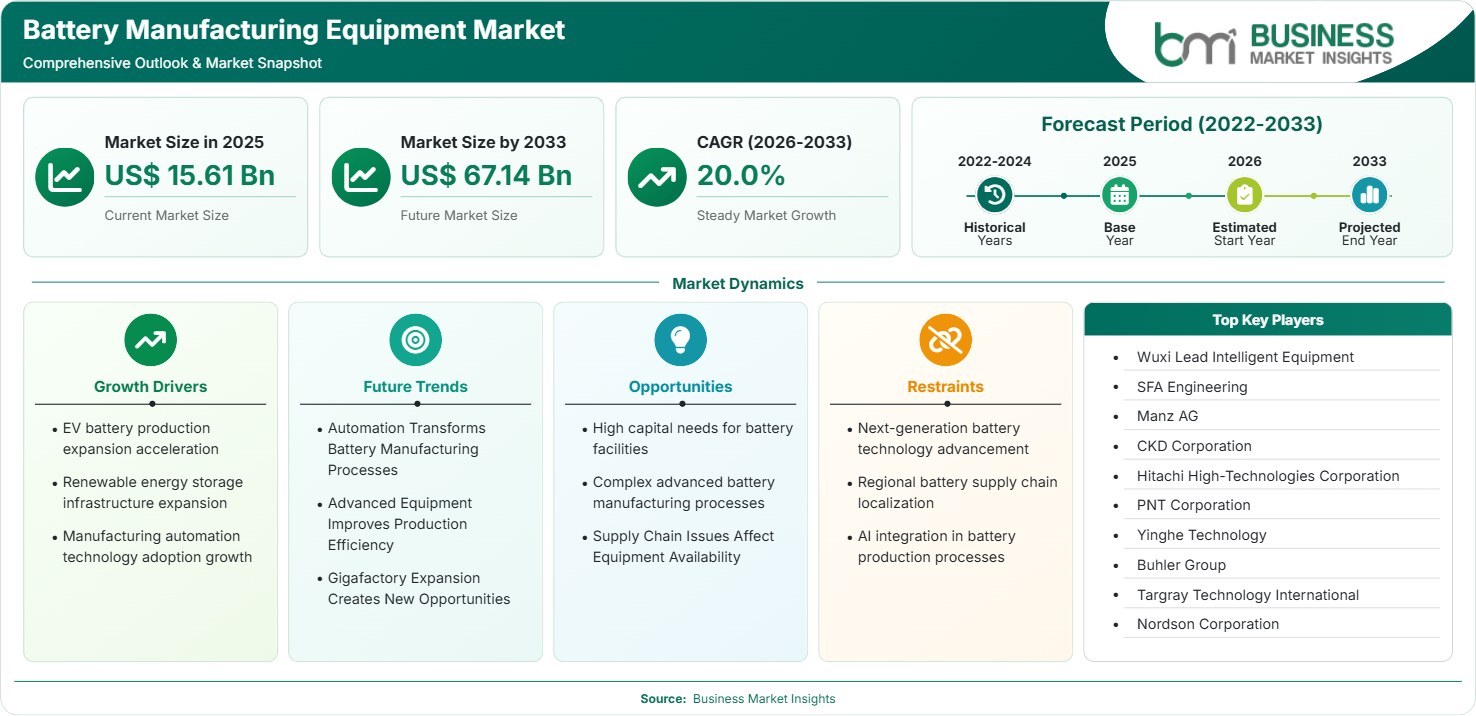
The Battery Manufacturing Equipment Market size was valued at US$ 15.61 billion in 2025 and is expected to reach USD 67.14 billion by 2033, registering a growth rate of 20.0% from 2026 to 2033, supported by increasing adoption of electric vehicles, growing investment in battery gigafactories, growing demand for energy storage, and developments in next-generation batteries.

Report Coverage
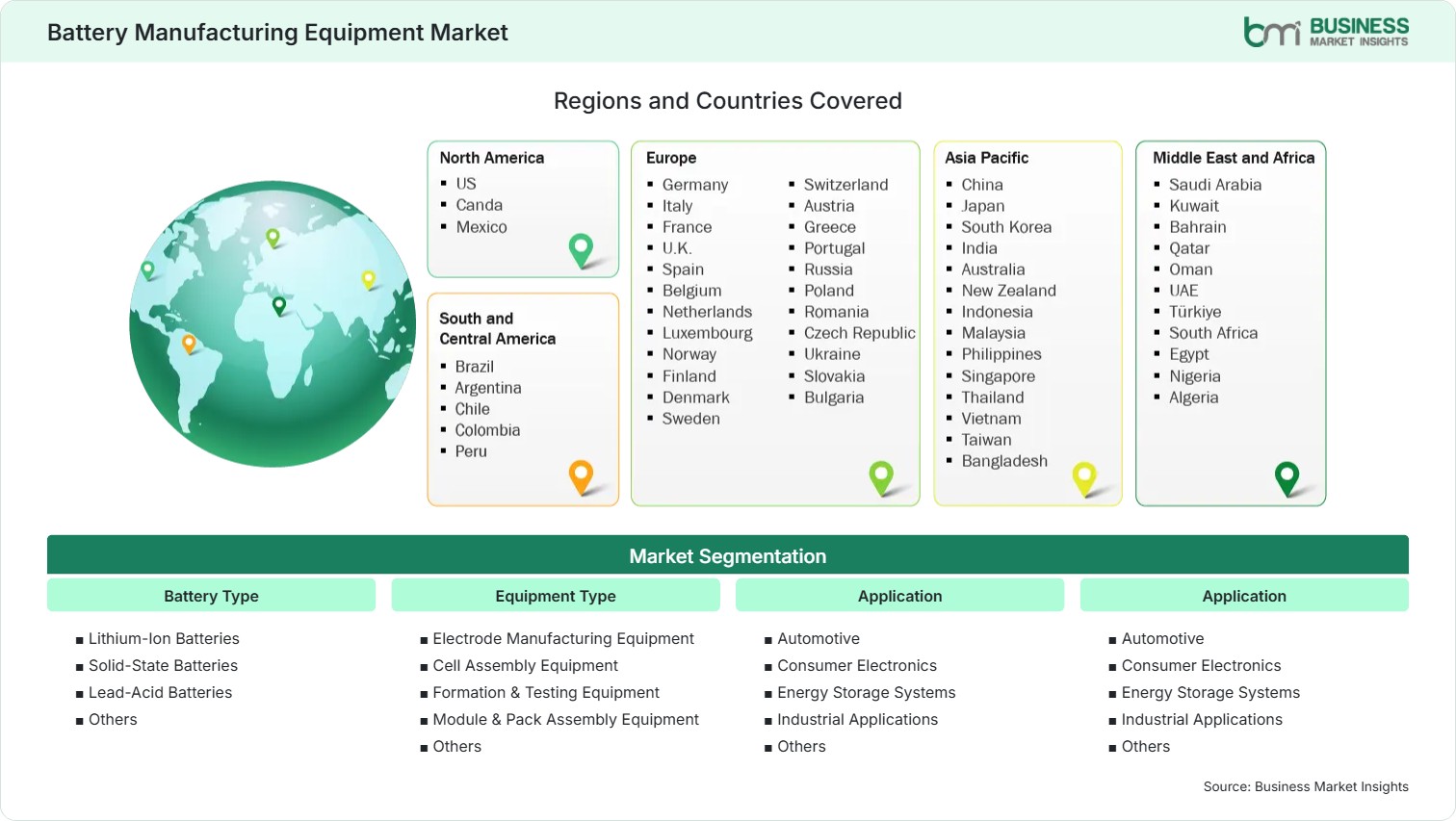
  • Battery Type: Lithium-Ion Batteries, Solid-State Batteries, Lead-Acid Batteries, Others
  • Equipment Type: Electrode Manufacturing Equipment, Cell Assembly Equipment, Formation & Testing Equipment, Module & Pack Assembly Equipment, Others
  • Application: Automotive, Consumer Electronics, Energy Storage Systems (ESS), Industrial Applications, Others
  • Application: Automotive, Consumer Electronics, Energy Storage Systems (ESS), Industrial Applications, Others
US$ 15.61 Bn Market size in 2025
US$ 67.14 Bn Market Size by 2033
20.0% CAGR, 2026 - 2033
2026-2033 Forecast Period

01 AI Overview

Battery Manufacturing Equipment Market Summary

  • North America Region: North America holds a market share of 18%–21% in 2025 and is expected to grow at CAGR of 19.0%–20.0% from 2026 to 2033 owing to domestic battery production programs, localized supply chains for EVs, energy storage investments, and manufacturing automation. USA continues to dominate the region in terms of expansion in battery plants and CAGR of 19.2%–20.2%.
  • Fastest Growing Region: The Asia-Pacific region holds 62%-65% share in the global market of 2025 with a CAGR of 20.8%-21.8% during the period from 2026 to 2033, owing to the well-established ecosystem in the manufacture of batteries, building of megafactories, production of electric
  • Leading Segment: Lithium-ion Batteries dominate the market at an estimated market share of 82%-85% in 2025 and will achieve a CAGR of 20.2%-21.1% from 2026 to 2033 driven by the rise in EVs, production of consumer electronics, energy
  • High Growth Segment: The Energy Storage System (ESS) constitutes 18% to 21% of the application market in 2025 and is forecasted to grow at a CAGR of 22.0% to 23.0% from 2026 to 2033 due to the use of renewable energy sources,
  • Key Market Opportunity: The battery equipment industry is witnessing growth due to global expansion of gigafactories, the need for automation, solid-state battery commercialization, and the demand for precision production technology.
  • Major Market Players: Wuxi Lead Intelligent Equipment Co., Ltd.; SFA Engineering Corporation; Manz AG; CKD Corporation; Hitachi High-Tech Corporation; PNT Corporation; Yinghe Technology Co., Ltd.; Bühler Group; Targray Technology International Inc.; Nordson Corporation.
02 Strategic Insights

Battery Manufacturing Equipment Market: Strategic Insights

Battery Manufacturing Equipment Market Strategic Framework
FREE PDF
Request your free sample
Request free sample
03 Stakeholder View

Key Takeaways

  • The industry value chain is increasingly integrating equipment manufacturers, battery cell producers, automotive companies, automation providers, material suppliers, and energy storage developers to improve manufacturing efficiency and supply chain resilience.
  • Lithium-ion battery production remains the primary commercial opportunity, while solid-state battery manufacturing equipment represents a strategic growth area as companies prepare for next-generation energy storage technologies.
  • Manufacturing innovation is shifting toward artificial intelligence-based inspection, robotic automation, advanced coating systems, digital twins, and real-time production monitoring to improve battery quality and reduce defects.
  • Asia Pacific continues offering the strongest investment opportunity due to established battery manufacturing capabilities, extensive supplier networks, and large-scale electric vehicle production capacity.
  • Strategic partnerships between battery manufacturers and equipment suppliers are increasing as companies seek customized production lines capable of supporting different battery chemistries and formats.
  • Growing demand for renewable energy storage solutions is creating additional opportunities for equipment providers beyond automotive applications, particularly in utility-scale and commercial energy storage projects.
04 Geographic Outlook

Battery Manufacturing Equipment Market Regional Highlights

North America Battery Manufacturing Equipment Market

North America accounts for 18%–21% Battery Manufacturing Equipment Market share in 2025 while expanding at a CAGR of 19.0%–20.0% during 2026–2033. Regional growth is supported by battery supply chain localization, electric vehicle manufacturing expansion, government incentives, and increasing investment in domestic production facilities. Automotive companies and battery manufacturers are establishing new plants requiring advanced manufacturing equipment and automation solutions.

  • The United States remains the dominant regional contributor due to expanding EV production, battery gigafactory investments, and government support for domestic energy storage manufacturing.
  • Battery equipment suppliers are increasingly developing localized service networks to support new production facilities and reduce dependency on international supply chains.
  • Automotive manufacturers are investing in automated battery assembly and testing equipment to improve production efficiency and meet increasing EV demand.
  • Energy storage companies are expanding manufacturing capacity, creating additional demand for specialized formation, testing, and pack assembly equipment.
  • Growing investment in battery research and manufacturing infrastructure continues supporting long-term Battery Manufacturing Equipment Market growth across North America.

US Battery Manufacturing Equipment Market

The United States is considered the biggest market in North America, contributing to 15%–17% of total global revenues in 2025 and growing at a CAGR of 19.2%–20.2% during 2026–2033. Increasing manufacture of electric vehicles, efforts towards domestic battery production, and increasing investment in energy storage systems are driving the requirement for advanced manufacturing equipment.

  • Federal clean energy initiatives continue encouraging domestic battery production through incentives supporting manufacturing capacity expansion and supply chain development.
  • Automotive manufacturers increasingly invest in advanced production technologies to improve battery quality, reduce manufacturing costs, and enhance EV competitiveness.
  • Battery startups are adopting flexible manufacturing equipment to support pilot production and commercial-scale battery development.
  • Equipment suppliers are expanding technical support capabilities to address increasing demand from new battery manufacturing facilities.

Europe Battery Manufacturing Equipment Market

accounts for 16%–19% of worldwide revenue during the period from 2025 with a compound annual growth rate of 19.5%–20.5% in 2026-2033. Climate policy, electric vehicles, and battery manufacturing in the region facilitate market growth. Germany and Sweden are key markets in Europe, while Hungary grows rapidly due to growing battery manufacturing and automobiles.

  • Germany maintains regional leadership through its strong automotive ecosystem, industrial automation expertise, and expanding battery manufacturing investments.
  • Hungary demonstrates higher projected growth with a CAGR of 21.0%–22.0%, supported by new battery production facilities and foreign investment.
  • Sweden continues developing sustainable battery manufacturing capabilities through renewable energy integration and advanced production technologies.
  • European manufacturers increasingly invest in automated equipment to improve battery production efficiency and reduce operational costs.
  • Government initiatives supporting domestic battery supply chains continue encouraging equipment investments across the region.

Asia Pacific Battery Manufacturing Equipment Market

Asia-Pacific is the key region that accounts for 62% to 65% share of the global market revenues in 2025 and shows the highest CAGR of 20.8% to 21.8% over 2026 to 2033. The region holds advantages due to the presence of battery manufacturing ecosystem, electronics manufacturing, growth of electric vehicles, and equipment suppliers.

  • China leads global battery equipment demand due to its dominant battery manufacturing ecosystem, extensive supplier base, and large-scale EV production capacity.
  • India records strong growth with a CAGR of 22.0%–23.0%, supported by domestic battery manufacturing initiatives and electric mobility expansion.
  • South Korea and Japan continue investing in advanced battery technologies and high-precision manufacturing equipment.
  • Southeast Asian countries are attracting battery manufacturing investments due to expanding EV supply chains and favorable production conditions.
  • Regional equipment manufacturers continue developing automated solutions to improve battery production speed, efficiency, and quality control.

Rest of World Battery Manufacturing Equipment Market

The Rest of World region will contribute 4%-7% of total worldwide revenues in 2025, but is set to grow at a CAGR of 18.5%-19.5% from 2026 to 2033. Latin America and Middle East & Africa will be developing regions because of the requirements of renewable energy storage and EVs.

  • Brazil remains the leading Latin American market, while Mexico demonstrates faster growth with a CAGR of 20.0%–21.0% due to automotive manufacturing expansion.
  • Middle Eastern countries are increasing battery storage investments to support renewable energy integration and grid modernization initiatives.
  • Africa presents emerging opportunities through renewable energy projects requiring distributed battery storage systems and manufacturing infrastructure.
  • International equipment suppliers are expanding partnerships with regional energy companies and industrial manufacturers.
  • Growing electrification initiatives continue creating demand for battery production technologies across developing markets.
Global Market Geography
FREE PDF
Request your free sample
Request free sample
05 Segment Analysis

Battery Manufacturing Equipment Market Segmentation

Battery Type

The battery type segment represents the core demand foundation for manufacturing equipment as global investments accelerate across electric mobility, consumer electronics, and stationary energy storage applications. This segment accounted for 100% of market demand in 2025 and is projected to expand at a CAGR of 20.0% during 2026–2033. Increasing battery production capacity, technology diversification, and manufacturing localization initiatives continue strengthening the Battery Manufacturing Equipment Market scope while supporting investments in advanced production systems.

  • Lithium-Ion Batteries: Lithium-ion batteries dominate equipment demand due to widespread adoption in electric vehicles, consumer electronics, and energy storage systems. Manufacturers are investing in high-speed production lines, advanced coating equipment, automated assembly systems, and precision testing technologies.
  • Solid-State Batteries: Solid-state battery development is increasing demand for specialized manufacturing equipment capable of handling new materials, electrode structures, and production processes. Automotive and energy companies are investing in pilot lines and scalable manufacturing technologies.
  • Lead-Acid Batteries: Lead-acid battery production continues generating equipment demand through automotive replacement markets, industrial applications, and backup power systems. Manufacturers focus on improving automation, efficiency, and environmental compliance within established production processes.

Equipment Type

The equipment type is an emerging market segment due to the growing need for automation across processes associated with battery manufacturing, from electrode production to packaging. The equipment type market segment accounted for 100% of demand in 2025 and is projected to grow at a CAGR of 20.0% during 2026-2033. The increase in demand for batteries will impact the Battery Manufacturing Equipment market share.

  • Electrode Manufacturing Equipment: Electrode manufacturing equipment remains critical for producing high-performance batteries through precise mixing, coating, drying, and calendaring processes. Increasing battery capacity requirements are driving investments in advanced coating and material handling technologies.
  • Cell Assembly Equipment: Cell assembly equipment adoption is increasing as manufacturers seek higher production accuracy, automation, and throughput. Advanced winding, stacking, welding, and sealing systems improve battery consistency and reduce manufacturing defects.
  • Formation & Testing Equipment: Formation and testing equipment plays a crucial role in battery quality assurance through charging cycles, performance evaluation, and safety validation. Growing demand for reliable batteries is encouraging investment in advanced testing infrastructure.
  • Module & Pack Assembly Equipment: Module and pack assembly equipment demand is increasing with EV production expansion and energy storage deployment. Manufacturers are adopting automated systems for battery integration, thermal management, and intelligent quality inspection.

Application

Application-based demand is expanding as battery manufacturing equipment suppliers serve multiple industries beyond electric vehicles. The application segment accounted for 100% of market activity in 2025 and is forecast to register a CAGR of 20.0% during 2026–2033. Growing electrification, renewable energy integration, and digital device adoption continue driving the Battery Manufacturing Equipment Market trends across automotive, industrial, and energy sectors.

  • Automotive: Automotive applications represent the largest demand source as electric vehicle manufacturers expand battery production capacity. Companies are investing in automated manufacturing lines, advanced testing systems, and scalable production equipment.
  • Consumer Electronics: Consumer electronics manufacturers continue requiring precision battery production equipment for smartphones, laptops, wearable devices, and portable electronics. Demand is supported by miniaturization and improved battery performance requirements.
  • Energy Storage Systems (ESS): Energy storage systems represent a rapidly expanding application due to renewable energy integration, grid stabilization needs, and commercial energy management solutions. Battery equipment investments are increasing for large-scale storage production.
  • Industrial Applications: Industrial applications include backup power, automation systems, material handling equipment, and specialized machinery requiring reliable battery solutions. Manufacturers are adopting advanced equipment to improve production efficiency and product reliability.
06 Market Forces

Battery Manufacturing Equipment Market Dynamics

Key Market Drivers

EV battery production expansion acceleration

The rapid shift to electric vehicles is driving increased demand for modern battery production machinery. Automakers and battery makers worldwide are building gigafactories to ensure a reliable supply chain amid the growing market for electric vehicles. This trend has been emphasized by organizations like the International Energy Agency (IEA). Equipment providers are benefiting from increased demand for automated electrode production, cell assembly, formation, and testing systems. As EV production scales globally, market growth is supported by investments in efficient manufacturing technologies, while Battery Manufacturing Equipment Market trends indicate increasing adoption of intelligent automation and digital production management.

Renewable energy storage infrastructure expansion

There is increased use of renewable energy sources such as solar and wind, resulting in high demand for battery energy storage solutions. Utilities, businesses, and even government bodies are investing in energy storage solutions to enhance stability and handle intermittent generation from renewables. Battery manufacturers are expanding their plants, which require specialized equipment for producing large-format batteries. The demand for energy storage solutions is prompting equipment providers to develop scalable systems to increase battery production.

Manufacturing automation technology adoption growth

Battery manufacturers are increasingly adopting robotics, artificial intelligence, machine vision, and automated production systems to improve quality, reduce defects, and increase manufacturing efficiency. The manufacture of batteries demands careful control of materials, assembly processes, and testing procedures, which call for automation to ensure efficient performance. This trend is evident in equipment vendors' provision of intelligent monitoring systems, predictive maintenance, and digital manufacturing. These innovations help in the optimization of production cost while enhancing the productivity and safety of the operations.

Key Market Opportunities

Next-generation battery technology advancement

The commercialization of solid-state batteries and advanced lithium-ion chemistries is creating new opportunities for equipment manufacturers. Next-generation batteries require specialized production processes, precision handling systems, and modified manufacturing infrastructure. Automobile and battery companies are making major investments in pilot plants to expedite commercialization. Equipment providers who can adapt their technology for new batteries will find themselves at a significant advantage when manufacturing firms make the shift from pilot-scale operations to commercial scale. The Battery Manufacturing Equipment Market Forecast indicates a growing need for flexible production platforms.

Regional battery supply chain localization

The governments of many countries in North America, Europe, and Asia are promoting battery development within their countries to reduce their dependence on concentrated supply chains. This has been creating opportunities for companies that provide the equipment required to build such facilities, as they will need all the necessary manufacturing equipment. The trend of localized production has increased the demand for equipment for electrodes, cell assembly, testing, and automation.

AI integration in battery production processes

Artificial intelligence and advanced analytics are creating opportunities to improve battery manufacturing efficiency through real-time monitoring, defect detection, and predictive maintenance. Equipment manufacturers are integrating intelligent software solutions with production systems to optimize material usage, reduce downtime, and improve quality control. As battery manufacturers face increasing pressure to improve production yields and reduce costs, AI-enabled equipment solutions are becoming increasingly valuable. This technology shift is expected to create new revenue opportunities for equipment providers offering integrated hardware and digital manufacturing platforms, reflecting evolving Battery Manufacturing Equipment Market trends.

Market Restraints and Challenges

High capital needs for battery facilities

Factor: Battery production facilities require substantial investment in specialized equipment, cleanroom infrastructure, automation systems, testing technologies, and facility development, creating significant upfront capital requirements.

Impact: High investment barriers can delay new manufacturing projects, particularly for smaller battery producers and emerging companies with limited financial resources. Equipment suppliers may experience longer sales cycles as manufacturers evaluate project feasibility, financing availability, and expected production returns before committing to large-scale investments.

Complex advanced battery manufacturing processes

Factor: Battery manufacturing involves highly precise processes requiring strict control of materials, environmental conditions, safety parameters, and production quality standards across multiple manufacturing stages.

Impact: Process complexity increases demand for specialized expertise, advanced equipment calibration, and continuous technical support. Manufacturing challenges can affect production efficiency, increase operational costs, and create implementation difficulties for companies transitioning toward advanced battery technologies or new production formats.

07 Company Analysis

Competitive Landscape

The competitive landscape is shaped by battery equipment manufacturers, industrial automation providers, precision engineering companies, and technology suppliers developing advanced production solutions for lithium-ion, solid-state, and energy storage batteries. The Battery Manufacturing Equipment Market analysis indicates that leading companies are focusing on automation, high-speed production systems, intelligent quality control, geographic expansion, and partnerships with battery manufacturers to support global gigafactory development.

Company Name

Overview

Products and Services relevant to this market

Wuxi Lead Intelligent Equipment Co., Ltd.

Battery equipment specialist providing intelligent manufacturing solutions for global battery producers.

Electrode production equipment, cell assembly systems, coating machines, automation solutions, battery production lines.

SFA Engineering Corporation

Industrial equipment manufacturer supporting advanced manufacturing processes across multiple industries.

Battery manufacturing systems, automation equipment, precision machinery, production line solutions, process equipment.

Manz AG

German engineering company specializing in automation and production technology solutions.

Battery production equipment, electrode manufacturing systems, assembly technology, automation platforms, inspection systems.

CKD Corporation

Japanese automation technology company providing precision manufacturing solutions.

Battery assembly equipment, automation systems, process machinery, manufacturing components, production technologies.

Hitachi High-Tech Corporation

Technology company offering advanced industrial equipment and measurement solutions.

Battery inspection systems, manufacturing equipment, analytical instruments, quality control technologies.

PNT Corporation

Korean battery equipment manufacturer specializing in production systems for energy storage applications.

Electrode coating equipment, lithium-ion battery production systems, roll-to-roll processing equipment, automation solutions.

Yinghe Technology Co., Ltd.

Chinese equipment manufacturer focused on intelligent battery production technologies.

Lithium battery equipment, coating systems, assembly equipment, automation solutions, manufacturing integration.

Bühler Group

Global engineering company providing advanced processing and manufacturing technologies.

Battery material processing equipment, coating solutions, production systems, industrial automation technologies.

Targray Technology International Inc.

Materials and technology supplier supporting battery manufacturing ecosystems.

Battery materials, electrode components, manufacturing supplies, energy storage solutions, production support services.

Nordson Corporation

Industrial technology company providing precision dispensing and process solutions.

Battery dispensing systems, coating technologies, adhesive application equipment, inspection and process solutions.

08 Industry Activity

Recent Developments

February, 2026

Buhler Group announced a milestone of more than 100 continuous mixing lines sold worldwide for battery manufacturing. The company reported delivery of 113 production systems for battery slurry and dry compound manufacturing, highlighting its growing role in industrial battery production.

April, 2025

Buhler Group received a major order from FIB S.p.A. to supply four continuous mixing lines for lithium iron phosphate (LFP) battery electrode slurry production at the Teverola 2 plant in Italy. The equipment will support large-scale battery production with an annual capacity of 8 GWh.

March, 2025

Hitachi High-Tech Corporation strengthened its analytical business capabilities by integrating its analytical science operations to enhance advanced measurement and inspection solutions. The technology supports industries including lithium-ion battery development and manufacturing through improved material analysis and quality control capabilities.

February, 2025

Wuxi Lead Intelligent Equipment Co., Ltd partnered with a South Korean battery manufacturer to provide advanced cutting and stacking equipment for high-end digital lithium-ion battery production lines. The collaboration focuses on improving manufacturing precision and supporting next-generation battery cell production.

10 Trust & Transparency

Research Methodology

The market analysis combines proprietary research with secondary data from government agencies, company disclosures, regulatory filings, industry databases and expert interviews. Market estimates are validated through data triangulation, cross-market benchmarking and analyst review.

View Full Research Methodology

11 Questions Answered

Frequently Asked Questions

Which regions are expected to lead the market expansion in the battery manufacturing equipment market report?

Asia Pacific remains the leading region due to established battery manufacturing ecosystems, large electric vehicle production capacity, extensive supplier networks, and significant investments in new battery production facilities.

Which application segment offers the strongest future opportunity?

Energy Storage Systems (ESS) represent a high-growth opportunity due to renewable energy integration, grid stabilization requirements, and increasing demand for large-scale electricity storage infrastructure.

Why are battery manufacturers investing in automation technologies?

Automation improves production consistency, reduces manufacturing defects, increases output capacity, enhances worker safety, and enables real-time quality monitoring across complex battery production processes.

Which battery type generates the highest demand for manufacturing equipment?

Lithium-ion batteries represent the dominant segment because they are widely used in electric vehicles, consumer electronics, and energy storage systems, requiring extensive manufacturing infrastructure and advanced production equipment.

What is driving growth in battery manufacturing equipment demand?

Growth is primarily driven by electric vehicle expansion, battery gigafactory investments, renewable energy storage deployment, manufacturing localization initiatives, and increasing demand for automated production technologies that improve battery quality and production efficiency.

Access the Full Battery Manufacturing Equipment Market Report

Get segment-level forecasts, regional estimates, competitive benchmarking, company profiles and downloadable Excel datasets.

Access the full Battery Manufacturing Equipment Market Report
350 pages PDF & Excel | 2026-07-28