
Electric Vehicle Battery Management System Market Outlook: Size, Share, Trends, Growth Analysis, Competitive Landscape & Forecast, 2026-2033

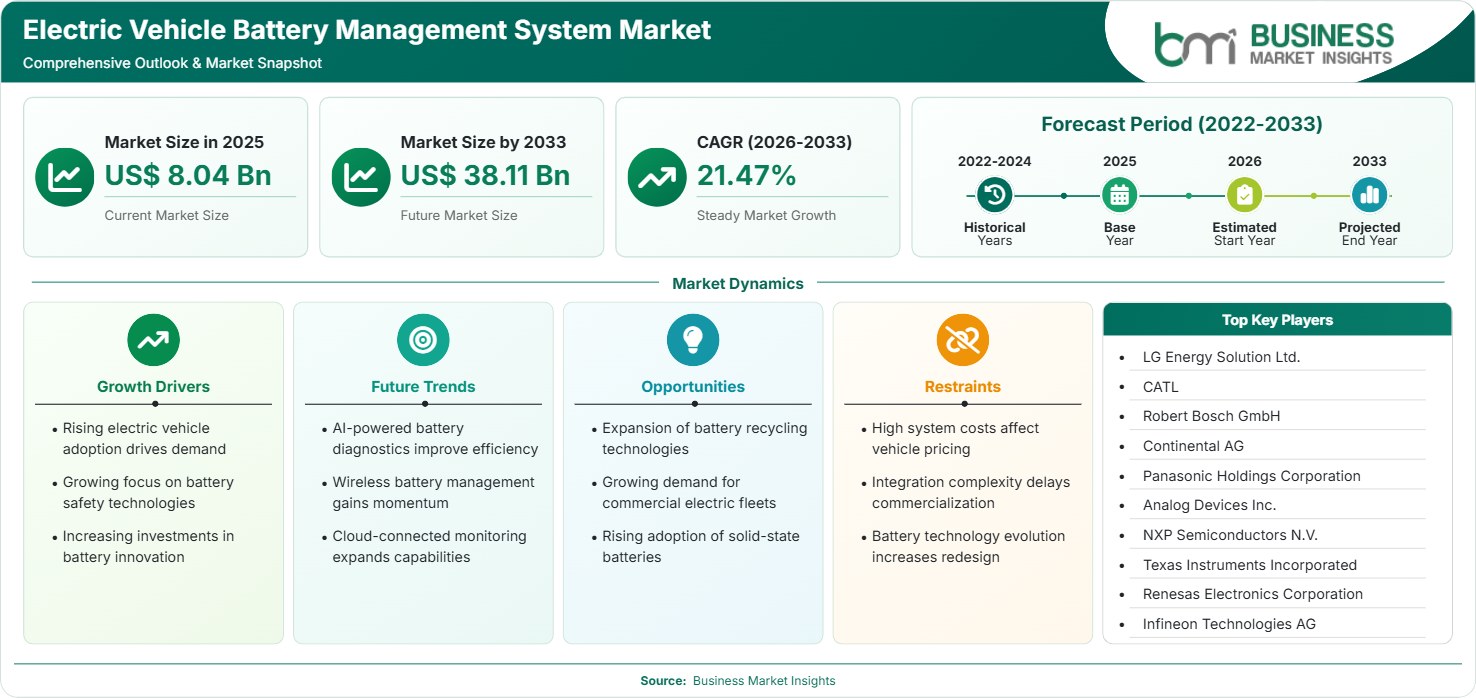
The Electric Vehicle Battery Management System Market size was valued at US$ 8.04 billion in 2025 and is projected to reach US$ 38.11 billion by 2033, growing at a CAGR of 21.47% during 2026–2033. Rising electric vehicle adoption, growing emphasis on battery safety technologies, and increasing investments in battery innovation are accelerating market expansion, while battery recycling technologies and solid-state battery development create strong long-term opportunities.

Report Coverage
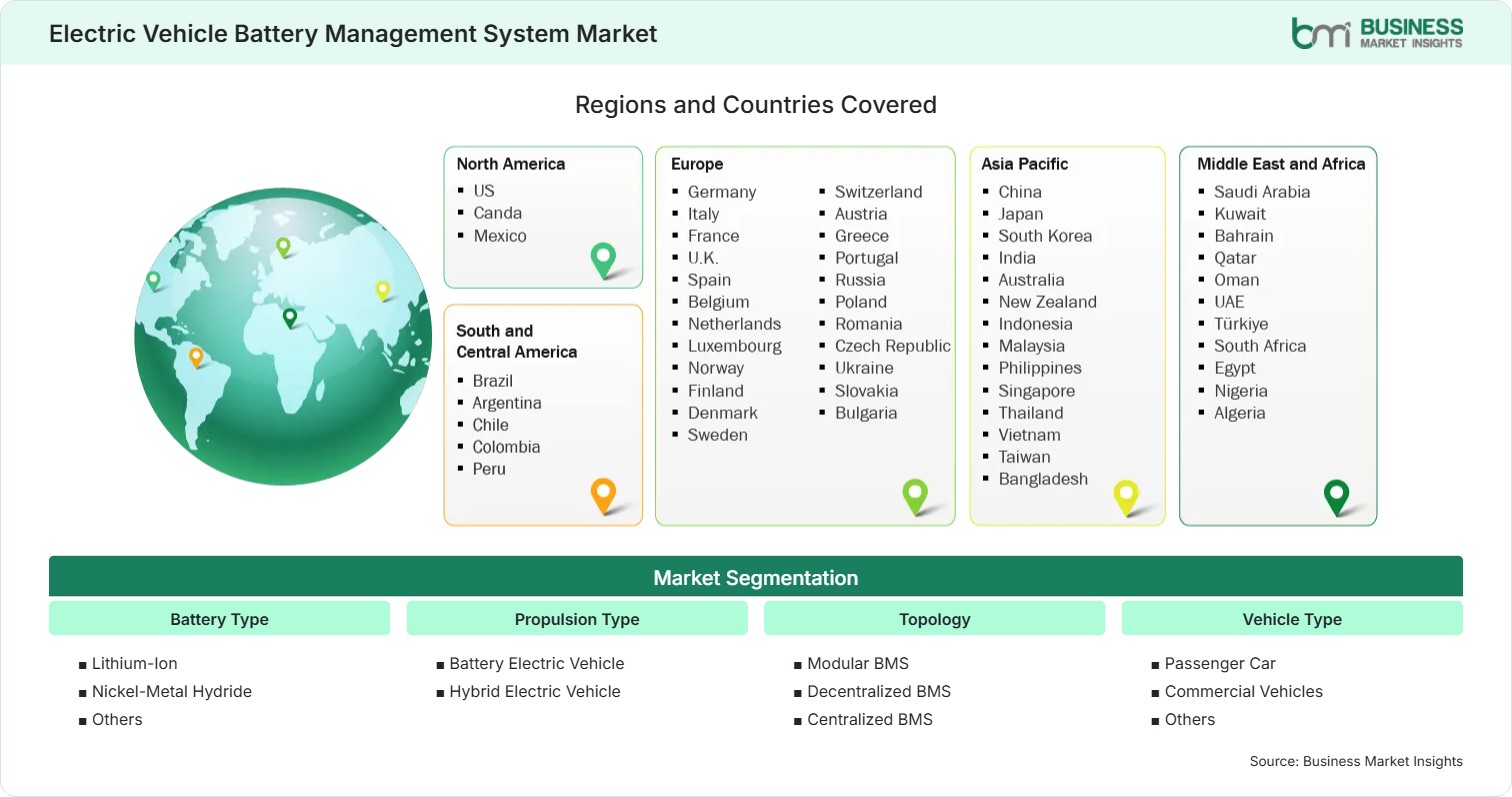
  • Battery Type: Lithium-Ion, Nickel-Metal Hydride, Others
  • Propulsion Type: Battery Electric Vehicle, Hybrid Electric Vehicle
  • Topology: Modular BMS, Decentralized BMS, Centralized BMS
  • Vehicle Type: Passenger Car, Commercial Vehicles, Others
US$ 8.04 Bn Market size in 2025
US$ 38.11 Bn Market Size by 2033
21.47% CAGR, 2026 - 2033
2026-2033 Forecast Period

01 AI Overview

Electric Vehicle Battery Management System Market Summary

  • North America Region: North America holds 23%–26% market share in 2025 and is projected to expand at a CAGR of 20.5%–21.4% during 2026–2033. Expanding electric vehicle production, battery manufacturing investments, and government incentives continue strengthening regional demand. The U.S. leads the regional market through large-scale EV manufacturing, battery gigafactory investments, and advanced semiconductor development, growing at an estimated CAGR of 20.8%–21.8% during 2026–2033.
  • Fastest Growing Region: Asia Pacific accounts for 45%–48% market share in 2025 and is expected to register a CAGR of 22.5%–23.4% during 2026–2033. Rapid electric vehicle adoption, expanding battery manufacturing capacity, supportive government policies, and increasing investments in charging infrastructure continue driving regional growth.
  • Leading Segment: Lithium-Ion (Li-Ion) represents 79%–82% market share in 2025 and is anticipated to grow at a CAGR of 21.6%–22.3% owing to high energy density, long cycle life, and widespread adoption across electric vehicles.
  • High Growth Segment: Battery Electric Vehicle accounts for 64%–67% market share in 2025 and is forecast to expand at a CAGR of 22.4%–23.1% as governments and automakers accelerate the transition toward fully electric mobility.
  • Key Market Opportunity: Expansion of battery recycling technologies, commercialization of solid-state batteries, and increasing deployment of commercial electric fleets are creating significant long-term opportunities for battery management system providers.
  • Major Market Players: LG Energy Solution Ltd., CATL, Robert Bosch GmbH, Continental AG, Panasonic Holdings Corporation, Analog Devices Inc., NXP Semiconductors N.V., Texas Instruments Incorporated, Renesas Electronics Corporation, and Infineon Technologies AG.
02 Strategic Insights

Electric Vehicle Battery Management System Market: Strategic Insights

Electric Vehicle Battery Management System Market Strategic Framework
FREE PDF
Request your free sample
Request free sample
03 Stakeholder View

Key Takeaways

  • Battery management systems have become an essential component of the electric vehicle value chain by improving battery safety, extending battery lifespan, and optimizing charging and discharging performance.
  • Commercial electric fleets and battery electric vehicles present the strongest revenue opportunities as governments strengthen vehicle electrification policies and fleet operators accelerate zero-emission transportation initiatives.
  • Technological innovation is increasingly focused on artificial intelligence-based battery diagnostics, wireless battery management systems, cloud connectivity, and predictive battery health monitoring capabilities.
  • Asia Pacific remains the most attractive investment destination because of its dominant battery manufacturing ecosystem, large electric vehicle production capacity, and expanding semiconductor supply chain.
  • Strategic partnerships among battery manufacturers, semiconductor suppliers, and automotive OEMs continue accelerating product innovation, manufacturing expansion, and commercialization of advanced battery management technologies.
04 Geographic Outlook

Electric Vehicle Battery Management System Market Regional Highlights

North America Electric Vehicle Battery Management System Market

North America accounted for 23%–26% of the Electric Vehicle Battery Management System Market Share in 2025 and is projected to expand at a CAGR of 20.5%–21.4% during 2026–2033. Growing electric vehicle production, investments in domestic battery manufacturing, and supportive government incentives continue strengthening market demand. Increasing adoption of advanced battery monitoring technologies further supports regional expansion.

  • Battery gigafactory investments continue increasing demand for advanced battery management systems across the electric mobility value chain.
  • Automakers are integrating intelligent battery monitoring technologies to improve safety, charging efficiency, and battery lifespan.
  • Government incentives for electric vehicle manufacturing continue supporting regional production capacity expansion.
  • Semiconductor innovation and advanced automotive electronics strengthen technology development across the region.

US Electric Vehicle Battery Management System Market

The U.S. represented 74%–77% of the North American market in 2025 and is expected to grow at a CAGR of 20.8%–21.8% through 2033. Strong EV production, battery manufacturing investments, and expanding charging infrastructure continue supporting nationwide market growth.

  • Domestic battery manufacturing projects continue increasing demand for advanced battery management technologies.
  • Rising electric vehicle adoption supports continuous innovation in battery safety and thermal management.
  • Advanced semiconductor development strengthens intelligent battery monitoring capabilities.
  • Federal incentives encourage investments across electric mobility and battery manufacturing ecosystems.

Europe Electric Vehicle Battery Management System Market

Europe held 24%–27% market share in 2025 and is projected to expand at a CAGR of 20.8%–21.6% through 2026–2033. Germany leads the regional market, while Hungary records the fastest growth due to expanding battery manufacturing investments and increasing electric vehicle production capacity.

  • Stringent emission regulations continue accelerating electric vehicle adoption across European markets.
  • Battery gigafactory investments strengthen regional battery supply chain development.
  • Automotive manufacturers increasingly adopt advanced battery management technologies for vehicle safety.
  • Growing research activities support commercialization of next-generation battery solutions.

Asia Pacific Electric Vehicle Battery Management System Market

Asia Pacific accounted for 45%–48% market share in 2025 and is projected to register the strongest Electric Vehicle Battery Management System Market Forecasts, expanding at a CAGR of 22.5%–23.4% during 2026–2033. China leads regional revenue, while India demonstrates the fastest growth owing to expanding EV production and battery manufacturing investments.

  • Large-scale battery production significantly strengthens demand for battery management systems.
  • Government incentives continue supporting domestic electric vehicle manufacturing and battery localization.
  • Increasing electric vehicle sales accelerate deployment of intelligent battery technologies.
  • Expanding semiconductor manufacturing strengthens regional component supply chains.
  • Growing commercial vehicle electrification creates additional market opportunities.

Rest of World Electric Vehicle Battery Management System Market

The Rest of World region represented 6%–9% market share in 2025 and is anticipated to grow at a CAGR of 20.2%–21.0% through 2033. Brazil leads adoption in South America, while the United Arab Emirates records the fastest growth through increasing investments in sustainable mobility and clean transportation infrastructure.

  • Government electrification initiatives encourage adoption of electric mobility technologies.
  • Investments in charging infrastructure support long-term electric vehicle deployment.
  • Commercial fleet electrification increases demand for advanced battery management systems.
  • Automotive industry diversification strengthens regional market development.
Global Market Geography
FREE PDF
Request your free sample
Request free sample
05 Segment Analysis

Electric Vehicle Battery Management System Market Segmentation

Battery Type

The Battery Type segment represents the largest, with Lithium-Ion (Li-Ion) accounting for 79%–82% market share in 2025 and expanding at a CAGR of 21.6%–22.3%. The Electric Vehicle Battery Management System Market Trends indicate sustained dominance of lithium-ion batteries because of their high energy density, long service life, fast charging capability, and broad adoption across passenger and commercial electric vehicles.

  • Lithium-Ion (Li-Ion): Dominates the market through superior energy efficiency, lightweight design, longer operational life, and compatibility with advanced battery management technologies.
  • Nickel-Metal Hydride: Continues to serve hybrid electric vehicles requiring proven reliability, thermal stability, and dependable performance under varying operating conditions.

Propulsion Type

The Propulsion Type segment continues expanding as vehicle electrification accelerates worldwide. Battery electric vehicles maintain the largest revenue contribution, while hybrid electric vehicles continue supporting transitional electrification strategies across multiple automotive markets.

  • Battery Electric Vehicle: Represents the largest adoption owing to increasing zero-emission vehicle production, government incentives, and growing consumer acceptance of fully electric mobility.
  • Hybrid Electric Vehicle: Maintains stable demand through balanced fuel efficiency, lower emissions, and continued adoption in regions transitioning toward full electrification.

Topology

The Topology segment is evolving as manufacturers optimize battery architecture to improve scalability, safety, diagnostics, and overall battery performance across different electric vehicle platforms.

  • Modular BMS: Widely adopted because it provides design flexibility, easier maintenance, enhanced scalability, and improved fault isolation for large battery packs.
  • Decentralized BMS: Supports improved monitoring accuracy by distributing sensing and communication functions across multiple battery modules.
  • Centralized BMS: Preferred for compact battery systems requiring simplified architecture, lower component count, and cost-effective battery monitoring.

Vehicle Type

The Vehicle Type segment continues expanding alongside rising electric mobility adoption across personal and commercial transportation sectors. Passenger cars dominate current demand, while commercial vehicles continue recording strong adoption through fleet electrification initiatives.

  • Passenger Car: Leads market demand owing to high electric vehicle sales, continuous battery innovation, and increasing consumer preference for zero-emission transportation.
  • Commercial Vehicles: Growing investments in electric buses, delivery vans, trucks, and logistics fleets continue driving demand for advanced battery management systems that maximize operational efficiency and battery reliability.
06 Market Forces

Electric Vehicle Battery Management System Market Dynamics

Key Market Drivers

Rising Electric Vehicle Adoption Drives Demand

The increasing adoption of electric vehicles is a primary factor accelerating the Electric Vehicle Battery Management System Market Growth. Governments worldwide continue promoting zero-emission transportation through incentives, emission regulations, and investments in charging infrastructure, encouraging consumers and fleet operators to transition toward electric mobility. The battery management system ensures proper tracking of the voltage level, temperature, charge level, and balancing of the cells in order to achieve safe and efficient performance. With the increasing production of electric vehicles around the globe, the automotive industry is increasingly adopting battery management technology in order to maximize the life and driving range of the battery.

Growing Focus on Battery Safety Technologies

Battery safety has become a strategic priority for electric vehicle manufacturers as battery capacity and charging speeds continue increasing. Advanced battery management systems help prevent thermal runaway, overcharging, excessive discharge, and cell imbalance through continuous monitoring and intelligent control algorithms. The automobile makers are making huge investments in advanced sensing technology, real time diagnostics and prediction of battery health in order to ensure vehicle safety and regulatory compliance. Awareness among consumers with respect to battery safety and reliability of vehicles enhances the deployment of such technologies in both passenger and commercial electric vehicles.

Increasing Investments in Battery Innovation

Rapid investments in battery technology research and development continue driving innovation across the electric vehicle ecosystem. Battery manufacturers, semiconductor companies, and automotive OEMs are investing in higher-energy-density batteries, advanced battery chemistries, intelligent battery monitoring software, and wireless battery management systems. These advancements enhance the efficiency of charging, battery longevity, heat management, and overall vehicle performance. The development of battery gigafactories, partnerships, and collaboration efforts help in boosting the commercialization of innovative batteries. The continuous investment in battery innovations is projected to boost the demand for battery management systems during the forecast period.

Key Market Opportunities

Expansion of Battery Recycling Technologies

Rapidly expanding electric vehicles are driving the need for battery recycling and the use of second-life batteries. With advanced battery management systems, battery condition, capacity, and life cycle can be monitored easily, facilitating the recycling and reusing of batteries. The Electric Vehicle Battery Management System Market Forecasts indicate that battery lifecycle management will become increasingly important as retired EV batteries enter secondary applications such as stationary energy storage. Manufacturers developing intelligent battery diagnostics and lifecycle management technologies are expected to benefit from expanding commercial opportunities as circular economy initiatives continue strengthening across the automotive industry.

Growing Demand for Commercial Electric Fleets

Commercial transportation companies are rapidly electrifying delivery vans, buses, trucks, and logistics fleets to reduce operating costs and achieve sustainability objectives. Commercial electric vehicles require highly reliable battery management systems capable of supporting frequent charging cycles, long operating hours, and intensive fleet utilization. Moreover, the fleet industry demands more sophisticated battery management solutions in order to enhance maintenance scheduling and increase battery life while minimizing downtime. Growing spends on electrified fleet vehicles, upgraded public transport, and commercial charging stations are likely to drive future growth prospects for suppliers of battery management systems.

Rising Adoption of Solid-State Batteries

The development of solid-state battery technology presents significant opportunities for next-generation battery management systems. Solid-state batteries offer higher energy density, faster charging capability, improved thermal stability, and enhanced operational safety compared with conventional lithium-ion batteries. As manufacturers in the automotive industry continue improving their commercialization processes, there is a need for new algorithms and monitoring technologies that can be used to manage new battery chemistries. Those firms that are currently developing intelligent battery control systems, sensing technologies, and battery management systems should stand to gain from the future implementation of solid state batteries.

Market Restraints and Challenges

High System Costs Affect Vehicle Pricing

Advanced battery management systems incorporate sophisticated electronic components, semiconductor devices, communication modules, thermal sensors, and embedded software, increasing the overall cost of electric vehicle battery systems.

Factor: High hardware and software integration costs.

Impact: Higher costs for the battery management system result in higher prices for the vehicle in general. This may affect affordability in sensitive pricing markets. However, car producers are still looking for ways to minimize the price of the battery management system while ensuring safety.

Integration Complexity Delays Commercialization

Integrating battery management systems with evolving battery chemistries, vehicle control units, charging infrastructure, and thermal management systems requires extensive engineering validation and system optimization.

Factor: Complex integration across multiple vehicle platforms.

Impact: Lengthy validation processes and compatibility testing can delay product commercialization and vehicle launches. Manufacturers must ensure seamless communication between battery packs, electronic control units, power electronics, and charging systems while meeting stringent automotive safety and performance requirements, increasing development timelines and engineering costs.

07 Company Analysis

Competitive Landscape

The competitive landscape of the Market is highly dynamic, with leading battery manufacturers, semiconductor companies, and automotive technology providers focusing on intelligent battery monitoring, wireless battery management systems, advanced power electronics, and battery safety innovations. The Electric Vehicle Battery Management System Market Analysis indicates that companies are strengthening their competitive positions through strategic partnerships with automotive OEMs, investments in battery research, expansion of semiconductor manufacturing capabilities, and development of software-defined battery management platforms. Increasing demand for high-performance electric vehicles and next-generation battery technologies continues encouraging product innovation, manufacturing expansion, and long-term collaboration across the electric mobility value chain.

Company Name

Overview

Products and Services Relevant to this Market

LG Energy Solution Ltd.

Global battery manufacturer specializing in advanced lithium-ion batteries and energy storage technologies for automotive and industrial applications.

EV battery packs, battery management systems, lithium-ion batteries, battery diagnostics, energy storage solutions, and battery safety technologies.

CATL

Leading global battery manufacturer focused on innovative battery technologies supporting electric mobility and renewable energy applications.

EV batteries, intelligent battery management solutions, battery modules, battery packs, energy storage systems, and battery lifecycle management technologies.

Robert Bosch GmbH

International technology company delivering automotive electronics, powertrain solutions, and intelligent vehicle technologies for global automakers.

Battery management electronics, automotive control units, sensors, power electronics, battery monitoring software, and vehicle electrification solutions.

Continental AG

Automotive technology supplier providing advanced electronic systems, vehicle software, and electrification technologies for passenger and commercial vehicles.

Battery management controllers, automotive electronics, thermal management systems, software platforms, and electric mobility technologies.

Panasonic Holdings Corporation

Global electronics manufacturer developing advanced rechargeable batteries and energy management technologies for electric vehicles.

Lithium-ion batteries, battery management technologies, battery modules, energy storage systems, and intelligent charging solutions.

Analog Devices Inc.

Semiconductor company specializing in high-performance analog, mixed-signal, and power management technologies for automotive applications.

Battery monitoring integrated circuits, voltage sensing devices, battery management chipsets, precision measurement technologies, and power management solutions.

NXP Semiconductors N.V.

Global semiconductor company providing secure connectivity and intelligent processing solutions for automotive electrification.

Battery management processors, automotive microcontrollers, communication chips, power management semiconductors, and vehicle networking solutions.

Texas Instruments Incorporated

Semiconductor manufacturer delivering analog and embedded processing technologies for electric vehicle battery management applications.

Battery monitoring ICs, battery protection devices, power management chips, sensing technologies, and embedded automotive processors.

Renesas Electronics Corporation

Semiconductor company focused on automotive microcontrollers, analog devices, and embedded system technologies supporting electric mobility.

Battery management integrated circuits, automotive controllers, sensing devices, embedded software, and power semiconductor solutions.

Infineon Technologies AG

Global semiconductor company delivering power electronics and automotive semiconductor technologies for electrified transportation.

Battery management chips, MOSFETs, microcontrollers, power semiconductors, automotive safety technologies, and battery monitoring solutions.

10 Trust & Transparency

Research Methodology

The market analysis combines proprietary research with secondary data from government agencies, company disclosures, regulatory filings, industry databases and expert interviews. Market estimates are validated through data triangulation, cross-market benchmarking and analyst review.

View Full Research Methodology

11 Questions Answered

Frequently Asked Questions

What does the Electric Vehicle Battery Management System Market Report include?

The Market Report provides comprehensive insights into market size, competitive landscape, segmentation analysis, technological developments, regional outlook, key growth drivers, investment opportunities, recent developments, and long-term industry forecasts.

What are the major future opportunities in this market?

Major opportunities include battery recycling technologies, commercial electric fleet expansion, wireless battery management systems, artificial intelligence-enabled battery diagnostics, and commercialization of solid-state batteries requiring advanced battery monitoring and control technologies.

Why are battery management systems essential for electric vehicles?

Battery management systems continuously monitor battery voltage, current, temperature, and state of charge while balancing battery cells, preventing thermal runaway, optimizing charging performance, extending battery lifespan, and improving overall vehicle safety and efficiency.

Which battery type dominates the market?

Lithium-ion batteries dominate the market because of their superior energy density, longer cycle life, fast-charging capability, lightweight characteristics, and widespread adoption across passenger cars, commercial vehicles, and next-generation electric mobility platforms.

What is driving the Electric Vehicle Battery Management System Market?

The market is primarily driven by increasing electric vehicle adoption, growing emphasis on battery safety, rising investments in battery innovation, and continuous advancements in battery monitoring technologies that improve battery lifespan, operational efficiency, and vehicle reliability.

Access the Full Electric Vehicle Battery Management System Market Report

Get segment-level forecasts, regional estimates, competitive benchmarking, company profiles and downloadable Excel datasets.

Access the full Electric Vehicle Battery Management System Market Report
350 pages PDF & Excel | 2026-08-05