
Electric Vehicle Powertrain Market Outlook: Size, Share, Trends, Growth Analysis, Competitive Landscape & Forecast, 2026-2033

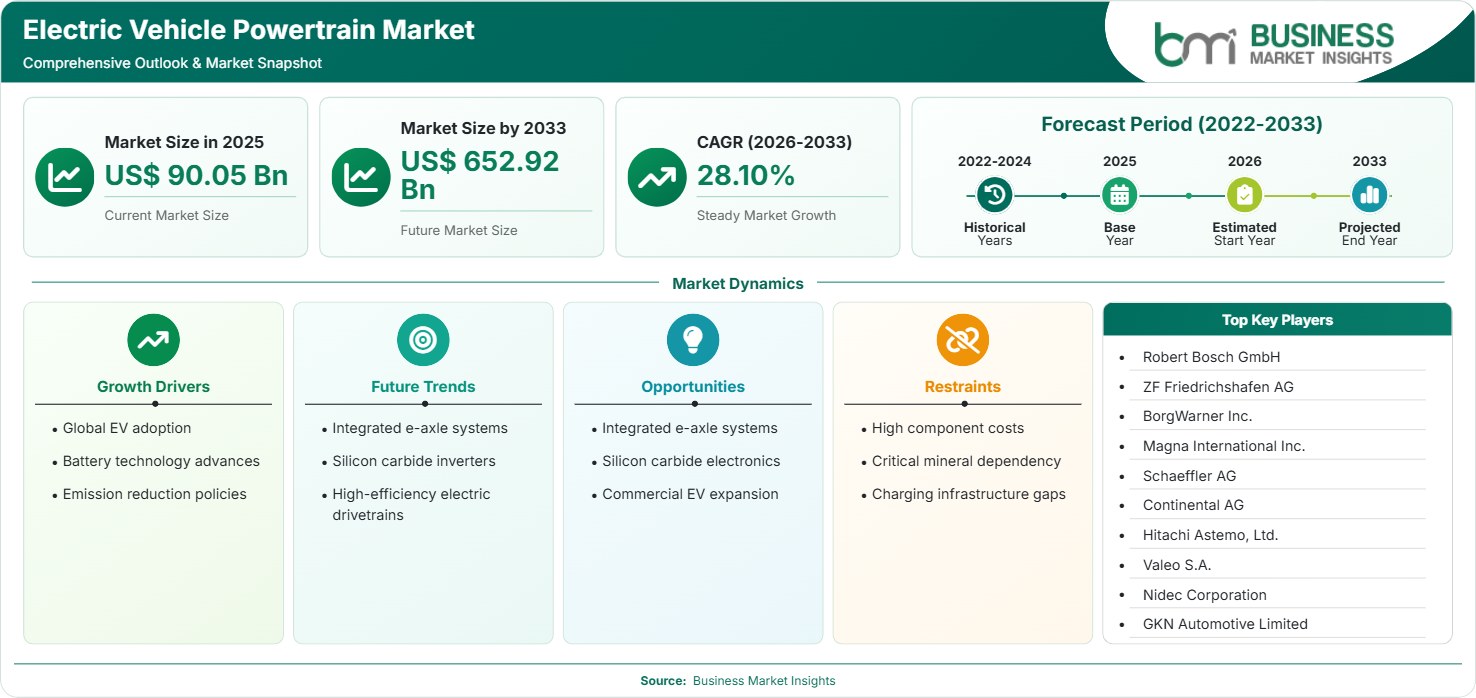
The Electric Vehicle Powertrain Market size was valued at US$ 90.05 billion in 2025 and is projected to reach US$ 652.92 billion by 2033, growing at a CAGR of 28.10% during 2026–2033. Growth is driven by accelerating EV adoption, battery efficiency improvements, emission reduction regulations, and opportunities from integrated e-axle systems, silicon carbide electronics, and expanding commercial electric vehicle deployment.

Report Coverage
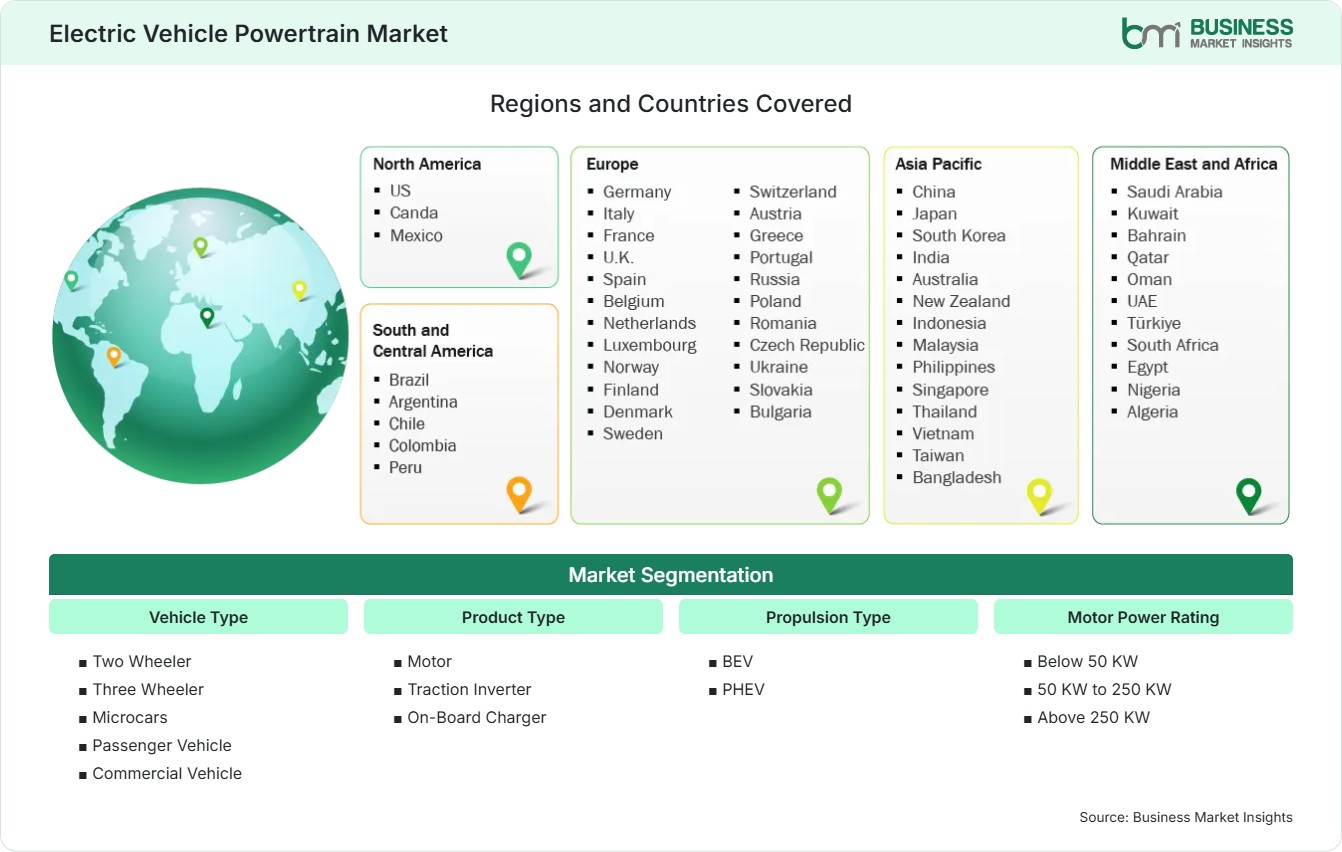
  • Vehicle Type: Two Wheeler, Three Wheeler, Microcars, Passenger Vehicle, Commercial Vehicle
  • Product Type: Motor, Traction Inverter, On-Board Charger
  • Propulsion Type: BEV, PHEV
  • Motor Power Rating: Below 50 KW, 50 KW to 250 KW, Above 250 KW
US$ 90.05 Bn Market size in 2025
US$ 652.92 Bn Market Size by 2033
28.10% CAGR, 2026 - 2033
2026-2033 Forecast Period

01 AI Overview

Electric Vehicle Powertrain Market Summary

  • North America Region: North America holds approximately 24%–27% market share in 2025, expanding at a 27.0%–28.5% CAGR through 2033. Growth is supported by EV manufacturing investments, charging infrastructure development, and increasing commercial fleet conversion. The U.S. market benefits from domestic EV production expansion and advanced automotive supply chains, and is estimated to grow at approximately 27.5%–29.0% CAGR.
  • Fastest Growing Region: Asia Pacific represents around 48%–52% of the global Electric Vehicle Powertrain Market in 2025 and is projected to grow at 29.0%–30.5% CAGR during 2026–2033. Regional expansion is supported by large EV production volumes, battery manufacturing ecosystems, government incentives, and rapid adoption of electric two-wheelers, passenger vehicles, and commercial fleets.
  • Leading Segment: Passenger Vehicle applications account for approximately 58%–62% market share in 2025 and are expected to expand at a 28.0%–29.5% CAGR. Growth is supported by increasing consumer EV adoption, expanding electric SUV availability, declining battery costs, and continuous improvements in powertrain efficiency.
  • High Growth Segment: Commercial Vehicle applications represent approximately 13%–16% market share in 2025 and are forecast to grow at 30.0%–31.5% CAGR. Fleet electrification, urban logistics requirements, regulatory pressure, and lower operating costs are accelerating adoption of electric buses, trucks, and delivery vehicles.
  • Key Market Opportunity: Integrated e-axle platforms, silicon carbide-based power electronics, and commercial EV electrification create significant opportunities by improving drivetrain efficiency, reducing system complexity, and enabling higher-performance electric mobility solutions.
  • Major Market Players: Robert Bosch GmbH, ZF Friedrichshafen AG, BorgWarner Inc., Magna International Inc., Schaeffler AG, Continental AG, Hitachi Astemo, Ltd., Valeo S.A., Nidec Corporation, and GKN Automotive Limited.
02 Strategic Insights

Electric Vehicle Powertrain Market: Strategic Insights

Electric Vehicle Powertrain Market Strategic Framework
FREE PDF
Request your free sample
Request free sample
03 Stakeholder View

Key Takeaways

  • The EV powertrain ecosystem is shifting toward integrated architectures combining motors, inverters, and transmission components into compact systems that improve efficiency, reduce weight, and simplify vehicle manufacturing.
  • Passenger vehicles remain the largest demand contributor, while commercial electrification presents stronger long-term opportunities.
  • Silicon carbide semiconductors, advanced motor designs, and software-controlled power management systems are becoming critical innovation areas.
  • Asia Pacific represents the strongest investment opportunity due to its dominant EV manufacturing base, battery supply chain strength, and large-scale adoption of electric two-wheelers and passenger vehicles.
  • Automotive suppliers are increasing strategic collaborations, technology partnerships, and production investments to secure positions in the rapidly expanding EV component ecosystem.
  • Supply chain localization for critical components, including power electronics, magnets, and semiconductor systems, is becoming a strategic priority for manufacturers seeking reduced dependency risks.
04 Geographic Outlook

Electric Vehicle Powertrain Market Regional Highlights

North America Electric Vehicle Powertrain Market

North America accounted for approximately 24%–27% of the global market in 2025 and is projected to expand at a 27.0%–28.5% CAGR from 2026 to 2033. The region benefits from increasing EV production capacity, government electrification programs, expanding charging infrastructure, and investments from automotive manufacturers. The Electric Vehicle Powertrain Market share remains concentrated among established automotive suppliers, while demand is increasing for advanced motors, inverters, and integrated electric drive systems.

  • The United States continues attracting EV manufacturing investments through battery supply chain development, domestic production incentives, and expansion of electric vehicle assembly facilities.
  • Automotive suppliers are increasing investments in local power electronics production to improve supply resilience and reduce dependence on imported components.
  • Commercial fleet electrification is gaining momentum as logistics operators adopt electric delivery vehicles to reduce operating expenses and meet sustainability targets.
  • Advanced semiconductor adoption, particularly silicon carbide technologies, is supporting improvements in inverter efficiency, thermal performance, and vehicle driving range.

US Electric Vehicle Powertrain Market

The United States represented approximately 21%–24% of global revenue in 2025 and is expected to grow at a 27.5%–29.0% CAGR during 2026–2033. The country remains a key market due to strong automotive manufacturing capabilities, increasing electric passenger vehicle adoption, and growing investments in battery and component ecosystems. The Electric Vehicle Powertrain Market growth in the U.S. is supported by technology innovation, fleet electrification, and expanding domestic EV supply chains.

  • Automakers and suppliers are establishing localized manufacturing facilities for electric motors, inverters, and integrated drive units to support rising domestic EV production.
  • Government emission reduction initiatives and corporate sustainability commitments are accelerating adoption of electric buses, delivery vehicles, and commercial fleets.
  • Premium electric vehicle adoption is encouraging demand for high-performance powertrain systems with improved efficiency and enhanced driving characteristics.

Europe Electric Vehicle Powertrain Market

Europe accounted for approximately 22%–25% of the global market in 2025 and is forecast to grow at a 26.0%–27.5% CAGR between 2026 and 2033. Germany, France, the United Kingdom, and Italy remain major contributors due to strong automotive manufacturing capabilities and regulatory support for vehicle electrification. Germany is estimated to grow at 26.5%–28.0% CAGR, while the United Kingdom is expected to expand at 25.5%–27.0% CAGR due to increasing EV adoption and supply chain investments during electric vehicle powertrain market forecasts.

  • European automakers are accelerating electric platform development to comply with stringent carbon emission targets and strengthen competitiveness in global EV markets.
  • Germany remains a major powertrain innovation hub due to its advanced automotive engineering ecosystem and supplier network.
  • Demand for high-efficiency electric drive units is increasing as manufacturers focus on improving vehicle range and reducing energy consumption.
  • Battery-electric vehicle production expansion is encouraging investments in regional motor, inverter, and power electronics manufacturing.

Asia Pacific Electric Vehicle Powertrain Market

Asia Pacific dominated the global market with approximately 48%–52% share in 2025 and is expected to achieve the fastest growth rate of 29.0%–30.5% CAGR during 2026–2033. China, Japan, South Korea, and India are driving regional expansion through large-scale EV manufacturing, battery ecosystem development, and government-supported electrification initiatives. China is projected to grow at 29.5%–31.0% CAGR, while India is expected to expand at 31.0%–32.5% CAGR due to rapid electric mobility adoption.

  • China maintains global leadership in EV production and component manufacturing, supported by extensive battery, motor, and power electronics supply chains.
  • India is witnessing increased adoption of electric two-wheelers and commercial vehicles, supported by government incentives and domestic manufacturing programs.
  • Japanese and South Korean companies continue advancing motor efficiency, semiconductor technology, and compact electric drive solutions.
  • Regional suppliers are scaling production capacity to meet increasing demand from domestic and international automotive manufacturers.
  • Expanding EV exports from Asian manufacturing hubs are creating additional opportunities for powertrain component suppliers.

Rest of World Electric Vehicle Powertrain Market

Latin America, the Middle East, and Africa collectively accounted for approximately 5%–8% of global revenue in 2025 and are expected to grow at a 25.0%–27.0% CAGR between 2026 and 2033. Brazil, Mexico, the UAE, Saudi Arabia, and South Africa represent emerging opportunities as governments and businesses explore transportation electrification. The Electric Vehicle Powertrain Market trends in these regions are influenced by urban mobility requirements, fleet electrification initiatives, and increasing investments in sustainable transportation infrastructure.

  • Mexico is benefiting from its automotive manufacturing ecosystem and proximity to North American EV supply chains, supporting component production opportunities.
  • Brazil is exploring electric mobility solutions across passenger and commercial transportation segments due to urban sustainability initiatives.
  • Middle Eastern countries are investing in clean transportation projects as part of broader economic diversification and emissions reduction strategies.
  • African markets present long-term opportunities through electric public transport adoption and renewable energy integration.
  • Fleet operators across developing economies are evaluating electric commercial vehicles to reduce fuel costs and improve operational efficiency.
Global Market Geography
FREE PDF
Request your free sample
Request free sample
05 Segment Analysis

Electric Vehicle Powertrain Market Segmentation

Vehicle Type

Vehicle Type is the largest segment, holding around 65%–68% of the global market share in 2025 and growing at a CAGR of 28.0%–28.8% during the forecast period 2026 to 2034. Increasing penetration of electric vehicles for passenger mobility, commercial vehicles, and two-wheelers is boosting the demand for electric motors, traction inverters, and integrated powertrain systems.

  • Two Wheeler: Electric two-wheelers are experiencing rapid adoption due to lower ownership costs, urban mobility requirements, and government incentives. Manufacturers are focusing on compact motors and efficient controllers.
  • Three Wheeler: Electric three-wheelers are expanding in emerging markets due to commercial transport demand, improved battery economics, and suitability for short-distance passenger and cargo applications.
  • Microcars: Microcars are gaining attention in urban markets where compact electric mobility solutions address congestion, parking limitations, and affordable transportation requirements.
  • Passenger Vehicle: Passenger vehicles represent the dominant application area due to increasing consumer EV adoption, expanding model availability, and investments in dedicated electric vehicle platforms.
    • Hatchback/Sedan: Electric hatchbacks and sedans continue supporting urban electrification through efficient designs, lower operating costs, and growing consumer preference for environmentally responsible mobility solutions.
    • SUV: Electric SUVs are gaining strong momentum due to higher consumer acceptance, premium positioning, improved battery range, and increasing availability from global automotive manufacturers.
  • Commercial Vehicle: Commercial vehicles represent a high-growth application due to fleet electrification initiatives, operational cost savings, and regulatory pressure for lower-emission transportation.
    • Light Duty Vehicle: Electric light-duty vehicles are expanding across delivery, logistics, and urban transport applications due to favorable operating economics and increasing charging infrastructure availability.
    • Medium & Heavy Duty Vehicle: Electric medium and heavy-duty vehicles are gaining traction through advancements in high-power motors, charging systems, and fleet-focused electrification strategies.

Product Type

Product Type accounted for approximately 70%–73% of the overall component demand in 2025 and is projected to grow at a 28.5%–29.5% CAGR through 2034. Increasing powertrain integration, efficiency requirements, and demand for higher vehicle performance are driving innovation across motors, traction inverters, and charging systems in the electric vehicle powertrain market.

  • Motor: Electric motors remain a critical powertrain component as manufacturers prioritize higher efficiency, reduced weight, and improved performance. Permanent magnet and advanced motor technologies are supporting next-generation EV platforms.
    • Motor Stator: Stators are evolving through improved winding technologies, optimized magnetic designs, and manufacturing advancements aimed at increasing efficiency and reducing energy losses.
    • Rotor: Rotor technology development focuses on enhanced torque output, improved thermal management, and optimized materials to support higher-performance electric vehicles.
    • Shaft and Bearing: Shaft and bearing systems are advancing through durability improvements, friction reduction technologies, and designs capable of supporting higher-speed electric motors.
    • Permanent Magnet: Permanent magnet systems continue gaining adoption due to high power density, efficiency advantages, and suitability for compact electric vehicle powertrain architectures.
    • Casing: Motor casing innovations focus on lightweight materials, improved heat dissipation, and structural protection for enhanced powertrain reliability.
    • Wiring & Connectors: Wiring and connector technologies are advancing through higher voltage capabilities, improved safety standards, and optimized electrical performance for modern EV systems.
  • Traction Inverter: Traction inverters are becoming increasingly important due to their role in energy conversion efficiency and vehicle performance. Semiconductor improvements are enabling higher power density and reduced losses.
    • IGBT/SiC Power Module: Silicon carbide and advanced power modules are improving inverter efficiency, thermal performance, and charging capabilities while supporting next-generation electric mobility platforms.
    • Microcontroller: Microcontrollers enable intelligent power management, real-time control, and communication between vehicle systems, supporting improved efficiency and driving performance.
    • Sensing Element: Sensing elements improve powertrain monitoring through accurate measurement of temperature, current, voltage, and operational conditions.
  • On-Board Charger: On-board chargers are advancing through higher charging capacity, improved efficiency, and compact designs that support faster and more convenient EV charging experiences.

Propulsion Type

Propulsion Type segmentation is estimated to hold around 88%-91% of the market share in 2025, driven by the rising preference for battery-operated mobility solutions. This segment is projected to register a CAGR of 28.3%-29.2% during 2026 to 2034.

  • BEV: Battery Electric Vehicles represent the leading propulsion category due to zero-emission operation, improving battery technology, and increasing government support for electrified transportation.
  • PHEV: Plug-in Hybrid Electric Vehicles continue supporting transitional electrification strategies by combining electric driving capability with conventional power systems for extended mobility flexibility.

Motor Power Rating

The Motor Power Rating Segmentation is driven by the growing need for diversification across various vehicles. This market segment constitutes an estimated 75%-78% of the overall market demand in 2025 and is forecasted to grow at a CAGR of 28.0%-28.9% till 2034. Passenger cars, commercial vehicles, and high-performance electric vehicles will require different motor power ratings.

  • Below 50 KW: Low-power motors are widely used in electric two-wheelers, three-wheelers, and compact mobility applications requiring efficiency and affordability.
  • 50 kW to 250 kW: Mid-range power systems represent a major adoption area due to widespread usage in passenger vehicles, urban EVs, and light commercial electric platforms.
  • Above 250 kW: High-power systems support premium EVs, performance vehicles, and heavy-duty applications requiring increased torque, acceleration, and load-handling capabilities.
06 Market Forces

Electric Vehicle Powertrain Market Dynamics

Key Market Drivers

Accelerating Global Electric Vehicle Adoption

The rapid shift from conventional ICE cars to electric cars is the primary driver of growth in the electric powertrain ecosystem. Higher production volumes of electric vehicles are generating higher demand for motors, traction converters, onboard chargers, and drive modules. Factors like the increased development of EV platforms by automobile manufacturers and the increase in production capabilities by suppliers have contributed to the Electric Vehicle Powertrain Market growth.

Advancements in Battery and Powertrain Efficiency Technologies

Advancements in battery energy density, chargeability, and power electronics are enhancing the evolution of high-performance electric powertrain systems. Silicon carbide-based semiconductors, high-end motors, and electric drive systems contribute to high powertrain performance and low energy loss. All these technological advancements are shaping the Electric Vehicle Powertrain market trends by encouraging the use of small-sized, energy-efficient components.

Stringent Emission Reduction Policies and Electrification Targets

Climate change commitments worldwide, along with vehicle emission restrictions, are pushing automakers to accelerate electrification initiatives. Increasingly stringent fuel efficiency norms and carbon reduction policies being implemented by the authorities in Europe, North America, and Asia Pacific regions have paved the way for electric vehicles. Electrification plans being rolled out by the countries are helping the powertrain technology providers immensely.

Key Market Opportunities

Integration of Advanced E-Axle Powertrain Systems

The integrated e-axle offers significant potential as car makers search for easy, efficient, and lightweight electric drive trains. Combining an electric motor, power electronics, and the transmission system into a single unit simplifies the car's design and improves efficiency and performance. The e-axle manufacturers have been focusing on producing e-axles to fit a wide variety of cars.

Expansion of Silicon Carbide-Based Power Electronics

The introduction of silicon carbide semiconductors has created many possibilities due to their ability to improve inverter efficiency, reduce energy loss, and enable fast charging. When compared with traditional semiconductors, silicon carbide semiconductors have high voltage ratings and good thermal properties; therefore, they are suitable for use in electric cars. Electric car manufacturers prefer to use silicon carbide power modules for their improved performance.

Commercial Electric Vehicle Electrification Expansion

Electrification of commercial vehicles is an excellent business opportunity for those interested in low-cost operations and compliance with emissions standards. According to Electric Vehicle Powertrain Market Forecasts, there is growing potential in commercial vehicles due to advances in battery technology and the expansion of charging stations. Companies that provide high-quality products, such as high-torque motors and inverters, can take advantage of this business opportunity.

Market Restraints and Challenges

High Component Costs and Manufacturing Complexity

Factor: The use of highly advanced components for electric vehicle powertrains like permanent magnets, silicon carbide modules, high-efficiency motors, and electronics has high manufacturing costs. Impact: The high cost of components raises the vehicle's price, hindering consumers' ability to purchase it due to price sensitivity.

Dependency on Critical Minerals and Raw Material Availability

Factor: Production of electric vehicle powertrains involves crucial materials including rare earth metals, lithium, cobalt, and nickel utilized in motors, batteries, and electronics.

Impact: Issues related to the supply of these materials, including their cost volatility and political risks, could create problems with respect to their availability and affect the costs of manufacture.

07 Company Analysis

Competitive Landscape

The Electric Vehicle Powertrain Market analysis indicates a very competitive environment resulting from the involvement of automotive parts makers, technology providers, and parts manufacturers in developing electrification technologies.

Company Name

Overview

Products and Services relevant to this market

Robert Bosch GmbH

Global automotive technology supplier with extensive expertise in electrification and vehicle systems.

Electric motors, power electronics, inverters, e-mobility solutions, and integrated EV powertrain components.

ZF Friedrichshafen AG

Automotive technology company specializing in driveline, chassis, and electrification technologies.

Electric drives, e-axles, power electronics, transmissions, and electric mobility systems.

BorgWarner Inc.

Global propulsion technology supplier focused on electrification and advanced drivetrain solutions.

Electric motors, battery systems, inverters, e-propulsion systems, and thermal management technologies.

Magna International Inc.

Automotive supplier providing complete vehicle systems and electrification technologies.

Electric powertrain systems, e-drives, battery enclosures, and integrated vehicle solutions.

Schaeffler AG

Automotive and industrial supplier developing efficient mobility and electrification solutions.

Electric motors, hybrid modules, bearings, transmission components, and electric drive systems.

Continental AG

Technology company offering automotive electronics and electrification solutions.

Electric drive systems, power electronics, sensors, controllers, and EV system components.

Hitachi Astemo, Ltd.

Automotive technology supplier focused on advanced mobility and electrification products.

Electric motors, inverters, power control units, and EV drivetrain technologies.

Valeo S.A.

Global mobility technology company specializing in intelligent and sustainable vehicle systems.

Electric motors, charging systems, power electronics, thermal systems, and electrification components.

Nidec Corporation

Motor technology specialist supplying high-efficiency electric drive solutions globally.

EV traction motors, motor systems, inverters, and precision electric mobility components.

GKN Automotive Limited

Automotive driveline supplier with expertise in electric propulsion technologies.

E-axles, electric drive units, AWD systems, and integrated powertrain technologies.

08 Industry Activity

Recent Developments

June 2026

Uno Minda received approval from India's Ministry of Heavy Industries for Hong Kong-based Inovance Automotive's investment in their EV joint venture. The venture will manufacture high-voltage EV powertrain components, including e-Axles, inverters, motors, and combined charging units, strengthening domestic electric vehicle component manufacturing.

May 2026

Musashi India and Kinetic Green signed a letter of intent for the supply of a side-mounted e-Axle system integrating the motor, gearbox, and controller for Kinetic Green's upcoming electric two-wheelers. The partnership supports the development of more efficient and durable electric drivetrains with pilot production scheduled for late 2026.

May 2026

Hyundai Mobis developed a 160-kW Power Electric (PE) system for mass-market electric vehicles and advanced development of a 120-kW version for compact mobility vehicles, expanding its integrated EV powertrain portfolio across multiple vehicle segments.

March 2026

Valeo inaugurated a new manufacturing line in Pune, India, for its integrated 3-in-1 e-Axle, combining the electric motor, inverter, and reducer into a compact powertrain. The locally manufactured system will supply Mahindra's Born Electric platform, strengthening domestic electric vehicle powertrain production.

10 Trust & Transparency

Research Methodology

The market analysis combines proprietary research with secondary data from government agencies, company disclosures, regulatory filings, industry databases and expert interviews. Market estimates are validated through data triangulation, cross-market benchmarking and analyst review.

View Full Research Methodology

11 Questions Answered

Frequently Asked Questions

What role do e-axle systems play in EV development?

Integration of various drivetrain parts helps to achieve greater efficiency, reduces vehicle complexity, and makes adoption of new EV platforms easier.

How are companies reducing electric powertrain costs?

Companies optimize production, design integrated systems, localize their operations, choose less expensive materials, and invest in manufacturing automation.

Why are silicon carbide components important for EV powertrains?

Silicon carbide electronics increase energy efficiency, thermal properties, and charging capacity and help to design EVs with more mileage and better performance.

Which vehicle segment offers the strongest growth potential?

In the electric vehicle powertrain market report, commercial electric vehicles are regarded as one of the biggest opportunities for the EV powertrains market due to fleet electrification programs, economic benefits, regulations, and growing demand for sustainable logistics.

What is driving demand for electric vehicle powertrain systems?

The factors that influence the demand for electric motors, inverters, and powertrains include the growing popularity of EVs, environmental regulations, batteries, and investment in electrification infrastructure.

Access the Full Electric Vehicle Powertrain Market Report

Get segment-level forecasts, regional estimates, competitive benchmarking, company profiles and downloadable Excel datasets.

Access the full Electric Vehicle Powertrain Market Report
350 pages PDF & Excel | 2026-07-31