
Luxury Electric Vehicle Market Outlook: Size, Share, Trends, Growth Analysis, Competitive Landscape & Forecast, 2026-2033

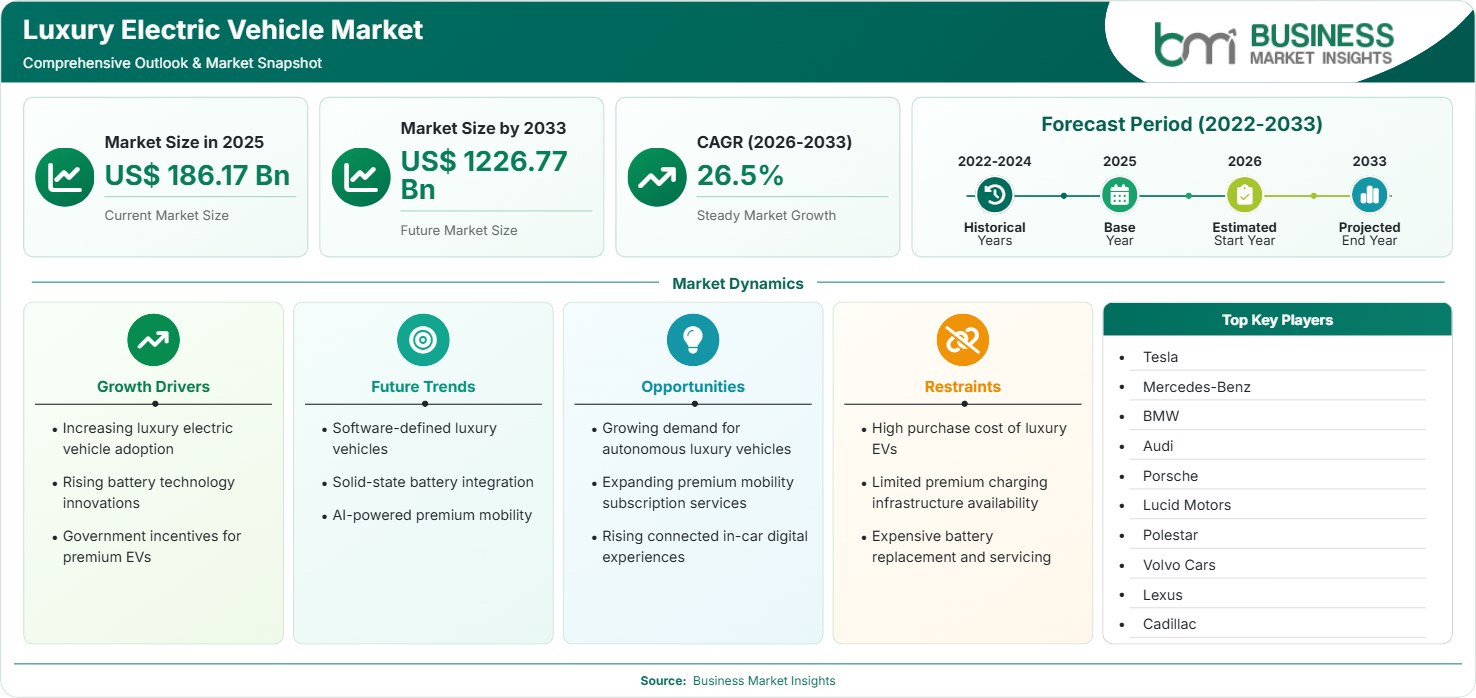
The Luxury Electric Vehicle Market size was valued at US$ 186.17 Billion in 2025 and is projected to reach US$ 1226.77 Billion by 2033, growing at a CAGR of 26.5% from 2026 to 2033. Increasing premium EV adoption, battery technology innovations, government incentives, autonomous driving development, connected mobility services, and digital in-car experiences are accelerating market expansion.

Report Coverage
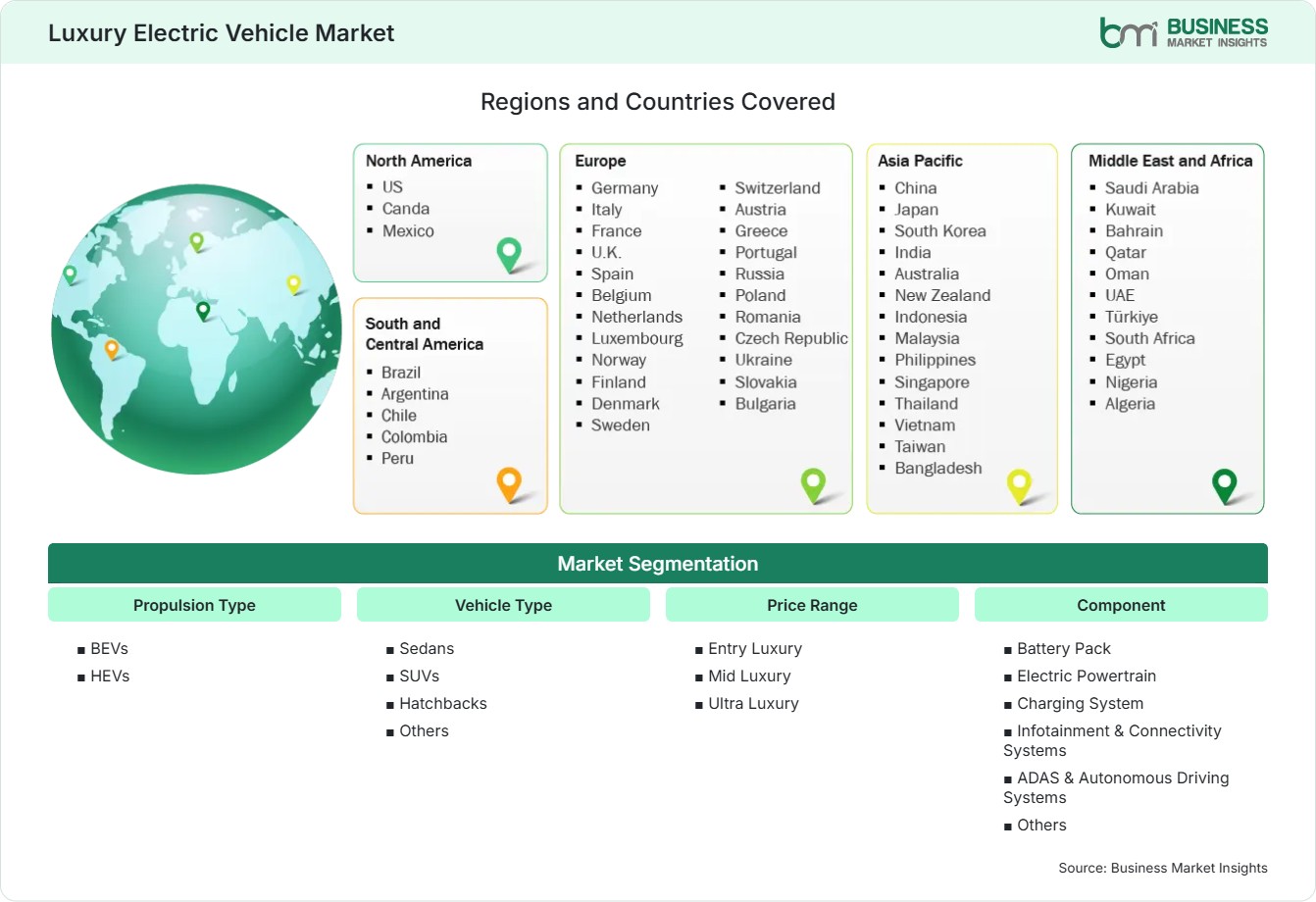
  • Propulsion Type: BEVs, HEVs
  • Vehicle Type: Sedans, SUVs, Hatchbacks, Others
  • Price Range: Entry Luxury, Mid Luxury, Ultra Luxury
  • Component: Battery Pack, Electric Powertrain, Charging System, Infotainment & Connectivity Systems, ADAS & Autonomous Driving Systems, Others
US$ 186.17 Bn Market size in 2025
US$ 1226.77 Bn Market Size by 2033
26.5% CAGR, 2026 - 2033
2026-2033 Forecast Period

01 AI Overview

Luxury Electric Vehicle Market Summary

  • North America Region: North America holds a market share of 32%–35% in 2025 and is projected to grow at a CAGR of 25.8%–26.7% during 2026–2033. Growth is supported by premium EV demand, charging infrastructure investments, technology adoption, and consumer preference for advanced mobility solutions. The US market is expanding at a CAGR of 26.0%–26.9% due to luxury EV launches, battery innovation, and premium automotive electrification.
  • Fastest Growing Region: Asia Pacific accounts for 34%–37% market share in 2025 and is expected to grow at a CAGR of 27.0%–27.9% during 2026–2033. Growth is driven by luxury vehicle demand, EV manufacturing expansion, government electrification programs, and increasing adoption of connected automotive technologies.
  • Leading Segment: Battery Electric Vehicles (BEVs) represent 68%–72% market share in 2025 and are projected to grow at a CAGR of 27.2%–28.0% during 2026–2033. Adoption is supported by zero-emission regulations, advanced battery systems, improved driving range, and increasing premium EV investments.
  • High Growth Segment: SUVs account for 45%–48% share in 2025 and are estimated to grow at a CAGR of 28.0%–28.8% through 2026–2033. Growth is supported by consumer preference for spacious luxury vehicles, premium features, and electric SUV launches.
  • Key Market Opportunity: Autonomous luxury vehicles connected mobility platforms, premium subscription models, and advanced digital ecosystems are creating opportunities for manufacturers targeting high-value electric mobility consumers.
  • Major Market Players: Tesla, Mercedes-Benz, BMW, Audi, Porsche, Lucid Motors, Polestar, Volvo Cars, Lexus, Cadillac.
02 Strategic Insights

Luxury Electric Vehicle Market: Strategic Insights

Luxury Electric Vehicle Market Strategic Framework
FREE PDF
Request your free sample
Request free sample
03 Stakeholder View

Key Takeaways

  • The market ecosystem includes luxury automakers, battery suppliers, charging infrastructure providers, software developers, technology companies, and premium mobility service operators.
  • Battery electric vehicles and electric SUVs represent high-growth opportunities due to consumer demand for extended range, premium performance, and sustainable transportation solutions.
  • Innovation priorities include solid-state batteries, autonomous driving systems, artificial intelligence integration, advanced infotainment platforms, and connected vehicle ecosystems.
  • Asia Pacific offers strong investment potential due to expanding luxury vehicle demand, EV manufacturing capabilities, and supportive electrification policies.
  • Automakers are pursuing partnerships, technology collaborations, and strategic investments to accelerate premium EV development and strengthen market positions.
  • Future competitiveness will depend on battery efficiency, charging availability, software capabilities, and delivering differentiated luxury ownership experiences.
04 Geographic Outlook

Luxury Electric Vehicle Market Regional Highlights

North America Luxury Electric Vehicle Market

North America accounted for a 32%–35% share of the Luxury Electric Vehicle Market in 2025 and is projected to grow at a CAGR of 25.8%–26.7% during 2026–2033. The region benefits from strong premium vehicle demand, expanding charging networks, advanced automotive technologies, and increasing consumer preference for sustainable luxury mobility. The United States remains the largest contributor due to high EV adoption, technology innovation, and strong presence of luxury automotive brands.

  • The United States drives regional expansion through premium EV adoption, battery investments, and advanced automotive technology development.
  • Canada is increasing luxury EV demand through clean transportation initiatives, charging infrastructure development, and sustainable mobility programs.
  • Automakers are expanding premium electric vehicle portfolios to address rising demand for high-performance sustainable transportation.
  • Charging infrastructure investments are improving consumer confidence and supporting long-distance luxury EV adoption.

US Luxury Electric Vehicle Market

The US represented a 29%–32% share of the Luxury Electric Vehicle Market in 2025 and is expected to grow at a CAGR of 26.0%–26.9% during 2026–2033. Market expansion is supported by premium EV launches, government support programs, battery manufacturing investments, and increasing demand for connected automotive experiences. Luxury brands are strengthening their US presence through advanced electric models and technology-driven features.

  • Premium electric vehicle adoption is increasing due to rising consumer interest in sustainable luxury transportation solutions.
  • Domestic battery production investments are supporting availability of advanced electric powertrain technologies.
  • Luxury automakers are introducing software-enabled vehicles with enhanced connectivity and autonomous capabilities.
  • Expanding charging infrastructure is reducing barriers associated with premium EV ownership.

Europe Luxury Electric Vehicle Market

Europe held a 24%–27% share of the Luxury Electric Vehicle Market in 2025 and is forecast to grow at a CAGR of 25.2%–26.1% from 2026–2033. The region benefits from strict emission regulations, strong luxury automotive heritage, and rapid electrification initiatives. Germany, the United Kingdom, Norway, and France represent major markets due to premium vehicle demand and advanced EV infrastructure development.

  • Germany supports growth through luxury automotive manufacturing, EV innovation, and premium electric vehicle production.
  • Norway demonstrates strong adoption through electric mobility incentives and high consumer acceptance of premium EVs.
  • The United Kingdom is expanding demand through sustainability targets and luxury vehicle electrification strategies.
  • France is increasing adoption through government electrification programs and charging network expansion.

Asia Pacific Luxury Electric Vehicle Market

Asia Pacific captured a 34%–37% share of the Luxury Electric Vehicle Market in 2025 and is expected to achieve a CAGR of 27.0%–27.9% during 2026–2033. The region represents the fastest-growing market due to increasing luxury vehicle demand, EV manufacturing expansion, battery technology leadership, and government electrification policies. China, Japan, South Korea, and Singapore are major contributors supporting regional growth.

  • China dominates regional expansion through luxury EV production, battery manufacturing leadership, and strong domestic electric vehicle demand.
  • Japan is advancing premium EV adoption through automotive innovation, technology development, and established luxury brands.
  • South Korea supports growth through battery technology expertise and electric vehicle manufacturing capabilities.
  • Singapore is encouraging luxury EV adoption through sustainable transportation initiatives and charging infrastructure development.

Rest of World Luxury Electric Vehicle Market

Rest of World represented a 4%–7% share of the Luxury Electric Vehicle Market in 2025 and is projected to grow at a CAGR of 24.8%–25.7% during 2026–2033. South America and the Middle East & Africa are emerging through premium mobility demand, urban development, and sustainable transportation investments. Brazil, UAE, Saudi Arabia, and South Africa represent developing opportunities.

South American markets are gradually adopting premium electric vehicles through environmental initiatives and increasing interest in advanced mobility solutions. Middle Eastern countries are investing in luxury EV infrastructure and sustainable transportation projects.

  • Brazil is developing luxury EV demand through urban mobility improvements and increasing environmental awareness.
  • The United Arab Emirates is expanding premium EV adoption through smart city projects and sustainability programs.
  • Saudi Arabia is investing in electric mobility infrastructure and premium automotive market development.
  • South Africa is emerging through EV awareness, renewable energy integration, and sustainable transportation initiatives.
Global Market Geography
FREE PDF
Request your free sample
Request free sample
05 Segment Analysis

Luxury Electric Vehicle Market Segmentation

Propulsion Type

Propulsion Type segmentation includes BEVs and HEVs. BEVs represented the leading segment in 2025 due to increasing demand for zero-emission luxury vehicles, advanced battery technology, and stronger regulatory support for electrification. Premium automakers are expanding battery electric portfolios with improved range, performance, and digital capabilities. HEVs continue supporting transition strategies in regions with developing charging infrastructure. The segment is projected to grow at a CAGR of 27.2%–28.0% during 2026–2033, supported by battery innovation, sustainability goals, and premium EV adoption.

  • BEVs: Battery electric vehicles are gaining strong adoption through improved battery efficiency, extended driving range, advanced software integration, and increasing luxury consumer preference.
  • HEVs: Hybrid electric vehicles support transitional electrification strategies by combining conventional engines with electric systems for improved efficiency and reduced emissions.

Vehicle Type

Vehicle Type segmentation includes Sedans, SUVs, and Hatchbacks. SUVs represented the fastest-growing vehicle category in Luxury Electric Vehicle Market share 2025 due to consumer preference for spacious premium vehicles, enhanced performance, and advanced electric powertrains. Sedans maintain demand among luxury customers seeking efficiency, comfort, and premium driving experiences. Hatchbacks serve urban luxury mobility requirements. The vehicle type segment is expected to grow at a CAGR of 28.0%–28.8% during 2026–2033, driven by product diversification and expanding luxury EV offerings.

  • Sedans: Luxury sedans provide premium comfort, aerodynamic efficiency, advanced technology features, and performance-oriented electric mobility experiences.
  • SUVs: Electric SUVs are expanding rapidly due to spacious designs, higher consumer demand, premium features, and increasing manufacturer launches.
  • Hatchbacks: Luxury electric hatchbacks support urban mobility through compact designs, efficient operation, and advanced connectivity features.

Price Range

Price Range segmentation includes Entry Luxury, Mid Luxury, and Ultra Luxury. Mid Luxury vehicles accounted for significant adoption in 2025 due to broader consumer accessibility and increasing availability of premium electric models. Ultra Luxury vehicles continue attracting high-income customers through advanced technology, customization, and exclusive features. Entry Luxury vehicles are expanding as manufacturers introduce more affordable premium EV options. The segment is projected to grow at a CAGR of 26.5%–27.4% during 2026–2033, supported by wider product availability and consumer demand.

  • Entry Luxury: Entry luxury EVs attract consumers seeking premium features, electric performance, and advanced technology at comparatively accessible price points.
  • Mid Luxury: Mid luxury vehicles combine advanced electric capabilities, comfort features, and premium brand value for expanding customer segments.
  • Ultra Luxury: Ultra luxury EVs emphasize exclusivity, customized designs, autonomous technologies, and advanced digital experiences for premium buyers.

Component

Component segmentation includes Battery Pack, Electric Powertrain, Charging System, Infotainment & Connectivity Systems, and ADAS & Autonomous Driving Systems. Battery packs represent a major component category due to their influence on vehicle range, performance, and cost structure. Connectivity and autonomous systems are expanding through software-defined vehicle development. The component segment is expected to grow at a CAGR of 27.5%–28.3% during 2026–2033, supported by technology integration and premium vehicle innovation.

  • Battery Pack: Battery packs enable luxury EV performance through improved energy density, longer driving range, and advanced thermal management technologies.
  • Electric Powertrain: Electric powertrains provide efficient performance, rapid acceleration, and optimized energy usage for premium electric vehicles.
  • Charging System: Charging systems support ownership convenience through faster charging technologies, improved infrastructure compatibility, and enhanced energy management.
  • Infotainment & Connectivity Systems: These systems enhance luxury experiences through digital interfaces, connected services, entertainment platforms, and personalized vehicle features.
  • ADAS & Autonomous Driving Systems: Autonomous technologies improve safety, convenience, and driving experiences through advanced sensors, artificial intelligence, and automated vehicle functions.
06 Market Forces

Luxury Electric Vehicle Market Dynamics

Key Market Drivers

Increasing Luxury Electric Vehicle Adoption

Increased acceptance of electric luxury cars is an important factor because people are now looking for more sustainable modes of transport that can offer both performance and comfort along with high-end technology. Auto companies are producing luxurious electric vehicles with high range and intelligent software platforms. The Luxury Electric Vehicle Market growth is supported by changing consumer preferences, stricter emission regulations, and expanding charging ecosystems. There is an evident tendency towards greater digitization, personalization of the experience behind the wheel, as well as the development of new battery technologies. Automakers are making huge investments in electric technology to succeed in the premium mobility segment.

Rising Battery Technology Innovations

Advancements in battery technology are accelerating luxury EV adoption by improving driving range, charging speed, energy density, and overall vehicle performance. Battery manufacturers and automotive companies are investing in next-generation technologies to address consumer concerns related to range limitations and charging convenience. The Luxury Electric Vehicle market trends indicate Improvements in battery chemistry, thermal management systems, and lightweight designs are enabling luxury vehicles to deliver enhanced performance characteristics. Advancements in battery technology are fostering collaboration between car manufacturers and technology suppliers. As interest in high-capacity batteries and future solid-state technologies grows, this is expected to support the development of luxury electric cars.

Government Incentives for Premium EVs

Government incentives and electrification policies have been instrumental in driving the adoption of luxury electric cars in the auto industry. Through purchase benefits, tax relief, investment in charging stations, and reduced-emission programs, luxury EVs become more accessible to consumers while also helping companies pursue their expansion strategies. The regulatory push to reduce emissions in the transportation sector is prompting luxury car manufacturers to launch their electric models. Policies that encourage the use of electric cars are being implemented in countries all over North America, Europe, and the Asia Pacific.

Key Market Opportunities

Growing Demand for Autonomous Luxury Vehicles

The growing consumer demand for luxury vehicles with self-driving capabilities is creating many opportunities for automotive brands to develop sophisticated mobility technologies. There is an increasing trend among the luxury consumer segment toward interest in vehicles with self-driving capabilities, artificial intelligence technologies, and advanced safety features. Luxury electric vehicle manufacturers are using advanced driver assistance systems and software platforms to offer a better driving experience and convenience to their customers. The coming together of electricity and autonomy has resulted in the creation of a whole new class of luxury vehicles, which are driven by technology.

Expanding Premium Mobility Subscription Services

Mobility subscription services for premium vehicles offer a growing business potential as more individuals become interested in flexible forms of car ownership regarding luxury electric cars. The concept of subscription enables customers to access premium vehicles while providing a continuous revenue stream for companies. Premium vehicle manufacturers are considering various digital mobility solutions, fleet options, and custom ownership experiences to appeal to different customer categories. Urbanization and changes in mobility preferences contribute to the growth of demand for flexible forms of mobility.

Rising Connected In-Car Digital Experiences

Connected in-car digital experiences are creating new growth opportunities as luxury EV buyers increasingly value software-driven features, personalized interfaces, and seamless connectivity. Auto manufacturers are increasingly integrating innovative infotainment features, cloud computing, AI assistants, and digital ecosystems in luxury EVs. The move to make vehicles software-defined is pushing regular updates and customer interactions. Those working on sophisticated connectivity platforms will be able to enhance customer experience and find new ways of monetizing digitally. Increasing demand for personalized entertainment, navigation, remote vehicle management, and smart vehicle interactions is expected to strengthen the role of connected technologies in future luxury electric vehicles, supporting the Luxury Electric Vehicle Market forecast.

Market Restraints and Challenges

High Purchase Cost of Luxury EVs

Factor: Luxury electric vehicles require expensive battery systems, advanced technologies, premium materials, and sophisticated electronic components, resulting in higher purchase prices compared with conventional vehicles.

Impact: High upfront costs can limit adoption among broader consumer groups and restrict market penetration in price-sensitive regions. Battery production expenses, premium brand positioning, and advanced technology integration contribute to elevated vehicle pricing. Automakers are addressing this challenge through battery cost reduction, platform optimization, and broader product portfolios. However, maintaining luxury positioning while improving affordability remains a challenge. Reducing component costs and improving manufacturing efficiency will be important for expanding premium EV accessibility.

Limited Premium Charging Infrastructure Availability

Factor: The availability of high-speed charging infrastructure suitable for luxury electric vehicles remains limited in several markets, particularly outside major urban centers.

Impact: Insufficient charging networks can reduce consumer confidence, create range concerns, and slow premium EV adoption. Luxury vehicle users expect convenient, reliable, and fast charging experiences aligned with premium ownership standards. Automakers and infrastructure providers are investing in charging expansion, but regional differences remain a challenge. Improving charging accessibility, charging speed, and network reliability will be essential for supporting wider adoption of luxury electric vehicles and enhancing overall ownership experiences.

07 Company Analysis

Competitive Landscape

The Luxury Electric Vehicle Market analysis highlights increasing competition among premium automotive manufacturers, electric vehicle technology companies, battery innovators, and mobility ecosystem providers. Leading companies are focusing on expanding electric model portfolios, improving battery performance, integrating autonomous technologies, and enhancing connected vehicle experiences. Strategic partnerships, software development, charging ecosystem investments, and premium customer experience initiatives are shaping competitive positioning across the luxury EV industry.

Company Name

Overview

Products and Services relevant to this market

Tesla

Electric vehicle manufacturer focused on premium EV innovation and technology.

Luxury electric vehicles, battery systems, charging solutions, autonomous driving, and connectivity platforms.

Mercedes-Benz

Premium automotive manufacturer expanding its electric vehicle portfolio.

Luxury EV models, electric powertrains, battery technology, digital systems, and advanced safety features.

BMW

Luxury automaker developing electric mobility solutions worldwide.

Premium EVs, electric drivetrains, battery systems, infotainment, and autonomous technologies.

Audi

German luxury vehicle manufacturer advancing electric mobility strategies.

Electric cars, premium EV platforms, charging technologies, and digital vehicle systems.

Porsche

Performance luxury automaker developing high-performance electric vehicles.

Electric sports cars, battery technology, electric powertrains, and premium performance systems.

Lucid Motors

Electric vehicle company specializing in luxury EV technology.

Premium electric sedans, battery platforms, advanced powertrains, and software technologies.

Polestar

Electric performance vehicle brand focused on sustainable mobility.

Luxury EV models, electric platforms, connectivity systems, and sustainable vehicle solutions.

Volvo Cars

Automotive company emphasizing safety and electrification.

Electric SUVs, battery-powered vehicles, safety technologies, and connected mobility solutions.

Lexus

Luxury automotive brand expanding electrified vehicle offerings.

Premium hybrid and electric vehicles, advanced connectivity, and luxury mobility features.

Cadillac

Luxury automotive brand developing electric vehicle platforms.

Luxury EVs, electric SUVs, battery systems, and advanced driver assistance technologies.

08 Industry Activity

Recent Developments

April 2026

Mercedes-Benz Group accelerated its luxury electric vehicle strategy with the start of production for the new EQS at its Sindelfingen plant, alongside other top-end models, strengthening its premium EV manufacturing capabilities in Germany.

November 2025

Porsche unveiled the all-electric Cayenne Electric SUV, expanding its luxury EV portfolio with a new fully electric model that combines high-performance driving, long-distance capability, and advanced electric technology.

September 2025

Lucid Group introduced the Lucid Gravity all-electric SUV to the European market at IAA Mobility Munich, expanding its luxury EV lineup beyond the Lucid Air sedan with a premium three-row electric SUV offering.

January 2025

BMW Group advanced its BMW M electrification strategy by confirming development of fully electric high-performance models based on Neue Klasse technologies, including advanced electric drive systems and next-generation battery technology.

10 Trust & Transparency

Research Methodology

The market analysis combines proprietary research with secondary data from government agencies, company disclosures, regulatory filings, industry databases and expert interviews. Market estimates are validated through data triangulation, cross-market benchmarking and analyst review.

View Full Research Methodology

11 Questions Answered

Frequently Asked Questions

What does the Luxury Electric Vehicle Market Report analyze?

The report evaluates market size, segments, regional trends, competitive strategies, technology developments, and factors influencing future industry growth.

How are autonomous technologies influencing luxury EV development?

Autonomous driving systems are enhancing safety, convenience, and personalized experiences while enabling manufacturers to differentiate premium electric vehicles through advanced technology features.

Why are luxury SUVs gaining popularity in the EV segment?

Luxury electric SUVs are gaining demand due to spacious designs, premium features, higher driving positions, advanced technologies, and growing consumer preference for versatile vehicles.

Which propulsion type dominates the Luxury Electric Vehicle Market?

Battery Electric Vehicles (BEVs) represent the leading propulsion type due to zero-emission benefits, improved battery performance, and strong investments from luxury automotive manufacturers.

What is driving growth in luxury electric vehicles?

Increasing premium EV adoption, battery technology improvements, government incentives, charging infrastructure development, and consumer demand for advanced digital mobility experiences are driving market expansion.

Access the Full Luxury Electric Vehicle Market Report

Get segment-level forecasts, regional estimates, competitive benchmarking, company profiles and downloadable Excel datasets.

Access the full Luxury Electric Vehicle Market Report
350 pages PDF & Excel | 2026-07-31