
Electric Vehicle Supply Equipment Market Outlook: Size, Share, Trends, Growth Analysis, Competitive Landscape & Forecast, 2026-2033

Historic Data: 2022-2024   |   Base Year: 2025   |   Forecast Period: 2026-2033
Report Content: Market Scope, Market Segmentation, Market Dynamics, and Competitive Analysis

Report Coverage:
  • Charging Level (Level 1, Level 2, Level 3)
  • Application (Public, Private)
  • Installation (Portable Charger, Fixed Charger)

No. of Pages: 400
Report Code: BMIPUB00035599
Category: Automotive and Transportation
Electric Vehicle Supply Equipment Market

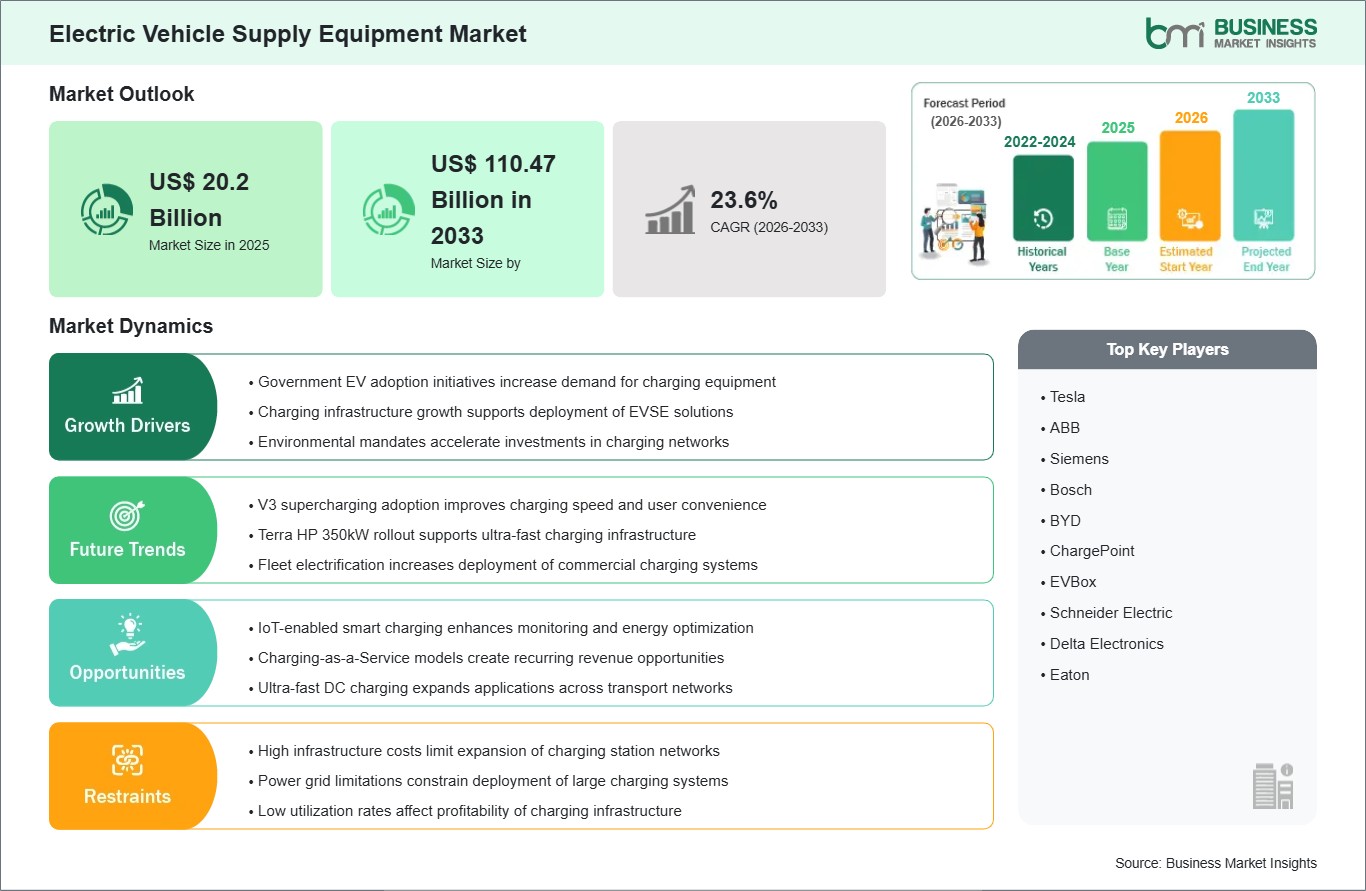
The electric vehicle supply equipment market size is expected to reach US$ 110.47 billion by 2033 from US$ 20.2 billion in 2025. The market is estimated to record a CAGR of 23.6% from 2026 to 2033.

Executive Summary and Global Market Analysis:

Electric Vehicle Supply Equipment 's market is expanding rapidly as electric mobility adoption accelerates and the need for reliable charging infrastructure becomes increasingly critical. EVSE includes a wide range of charging solutions such as residential chargers, public charging stations, fast-charging systems, and supporting grid integration technologies. These systems are essential for enabling convenient, accessible, and efficient charging experiences, which directly influence consumer confidence and EV adoption rates worldwide.

A major driver of this market is the growing penetration of electric vehicles across passenger and commercial segments, which is placing significant pressure on existing energy infrastructure. Governments and private stakeholders are investing heavily in building extensive charging networks to reduce range anxiety and support long-distance EV travel. Technological advancements such as ultra-fast charging, smart charging systems, and digital payment integration are further enhancing user convenience and operational efficiency within the EVSE ecosystem.

Another key factor supporting market growth is the increasing integration of renewable energy sources with EV charging infrastructure. Smart grid-enabled charging stations are being developed to optimize energy consumption, manage peak load demands, and improve overall grid stability. Additionally, the expansion of urban charging hubs and highway fast-charging corridors is improving accessibility and encouraging wider EV adoption across both developed and emerging markets.

However, the market faces challenges including high installation costs, grid capacity constraints, and uneven infrastructure development across regions. Standardization issues and interoperability between different charging systems also pose operational hurdles. Despite these challenges, the EVSE market remains a foundational pillar of the global electric mobility transition, playing a crucial role in shaping the future of sustainable transportation.

Electric Vehicle Supply Equipment Market - Strategic Insights:

global-market-strategic-framework
Get more information on this report

Electric Vehicle Supply Equipment Market Segmentation Analysis:

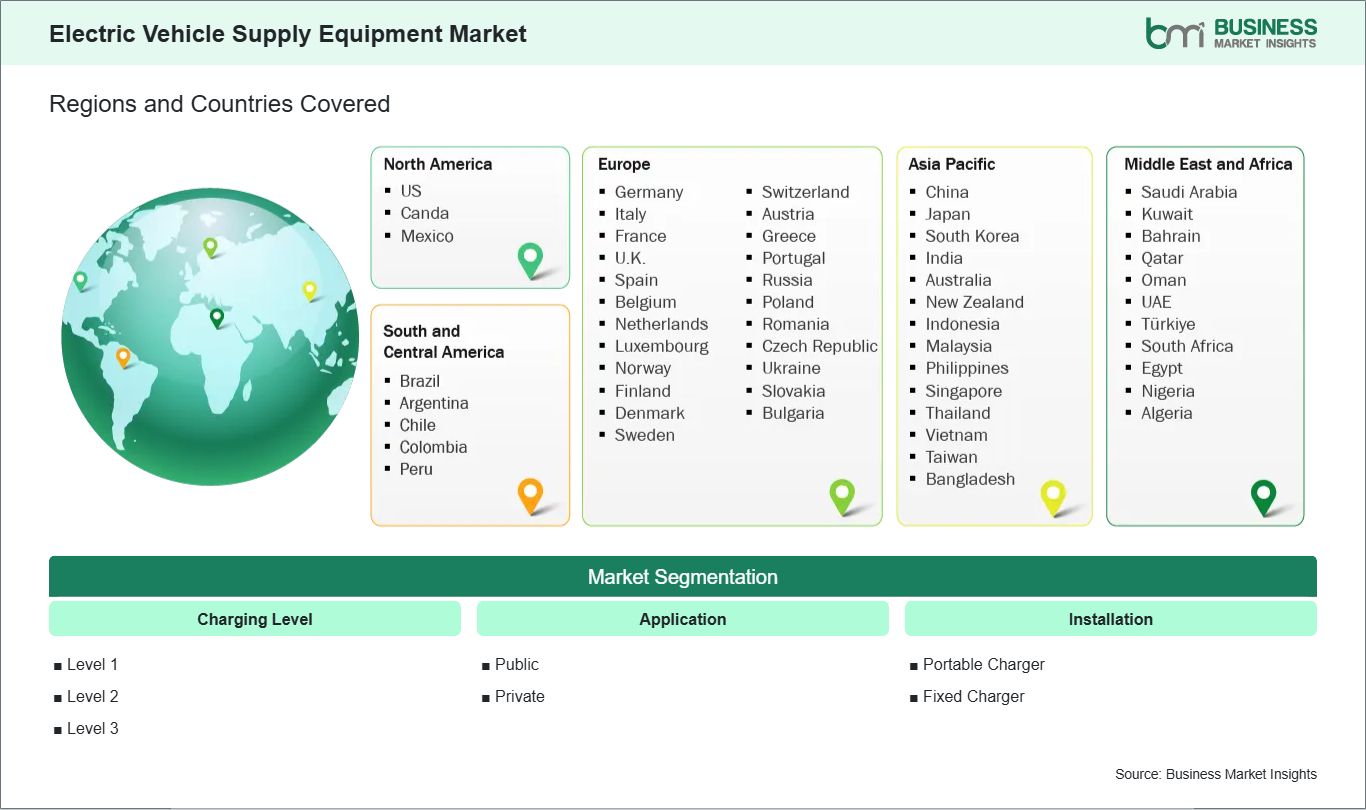
The electric vehicle supply equipment market is segmented based on charging level, application, and installation type, driven by the rapid expansion of electric mobility infrastructure, increasing EV adoption, and the need for faster, more accessible, and efficient charging solutions.

By Charging Level

  • Level 1 Charging: Utilizes standard household outlets and provides slow charging speeds, primarily used for residential overnight charging of passenger EVs. It is cost-effective but limited in performance.
  • Level 2 Charging: Offers faster charging through dedicated charging units installed in homes, workplaces, and public spaces. It is the most widely adopted segment due to balanced cost and efficiency.
  • Level 3 Charging (DC Fast Charging): Provides ultra-fast charging capabilities using direct current, significantly reducing charging time. It is primarily deployed in commercial and highway charging stations for long-distance travel support.

By Application

  • Public: Includes charging stations in urban areas, highways, shopping centers, and commercial hubs. Public EVSE infrastructure is critical for reducing range anxiety and supporting mass EV adoption.
  • Private: Includes residential and workplace charging setups. This segment is driven by convenience, lower operating costs, and increasing home EV ownership.

By Installation

  • Portable Charger: Compact and mobile charging units that can be carried and used across different locations, offering flexibility for emergency or basic charging needs.
  • Fixed Charger: Permanently installed charging stations that provide higher efficiency, faster charging, and enhanced safety features. These dominate both residential and commercial infrastructure deployments.
Electric Vehicle Supply Equipment Market Drivers and Opportunities:

Government Push For EV Adoption

The electric vehicle supply equipment (EVSE) market is experiencing significant growth due to increasing government support for electric mobility. Government agencies within different geographic locations are introducing policies, rewards schemes, and other forms of support to encourage the rapid adoption of electric transportation from traditional automobiles. As there is an increase in the number of electric vehicles, the demand for charging stations also increases.

Investments by the government in charging networks have been instrumental in contributing to market growth. The government is promoting the setting up of charging stations at urban areas, on highways, at work places, in apartment buildings, and even business districts.These initiatives are contributing towards addressing consumer issues related to charging access, which have been major hurdles preventing more widespread adoption of electric vehicles. This infrastructure expansion is leading to greater demand for hardware, connectors, power management equipment, and other electric vehicle supply equipment.

In addition, regulatory frameworks promoting clean transportation are encouraging businesses, property developers, and fleet operators to invest in charging infrastructure. Further development of building codes, sustainability policies, and transportation electrification initiatives will also bolster the use of electric vehicle charging stations. The growing emphasis of governments on low-emission and energy-efficient solutions will ensure that demand for EVSE continues to depend largely on supportive policies and measures.

IoT-Enabled Smart Charging

A major opportunity in the electric vehicle supply equipment market lies in the adoption of IoT-enabled smart charging solutions. With increasing growth and connectivity of charging networks, providers are now looking for systems that can help optimize energy usage and provide a better experience. The use of the Internet of Things allows seamless communication among charging stations, cars, the power grid, and cloud-managed systems.

Smart charging technology allows dynamic load balancing, remote monitoring, predictive maintenance, and automated energy management. Such capabilities will enable the charging operators to cut down on operational expenses while optimizing the allocation of the available energy to different charging stations. For the consumer, smart charging stations are equipped with functions like mobile monitoring, scheduling, data analysis, and automatic payments.

The growing integration of renewable energy sources and smart grids further strengthens the potential of IoT-enabled charging infrastructure. Intelligent charging systems can respond to grid conditions, optimize charging during off-peak periods, and support vehicle-to-grid interactions where applicable. As digitalization emerges as an integral part of the ecosystem of electric mobility, it is anticipated that IoT-based smart charging technologies will form an important field of innovation, providing significant potential for EVSE equipment makers, software companies, and charging network providers.

Electric Vehicle Supply Equipment Market Size and Share Analysis:

The electric vehicle supply equipment market is projected to grow from US$ 20.2 billion in 2025 to US$ 110.47 billion by 2033, registering a CAGR of 23.6% from 2026 to 2033.

By charging level, Level 2 charging dominates the EVSE market due to its optimal balance of charging speed, cost, and infrastructure requirements, making it the most widely deployed solution in both residential and commercial settings. It supports daily EV charging needs effectively, especially in urban and semi-urban environments where overnight and workplace charging are common.

By application, the public segment dominates as governments and private operators rapidly expand charging infrastructure across highways, cities, commercial hubs, and retail locations to address range anxiety and support growing EV adoption. Public charging networks are critical for long-distance travel and fleet electrification.

By installation, fixed chargers dominate the market because they offer higher power output, greater durability, and better integration with grid infrastructure, making them the preferred choice for residential buildings, workplaces, commercial parking spaces, and highway charging stations. Portable chargers remain secondary, mainly serving emergency or low-frequency use cases.

Electric Vehicle Supply Equipment Market Report Highlights:

Report Attribute Details
Market size in 2025 US$ 20.2 Billion
Market Size by US$ 110.47 Billion in 2033
Global CAGR (2026 - 2033)23.6%
Historical Data 2022-2024
Forecast period 2026-2033
Segments Covered By Charging Level
  • Level 1
  • Level 2
  • Level 3
By Application
  • Public
  • Private
By Installation
  • Portable Charger
  • Fixed Charger
Regions and Countries Covered
North America US, Canada, Mexico
Europe Germany, Italy, France, U.K., Spain, Belgium, Netherlands, Luxembourg, Norway, Finland, Denmark, Sweden, Switzerland, Austria, Greece, Portugal, Russia, Poland, Romania, Czech Republic, Ukraine, Slovakia, Bulgaria
Asia-Pacific China, Japan, South Korea, India, Australia, New Zealand, Indonesia, Malaysia, Philippines, Singapore, Thailand, Vietnam, Taiwan, Bangladesh
South and Central America Brazil, Argentina, Chile, Colombia, Peru
Middle East and Africa Saudi Arabia, United Arab Emirates, Kuwait, Bahrain, Qatar, Oman, Turkiye, South Africa, Egypt, Nigeria, Algeria
Market leaders and key company profiles
  • Tesla
  • ABB
  • Siemens
  • Bosch
  • BYD
  • ChargePoint
  • EVBox
  • Schneider Electric
  • Delta Electronics
  • Eaton
Get more information on this report

Electric Vehicle Supply Equipment Market Report Coverage and Deliverables:

The "Electric Vehicle Supply Equipment Market Size and Forecast (2022-2033)" report provides a detailed analysis of the market covering below areas:

  • Market size and forecast at global, regional, and country levels for all key market segments covered under the scope
  • Market trends, along with market dynamics such as drivers, restraints, and key opportunities
  • Market analysis covering key trends, global and regional frameworks, major players, regulations, and recent developments
  • Industry landscape and competitive analysis covering market concentration, heat map analysis, prominent players, and recent developments
  • Detailed company profiles, including SWOT analysis

Electric Vehicle Supply Equipment Market Geographic Insights:

In terms of geographical distribution of the Electric Vehicle Supply Equipment (EVSE) Market, there is a varied pattern of adoption based on factors such as electric vehicle penetration, development of charging infrastructure, government incentives for EV charging networks, and advancements in smart grid and energy management technologies.

North America is a leading market for electric vehicle supply equipment, supported by strong government funding, private sector investments, and rapid expansion of public and private charging networks. Fast AC & DC charger installations are increasingly being seen in North America in highway stops, cities, commercial areas, and even residential zones. Decarbonization policies by governments, along with investments in electric vehicles, are boosting demand in the country. Moreover, adoption of technologies such as smart charging stations, IoT-enabled management platforms, and grid-integration services is helping to drive regional development further.

Asia Pacific is the fastest-growing region in the EV supply equipment market, driven by large-scale EV adoption, strong government mandates, and rapid urbanization. Several countries in this region, including China, India, Japan, and South Korea, are making significant investments in developing charging facilities to meet rising demands. This is because the presence of advanced charging networks makes these nations leaders in EV charging infrastructure globally. Additionally, cheap manufacturing of charging infrastructure and an increase in the usage of fast charging systems, battery swap facilities, and smart charging facilities are contributing significantly to regional development.

Both the rwgion play a critical role in driving the expansion of the EV supply equipment market, supported by accelerating electrification of transportation, large-scale investments in charging infrastructure, and the growing integration of digital and smart energy management solutions to enable efficient and reliable EV charging ecosystems.

global-market-geography
Get more information on this report

Electric Vehicle Supply Equipment Market Research Report Guidance:

  • The report includes qualitative and quantitative data in the electric vehicle supply equipment market across charging level, application, installation, and geography.
  • The report starts with the key takeaways (chapter 2), highlighting the key trends and outlook of the market.
  • Chapter 3 focuses on the research methodology of the study.
  • Chapter 4 includes ecosystem analysis.
  • Chapter 5 highlights the major industry dynamics in the market, including factors that are driving the market, prevailing deterrents, potential opportunities, as well as future trends. Impact analysis of these drivers and restraints is also covered in this section.
  • Chapter 6 discusses the market scenario, in terms of historical market revenues, and forecast till the year 2033.
  • Chapters 7 to 10 cover market segments by charging level, application, installation, and geography across North America, Europe, Asia Pacific, Middle East and Africa, and South and Central America. They cover the market revenue, forecast, and factors driving the market.
  • Chapter 11 describes the competitive analysis along with the heat map analysis for the key players operating in the market.
  • Chapter 12 describes the industry landscape analysis. It provides detailed descriptions of business activities such as market initiatives, new developments, mergers, and joint ventures globally, along with a competitive landscape.
  • Chapter 13 provides detailed profiles of the major companies operating in the market. Companies have been profiled on the basis of their key facts, business descriptions, products and services, financial overview, SWOT analysis, and key developments.
  • Chapter 14, i.e., the appendix, is inclusive of a brief overview of the company, list of abbreviations, and disclaimer.

Electric Vehicle Supply Equipment Market News and Key Development:

The electric vehicle supply equipment market is evaluated by gathering qualitative and quantitative data post primary and secondary research, which includes important corporate publications, association data, and databases. Recent developments and news in the market include:

  • In May 2025, Eaton and ChargePoint, announced that they had entered a strategic partnership to jointly develop integrated EV charging and electrical infrastructure solutions, including bidirectional vehicle-to-everything (V2X) capabilities, aimed at simplifying large-scale EV charging deployment across North America and Europe.
  • In September 2025, Pioneer Power Solutions, announced that it had secured multiple new contracts and partnerships for its mobile EV charging and distributed power solutions across sectors such as emergency services, logistics, aerospace, and fleet electrification, highlighting growing demand for flexible and mobile charging infrastructure.

Key Sources Referred:

World Bank World Trade Organization (WTO) International Monetary Fund (IMF) International Trade Administration (ITA) International Energy Agency (IEA) Organisation for Economic Co-operation and Development (OECD) United Nations Environment Programme (UNEP) International Organization for Standardization (ISO) Society of Automotive Engineers (SAE International) National Electrical Manufacturers Association (NEMA) United Nations Economic Commission for Europe (UNECE) European Commission Company Websites Company Annual Reports Company Investor Presentations
The List of Companies - Electric Vehicle Supply Equipment Market
  • Tesla
  • ABB
  • Siemens
  • Bosch
  • BYD
  • ChargePoint
  • EVBox
  • Schneider Electric
  • Delta Electronics
  • Eaton
Frequently Asked Questions
How big is the Electric Vehicle Supply Equipment Market?

The Electric Vehicle Supply Equipment Market is valued at US$ 20.2 Billion in 2025, it is projected to reach US$ 110.47 Billion in 2033 by .

What is the CAGR for Electric Vehicle Supply Equipment Market by (2026 - 2033)?

As per our report Electric Vehicle Supply Equipment Market, the market size is valued at US$ 20.2 Billion in 2025, projecting it to reach US$ 110.47 Billion in 2033 by . This translates to a CAGR of approximately 23.6% during the forecast period.

What segments are covered in this report?

The Electric Vehicle Supply Equipment Market report typically cover these key segments-

  • Charging Level (Level 1, Level 2, Level 3)
  • Application (Public, Private)
  • Installation (Portable Charger, Fixed Charger)

What is the historic period, base year, and forecast period taken for Electric Vehicle Supply Equipment Market?

The historic period, base year, and forecast period can vary slightly depending on the specific market research report. However, for the Electric Vehicle Supply Equipment Market report:

  • Historic Period : 2022-2024
  • Base Year : 2025
  • Forecast Period : 2026-2033
  • Who are the major players in Electric Vehicle Supply Equipment Market?

    The Electric Vehicle Supply Equipment Market is populated by several key players, each contributing to its growth and innovation. Some of the major players include:

  • Tesla
  • ABB
  • Siemens
  • Bosch
  • BYD
  • ChargePoint
  • EVBox
  • Schneider Electric
  • Delta Electronics
  • Eaton
  • Who should buy this report?

    The Electric Vehicle Supply Equipment Market report is valuable for diverse stakeholders, including:

    • Investors: Provides insights for investment decisions pertaining to market growth, companies, or industry insights. Helps assess market attractiveness and potential returns.
    • Industry Players: Offers competitive intelligence, market sizing, and trend analysis to inform strategic planning, product development, and sales strategies.
    • Suppliers and Manufacturers: Helps understand market demand for components, materials, and services related to concerned industry.
    • Researchers and Consultants: Provides data and analysis for academic research, consulting projects, and market studies.
    • Financial Institutions: Helps assess risks and opportunities associated with financing or investing in the concerned market.

    Essentially, anyone involved in or considering involvement in the Electric Vehicle Supply Equipment Market value chain can benefit from the information contained in a comprehensive market report.

    Available Report Formats

    pdf-format excel-format pptx-format
    Buy Now
    Sales Assistance
    +1 646 791 7070 (US & UK)
    Customization Form

    Please tell us your area of interest
    (Market Segments/ Regions and Countries/ Companies)