
Electric Vehicle E-Axle Market Outlook: Size, Share, Trends, Growth Analysis, Competitive Landscape & Forecast, 2026-2033

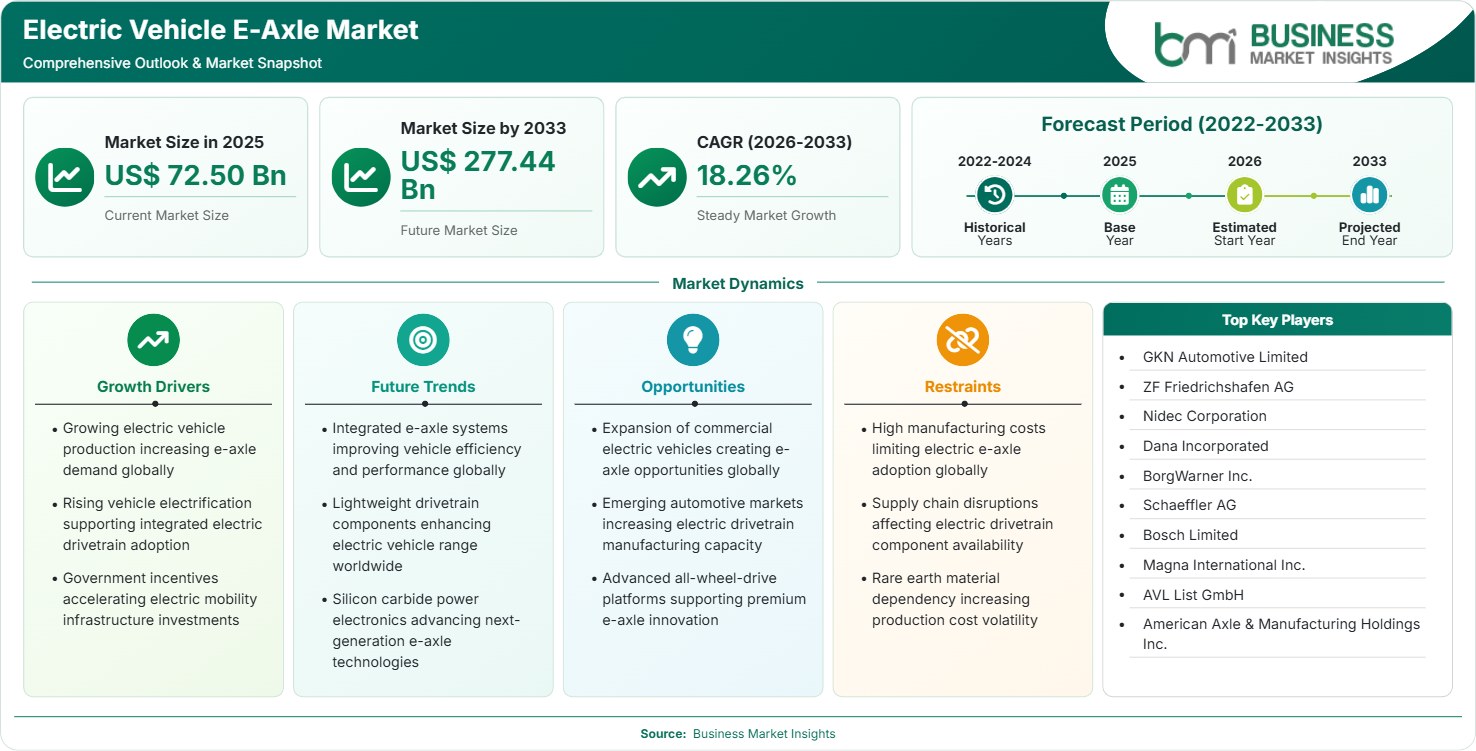
The Electric Vehicle E-Axle Market size was valued at US$ 72.5 billion in 2025 and is projected to reach US$ 277.44 billion by 2033, growing at a CAGR of 18.26% during 2026–2033, driven by accelerating electric vehicle production, integrated drivetrain adoption, supportive government policies, and continuous innovation in high-efficiency electric propulsion technologies.

Report Coverage
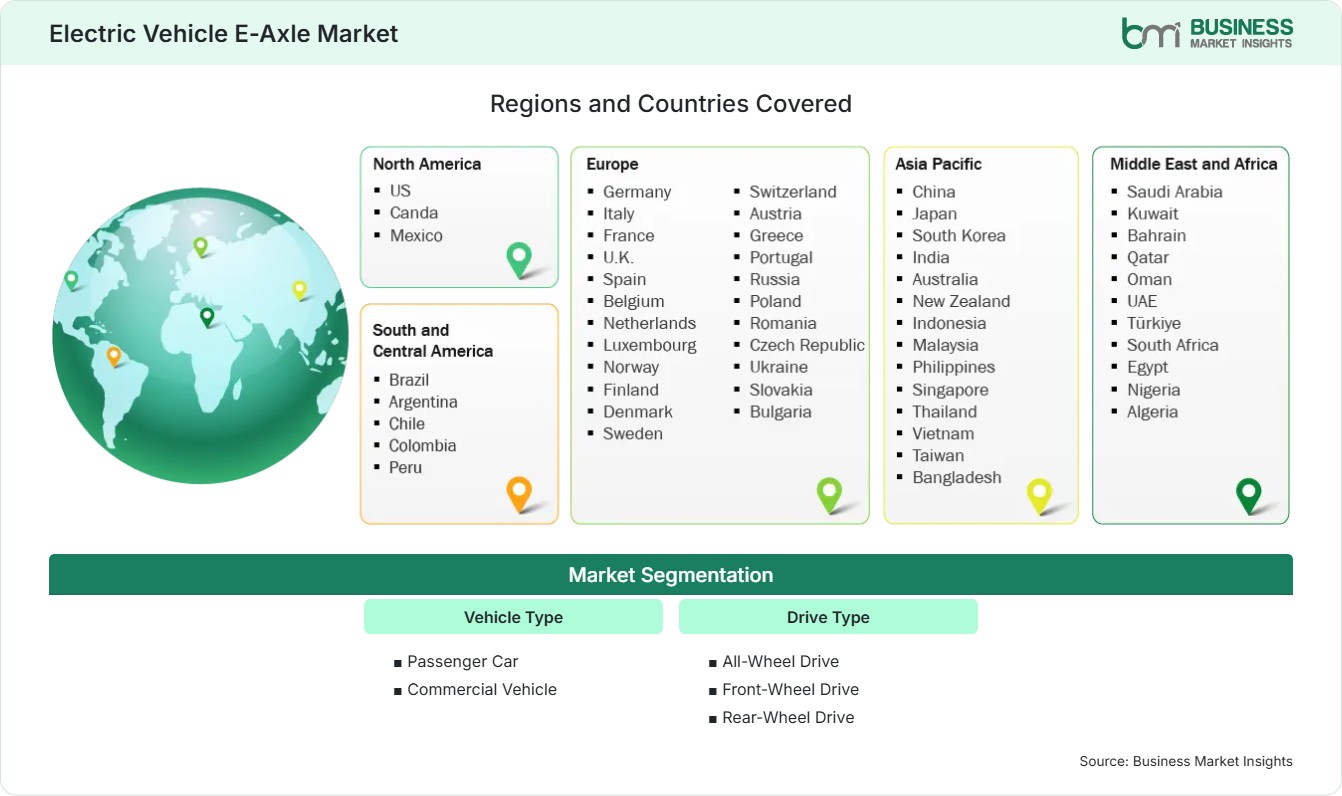
  • Vehicle Type: Passenger Car, Commercial Vehicle
  • Drive Type: All-Wheel Drive, Front-Wheel Drive, Rear-Wheel Drive
US$ 72.50 Bn Market size in 2025
US$ 277.44 Bn Market Size by 2033
18.26% CAGR, 2026 - 2033
2026-2033 Forecast Period

01 AI Overview

Electric Vehicle E-Axle Market Summary

  • North America Region: North America held a 29%–32% share in 2025 and is projected to expand at a CAGR of 17%–19% during 2026–2033. Rising electric vehicle production, battery manufacturing investments, and localization of electric powertrain components continue supporting regional expansion. The US market is projected to register a 17.5%–19.5% CAGR during 2026–2033, supported by EV manufacturing investments, battery gigafactories, and increasing domestic drivetrain production.
  • Fastest Growing Region: Asia Pacific accounted for 39%–42% of the market in 2025 and is expected to grow at a CAGR of 19%–21% through 2026–2033. Expanding EV production, battery supply chains, and supportive industrial policies continue strengthening regional manufacturing competitiveness.
  • Leading Segment: Passenger Car represented 72%–75% market share in 2025 and is forecast to grow at a CAGR of 18%–20% during 2026–2033. Increasing global passenger EV production, higher consumer adoption, and OEM investments continue driving segment expansion.
  • High Growth Segment: All-Wheel Drive accounted for 28%–31% share in 2025 while registering the fastest 19%–21% CAGR during 2026–2033. Premium electric vehicles, higher torque requirements, and performance-oriented EV platforms are driving accelerated adoption.
  • Key Market Opportunity: Growing commercial EV production, localization of electric drivetrain manufacturing, and technological advancement in integrated powertrain architectures are creating attractive opportunities for suppliers and vehicle manufacturers worldwide.
  • Major Market Players: GKN Automotive Limited, ZF Friedrichshafen AG, Nidec Corporation, Dana Incorporated, BorgWarner Inc., Schaeffler AG, Bosch Limited, Magna International Inc., AVL List GmbH, American Axle & Manufacturing Holdings Inc.
02 Strategic Insights

Electric Vehicle E-Axle Market: Strategic Insights

Electric Vehicle E-Axle Market Strategic Framework
FREE PDF
Request your free sample
Request free sample
03 Stakeholder View

Key Takeaways

  • The value chain is becoming increasingly integrated as electric motor manufacturers, gearbox suppliers, semiconductor companies, and OEMs collaborate to develop compact high-efficiency e-axle systems.
  • Passenger electric vehicles continue representing the largest revenue opportunity, while commercial vehicle electrification is expected to create significant long-term demand for high-capacity drivetrain systems.
  • Product innovation is increasingly focused on silicon carbide power electronics, lightweight materials, thermal management technologies, and integrated motor-drive architectures improving efficiency and driving range.
  • Asia Pacific remains the strongest investment destination due to large-scale EV manufacturing capacity, battery ecosystem expansion, and government-backed industrial development programs.
  • Strategic collaborations between drivetrain suppliers and global automotive manufacturers are accelerating commercialization of next-generation integrated electric propulsion technologies.
  • Continuous investments in automated manufacturing and localized supply chains are expected to improve production efficiency while reducing dependence on imported drivetrain components.
04 Geographic Outlook

Electric Vehicle E-Axle Market Regional Highlights

North America Electric Vehicle E-Axle Market

North America accounted for a 29%–32% share of the Electric Vehicle E-Axle Market in 2025 and is projected to expand at a CAGR of 17%–19% during 2026–2033. Increasing domestic EV manufacturing, localization of battery supply chains, and investments in advanced automotive production continue strengthening regional demand. Major OEMs are expanding electric vehicle portfolios while drivetrain suppliers invest in integrated propulsion technologies. The Electric Vehicle E-Axle Market share remains supported by government incentives, growing charging infrastructure, and expanding production of premium electric vehicles.

  • Government incentives encouraging domestic electric vehicle manufacturing continue supporting investments in integrated drivetrain production facilities across the United States and Canada.
  • Automotive manufacturers are increasingly adopting compact e-axle platforms to improve vehicle efficiency, simplify assembly, and reduce drivetrain weight.
  • Battery manufacturing expansion is strengthening regional supply chains while supporting localized production of electric propulsion components.
  • Strategic collaborations between OEMs and drivetrain suppliers are accelerating commercialization of next-generation integrated electric axle systems.

US Electric Vehicle E-Axle Market

The US represented 68%–71% of the North American Electric Vehicle E-Axle Market in 2025 and is expected to register a CAGR of 17.5%–19.5% through 2026–2033. Increasing EV production capacity, battery gigafactory investments, and supportive federal incentives continue driving demand. Vehicle manufacturers are expanding domestic production while integrating advanced electric propulsion technologies to improve efficiency and vehicle performance.

  • Large automotive manufacturers continue investing in dedicated EV platforms supporting integrated electric drivetrain technologies.
  • Federal clean transportation initiatives are encouraging domestic manufacturing of motors, inverters, and electric axle assemblies.
  • Battery supply chain localization is improving manufacturing resilience while supporting higher drivetrain production volumes.
  • Premium electric vehicle manufacturers are increasing adoption of advanced all-wheel-drive e-axle technologies.

Europe Electric Vehicle E-Axle Market

Europe held a 26%–29% share of the Electric Vehicle E-Axle Market in 2025 and is forecast to grow at a CAGR of 18%–20% during 2026–2033. Strong vehicle emission regulations, expanding electric vehicle production, and investments in sustainable mobility continue supporting regional growth. Germany leads manufacturing capacity, while France and the United Kingdom remain important EV markets. The Electric Vehicle E-Axle Market growth is further supported by increasing localization of drivetrain manufacturing and battery production.

  • Germany continues leading regional production through strong automotive engineering capabilities and extensive EV manufacturing investments.
  • France is expanding electric mobility through incentives supporting passenger and commercial electric vehicle adoption.
  • The United Kingdom is increasing investments in electric drivetrain technologies and advanced automotive manufacturing.
  • European suppliers are strengthening integrated e-axle development through collaborations with major global vehicle manufacturers.
  • Stringent carbon emission regulations continue encouraging adoption of highly efficient integrated electric propulsion systems.

Asia Pacific Electric Vehicle E-Axle Market

Asia Pacific accounted for 39%–42% share of the Electric Vehicle E-Axle Market in 2025 and is anticipated to register the fastest 19%–21% CAGR through 2026–2033. China, Japan, South Korea, and India continue expanding electric vehicle production supported by large battery ecosystems and government-backed industrial policies. Rising investments in localized component manufacturing, integrated drivetrain development, and export-oriented production are strengthening regional competitiveness.

  • China remains the largest manufacturing hub for electric vehicles, batteries, and integrated electric drivetrain systems.
  • Japan continues investing in advanced electric powertrain technologies emphasizing efficiency, reliability, and lightweight engineering.
  • South Korea is expanding production through battery innovation and advanced automotive component manufacturing.
  • India is increasing investments in domestic EV production under supportive industrial development initiatives.
  • Regional suppliers continue expanding manufacturing capacity to meet increasing global electric vehicle demand.

Rest of World Electric Vehicle E-Axle Market

Rest of World represented 4%–7% of the market in 2025 and is projected to expand at a CAGR of 16%–18% during 2026–2033. Latin America and the Middle East are gradually increasing investments in electric mobility while selected African economies begin developing EV assembly capabilities. Government electrification programs, fleet modernization, and infrastructure investments are supporting gradual market expansion.

  • Brazil and Mexico are increasing electric vehicle production through investments in automotive manufacturing and localization initiatives.
  • Middle Eastern countries are adopting electric mobility as part of long-term economic diversification strategies.
  • Fleet electrification projects are encouraging demand for commercial electric drivetrain technologies.
  • International automotive manufacturers are expanding regional partnerships supporting localized EV component production.
  • Improving charging infrastructure continues strengthening long-term electric vehicle adoption across developing markets.
Global Market Geography
FREE PDF
Request your free sample
Request free sample
05 Segment Analysis

Electric Vehicle E-Axle Market Segmentation

Vehicle Type

Vehicle type segmentation demonstrates strong demand across passenger and commercial electric vehicles as manufacturers increase production of battery-electric platforms. Passenger Car accounted for 72%–75% market share in 2025 and is projected to register a CAGR of 18%–20% during 2026–2034. Rising consumer EV adoption, expanding model availability, and OEM investments in dedicated electric platforms continue supporting segment leadership. The Electric Vehicle E-Axle Market scope continues expanding with increasing electrification across vehicle categories.

  • Passenger Car: Passenger electric vehicles remain the largest application due to increasing consumer adoption, expanding charging infrastructure, improved battery technology, and continuous introduction of new electric vehicle models by global automotive manufacturers.
  • Commercial Vehicle: Commercial electric vehicles are witnessing increasing adoption as logistics operators, public transport agencies, and fleet owners prioritize lower operating costs, regulatory compliance, and sustainable transportation solutions.

Drive Type

Drive type segmentation reflects varying vehicle performance requirements across passenger and commercial applications. Front-Wheel Drive maintained the largest share at 41%–44% in 2025 and is expected to grow at a CAGR of 17%–19% during 2026–2034 owing to its extensive adoption in compact and mid-size electric vehicles. The Electric Vehicle E-Axle Market trends indicate growing demand for advanced integrated drive systems offering improved efficiency, reduced weight, and optimized packaging.

  • All-Wheel Drive: All-wheel-drive configurations are gaining popularity in premium electric vehicles due to superior traction, enhanced vehicle stability, higher torque delivery, and increasing demand for high-performance electric mobility.
  • Front-Wheel Drive: Front-wheel-drive systems remain widely adopted because of cost efficiency, simplified vehicle architecture, improved packaging flexibility, and suitability for mass-market passenger electric vehicles.
  • Rear-Wheel Drive: Rear-wheel-drive configurations are increasingly utilized in performance-oriented and commercial electric vehicles requiring balanced weight distribution, improved acceleration characteristics, and higher drivetrain efficiency.
06 Market Forces

Electric Vehicle E-Axle Market Dynamics

Key Market Drivers

Growing electric vehicle production increasing e-axle demand globally

Growing electric vehicle production increasing e-axle demand globally is accelerating deployment of integrated electric drivetrains as global automotive manufacturers expand battery electric vehicle portfolios. According to the International Energy Agency, global EV sales continue setting new records, encouraging suppliers to increase production capacity for motors, gearboxes, and integrated axle systems. Market growth is supported by higher vehicle production, expanding battery manufacturing, and increasing investments in dedicated EV platforms. Electric Vehicle E-Axle Market forecasts indicate manufacturers are prioritizing compact, lightweight, and high-efficiency propulsion systems to improve driving range, vehicle performance, and manufacturing efficiency across passenger and commercial electric vehicles.

Rising vehicle electrification supporting integrated electric drivetrain adoption

Rising vehicle electrification supporting integrated electric drivetrain adoption is strengthening demand for compact propulsion systems combining electric motors, reduction gears, and power electronics within a single assembly. Integrated architectures reduce component count, improve energy efficiency, simplify manufacturing, and lower overall vehicle weight. Automotive manufacturers are increasingly standardizing e-axle platforms across multiple vehicle models to reduce production costs while improving performance. Advancements in thermal management, lightweight materials, and power electronics continue enhancing drivetrain efficiency. These developments are encouraging wider adoption among passenger cars and commercial electric vehicles globally.

Government incentives accelerating electric mobility infrastructure investments

Government incentives accelerating electric mobility infrastructure investments continue supporting electric vehicle production through purchase subsidies, manufacturing incentives, emissions regulations, and charging infrastructure expansion. National electrification strategies across Europe, North America, and Asia Pacific are encouraging automotive manufacturers to increase investments in electric vehicle production facilities and localized component manufacturing. Public policies supporting domestic battery production, advanced manufacturing, and clean transportation are strengthening the overall electric mobility ecosystem. Increasing infrastructure availability further enhances consumer confidence while supporting long-term demand for integrated electric drivetrain technologies.

Key Market Opportunities

Expansion of commercial electric vehicles creating e-axle opportunities globally

Expansion of commercial electric vehicles creating e-axle opportunities globally is generating strong demand for high-capacity integrated drivetrains across logistics, public transportation, and municipal fleet applications. Governments and fleet operators are accelerating electrification to reduce emissions and operating costs. Manufacturers are developing durable, high-torque e-axle systems specifically designed for heavy-duty applications. Growing investments in electric buses, delivery vans, and medium-duty commercial vehicles are creating attractive opportunities for drivetrain suppliers. Increasing fleet electrification is expected to remain an important long-term growth driver for advanced integrated propulsion systems.

Emerging automotive markets increasing electric drivetrain manufacturing capacity

Emerging automotive markets increasing electric drivetrain manufacturing capacity are creating new opportunities as countries strengthen domestic EV production ecosystems. Governments are supporting localized manufacturing through industrial incentives, foreign direct investment, and supply chain development initiatives. Component suppliers are expanding regional production facilities to improve competitiveness and reduce logistics costs. Rising consumer demand, improving charging infrastructure, and favorable industrial policies across developing economies are encouraging investments in motors, inverters, reduction gears, and integrated e-axle production capabilities.

Advanced all-wheel-drive platforms supporting premium e-axle innovation

Advanced all-wheel-drive platforms supporting premium e-axle innovation are encouraging suppliers to develop high-performance integrated propulsion technologies capable of delivering superior torque distribution, vehicle stability, and acceleration. Premium automotive manufacturers are investing in dual-motor architectures, intelligent torque vectoring, and advanced electronic control systems to differentiate electric vehicle performance. Continuous innovation in lightweight materials, high-speed motors, and power electronics is creating opportunities for suppliers serving premium passenger vehicle and performance EV segments.

Market Restraints and Challenges

High manufacturing costs limiting electric e-axle adoption globally

Factor: High manufacturing costs remain a significant challenge because integrated electric axles require advanced electric motors, precision gear systems, power electronics, and sophisticated manufacturing processes. Impact: Elevated production costs increase vehicle prices and may slow adoption, particularly in cost-sensitive markets. Manufacturers continue investing in production automation, localized sourcing, and economies of scale to improve affordability. However, fluctuations in raw material prices and advanced component costs continue influencing profitability and large-scale commercialization.

Supply chain disruptions affecting electric drivetrain component availability

Factor: Supply chain disruptions continue affecting availability of semiconductors, permanent magnets, electronic components, and specialized drivetrain materials required for integrated e-axle manufacturing. Impact: Component shortages can delay vehicle production, extend delivery timelines, and increase procurement costs for manufacturers. Automotive suppliers are responding by diversifying sourcing strategies, strengthening regional manufacturing capabilities, and increasing inventory resilience. Continued localization of supply chains and strategic partnerships will remain essential for ensuring stable production of advanced electric drivetrain systems.

07 Company Analysis

Competitive Landscape

The Electric Vehicle E-Axle Market analysis reflects intense competition among global drivetrain manufacturers, automotive technology suppliers, and engineering companies focusing on integrated electric propulsion systems. Companies are investing in lightweight e-axle architectures, high-efficiency motors, silicon carbide power electronics, and scalable manufacturing capabilities. Strategic partnerships with automotive OEMs, regional manufacturing expansion, and continuous research and development remain central to strengthening competitive positioning as electric vehicle production accelerates worldwide.

Company Name

Overview

Products and Services relevant to this market

GKN Automotive Limited

GKN Automotive Limited develops advanced driveline and electric propulsion technologies for global automotive manufacturers.

Integrated e-axle systems, electric drive units, all-wheel-drive technologies, driveline components, and electric propulsion solutions.

ZF Friedrichshafen AG

ZF Friedrichshafen AG is a leading global supplier of mobility technologies for passenger and commercial vehicles.

Electric axle drives, electric motors, transmissions, power electronics, chassis systems, and integrated e-mobility solutions.

Nidec Corporation

Nidec Corporation manufactures precision electric motors and integrated electric vehicle drive systems.

E-axles, traction motors, automotive motor systems, electric drive modules, and integrated propulsion technologies.

Dana Incorporated

Dana Incorporated supplies drivetrain and power technologies supporting electrified mobility worldwide.

Electric drive systems, e-axles, thermal management technologies, driveline products, and vehicle electrification solutions.

BorgWarner Inc.

BorgWarner Inc. develops clean mobility technologies supporting electrified transportation applications.

Integrated drive modules, electric motors, e-axles, inverters, power electronics, and drivetrain technologies.

Schaeffler AG

Schaeffler AG develops precision mobility technologies for electric and hybrid vehicle applications.

Electric axle drives, bearings, transmission components, electric propulsion systems, and mobility engineering solutions.

Bosch Limited

Bosch Limited provides automotive technologies supporting vehicle electrification and intelligent mobility.

Electric drive systems, motors, power electronics, software solutions, and integrated automotive components.

Magna International Inc.

Magna International Inc. supplies complete vehicle systems and advanced electrified drivetrain technologies.

Electric drive units, e-axles, transmission systems, vehicle engineering, and manufacturing solutions.

AVL List GmbH

AVL List GmbH specializes in automotive engineering, testing, and powertrain development technologies.

Electric drivetrain engineering, e-axle development, simulation services, testing systems, and propulsion optimization solutions.

American Axle & Manufacturing Holdings Inc.

American Axle & Manufacturing Holdings Inc. manufactures driveline technologies for global automotive manufacturers.

Electric drive units, integrated e-axles, drivetrain systems, axle technologies, and mobility solutions.

10 Trust & Transparency

Research Methodology

The market analysis combines proprietary research with secondary data from government agencies, company disclosures, regulatory filings, industry databases and expert interviews. Market estimates are validated through data triangulation, cross-market benchmarking and analyst review.

View Full Research Methodology

11 Questions Answered

Frequently Asked Questions

How will technology influence future market development?

Future growth will be supported by lightweight materials, silicon carbide power electronics, intelligent torque vectoring, integrated drive units, advanced thermal management, and automated manufacturing technologies that improve drivetrain efficiency and vehicle performance.

What are the major challenges affecting industry expansion?

In electric vehicle E-axle market report, high manufacturing costs, semiconductor shortages, supply chain disruptions, and dependence on critical raw materials remain significant challenges affecting production efficiency and large-scale commercialization of integrated electric drivetrain technologies.

Which vehicle type generates the highest revenue?

Passenger cars account for the largest revenue share owing to increasing consumer adoption of electric vehicles, expanding product portfolios, supportive incentives, and continuous investments by global automotive manufacturers.

Which region dominates the market?

Asia Pacific leads the market because of its extensive electric vehicle production, strong battery manufacturing ecosystem, supportive government policies, and presence of major automotive manufacturers investing in electric drivetrain technologies.

What is driving demand for electric vehicle e-axle systems?

Growing global electric vehicle production, integrated drivetrain technologies, supportive government policies, and increasing investments in battery manufacturing are accelerating demand for efficient e-axle systems across passenger and commercial vehicle segments.

Access the Full Electric Vehicle E-Axle Market Report

Get segment-level forecasts, regional estimates, competitive benchmarking, company profiles and downloadable Excel datasets.

Access the full Electric Vehicle E-Axle Market Report
350 pages PDF & Excel | 2026-08-12