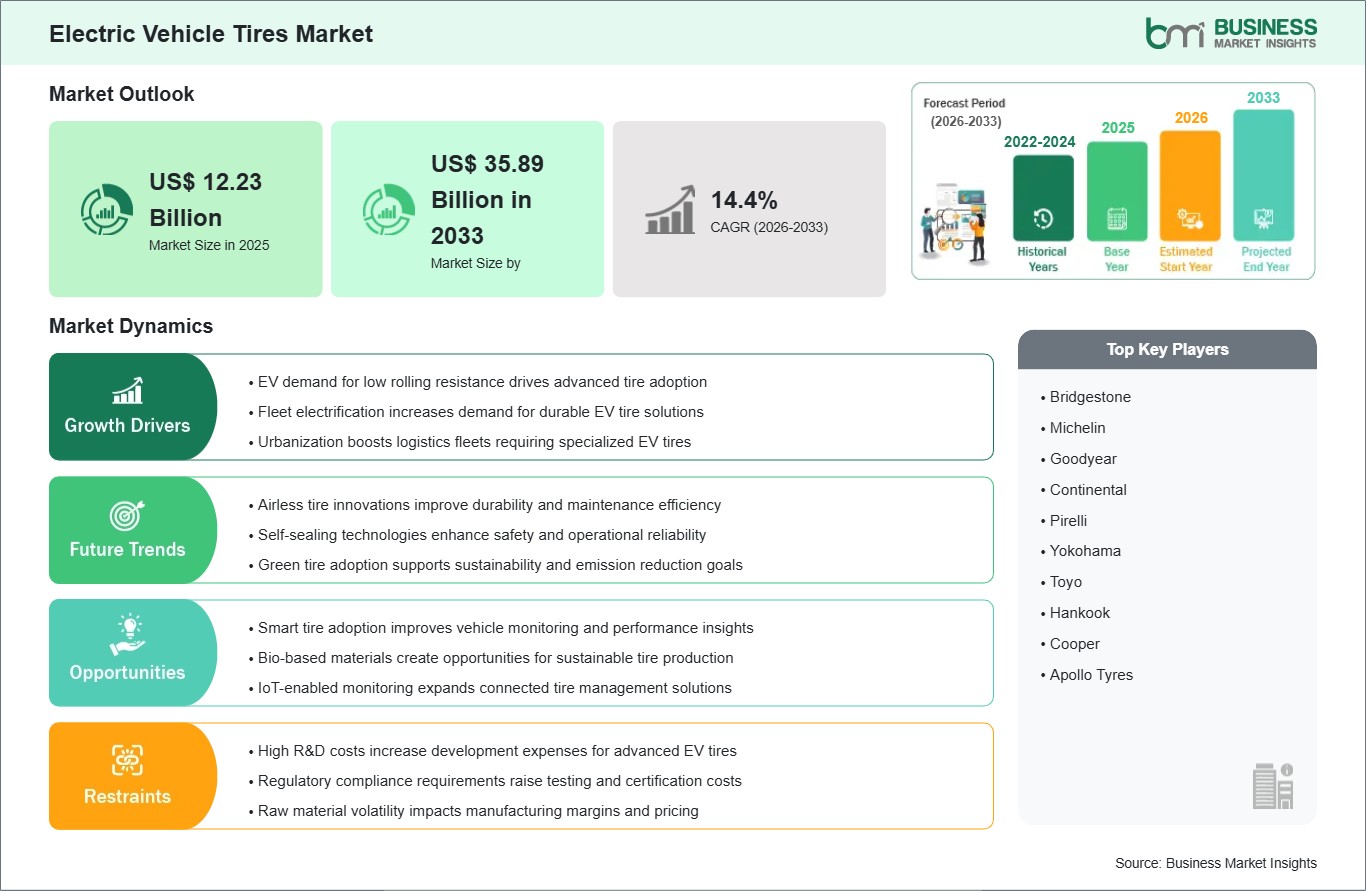
The electric vehicle tires market size is expected to reach US$ 35.89 billion by 2033 from US$ 12.23 billion in 2025. The market is estimated to record a CAGR of 14.4% from 2026 to 2033.
Electric vehicle (EV) tires's market is emerging as a specialized segment within the broader automotive tire industry, shaped by the distinct performance requirements of electric mobility. EV tires are engineered to handle higher vehicle weight due to battery packs, deliver low rolling resistance for improved driving range, and provide enhanced grip to manage instant torque delivery. As EV adoption expands globally, demand for purpose-built tires optimized for efficiency, durability, and noise reduction continues to rise steadily.
A key growth driver in this market is the unique operational characteristics of electric vehicles, which place significantly higher stress on conventional tires. EVs generate immediate torque, leading to faster tire wear, which has prompted manufacturers to develop advanced rubber compounds and reinforced structures. Additionally, the need to maximize driving range has increased the adoption of low rolling resistance tire technologies, which help reduce energy loss and improve overall vehicle efficiency. Noise reduction has also become a critical design focus due to the near-silent operation of EVs.
The market is further supported by continuous innovation in tire materials and design, including the use of silica-enhanced compounds, specialized tread patterns, and lightweight construction techniques. Tire manufacturers are increasingly collaborating with EV producers to create vehicle-specific tire models tailored to different EV segments, including passenger cars, SUVs, and commercial vehicles. This integration is helping improve performance consistency and safety across varying driving conditions.
However, the market faces challenges such as higher production costs and shorter replacement cycles compared to traditional tires. EV tires also require frequent optimization to balance durability with energy efficiency, which increases R&D complexity. Despite these constraints, the shift toward electrified mobility is expected to sustain strong demand for advanced EV tire solutions globally.

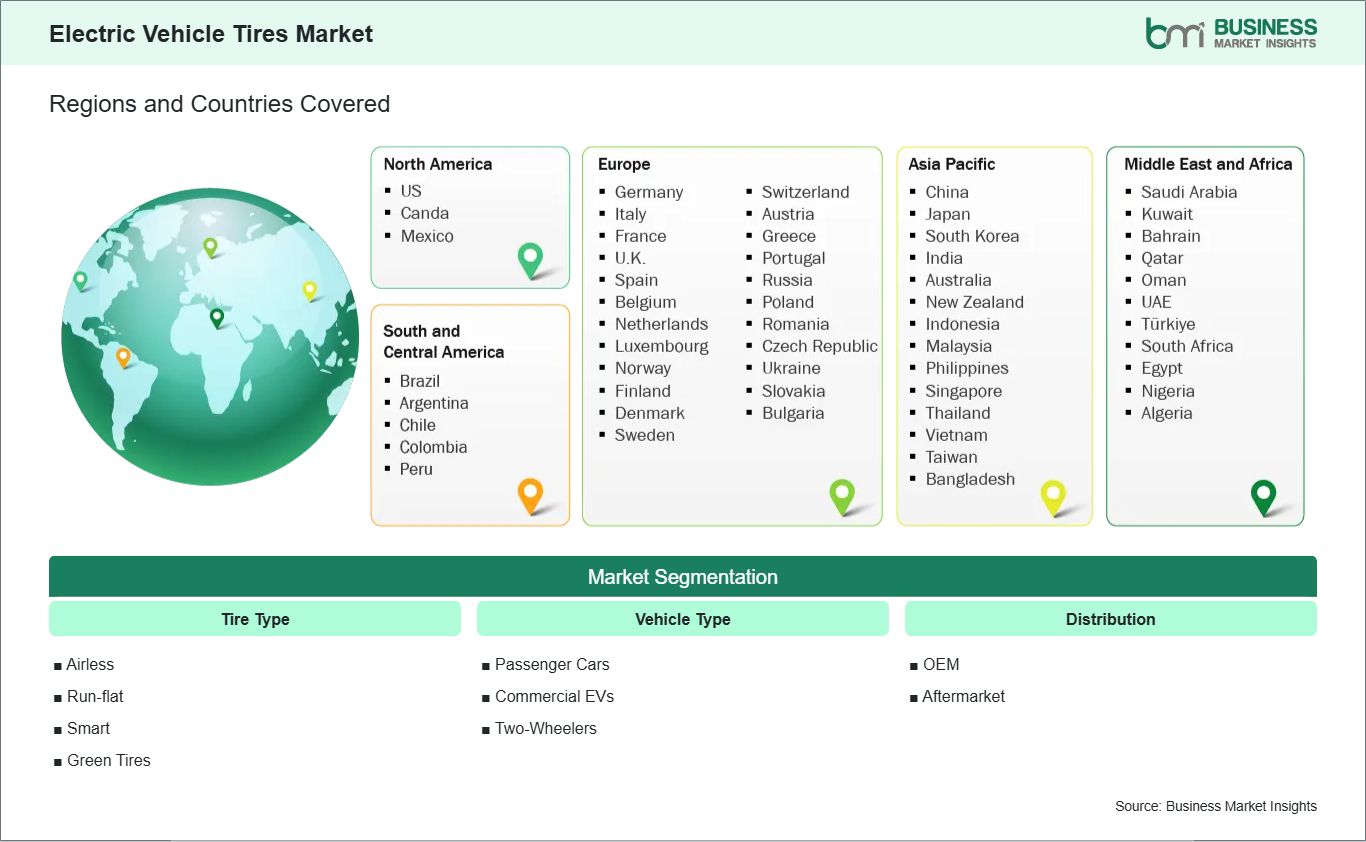
The electric vehicle (EV) tires market is segmented based on tire type, vehicle type, and distribution channel, driven by the rising demand for low rolling resistance, higher load-bearing capacity, and smart mobility solutions tailored for electric vehicles.
The electric vehicle tires market is expanding rapidly as EV adoption increases and performance requirements become more specialized compared to conventional vehicles. One such factor that drives the market is the need for tires with low rolling resistance because they actually work towards improving driving range through energy savings while driving. As efficiency in electric vehicles is very much determined by battery performance, any improvement in this area will have a marked impact.
Unlike internal combustion engine vehicles, electric vehicles generate instant torque and operate with heavier battery packs, creating higher stress on tire performance. This has led to an increased demand for more sophisticated tire materials that offer both durability and good road performance. The manufacturers have been relying on tread rubber enriched with silica content, tread patterns, and low density reinforcement material to ensure reduced rolling resistance.
Another important factor is the rising consumer expectation for quieter and smoother rides in EVs.Since the electrical drive trains create very little engine noise, tire-road noise becomes more pronounced, which leads to the creation of special acoustic tires. In addition, there is a growing trend in the development of tread design and foam insulations that make vehicles quieter while being energy efficient.
A major opportunity in the electric vehicle tires market lies in the adoption of smart tire technology integrated with sensors and real-time monitoring systems. These advanced tires have the capability to monitor parameters like tire pressure, temperature, loads, and tread wear, which helps in conducting predictive maintenance and ensuring increased vehicle safety. When it comes to electric vehicles, monitoring such parameters becomes extremely important since it affects vehicle driving range.
The smart tires also assist in sophisticated control systems of the car, where continuous feedback can be provided by the tire to the software installed within the car. This helps in optimizing torque distribution, regenerating power through efficient brakes, and changing driving attributes based on road conditions. In light of electric cars increasingly using software, tire information gains importance.
In addition, smart tire systems open new possibilities for fleet management and mobility services. Real-time analysis of the performance of tires helps minimize downtime, increase efficiency, and prolong tire lifecycles, especially in heavy-duty electric trucks. With falling prices for connectivity and sensors, it can be inferred that smart tires will become a vital feature in future electric mobility ecosystems.
The electric vehicle tires market is projected to grow from US$ 12.23 billion in 2025 to US$ 35.89 billion by 2033, registering a CAGR of 14.4% from 2026 to 2033.
By tire type, smart tires dominate the EV tire market due to their integration of sensors that provide real-time data on pressure, temperature, and wear, which is critical for optimizing EV efficiency, safety, and range performance.
By vehicle type, passenger cars dominate because of their high production volumes, faster EV adoption rates, and greater consumer demand for advanced tire technologies that enhance range, comfort, and safety.
By distribution channel, OEMs dominate as EV manufacturers increasingly equip vehicles with factory-fitted, vehicle-optimized tires to ensure maximum efficiency, performance, and compliance with EV-specific requirements.
| Report Attribute | Details |
|---|---|
| Market size in 2025 | US$ 12.23 Billion |
| Market Size by | US$ 35.89 Billion in 2033 |
| Global CAGR (2026 - 2033) | 14.4% |
| Historical Data | 2022-2024 |
| Forecast period | 2026-2033 |
| Segments Covered | By Tire Type
|
|
Regions and Countries Covered
| |
| North America | US, Canada, Mexico |
| Europe | Germany, Italy, France, U.K., Spain, Belgium, Netherlands, Luxembourg, Norway, Finland, Denmark, Sweden, Switzerland, Austria, Greece, Portugal, Russia, Poland, Romania, Czech Republic, Ukraine, Slovakia, Bulgaria |
| Asia-Pacific | China, Japan, South Korea, India, Australia, New Zealand, Indonesia, Malaysia, Philippines, Singapore, Thailand, Vietnam, Taiwan, Bangladesh |
| South and Central America | Brazil, Argentina, Chile, Colombia, Peru |
| Middle East and Africa | Saudi Arabia, United Arab Emirates, Kuwait, Bahrain, Qatar, Oman, Turkiye, South Africa, Egypt, Nigeria, Algeria |
| Market leaders and key company profiles |
|
The "Electric Vehicle Tires Market Size and Forecast (2022-2033)" report provides a detailed analysis of the market covering below areas:
In terms of geographical distribution of the Electric Vehicle Tires Market, there is a varied pattern of adoption based on factors such as electric vehicle penetration, expansion of EV manufacturing, advancements in tire technology, and increasing demand for low rolling resistance and high-durability tires. The shift toward improving vehicle efficiency, extending driving range, reducing noise, and enhancing load-bearing capacity in EVs is one of the major drivers behind market growth.
North America is a technologically advanced market for electric vehicle tires, supported by strong automotive OEM presence, rising EV adoption, and continuous investments in mobility infrastructure.The increase in the demand for specialized tires that serve EVs, whose capabilities include being able to support more torque, increased weight due to batteries, and increased energy-efficiency needs, has been noted. It is the focus on high-performance EVs in this area that is driving new developments in the tire sector. The development of EV charging stations and increased consumer inclination towards sustainable transportation systems is also aiding market growth.
Asia Pacific is the fastest-growing region in the electric vehicle tires market, driven by large-scale EV production, strong government support, and a well-established automotive manufacturing ecosystem. Some of the country contributing to the development of the market include China, India, Japan, and South Korea, with China dominating the global use of EVs as well as the demand for tires because of its huge number of EVs. The area is advantaged by efficient manufacturing facilities and high demand for electric mobility in its own territory. More production of electric cars, buses, and bikes has led to higher demands for EV-specific tires.
Both North America and Asia Pacific are key contributors to the growth of the electric vehicle tires market, driven by increasing EV adoption, rapid advancements in tire technologies, and the rising need for energy-efficient, durable, and low-noise tire solutions. The transition toward electric mobility, combined with expanding EV manufacturing ecosystems and infrastructure development, is further strengthening demand for specialized tires that enhance vehicle range, safety, and overall performance.

The electric vehicle tires market is evaluated by gathering qualitative and quantitative data post primary and secondary research, which includes important corporate publications, association data, and databases. Recent developments and news in the market include:
The Electric Vehicle Tires Market is valued at US$ 12.23 Billion in 2025, it is projected to reach US$ 35.89 Billion in 2033 by .
As per our report Electric Vehicle Tires Market, the market size is valued at US$ 12.23 Billion in 2025, projecting it to reach US$ 35.89 Billion in 2033 by . This translates to a CAGR of approximately 14.4% during the forecast period.
The Electric Vehicle Tires Market report typically cover these key segments-
The historic period, base year, and forecast period can vary slightly depending on the specific market research report. However, for the Electric Vehicle Tires Market report:
The Electric Vehicle Tires Market is populated by several key players, each contributing to its growth and innovation. Some of the major players include:
The Electric Vehicle Tires Market report is valuable for diverse stakeholders, including:
Essentially, anyone involved in or considering involvement in the Electric Vehicle Tires Market value chain can benefit from the information contained in a comprehensive market report.
Please tell us your area of interest
(Market Segments/ Regions and Countries/ Companies)