
Electric Commercial Vehicle Market Outlook: Size, Share, Trends, Growth Analysis, Competitive Landscape & Forecast, 2026-2033

Historic Data: 2022-2024   |   Base Year: 2025   |   Forecast Period: 2026-2033
Report Content: Market Scope, Market Segmentation, Market Dynamics, and Competitive Analysis

Report Coverage:
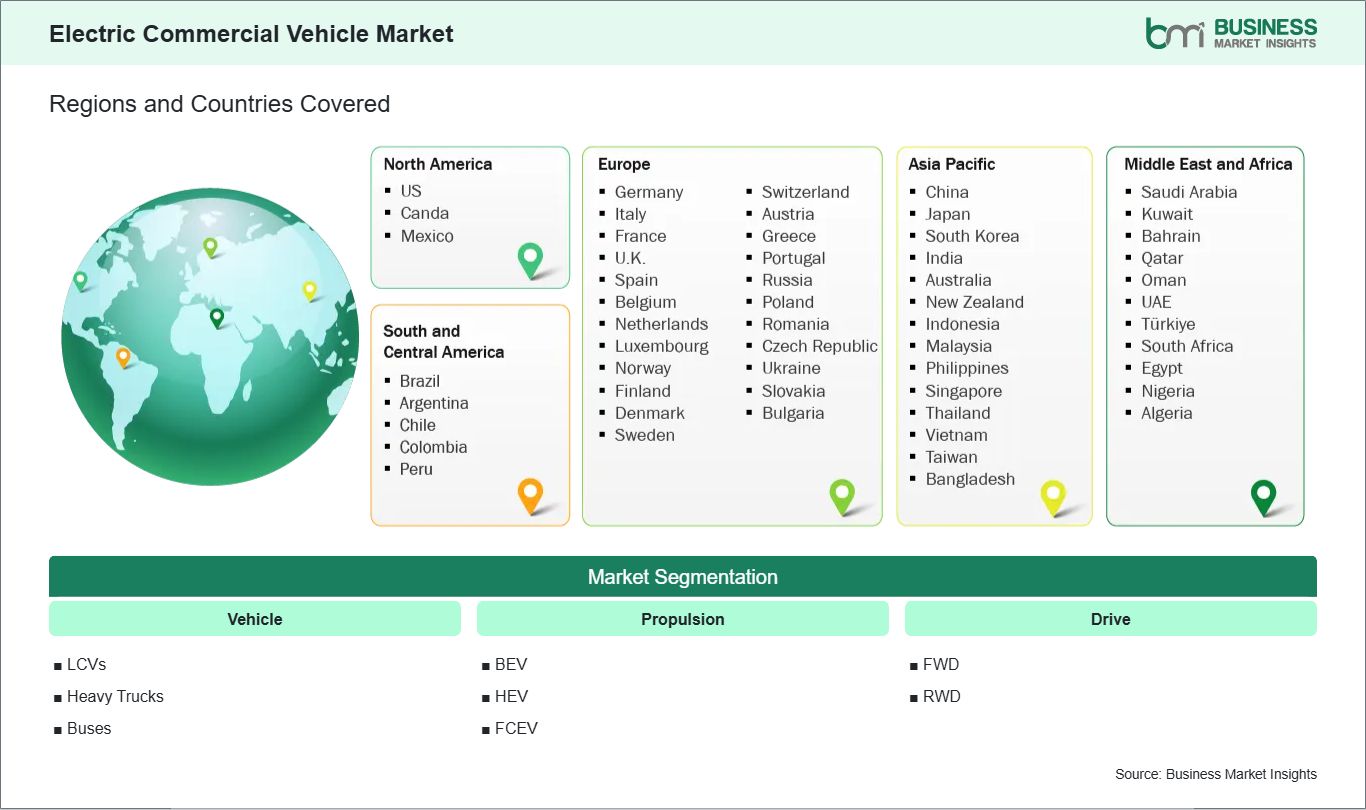
  • Vehicle (LCVs, Heavy Trucks, Buses)
  • Propulsion (BEV, HEV, FCEV)
  • Drive (FWD, RWD)

No. of Pages: 400
Report Code: BMIPUB00035578
Category: Automotive and Transportation
Electric Commercial Vehicle Market

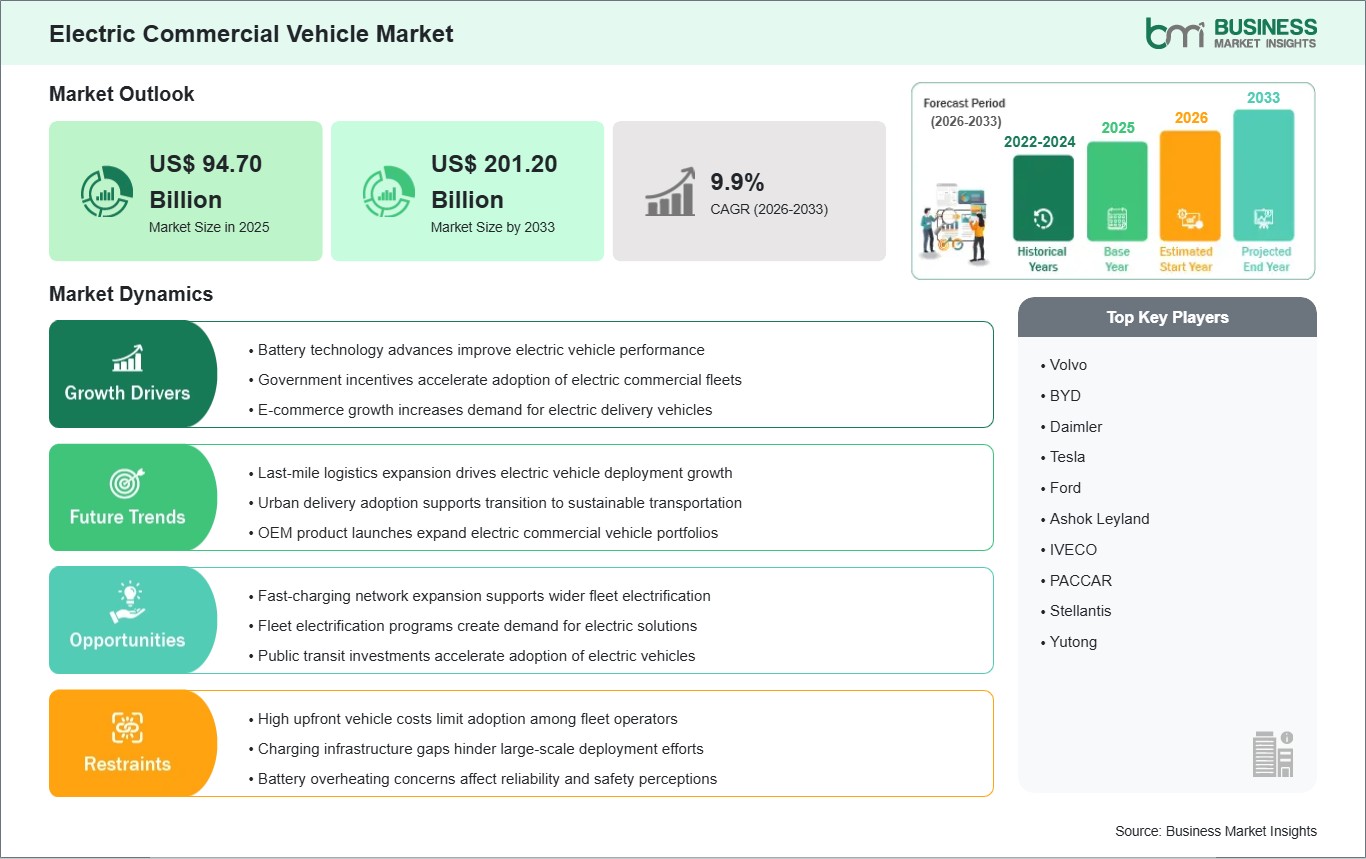
The electric commercial vehicle market size is expected to reach US$ 201.20 billion by 2033 from US$ 94.70 billion in 2025. The market is estimated to record a CAGR of 9.9% during 2026 to 2033.

Executive Summary and Global Market Analysis:

Electric commercial vehicles (ECVs) are transportation solutions powered partially or entirely by electric propulsion systems and are increasingly deployed across freight logistics, public transportation, municipal services, and industrial operations. These vehicles include electric light commercial vehicles (LCVs), heavy-duty trucks, and buses designed to reduce emissions, improve energy efficiency, and support sustainable transportation objectives.

The market is witnessing substantial growth as governments, fleet operators, and logistics providers accelerate the transition toward low-carbon mobility solutions. Growing concerns regarding greenhouse gas emissions, fuel price volatility, and urban air quality are encouraging the adoption of battery-electric and alternative electric propulsion technologies. Regulatory frameworks promoting vehicle electrification are further supporting deployment across developed and emerging economies.

The rapid expansion of e-commerce and urban delivery networks is reshaping transportation requirements globally. Fleet operators are increasingly adopting electric commercial vehicles to improve operational efficiency and comply with emissions regulations in densely populated urban areas. The demand for last-mile delivery solutions is particularly strong among logistics companies seeking cost-effective and sustainable transportation alternatives.

Technological advancements in battery systems, vehicle telematics, and charging infrastructure are improving vehicle range, charging speed, and total cost of ownership. Battery energy density improvements and declining battery costs are enhancing the economic viability of electric trucks and buses. Integration of smart fleet management systems is also enabling optimized route planning, predictive maintenance, and energy utilization.

Electric Commercial Vehicle Market - Strategic Insights:

global-market-strategic-framework
Get more information on this report

Electric Commercial Vehicle Market Segmentation Analysis:

The electric commercial vehicle market is segmented based on vehicle, propulsion, and drive, reflecting the increasing adoption of electrified transportation solutions across logistics, freight, and public transportation sectors.

By Vehicle

  • LCVs: Widely adopted for urban freight transportation and last-mile delivery applications due to lower operating costs, regulatory compliance benefits, and increasing e-commerce activity.
  • Heavy Trucks: Gaining adoption in regional and long-haul freight transportation as battery technologies improve range capabilities and charging infrastructure expands.
  • Buses: Experiencing strong deployment across public transportation networks due to government-supported electrification initiatives and urban sustainability programs.

By Propulsion

  • BEV: Dominates market adoption owing to zero tailpipe emissions, improving battery performance, and increasing charging infrastructure availability.
  • HEV: Utilized in applications requiring enhanced fuel efficiency and operational flexibility where full electrification infrastructure remains limited.
  • FCEV: Emerging in heavy-duty transportation segments requiring extended driving ranges, rapid refueling capabilities, and high payload capacity.

By Drive

  • FWD: Primarily used in light commercial vehicle applications due to compact drivetrain architecture and operational efficiency.
  • RWD: Preferred in heavy commercial vehicles and buses because of superior load-carrying capabilities, traction, and durability under demanding operating conditions.
Electric Commercial Vehicle Market Drivers and Opportunities:

Advancements in Battery Technology

By making constant improvements in battery chemistry, energy density, charging efficiency and lifecycle performance, the rate of electric commercial vehicle adoption is increasing rapidly. Modern battery technologies allow for greater vehicle ranges, shortened charging periods, as well as overall lower operating costs. In addition to this, manufacturers are putting a lot of money into next generation battery platforms so they will last longer and can handle more weight per load.

With the steady decrease in the cost of lithium ion battery systems, the economic feasibility for the use of electric trucks, buses and delivery vehicles has drastically improved. In addition, battery management systems have improved to the point where performance degradation has been minimized and the reliability of the vehicle over extended use has improved. The continuing evolution of battery technology has led to many commercial fleet operators viewing electric vehicles as a viable alternative to conventional diesel powered fleets.

Through funding programs and manufacturing incentives, governments around the globe are paving the way for the development of a domestic supply chain for battery innovation. This is increasing production capabilities and decreasing reliance on foreign energy resources. As a result, battery technology advancements will drive market expansion throughout the forecast period.

Expansion of Fast-Charging Networks

There is a lot of growth potential in the growing arena of charging infrastructure for electric commercial vehicles. The fast-tracking of high-capacity charging station installations in urban areas and industrial transport hubs is supported by both public and private investments.

Demand for rapid charging networks will reduce downtime for vehicles. Historically, range concerns have been the biggest barrier to the electrification of commercial fleets. The rapid emergence of megawatt charging solutions for heavy-duty trucks will support long-haul freight transportation by assisting in the rapid recharging of truck batteries during mandated driver rest periods.

Increasing collaboration between logistics operators, charging infrastructure providers, utility companies, and manufacturers will help facilitate the establishment of comprehensive charging ecosystems. Reliably accessible charging along all routes is critical for successful fleet electrification.

In addition, because of long-term infrastructure investments facilitated by national clean transportation policies and decarbonization targets, the continued improvement of charging access will drive the increased adoption of electric commercial vehicles across the freight, transit, and municipal service markets.

Electric Commercial Vehicle Market Size and Share Analysis:

The electric commercial vehicle market is projected to grow from US$ 94.70 billion in 2025 to US$ 201.20 billion by 2033, registering a CAGR of 9.9% from 2026 to 2033.

By vehicle, LCVs account for a significant market share due to growing demand for urban delivery solutions and expanding e-commerce activities. Buses also represent a major segment, supported by public transportation electrification programs globally. Heavy trucks are witnessing increasing adoption as battery performance and charging infrastructure continue to improve.

By propulsion, BEVs dominate the market owing to strong regulatory support, technological advancements, and growing charging infrastructure availability. HEVs maintain relevance in regions with evolving electrification ecosystems, while FCEVs are gradually expanding within heavy-duty transportation applications.

By drive, RWD holds a notable share due to its widespread use in buses and heavy-duty commercial vehicles. FWD adoption remains concentrated in light commercial vehicle categories serving urban logistics operations.

Electric Commercial Vehicle Market Report Highlights:

Report Attribute Details
Market size in 2025 US$ 94.70 Billion
Market Size by 2033 US$ 201.20 Billion
Global CAGR (2026 - 2033)9.9%
Historical Data 2022-2024
Forecast period 2026-2033
Segments Covered By Vehicle
  • LCVs
  • Heavy Trucks
  • Buses
By Propulsion
  • BEV
  • HEV
  • FCEV
By Drive
  • FWD
  • RWD
Regions and Countries Covered
North America US, Canada, Mexico
Europe Germany, Italy, France, U.K., Spain, Belgium, Netherlands, Luxembourg, Norway, Finland, Denmark, Sweden, Switzerland, Austria, Greece, Portugal, Russia, Poland, Romania, Czech Republic, Ukraine, Slovakia, Bulgaria
Asia-Pacific China, Japan, South Korea, India, Australia, New Zealand, Indonesia, Malaysia, Philippines, Singapore, Thailand, Vietnam, Taiwan, Bangladesh
South and Central America Brazil, Argentina, Chile, Colombia, Peru
Middle East and Africa Saudi Arabia, United Arab Emirates, Kuwait, Bahrain, Qatar, Oman, Turkiye, South Africa, Egypt, Nigeria, Algeria
Market leaders and key company profiles
  • Volvo
  • BYD
  • Daimler
  • Tesla
  • Ford
  • Ashok Leyland
  • IVECO
  • PACCAR
  • Stellantis
  • Yutong
Get more information on this report

Electric Commercial Vehicle Market Report Coverage and Deliverables:

The "Electric Commercial Vehicle Market Size and Forecast (2022 - 2033)" report provides a detailed analysis of the market covering below areas:

  • Market size and forecast at global, regional, and country levels for all key market segments covered under the scope
  • Market trends, along with market dynamics such as drivers, restraints, and key opportunities
  • Market analysis covering key trends, global and regional frameworks, major players, regulations, and recent developments
  • Industry landscape and competitive analysis covering market concentration, heat map analysis, prominent players, and recent developments
  • Detailed company profiles, including SWOT analysis

Electric Commercial Vehicle Market Geographic Insights:

The electric commercial vehicle sector is experiencing different degrees of acceptance in the various regions. This can be attributed to the regions' individual regulatory frameworks, readiness of infrastructure, truck fleet modernization initiatives and transportation electrification target. General market development will also be affected by government incentives, the expansion of charging networks and truck replacement cycles within the respective fleets.

In North America, the electric commercial vehicle market continues to see strong level of growth; catalysts such as corporate sustainability commitments, programmes to support fleet electrification, and investment in charging infrastructure are providing the necessary momentum that leads to increased numbers of electric commercial vehicles within fleet-based operations such as logistics providers deploying electric delivery vehicles to fulfil the urban transportation and emissions reduction strategies of their clients; and transit authorities developing or expanding the procurement of electric bus programmes.

Asia Pacific will be the largest area for the growth of electric commercial vehicles in the near future; due to increasing population density and rapid urbanization; the expansion of manufacturing capacity; and strong government initiatives in support of electric mobility. Countries within this region are investing heavily in the procurement of electric buses, electric commercial fleets and manufacturing capabilities for batteries used in electric vehicles. Growth within e-commerce will also encourage the adoption of LCVs; therefore, the overall growth of this region will exceed that in other parts of the world.

Europe holds the largest market share of all regions because it has very aggressive emission standards for commercial vehicles; as well as low-emissions zones; and aggressive targets for decarbonization. Additionally, the continued use of government incentives and sustainability mandates by fleet operators are driving fleet owners toward adopting electric commercial vehicles. The development of infrastructure for charging and overall clean technology within the transportation industry are also benefiting from large investments within this region.

global-market-geography
Get more information on this report

Electric Commercial Vehicle Market Research Report Guidance:

  • The report includes qualitative and quantitative data in the Electric Commercial Vehicle Market across vehicle, propulsion, drive, and geography.
  • The report starts with the key takeaways (chapter 2), highlighting key trends and outlook of the market.
  • Chapter 3 focuses on the research methodology of the study.
  • Chapter 4 includes ecosystem analysis.
  • Chapter 5 highlights the major industry dynamics in the market, including factors that are driving the market, prevailing deterrents, potential opportunities, as well as future trends. Impact analysis of these drivers and restraints is also covered in this section.
  • Chapter 6 discusses the market scenario, in terms of historical market revenues, and forecast till the year 2033.
  • Chapters 7 to 10 cover market segments by vehicle, propulsion, drive, and geography across North America, Asia Pacific, Europe, Middle East and Africa, and South and Central America. They cover the market revenue forecast and factors driving the market.
  • Chapter 11 describes the competitive analysis along with the heat map analysis for the key players operating in the market.
  • Chapter 12 describes the industry landscape analysis. It provides detailed descriptions of business activities such as market initiatives, new developments, mergers, and joint ventures globally, along with a competitive landscape.
  • Chapter 13 provides detailed profiles of the major companies operating in the market. Companies have been profiled on the basis of their key facts, business descriptions, products, financial overview, SWOT analysis, and key developments.
  • Chapter 14, i.e., the appendix, is inclusive of a brief overview of the company, a list of abbreviations, and a disclaimer.

Electric Commercial Vehicle Market News and Key Development:

The electric commercial vehicle market is evaluated by gathering qualitative and quantitative data post primary and secondary research, which includes important corporate publications, association data, and databases. Recent developments and news in the market include:

  • In April 2026, Volvo Trucks announced an upgraded version of its FH Aero Electric heavy-duty truck with a driving range of up to 700 km and compatibility with Megawatt Charging System (MCS) technology, strengthening its position in long-haul electric freight transportation.
  • In November 2025, BYD Commercial Vehicles showcased its new family of pure-electric commercial trucks, including the all-new battery-electric cab-over truck T4 and showcase its heavy-hitters across light-duty, heavy-duty and passenger segments—the hybrid light truck T5, electric tractor Q3 and the new-generation e-bus C11—underscoring BYD's drive to accelerate green transformation in road transport.

Key Sources Referred:

World Bank - Global Transport and Infrastructure DataInternational Energy Agency (IEA)International Monetary Fund (IMF)International Trade Administration (ITA)International Council on Clean Transportation (ICCT)World Trade Organization (WTO)
The List of Companies - Electric Commercial Vehicle Market
  • Volvo
  • BYD
  • Daimler
  • Tesla
  • Ford
  • Ashok Leyland
  • IVECO
  • PACCAR
  • Stellantis
  • Yutong
Frequently Asked Questions
How big is the Electric Commercial Vehicle Market?

The Electric Commercial Vehicle Market is valued at US$ 94.70 Billion in 2025, it is projected to reach US$ 201.20 Billion by 2033.

What is the CAGR for Electric Commercial Vehicle Market by (2026 - 2033)?

As per our report Electric Commercial Vehicle Market, the market size is valued at US$ 94.70 Billion in 2025, projecting it to reach US$ 201.20 Billion by 2033. This translates to a CAGR of approximately 9.9% during the forecast period.

What segments are covered in this report?

The Electric Commercial Vehicle Market report typically cover these key segments-

  • Vehicle (LCVs, Heavy Trucks, Buses)
  • Propulsion (BEV, HEV, FCEV)
  • Drive (FWD, RWD)

What is the historic period, base year, and forecast period taken for Electric Commercial Vehicle Market?

The historic period, base year, and forecast period can vary slightly depending on the specific market research report. However, for the Electric Commercial Vehicle Market report:

  • Historic Period : 2022-2024
  • Base Year : 2025
  • Forecast Period : 2026-2033
  • Who are the major players in Electric Commercial Vehicle Market?

    The Electric Commercial Vehicle Market is populated by several key players, each contributing to its growth and innovation. Some of the major players include:

  • Volvo
  • BYD
  • Daimler
  • Tesla
  • Ford
  • Ashok Leyland
  • IVECO
  • PACCAR
  • Stellantis
  • Yutong
  • Who should buy this report?

    The Electric Commercial Vehicle Market report is valuable for diverse stakeholders, including:

    • Investors: Provides insights for investment decisions pertaining to market growth, companies, or industry insights. Helps assess market attractiveness and potential returns.
    • Industry Players: Offers competitive intelligence, market sizing, and trend analysis to inform strategic planning, product development, and sales strategies.
    • Suppliers and Manufacturers: Helps understand market demand for components, materials, and services related to concerned industry.
    • Researchers and Consultants: Provides data and analysis for academic research, consulting projects, and market studies.
    • Financial Institutions: Helps assess risks and opportunities associated with financing or investing in the concerned market.

    Essentially, anyone involved in or considering involvement in the Electric Commercial Vehicle Market value chain can benefit from the information contained in a comprehensive market report.

    Available Report Formats

    pdf-format excel-format pptx-format
    Buy Now
    Sales Assistance
    +1 646 791 7070 (US & UK)
    Customization Form

    Please tell us your area of interest
    (Market Segments/ Regions and Countries/ Companies)