
Electric Vehicle Polymers Market Outlook: Size, Share, Trends, Growth Analysis, Competitive Landscape & Forecast, 2026-2033

Historic Data: 2022-2024   |   Base Year: 2025   |   Forecast Period: 2026-2033
Report Content: Market Scope, Market Segmentation, Market Dynamics, and Competitive Analysis

Report Coverage:
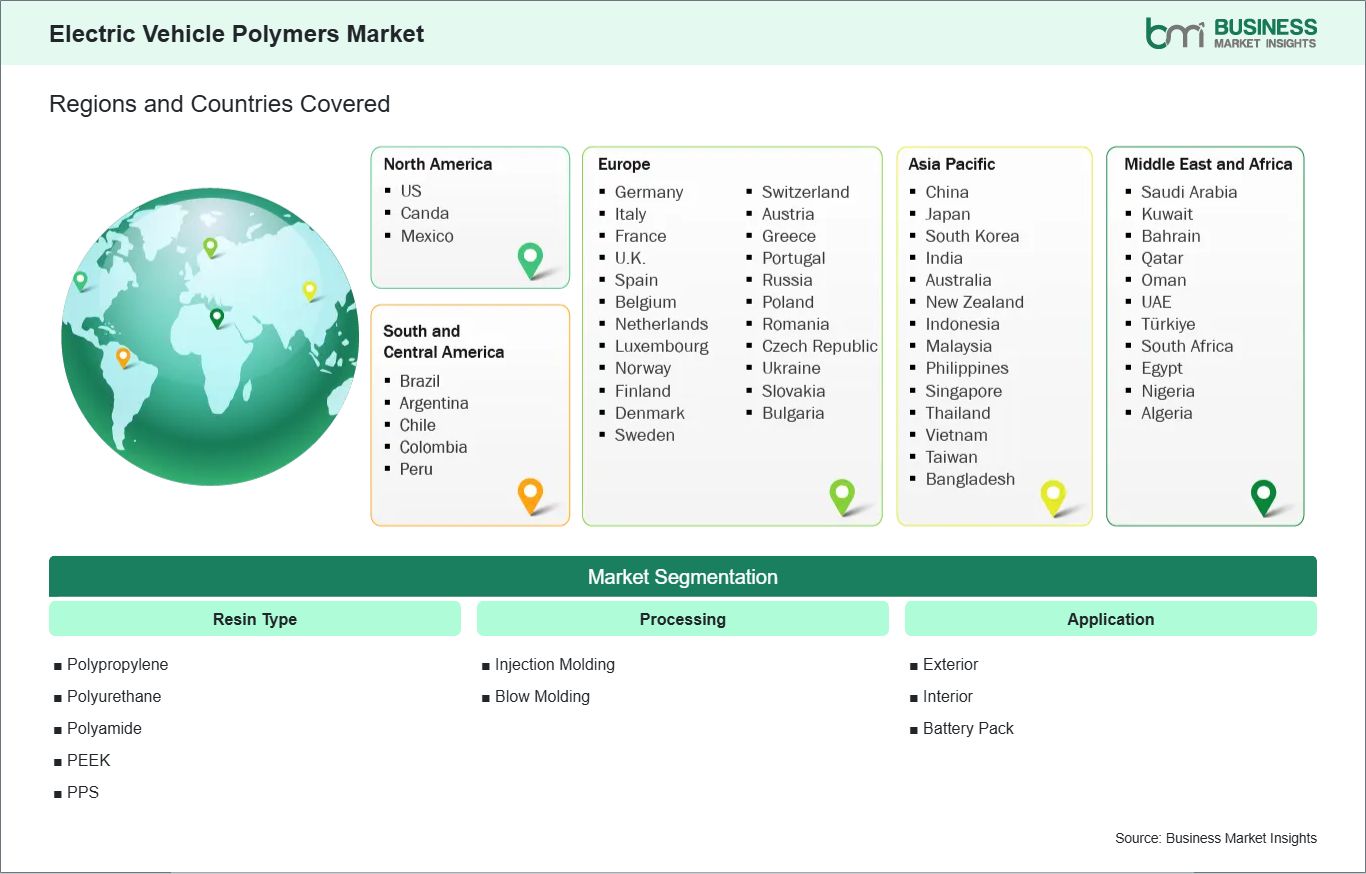
  • Resin Type (Polypropylene, Polyurethane, Polyamide, PEEK, PPS)
  • Processing (Injection Molding, Blow Molding)
  • Application (Exterior, Interior, Battery Pack)

No. of Pages: 400
Report Code: BMIPUB00035597
Category: Automotive and Transportation
Electric Vehicle Polymers Market

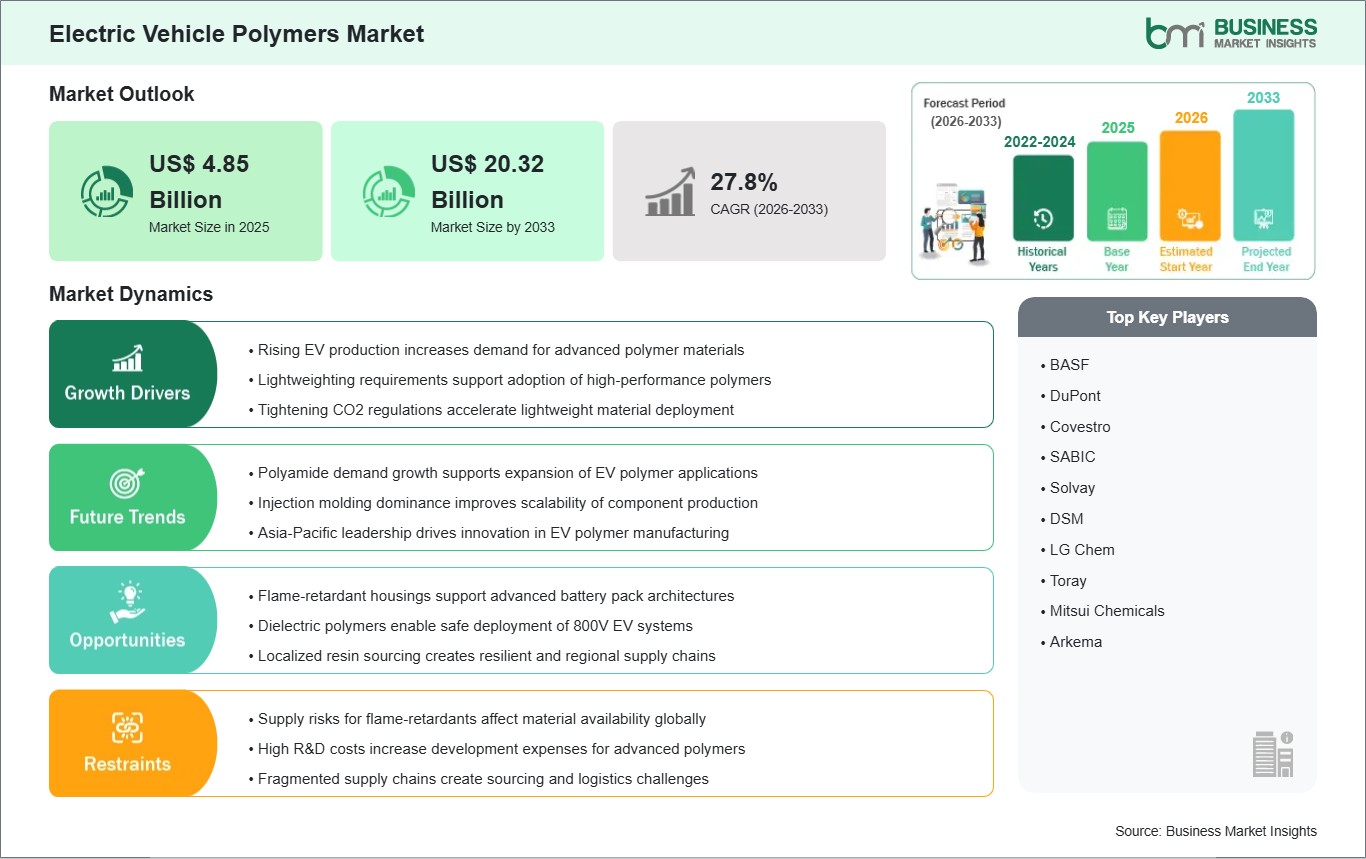
The electric vehicle polymers market size is expected to reach US$ 20.32 billion by 2033 from US$ 4.85 billion in 2025. The market is estimated to record a CAGR of 27.8% from 2026 to 2033.

Executive Summary and Global Market Analysis:

Electric vehicle (EV) polymers market is emerging as a vital component of the electric mobility ecosystem, driven by the increasing adoption of electric vehicles and the need for lightweight, durable, and energy-efficient materials. Polymers are extensively used across EV applications such as battery systems, interior modules, electrical insulation, and structural components. Their ability to replace heavier metals while maintaining strength and flexibility supports improved vehicle efficiency, enhanced design freedom, and optimized performance in modern EV architectures worldwide.

A major factor driving market growth is the continuous advancement in high-performance polymer materials designed for demanding EV environments. These include thermoplastics, composites, and engineered elastomers that offer superior thermal resistance, flame retardancy, and electrical insulation. The rising focus on battery safety and thermal management has further strengthened the demand for specialized polymer solutions. Additionally, automakers are increasingly adopting sustainable material strategies, encouraging the use of recyclable and bio-based polymers in EV production systems.

Despite strong growth drivers, the market faces notable challenges that can restrain its expansion. High production costs associated with advanced polymer formulations and processing technologies remain a key barrier, particularly for price-sensitive EV segments. Additionally, technical limitations in extreme operating conditions and the complexity of recycling multi-layered polymer structures create sustainability and end-of-life management concerns. These factors require ongoing innovation and cost optimization efforts across the value chain.

Looking ahead, the market is expected to benefit from rapid advancements in material science and the expanding global EV manufacturing ecosystem. Increasing collaboration between automotive OEMs and polymer manufacturers is accelerating the development of customized, application-specific materials. As EV penetration deepens across global markets, polymers will play an increasingly strategic role in enabling lighter, safer, and more energy-efficient vehicles, reinforcing their importance in the future of sustainable transportation.

Electric Vehicle Polymers Market - Strategic Insights:

global-market-strategic-framework
Get more information on this report

Electric Vehicle Polymers Market Segmentation Analysis:

The electric vehicle (EV) polymers market is segmented based on resin type, processing technology, and application, reflecting the growing shift toward lightweight materials, improved energy efficiency, and enhanced thermal and mechanical performance in electric mobility systems.

By Resin Type

  • Polypropylene (PP): Widely used due to its lightweight nature, cost-effectiveness, and good chemical resistance. Common in interior trims, bumpers, and battery casings.
  • Polyurethane (PU): Used for cushioning, seating, insulation, and flexible foams. Offers excellent durability, comfort, and thermal insulation properties.
  • Polyamide (PA / Nylon): Preferred for structural and under-the-hood components due to high strength, heat resistance, and mechanical stability.
  • PEEK (Polyether Ether Ketone): High-performance engineering polymer used in critical EV components requiring extreme heat resistance and chemical stability, especially in battery systems and electrical parts.
  • PPS (Polyphenylene Sulfide): Used in high-temperature and chemical-resistant applications such as connectors, sensors, and battery-related components.

By Processing

  • Injection Molding: The most widely used process for EV polymers, enabling high-volume production of complex and precise components such as dashboards, housings, connectors, and structural parts.
  • Blow Molding: Used primarily for hollow plastic parts such as fluid reservoirs, ducts, and lightweight structural containers in EV systems.

By Application

  • Exterior: Includes bumpers, body panels, underbody shields, grilles, and trims. Polymers help reduce vehicle weight and improve aerodynamics and energy efficiency.
  • Interior: Covers dashboards, seating components, door panels, consoles, and insulation materials, focusing on comfort, aesthetics, and lightweight design.
  • Battery Pack: One of the fastest-growing segments, involving enclosures, separators, thermal management components, and electrical insulation parts where high-performance polymers ensure safety and thermal stability.
Electric Vehicle Polymers Market Drivers and Opportunities:

Rising EV Production Globally

Electric vehicle production has been expanding rapidly across major automotive economies, driven by regulatory pressure on emissions, consumer shift toward cleaner mobility, and aggressive electrification roadmaps from leading OEMs. China remains the world’s leading production center, owing to an extensive network of battery providers and polymer compound producers that allow for quick scalability in EV designs. On the other hand, the United States has seen considerable investments in its domestic facilities for manufacturing EVs, with car companies adopting more sophisticated polymer parts in the new generation vehicles.

This production expansion is directly increasing the consumption of engineering polymers used in battery systems, electric drivetrains, and lightweight structural parts. Polyamides, polycarbonate alloys, and other high-performance polymers are being increasingly used as substitutes for traditional metals. Apart from their lightweight nature, the emphasis here is also placed on the material’s improved thermal stability and ability to withstand high voltage operations while providing necessary insulation. As electric vehicle platforms continue to evolve towards becoming more modular, polymers will play an important role in making this possible.

Another important factor is the geographic diversification of EV supply chains. Germany, along with other major European centers for manufacturing, has started focusing on sustainable mobility projects, promoting the usage of recyclable or bio-based polymers within the automobile industry. On the other hand, India has become one of the fastest-growing manufacturing bases owing to policies and an increase in the manufacture of electric two-wheelers or three-wheelers.

Flame-Retardant Housings for Cell-To-Pack

A major opportunity in the global EV polymers market lies in the development of flame-retardant materials for advanced battery enclosure systems, particularly in cell-to-pack and evolving cell-to-chassis designs. With increased system integration, thermal safety management has become a key consideration in engineering, thereby leading to the need for polymers that offer a combination of fire retardancy, high tensile strength, and heat resistance, particularly in high-voltage battery applications.

In China, the rapid adoption of integrated battery pack designs is accelerating the use of reinforced thermoplastics in battery covers, module separators, and protective casings. Such materials have been chosen owing to the fact that they ensure lightweight protection and are suitable for mass production. In the United States, producers of high-end electric cars are concentrating on the use of composite housing that increases crash protection and heat dissipation efficiency.

Material innovation is also reshaping this opportunity space. Polymer developers are increasingly moving toward halogen-free flame-retardant systems that rely on phosphorus- and nitrogen-based chemistries. This ensures proper mechanical strength without compromising fire safety guidelines set out for such systems. There is an increasing trend toward the adoption of such recyclable flame-retardant polymers that follow circular economy principles due to regulatory requirements in Germany and other European countries. With the continued development of battery structures, flame-retardant polymers can be seen as an essential component of future EV technology.

Electric Vehicle Polymers Market Size and Share Analysis:

The electric vehicle polymers market is projected to grow from US$ 4.85 billion in 2025 to US$ 20.32 billion by 2033, registering a CAGR of 27.8% from 2026 to 2033.

By resin type, polypropylene (PP) dominates the EV polymers market due to its low cost, lightweight nature, and balanced mechanical and chemical properties, making it widely suitable for large-scale use in both interior and exterior non-structural EV components.

By processing technology, injection molding dominates because it enables high-volume, cost-efficient production of complex, precision-engineered EV parts with consistent quality, which is essential for mass EV manufacturing.

By application, the interior segment dominates due to the extensive use of polymers in dashboards, seating, trims, and cabin components, where manufacturers prioritize lightweight materials, design flexibility, and cost efficiency.

Electric Vehicle Polymers Market Report Highlights:

Report Attribute Details
Market size in 2025 US$ 4.85 Billion
Market Size by 2033 US$ 20.32 Billion
Global CAGR (2026 - 2033)27.8%
Historical Data 2022-2024
Forecast period 2026-2033
Segments Covered By Resin Type
  • Polypropylene
  • Polyurethane
  • Polyamide
  • PEEK
  • PPS
By Processing
  • Injection Molding
  • Blow Molding
By Application
  • Exterior
  • Interior
  • Battery Pack
Regions and Countries Covered
North America US, Canada, Mexico
Europe Germany, Italy, France, U.K., Spain, Belgium, Netherlands, Luxembourg, Norway, Finland, Denmark, Sweden, Switzerland, Austria, Greece, Portugal, Russia, Poland, Romania, Czech Republic, Ukraine, Slovakia, Bulgaria
Asia-Pacific China, Japan, South Korea, India, Australia, New Zealand, Indonesia, Malaysia, Philippines, Singapore, Thailand, Vietnam, Taiwan, Bangladesh
South and Central America Brazil, Argentina, Chile, Colombia, Peru
Middle East and Africa Saudi Arabia, United Arab Emirates, Kuwait, Bahrain, Qatar, Oman, Turkiye, South Africa, Egypt, Nigeria, Algeria
Market leaders and key company profiles
  • BASF
  • DuPont
  • Covestro
  • SABIC
  • Solvay
  • DSM
  • LG Chem
  • Toray
  • Mitsui Chemicals
  • Arkema
Get more information on this report

Electric Vehicle Polymers Market Report Coverage and Deliverables:

The "Electric Vehicle Polymers Market Size and Forecast (2022-2033)" report provides a detailed analysis of the market covering below areas:

  • Market size and forecast at global, regional, and country levels for all key market segments covered under the scope
  • Market trends, along with market dynamics such as drivers, restraints, and key opportunities
  • Market analysis covering key trends, global and regional frameworks, major players, regulations, and recent developments
  • Industry landscape and competitive analysis covering market concentration, heat map analysis, prominent players, and recent developments
  • Detailed company profiles, including SWOT analysis

Electric Vehicle Polymers Market Geographic Insights:

In terms of geographical distribution, the electric vehicle (EV) polymers Market shows strong regional variation driven by EV production scale, battery manufacturing ecosystems, regulatory support for electrification, and the increasing use of lightweight, durable, and thermally stable materials in EV components such as battery packs, interiors, power electronics, and structural parts.

North America represents a highly advanced and innovation-driven market, supported by strong automotive OEMs, material science companies, and rapidly expanding battery manufacturing facilities. Large investments have been made recently in EV manufacturing plants and gigafactories by the US and Canada, increasing the use of advanced polymers in battery enclosures, thermal insulation components, electrical systems, and lightweight structures. Incentives by governments to promote the use of EVs, strict emission standards, and expansion of EV charging stations are driving market growth. Additionally, increasing focus on sustainability is driving the adoption of recyclable and bio-based polymer materials in automotive applications.

Asia Pacific is the fastest-growing region and a major hub for EV polymers demand, supported by large-scale EV manufacturing, strong government initiatives, and a well-established supply chain for electronics and chemicals. The nations include China, India, Japan, and South Korea, among many others, where China is leading globally in EV manufacturing and production of batteries. Asia has several advantages, including efficient manufacturing processes and high local demand for electric vehicles, hence fast-growing application of polymers in batteries, interiors/exteriors, connectors, and heat transfer applications. Rapid urbanization, expansion of EV fleets, and continuous investments in gigafactories are further strengthening regional market growth.

Both region play a critical role in driving the expansion of the EV polymers market, supported by rapid electrification of transportation, increasing investments in battery and EV manufacturing infrastructure, and the growing integration of advanced polymer solutions to improve performance, safety, and energy efficiency across electric vehicles.

global-market-geography
Get more information on this report

Electric Vehicle Polymers Market Research Report Guidance:

  • The report includes qualitative and quantitative data in the electric vehicle polymers market across resign type, processing, application, and geography.
  • The report starts with the key takeaways (chapter 2), highlighting the key trends and outlook of the market.
  • Chapter 3 focuses on the research methodology of the study.
  • Chapter 4 includes ecosystem analysis.
  • Chapter 5 highlights the major industry dynamics in the market, including factors that are driving the market, prevailing deterrents, potential opportunities, as well as future trends. Impact analysis of these drivers and restraints is also covered in this section.
  • Chapter 6 discusses the market scenario, in terms of historical market revenues, and forecast till the year 2033.
  • Chapters 7 to 10 cover market segments by resign type, processing, application, and geography across North America, Europe, Asia Pacific, Middle East and Africa, and South and Central America. They cover the market revenue, forecast, and factors driving the market.
  • Chapter 11 describes the competitive analysis along with the heat map analysis for the key players operating in the market.
  • Chapter 12 describes the industry landscape analysis. It provides detailed descriptions of business activities such as market initiatives, new developments, mergers, and joint ventures globally, along with a competitive landscape.
  • Chapter 13 provides detailed profiles of the major companies operating in the market. Companies have been profiled on the basis of their key facts, business descriptions, products and services, financial overview, SWOT analysis, and key developments.
  • Chapter 14, i.e., the appendix, is inclusive of a brief overview of the company, list of abbreviations, and disclaimer.

Electric Vehicle Polymers Market News and Key Development:

The electric vehicle polymers market is evaluated by gathering qualitative and quantitative data post primary and secondary research, which includes important corporate publications, association data, and databases. Recent developments and news in the market include:

  • In July 2025, Covestro, announced that it had launched its next-generation flame-retardant polyurethane encapsulation foam (Baysafe BEF) designed to improve EV battery safety by limiting thermal runaway and thermal propagation between battery cells, supporting stricter global EV battery safety standards.
  • In September 2025, SABIC, announced that it had entered a strategic collaboration with LG Chem to jointly develop advanced polymer materials for electronics applications, focusing on high-performance polymers with improved thermal stability, durability, and electrical insulation relevant to EV and battery systems.

Key Sources Referred:

  • World Bank
  • World Trade Organization (WTO)
  • International Monetary Fund (IMF)
  • International Trade Administration (ITA)
  • International Energy Agency (IEA)
  • Organisation for Economic Co-operation and Development (OECD)
  • United Nations Environment Programme (UNEP)
  • International Organization for Standardization (ISO)
  • Society of Automotive Engineers (SAE International)
  • European Commission
  • Company Websites
  • Company Annual Reports
  • Company Investor Presentations
The List of Companies - Electric Vehicle Polymers Market
  • BASF
  • DuPont
  • Covestro
  • SABIC
  • Solvay
  • DSM
  • LG Chem
  • Toray
  • Mitsui Chemicals
  • Arkema
Frequently Asked Questions
How big is the Electric Vehicle Polymers Market?

The Electric Vehicle Polymers Market is valued at US$ 4.85 Billion in 2025, it is projected to reach US$ 20.32 Billion by 2033.

What is the CAGR for Electric Vehicle Polymers Market by (2026 - 2033)?

As per our report Electric Vehicle Polymers Market, the market size is valued at US$ 4.85 Billion in 2025, projecting it to reach US$ 20.32 Billion by 2033. This translates to a CAGR of approximately 27.8% during the forecast period.

What segments are covered in this report?

The Electric Vehicle Polymers Market report typically cover these key segments-

  • Resin Type (Polypropylene, Polyurethane, Polyamide, PEEK, PPS)
  • Processing (Injection Molding, Blow Molding)
  • Application (Exterior, Interior, Battery Pack)

What is the historic period, base year, and forecast period taken for Electric Vehicle Polymers Market?

The historic period, base year, and forecast period can vary slightly depending on the specific market research report. However, for the Electric Vehicle Polymers Market report:

  • Historic Period : 2022-2024
  • Base Year : 2025
  • Forecast Period : 2026-2033
  • Who are the major players in Electric Vehicle Polymers Market?

    The Electric Vehicle Polymers Market is populated by several key players, each contributing to its growth and innovation. Some of the major players include:

  • BASF
  • DuPont
  • Covestro
  • SABIC
  • Solvay
  • DSM
  • LG Chem
  • Toray
  • Mitsui Chemicals
  • Arkema
  • Who should buy this report?

    The Electric Vehicle Polymers Market report is valuable for diverse stakeholders, including:

    • Investors: Provides insights for investment decisions pertaining to market growth, companies, or industry insights. Helps assess market attractiveness and potential returns.
    • Industry Players: Offers competitive intelligence, market sizing, and trend analysis to inform strategic planning, product development, and sales strategies.
    • Suppliers and Manufacturers: Helps understand market demand for components, materials, and services related to concerned industry.
    • Researchers and Consultants: Provides data and analysis for academic research, consulting projects, and market studies.
    • Financial Institutions: Helps assess risks and opportunities associated with financing or investing in the concerned market.

    Essentially, anyone involved in or considering involvement in the Electric Vehicle Polymers Market value chain can benefit from the information contained in a comprehensive market report.

    Available Report Formats

    pdf-format excel-format pptx-format
    Buy Now
    Sales Assistance
    +1 646 791 7070 (US & UK)
    Customization Form

    Please tell us your area of interest
    (Market Segments/ Regions and Countries/ Companies)