
Electric Vehicle Battery Swapping Market Outlook: Size, Share, Trends, Growth Analysis, Competitive Landscape & Forecast, 2026–2033

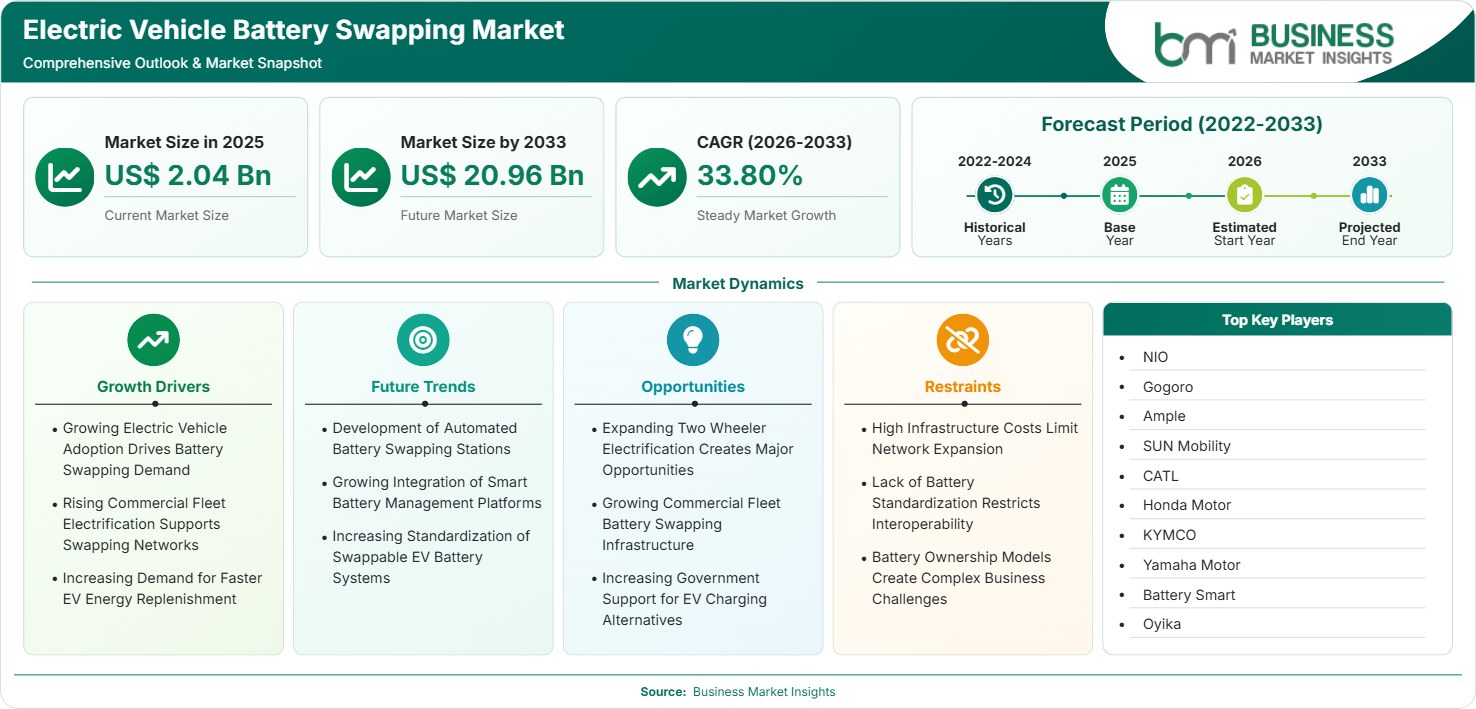
The Electric Vehicle Battery Swapping Market size was valued at US$ 2.04 billion in 2025 and is projected to reach US$ 20.96 billion by 2033, growing at a CAGR of 33.80% during 2026–2033, supported by fleet electrification, rapid energy replenishment, urban mobility demand, battery standardization, and expanding swapping infrastructure.

Report Coverage
  • Service Type: Subscription Model, Pay-Per-Use Model
  • Vehicle Type: Two-Wheeler, Three-Wheeler, Others
US$ 2.04 Bn Market size in 2025
US$ 20.96 Bn Market Size by 2033
33.80% CAGR, 2026 - 2033
2026-2033 Forecast Period

AI Overview

Electric Vehicle Battery Swapping Market Summary

  • North America Region: North America holds a 10%–14% share in 2025 and is projected to grow at a 27.0%–30.5% CAGR through 2033, supported by commercial electrification, fleet utilization, battery-as-a-service models, urban delivery demand, and infrastructure investment.
  • Fastest Growing Region: Asia Pacific holds a 58%–63% share in 2025 and is projected to grow at a 35.0%–38.5% CAGR through 2033, supported by two-wheeler electrification, dense urban mobility, commercial fleets, battery-swapping networks, and supportive policy environments.
  • Leading Segment: Two-Wheeler holds a 64%–69% share in 2025 and is projected to grow at a 34.0%–37.0% CAGR through 2033, supported by high utilization, compact battery packs, delivery fleets, limited charging access, and rapid energy replenishment needs.
  • High Growth Segment: Subscription Model holds a 32%–37% share in 2025 and is projected to grow at a 36.0%–40.0% CAGR through 2033, supported by predictable operating costs, fleet utilization, battery ownership flexibility, and recurring service relationships.
  • Key Market Opportunity: Dense urban fleets, electric two-wheelers, commercial delivery operations, battery-as-a-service platforms, and interoperable swapping networks create opportunities for infrastructure providers, mobility operators, battery manufacturers, and technology developers.
  • Major Market Players: NIO Inc.; Gogoro Inc.; Ample, Inc.; SUN Mobility; Contemporary Amperex Technology Co., Limited; Honda Motor Co., Ltd.; Kwang Yang Motor Co., Ltd.; Yamaha Motor Co., Ltd.; Battery Smart; Oyika.
Strategic Insights

Electric Vehicle Battery Swapping Market: Strategic Insights

Electric Vehicle Battery Swapping Market Strategic Framework
FREE PDF
Request your free sample
Request free sample
Stakeholder View

Key Takeaways

  • The value chain is shifting toward integrated ecosystems where batteries, swapping stations, software, fleet management, energy supply, and mobility services operate as connected components.
  • Commercial two-wheelers and other high-utilization vehicles offer strong upside because minimizing charging downtime directly improves asset utilization and operator productivity.
  • Battery-as-a-service models can reduce upfront vehicle costs by separating battery ownership from vehicle ownership, creating recurring revenue opportunities for specialized infrastructure operators.
  • Dense urban markets provide an attractive investment case where limited parking, high vehicle utilization, and frequent energy replenishment make conventional charging less convenient.
  • Strategic partnerships between vehicle manufacturers, battery suppliers, mobility platforms, energy companies, and swapping operators can accelerate network development and improve ecosystem compatibility.
  • Interoperability will remain strategically important because fragmented battery formats, connector architectures, software systems, and operating standards can restrict network utilization and slow market scaling.
Geographic Outlook

Electric Vehicle Battery Swapping Market Regional Highlights

North America Electric Vehicle Battery Swapping Market

North America holds a 10%–14% share in 2025 and is projected to grow at a 27.0%–30.5% CAGR through 2033. Adoption is supported by commercial electrification, delivery fleets, mobility platforms, and demand for energy replenishment solutions that reduce vehicle downtime.

  • Commercial fleets can benefit from swapping where vehicles operate continuously and charging downtime reduces route productivity, particularly for delivery, logistics, and shared mobility applications.
  • Urban delivery operators may favor compact swapping infrastructure where depot space is constrained and vehicles require frequent energy replenishment throughout operating cycles.
  • Battery-as-a-service models can reduce upfront ownership barriers and create recurring relationships between mobility operators, battery providers, and infrastructure companies.
  • Network expansion depends on vehicle compatibility, station economics, battery lifecycle management, electricity access, and sufficient utilization within defined operating territories.

US Electric Vehicle Battery Swapping Market

The U.S. represents approximately 82%–86% of North American demand in 2025 and is projected to grow at a 26.5%–30.0% CAGR through 2033. Adoption is concentrated around commercial mobility and high-utilization applications.

  • Delivery fleets and shared mobility operators can gain from shorter energy replenishment cycles that improve vehicle availability and reduce operational disruption.
  • Battery ownership models can make electrification more accessible for fleet operators that prefer predictable energy-service expenses over direct battery investment.
  • Deployment economics remain dependent on station utilization, vehicle compatibility, local electricity infrastructure, fleet density, and the availability of standardized battery platforms.

Europe Electric Vehicle Battery Swapping Market

Europe holds a 15%–19% share in 2025 and is projected to grow at a 28.0%–32.0% CAGR through 2033. Germany, France, Italy, Spain, and the United Kingdom provide major opportunities, while selected urban markets offer stronger growth.

  • European cities with constrained parking and dense mobility patterns provide favorable conditions for compact swapping stations serving high-frequency urban vehicles.
  • Two-wheeler electrification in Southern Europe can support swapping adoption where scooters and delivery vehicles require frequent energy replenishment.
  • Germany and France offer opportunities through commercial fleet electrification, mobility services, and growing integration of digital energy-management platforms.
  • Italy and Spain provide attractive two-wheeler opportunities because urban commuting, scooter usage, and delivery services create recurring battery-replenishment requirements.

Asia Pacific Electric Vehicle Battery Swapping Market

Asia Pacific holds a 58%–63% Electric Vehicle Battery Swapping Market share in 2025 and is projected to grow at a 35.0%–38.5% CAGR through 2033. China, India, Indonesia, Taiwan, and Southeast Asian markets provide substantial opportunities through two-wheeler and commercial mobility electrification.

  • China provides a major ecosystem opportunity because dense urban mobility, electric two-wheelers, battery manufacturing capabilities, and established swapping concepts support rapid infrastructure development.
  • India offers strong potential through electric three-wheelers, delivery fleets, commercial mobility, and expanding swapping networks designed around high-utilization applications.
  • Indonesia and other Southeast Asian markets can benefit from electric scooter adoption, delivery services, constrained urban charging space, and localized battery-service models.
  • Taiwan demonstrates the potential of integrated swapping ecosystems where vehicle platforms, battery formats, station networks, and digital service systems operate as connected infrastructure.

Rest of World Electric Vehicle Battery Swapping Market

Rest of World represents approximately 8%–12% of global demand in 2025 and is projected to grow at a 25.0%–30.0% CAGR through 2033. Latin America and the Middle East offer emerging opportunities as electric mobility services expand.

Latin American Electric Vehicle Battery Swapping Markets can use swapping to address charging constraints among delivery operators and electric two-wheelers. Middle Eastern cities provide opportunities through commercial mobility, fleet electrification, and digitally managed energy services.

  • Brazil, Mexico, and Colombia provide opportunities through delivery fleets, urban mobility services, and increasing interest in lower-emission transportation solutions.
  • Selected Middle Eastern markets can support premium swapping infrastructure where fleet operators prioritize vehicle availability, digital management, and predictable energy services.
  • African urban markets may benefit from two-wheeler swapping where motorcycles support commercial transportation and conventional charging infrastructure remains limited.
  • Market development will depend heavily on local vehicle economics, battery availability, financing structures, electricity infrastructure, and service-network density.
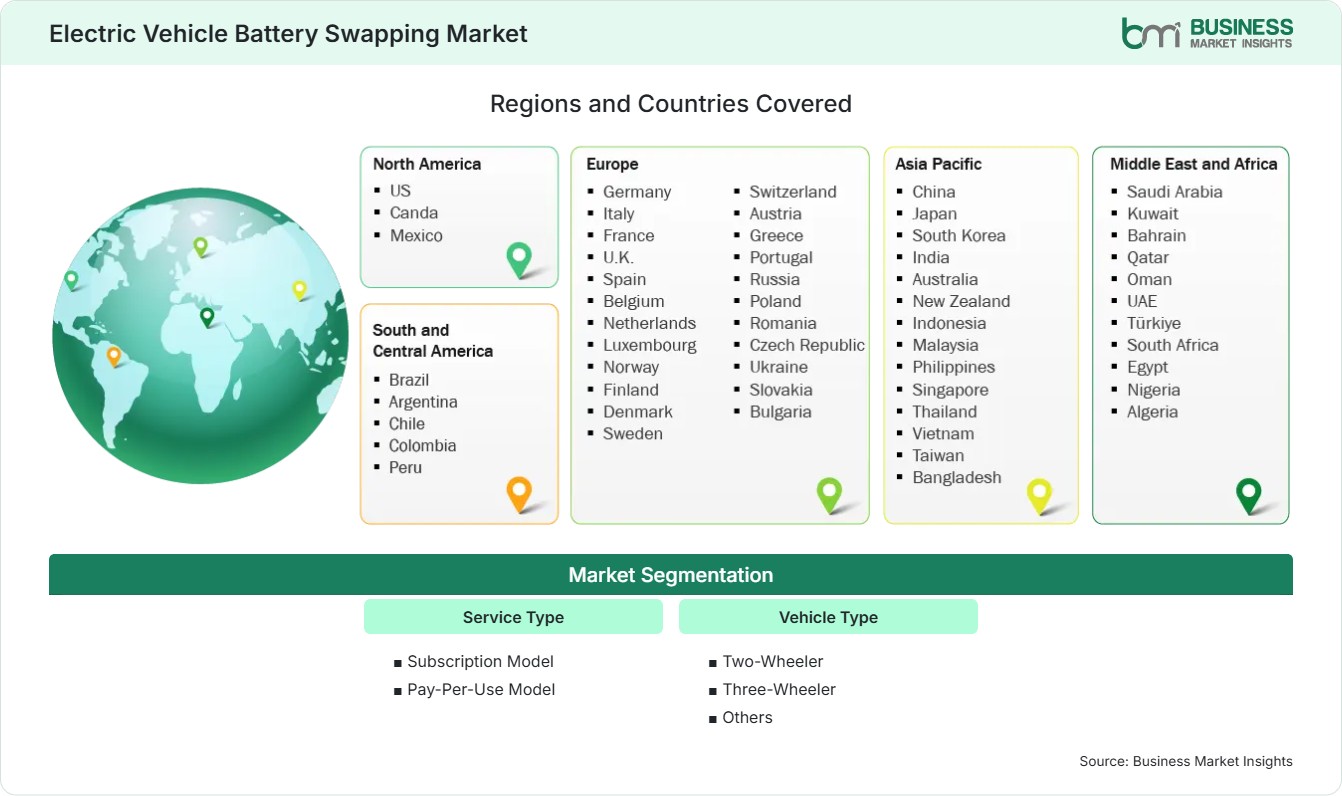
Global Market Geography
FREE PDF
Request your free sample
Request free sample
Segment Analysis

Electric Vehicle Battery Swapping Market Segmentation

Service Type

Subscription Model holds a 32%–37% share in 2025 and is projected to grow at a 36.0%–40.0% CAGR through 2033. Recurring access, predictable costs, and fleet-oriented service agreements support adoption.

  • Subscription Model: Subscription services provide recurring access to swapping infrastructure, supporting predictable energy expenses and reducing battery ownership complexity for commercial and mobility operators.
  • Pay-Per-Use Model: Pay-per-use services appeal to occasional users and flexible fleets, with adoption supported by transaction simplicity, limited upfront commitments, and convenient station access.

Vehicle Type

Two-Wheeler holds a 64%–69% share in 2025 and is projected to grow at a 34.0%–37.0% CAGR through 2033. Compact batteries, high utilization, and urban mobility requirements support segment leadership.

  • Two-Wheeler: Electric scooters and motorcycles are well suited to swapping because compact batteries can be exchanged quickly, supporting delivery, commuting, and shared mobility operations.
  • Three-Wheeler: Electric three-wheelers benefit from reduced downtime and high daily utilization, particularly in commercial passenger transport, logistics, and last-mile delivery applications.
  • Others: Other vehicles provide emerging opportunities where battery architecture, operating cycles, and infrastructure requirements support swapping as an alternative to conventional charging.
Market Forces

Electric Vehicle Battery Swapping Market Dynamics

Key Market Drivers

Growing Electric Vehicle Adoption Drives Swapping Demand

The rise in the use of electric vehicles is contributing to an increase in the number of installations that require easy and reliable energy top-ups. This can be achieved through battery swapping, which refers to the ability of users to replace their depleted batteries with charged ones. Battery swapping becomes even more important in the case of high-intensity driving or when there is limited access to recharging stations. The Electric Vehicle Battery Swapping Market growth is due to the combination of the electrification of the vehicle, mobility technology, and energy-as-a-service. Increasingly, manufacturers and infrastructure providers are building ecosystems based on the management of batteries, stations, automatic exchange, and fleets.

Rising Commercial Fleet Electrification Supports Swapping Networks

The commercialization of fleet electric vehicles will lead to an increase in the need for systems of energy replenishment that ensure minimal disruption to business operations. For delivery vehicles, fleet vehicles for hire, taxis, and commercial three-wheelers, they often run for long stretches and can afford little downtime for lengthy charging processes. Battery swapping turns the replenishment process into one that is quick rather than one that involves waiting, leading to higher availability of assets. Fleet managers can also arrange for central agreements to cover aspects such as battery access, servicing, and energy costs. These will encourage infrastructure providers to set up stations near areas of heavy usage.

Increasing Demand for Faster EV Energy Replenishment

Convenience becomes a key consideration for vehicle users as electric vehicle charging evolves towards commercial and urban applications. Charging is traditionally associated with keeping the vehicle stationary, while swapping allows separating the energy supply from the vehicle and decreasing downtime. Such an aspect proves to be highly beneficial for users with a busy schedule. In this regard, the Electric Vehicle Battery Swapping Market trend is going to focus on the service solutions offering battery swapping alongside station search through a mobile app, automatic payments, battery monitoring, and fleet management capabilities. Additional developments in station automation and battery diagnostics can increase the efficiency of such services even further.

Key Market Opportunities

Expanding Two-Wheeler Electrification Creates Major Opportunities

Electric two-wheelers offer particular potential in this respect since small battery packs, high usage rate, and urban driving patterns go well with the concept of battery swapping. Delivery drivers and other commercial users can enjoy lower downtime and easy battery management. Providers can build a network of stations near residential neighborhoods, commercial centers, logistics centers, and transit routes. The Electric Vehicle Battery Swapping Market forecast will be positively affected by the potential to bundle financing of vehicles, leasing of batteries, energy supply, and digital mobility services. The manufacturers can create a standard battery interface and architecture, allowing better station compatibility.

Growing Commercial Fleet Battery Swapping Infrastructure

Fleet energy infrastructure is an attractive opportunity to invest in due to the potential for increased fleet energy service, due to high vehicle utilization that will lead to frequent station use. There is potential for fleet operators to gain from predictable energy-service arrangements, centralization of battery management, and less time spent charging the batteries. Providers of the infrastructure can create swapping stations that will be located in proximity to delivery points, logistics centers, transport routes, and densely populated commercial areas. It will allow for optimization of battery inventory, schedule of battery charging, vehicle allocation, and maintenance needs. The lifecycle of batteries offers additional opportunities for secondary uses and recycling partnership programs.

Increasing Government Support for EV Charging Alternatives

Government backing for the process of electrification may provide a chance for battery swapping if there is a need to explore an alternative to the existing charging network. Battery swapping can assist in dealing with land issues, grid capacity constraints, and energy consumption needs of highly utilized automobiles. Policy initiatives that will back battery standardization, infrastructure rollout, funding, and e-mobility may foster investor confidence. It can also be a way for public-private partnerships to aid station installation at transport centers and urban centers. It is beneficial for infrastructure providers if regulations acknowledge that swapping is an integral element of the broader charging environment. Battery ownership, safety, energy billing, compatibility, and recycling regulations would create even better investment opportunities.

Market Restraints and Challenges

High Infrastructure Costs Limit Network Expansion

Factor: Swap networks need stations, battery inventories, charging technology, software solutions, access to the grid, maintenance services, and strategically placed facilities. Impact: A substantial upfront investment may hold back implementation when there is not enough density of vehicles and stations to ensure an economically viable business case. The provider of infrastructure needs to strike the right balance between the geographical coverage of its network and the utilization of the infrastructure. Low utilization increases the unit cost of swap operations, while low coverage deters customers from utilizing the service. Fleet-based deployments, modularity of stations, cooperation with mobility providers, and staged expansion are among the ways to overcome the problem.

Lack of Battery Standardization Restricts Interoperability

Factor: The design of battery components, such as physical dimensions, electrical architectures, software platforms, cooling and heating technology, and mechanics, will differ among manufacturers of vehicles. Effect: Technical fragmentation would make it impossible for batteries to be swapped between vehicles on different platforms and limit the number of vehicles that can be served by individual charging stations. Reduced interoperability would make the infrastructure more complex and reduce the efficiency of the system. Industry standards and modularity of batteries can help with compatibility, whereas software platforms can be useful for identifying, authenticating, and checking the status of batteries.

Company Analysis

Competitive Landscape

The competitive environment includes battery-swapping operators, electric mobility companies, battery manufacturers, vehicle manufacturers, and technology providers. Electric Vehicle Battery Swapping Market analysis indicates that competition increasingly centers on network expansion, battery interoperability, station efficiency, digital platforms, vehicle integration, and service-model flexibility.

Company Name

Overview

Products and Services relevant to this market

NIO Inc.

Electric vehicle manufacturer with an integrated battery-service ecosystem and dedicated swapping infrastructure strategy.

Battery swapping stations, battery-as-a-service offerings, EVs, energy services, and digital battery-management solutions.

Gogoro Inc.

Electric mobility company focused on battery-swapping infrastructure and urban two-wheeler ecosystems.

Swappable batteries, battery-swapping stations, electric scooters, subscription services, and mobility platforms.

Ample, Inc.

Technology company developing modular battery-swapping infrastructure for electric mobility applications.

Modular swapping stations, battery systems, software platforms, fleet services, and energy-management solutions.

SUN Mobility

Battery and mobility technology company focused on energy-as-a-service for electric vehicles.

Smart batteries, swapping stations, battery-as-a-service, fleet solutions, and energy infrastructure.

Contemporary Amperex Technology Co., Limited

Major battery manufacturer expanding into integrated battery-swapping and energy-service solutions.

EV batteries, swapping systems, battery-management technologies, charging and energy solutions.

Honda Motor Co., Ltd.

Global mobility manufacturer developing electric two-wheeler and battery-service ecosystems.

Electric motorcycles, interchangeable battery systems, battery-sharing initiatives, and mobility solutions.

Kwang Yang Motor Co., Ltd.

Taiwanese powersports manufacturer with capabilities across scooters and electric mobility technologies.

Electric scooters, battery-related mobility systems, vehicle platforms, and two-wheeler technologies.

Yamaha Motor Co., Ltd.

Global mobility manufacturer developing electric motorcycles and supporting battery standardization initiatives.

Electric motorcycles, interchangeable batteries, battery-related systems, and mobility technologies.

Battery Smart

Indian battery-swapping network focused on electric mobility and commercial vehicle applications.

Battery-swapping stations, smart batteries, subscription services, fleet solutions, and digital energy management.

Oyika

Mobility technology company developing battery-swapping solutions for electric motorcycles and urban transportation.

Swappable batteries, swapping stations, electric mobility services, fleet solutions, and digital platforms.

Trust & Transparency

Research Methodology

The market analysis combines proprietary research with secondary data from government agencies, company disclosures, regulatory filings, industry databases and expert interviews. Market estimates are validated through data triangulation, cross-market benchmarking and analyst review.

View Full Research Methodology

Questions Answered

Frequently Asked Questions

What does the Electric Vehicle Battery Swapping Market report indicate about future competition?

Competition will increasingly focus on station density, battery compatibility, network utilization, software integration, service pricing, vehicle partnerships, and battery lifecycle management. Companies capable of building scalable ecosystems across vehicles, batteries, infrastructure, and digital services should strengthen their competitive position.

Why are commercial fleets creating new opportunities for battery swapping?

Commercial fleets often operate on demanding schedules where vehicle downtime directly affects productivity. Swapping can provide rapid energy replenishment while enabling centralized battery management, predictable service arrangements, and improved vehicle availability across delivery, logistics, shared mobility, and commercial transportation applications.

How are battery-swapping technologies influencing EV adoption?

Swapping can reduce perceived charging inconvenience by separating energy replenishment from vehicle charging time. It can also provide users with access to managed batteries and service networks, making electrification more practical for vehicles operating intensively throughout the day.

Which applications present the strongest opportunity in the market?

Electric two-wheelers, delivery fleets, commercial three-wheelers, shared mobility, and other high-utilization vehicles present strong opportunities. These applications benefit most from reduced downtime and frequent energy replenishment, particularly in dense urban environments where conventional charging can be inconvenient.

What factors are improving Electric Vehicle Battery Swapping Market return on investment?

High vehicle utilization, recurring battery exchanges, commercial fleet electrification, subscription services, and dense urban mobility can improve infrastructure utilization and revenue potential. Battery-as-a-service models can also generate recurring income while reducing upfront battery ownership requirements for vehicle users.

Access the Full Electric Vehicle Battery Swapping Market Report

Get segment-level forecasts, regional estimates, competitive benchmarking, company profiles and downloadable Excel datasets.

Access the full Electric Vehicle Battery Swapping Market Report
350 pages PDF & Excel | 2026-08-19
Similar Research

Related Market Reports