
Automotive Battery Management System Market Outlook: Size, Share, Trends, Growth Analysis, Competitive Landscape & Forecast, 2026-2033

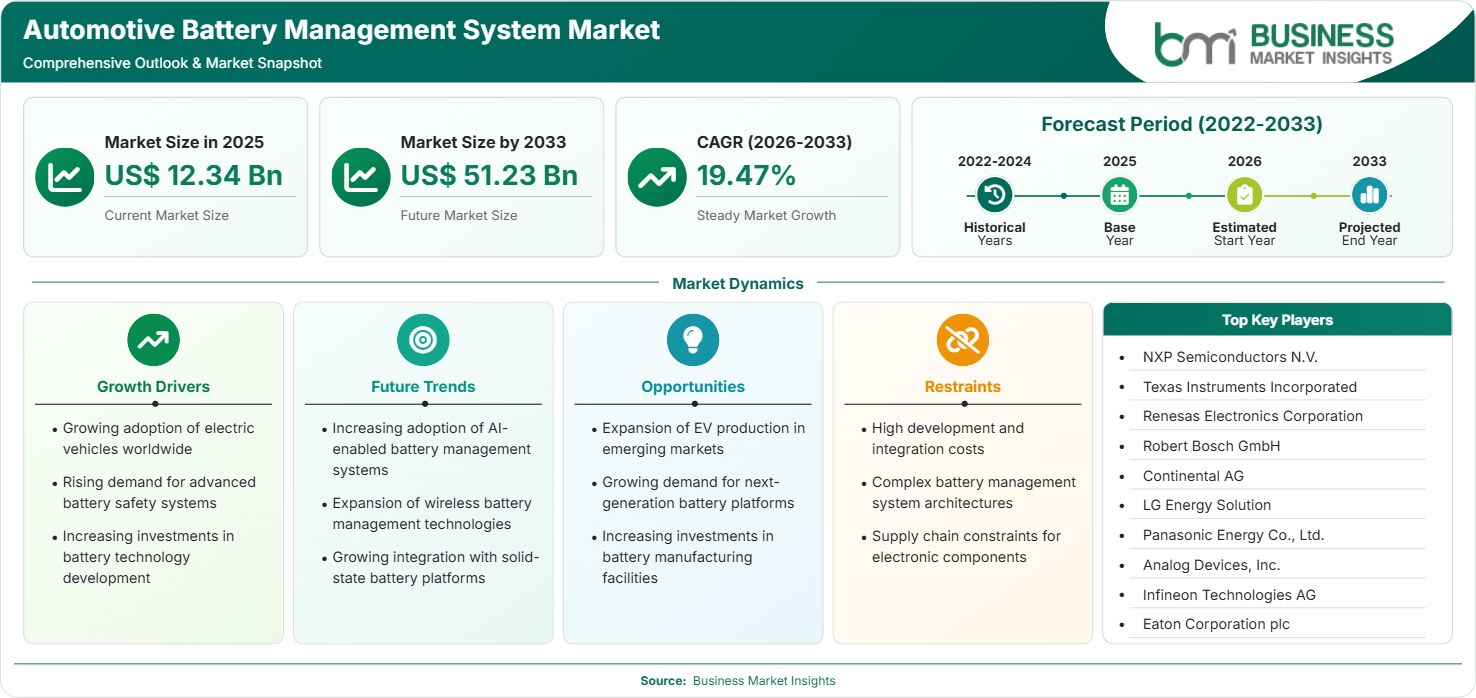
The Automotive Battery Management System Market size was valued at US$ 12.34 Billion in 2025 and is projected to reach US$ 51.23 Billion by 2033, growing at a CAGR of 19.47% from 2026 to 2033, driven by electric vehicle adoption, battery safety requirements, technological innovation, and expansion of advanced energy storage ecosystems.

Report Coverage
  • Propulsion Type: BEV, PHEV, HEV
  • Vehicle Type: Passenger Cars, Commercial Vehicles
US$ 12.34 Bn Market size in 2025
US$ 51.23 Bn Market Size by 2033
19.47% CAGR, 2026 - 2033
2026-2033 Forecast Period

01 AI Overview

Automotive Battery Management System Market Summary

  • North America Region: North America holds a market share of 28%–32% in 2025, growing with a CAGR of 18.80%–19.40% influenced by EV adoption, battery manufacturing investments, regulatory support, and advanced automotive technology integration. The U.S. market analysis indicates a CAGR of 19.00%–19.60% from 2026 to 2033, supported by increasing EV production and battery localization initiatives.
  • Fastest Growing Region: Asia Pacific holds a market share of 42%–46% in 2025, growing with a CAGR of 20.10%–20.80% influenced by expanding EV manufacturing, battery supply chain development, government incentives, and rising demand for intelligent battery monitoring systems.
  • Leading Segment: Battery Electric Vehicles (BEV) hold a market share of 48%–52% in 2025, growing with a CAGR of 20.00%–20.70% influenced by increasing EV penetration, higher battery capacity requirements, and demand for improved range and safety performance.
  • High Growth Segment: Commercial Vehicles hold a market share of 30%–34% in 2025, growing with a CAGR of 19.80%–20.50% influenced by electric fleet adoption, logistics electrification, and rising demand for efficient battery management solutions.
  • Key Market Opportunity: Expansion of EV manufacturing in emerging economies, development of next-generation batteries, and investments in battery production facilities are creating opportunities for advanced battery management technologies.
  • Major Market Players: NXP Semiconductors N.V., Texas Instruments Incorporated, Renesas Electronics Corporation, Robert Bosch GmbH, Continental AG, LG Energy Solution, Panasonic Energy Co., Ltd., Analog Devices, Inc., Infineon Technologies AG, Eaton Corporation plc.
02 Strategic Insights

Automotive Battery Management System Market: Strategic Insights

Automotive Battery Management System Market Strategic Framework
FREE PDF
Request your free sample
Request free sample
03 Stakeholder View

Key Takeaways

  • The market ecosystem is shifting from basic battery monitoring toward intelligent management platforms integrating sensors, semiconductor components, software algorithms, and predictive analytics. Suppliers with complete hardware and software capabilities are gaining stronger competitive positions.
  • BEVs represent the primary growth opportunity due to rising battery capacity requirements and increasing consumer demand for longer driving ranges. Battery management systems are becoming essential for optimizing performance, safety, and charging efficiency.
  • Technology innovation is focused on improving battery diagnostics, thermal control, state-of-charge accuracy, and communication between battery packs and vehicle control systems. Advanced semiconductor solutions are enabling smaller and more efficient designs.
  • Asia Pacific remains a major investment region due to strong EV manufacturing capabilities, battery production leadership, and supportive government policies. China, Japan, South Korea, and India are strengthening their electric mobility ecosystems.
  • Strategic partnerships between automotive manufacturers, battery suppliers, and semiconductor companies are increasing as companies seek to develop efficient battery platforms and secure supply chain advantages.
  • Commercial vehicle electrification is creating additional demand as fleet operators prioritize battery reliability, operational efficiency, and lifecycle cost reduction through advanced management technologies.
04 Geographic Outlook

Automotive Battery Management System Market Regional Highlights

North America Automotive Battery Management System Market

North America accounted for 28%–32% share in 2025 and is projected to expand at a CAGR of 18.80%–19.40% during 2026–2033. The region benefits from increasing electric vehicle adoption, battery manufacturing investments, and government support for domestic energy supply chains. The Automotive Battery Management System Market share in North America is supported by growing demand for intelligent battery monitoring, advanced vehicle electronics, and improved safety solutions. The United States remains the leading contributor due to expanding EV production and investments in battery technology.

  • The United States is strengthening EV manufacturing capabilities through investments in battery plants, semiconductor supply chains, and vehicle electrification programs.
  • Canada is developing electric mobility infrastructure and supporting battery-related industries through clean transportation initiatives and manufacturing investments.
  • Automotive suppliers are focusing on advanced battery monitoring technologies that improve vehicle performance, safety, and battery lifespan.
  • Increasing adoption of electric commercial fleets is creating additional demand for reliable battery management solutions across transportation sectors.

US Automotive Battery Management System Market

The United States represented 22%–26% share within North America in 2025 and is expected to grow at a CAGR of 19.00%–19.60% between 2026–2033. The country remains a key market due to rising EV production, expansion of battery manufacturing facilities, and increasing demand for advanced vehicle electronics. The Automotive Battery Management System Market is supported by investments from automotive manufacturers, battery companies, and semiconductor suppliers developing localized electric vehicle supply chains.

  • Increasing EV manufacturing capacity is encouraging demand for advanced battery control systems capable of supporting higher energy density battery packs.
  • Government incentives and emission reduction initiatives are accelerating electric vehicle adoption across passenger and commercial vehicle categories.
  • Technology providers are developing integrated solutions combining semiconductor components, software algorithms, and battery monitoring capabilities.

Europe Automotive Battery Management System Market

Europe accounted for 22%–26% share in 2025 and is forecast to grow at a CAGR of 18.50%–19.20% from 2026–2033. Germany, France, the United Kingdom, and Norway represent major markets due to strong automotive manufacturing capabilities, EV adoption, and sustainability regulations. Germany and Norway are among high-growth countries supported by electric mobility investments and battery ecosystem development in Automotive Battery Management System Market. European automakers are increasing focus on advanced battery technologies to improve vehicle efficiency, safety, and compliance with emissions targets.

  • Germany is expanding battery manufacturing and EV production capabilities, creating demand for advanced battery management technologies.
  • Norway continues to demonstrate strong electric vehicle adoption, supporting demand for efficient battery monitoring and charging management systems.
  • France is investing in domestic battery production and electric mobility infrastructure to strengthen automotive technology capabilities.
  • The United Kingdom is encouraging electrification of transportation through investments in EV supply chains and battery innovation.

Asia Pacific Automotive Battery Management System Market

Asia Pacific represented 42%–46% share in 2025 and is expected to grow at a CAGR of 20.10%–20.80% during 2026–2033. The region maintains leadership due to large-scale EV production, battery manufacturing expertise, and strong automotive supply chains. China, Japan, South Korea, and India are key markets supported by government electrification programs and investments in battery technologies. The Automotive Battery Management System Market trends in Asia Pacific are influenced by expanding EV sales, local battery production, and demand for efficient energy management systems.

  • China dominates regional EV production and battery manufacturing, supporting large-scale demand for battery management technologies.
  • Japan is advancing battery innovation through investments in next-generation energy storage and automotive electronics.
  • South Korea benefits from strong battery manufacturing capabilities and partnerships between automotive and technology companies.
  • India is expanding EV adoption through government initiatives and increasing investments in domestic electric vehicle manufacturing.

Rest of World Automotive Battery Management System Market

Rest of World accounted for 6%–10% share in 2025 and is projected to grow at a CAGR of 17.50%–18.30% during 2026–2033. South America and Middle East and Africa regions are gradually adopting electric mobility solutions through infrastructure development and government sustainability programs. Brazil, UAE, and Saudi Arabia are increasing investments in clean transportation and energy technologies. The region presents opportunities for suppliers supporting emerging EV markets and battery ecosystem development in Automotive Battery Management System Market.

  • Brazil is developing electric mobility initiatives and increasing adoption of electric vehicles across urban transportation applications.
  • Middle Eastern countries are investing in sustainable transportation programs and smart mobility infrastructure development.
  • The UAE is promoting electric vehicle adoption through government sustainability strategies and charging infrastructure expansion.
  • African markets are gradually exploring electric transportation solutions supported by renewable energy integration initiatives.
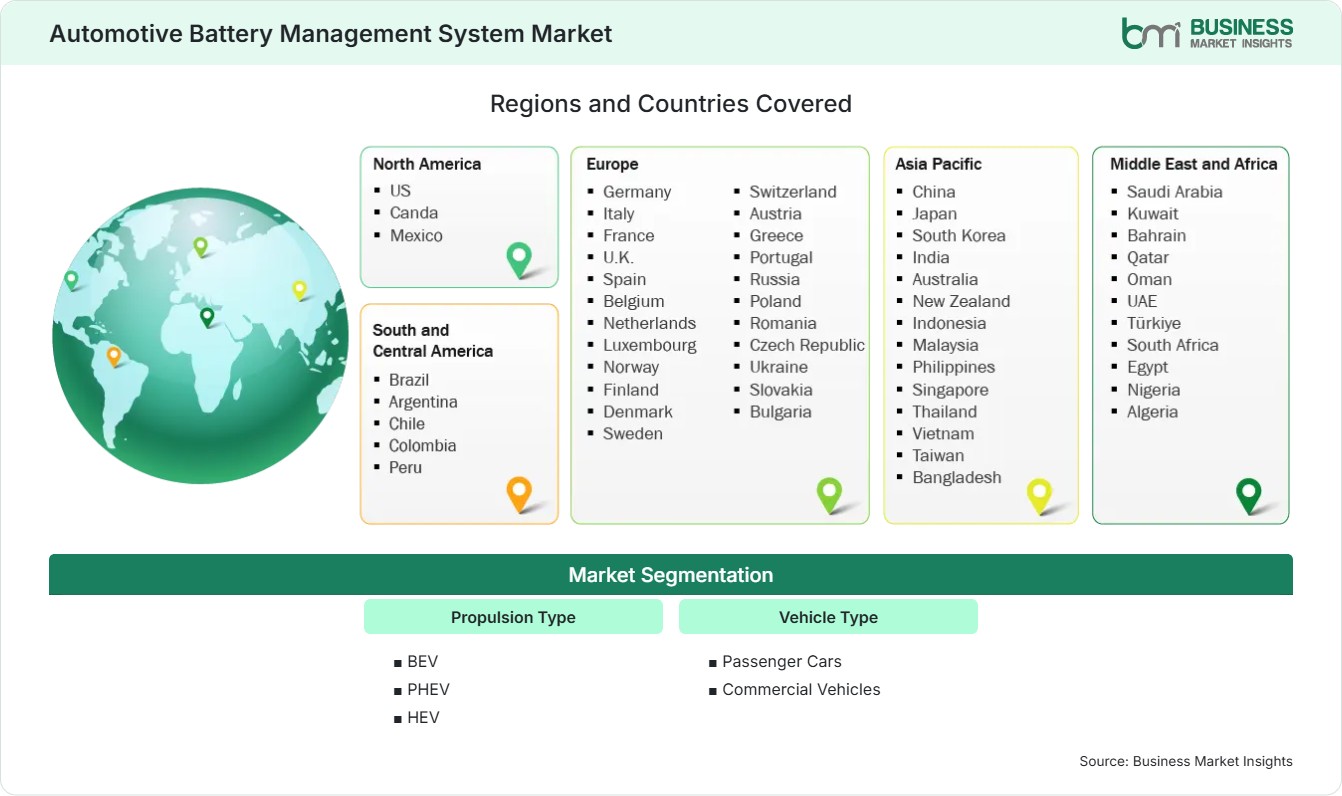
Global Market Geography
FREE PDF
Request your free sample
Request free sample
05 Segment Analysis

Automotive Battery Management System Market Segmentation

Propulsion Type

The propulsion type segment is driven by increasing electrification across passenger and commercial vehicles. BEVs represent the largest category due to higher battery dependency and demand for advanced monitoring systems. The segment accounted for 48%–52% share in 2025 and is projected to grow at a CAGR of 20.00%–20.70% during 2026–2033. The Automotive Battery Management System Market scope is expanding as manufacturers improve battery efficiency, safety, and lifecycle management.

  • BEV: Battery electric vehicles require advanced battery management systems to optimize charging, thermal performance, energy utilization, and overall battery health.
  • PHEV: Plug-in hybrid vehicles use battery management systems to coordinate electric and fuel-based power systems while improving efficiency and performance.
  • HEV: Hybrid electric vehicles depend on battery management solutions for monitoring energy flow, charging cycles, and power distribution between propulsion systems.

Vehicle Type

The vehicle type segment is influenced by increasing EV penetration across passenger and commercial transportation categories. Passenger cars represent the largest application area due to rising consumer adoption of electric vehicles and demand for efficient battery technologies. The segment accounted for 66%–70% share in 2025 and is expected to grow at a CAGR of 18.80%–19.50% from 2026–2033. Commercial electrification is creating additional opportunities for advanced battery management platforms.

  • Passenger Cars: Passenger electric vehicles require reliable battery management systems to enhance driving range, safety, charging efficiency, and battery longevity.
  • Commercial Vehicles: Electric commercial vehicles demand advanced battery monitoring solutions to support fleet operations, reduce maintenance requirements, and improve operational efficiency.
06 Market Forces

Automotive Battery Management System Market Dynamics

Key Market Drivers

Growing adoption of electric vehicles worldwide

The growing adoption of electric vehicles worldwide is a major factor accelerating demand for advanced battery management systems as automakers increase electrified vehicle production. Battery management solutions are becoming essential for monitoring battery health, improving charging efficiency, and ensuring operational safety across EV platforms. Global EV expansion is increasing requirements for accurate state-of-charge estimation, thermal control, and battery lifecycle optimization. The growth is supported by rising investments from automotive manufacturers, semiconductor suppliers, and battery companies developing advanced power management technologies. The Automotive Battery Management System Market trends indicate increasing integration of intelligent software, sensor networks, and predictive analytics to improve battery reliability and vehicle performance.

Rising demand for advanced battery safety systems

The rising demand for advanced battery safety systems is increasing adoption of sophisticated battery management technologies across electric and hybrid vehicles. Battery safety has become a critical priority due to higher energy density cells, increasing battery pack sizes, and growing consumer expectations regarding vehicle reliability. Battery management systems help detect abnormal temperature changes, voltage fluctuations, and potential performance issues before they affect vehicle operation. Automotive manufacturers are integrating advanced monitoring solutions to reduce thermal risks and improve overall battery durability. The increasing complexity of modern battery architectures is encouraging development of improved sensors, control algorithms, and safety mechanisms that support efficient energy management in Automotive Battery Management System Market forecasts.

Increasing investments in battery technology development

Increasing investments in battery technology development are supporting innovation in battery management systems as manufacturers focus on improving energy density, charging speed, and lifecycle performance. Automotive companies, battery producers, and technology providers are investing in research to support next-generation lithium-ion batteries and emerging battery chemistries. These developments require advanced management solutions capable of handling complex battery characteristics and improving system efficiency. Semiconductor suppliers are developing specialized components that enable faster communication, enhanced monitoring accuracy, and improved integration with vehicle control systems. Growing investment in battery research is strengthening demand for advanced management platforms across global electric mobility ecosystems.

Key Market Opportunities

Expansion of EV production in emerging markets

The expansion of EV production in emerging markets is creating significant opportunities for battery management system suppliers as countries develop electric mobility ecosystems. Governments in Asia, Latin America, and other developing regions have been implementing policies to encourage EV adoption and local manufacturing. Increased vehicle electrification calls for robust battery monitoring systems. Manufacturers with scalable technologies can take advantage of the increased demand by regional automakers. Battery manufacturing and deployment of charging stations are providing additional impetus to market opportunities. Firms investing in localized capabilities will be able to tap into demand in new EV markets.

Growing demand for next-generation battery platforms

Increasing demand for next-generation battery platforms is opening up new avenues for companies that are developing their battery management architectures. Next-generation battery technologies need better monitoring, communication, and control systems to achieve optimal results. The solid-state batteries, high energy density lithium-ion batteries, and next-gen cells are driving the need for more effective battery management systems. Battery management suppliers are now concentrating on developing software-based systems that offer predictive maintenance, diagnostics, and efficient energy utilization. OEMs are looking for adaptable battery management systems that can support various battery types and vehicle architectures.

Increasing investments in battery manufacturing facilities

Increasing investments in battery manufacturing facilities are generating opportunities for battery management system providers by strengthening global battery production capacity. Automakers and energy companies are establishing new manufacturing plants to secure battery supply chains and support electric vehicle growth. Such facilities will need modern technologies to test, monitor and manage their batteries. The expansion of battery manufacturing in North America, Europe, and Asia Pacific is leading to cooperation between battery manufacturers and technology providers. Manufacturers of solutions that enable effective battery management can capitalize on opportunities during the manufacturing of battery packs and vehicles.

Market Restraints and Challenges

High development and integration costs

Factor: High development and integration costs associated with automotive battery management systems increase expenses related to hardware design, software development, testing, and vehicle integration. Impact: Higher costs can slow adoption among price-sensitive manufacturers and increase overall electric vehicle production expenses. Advanced battery management systems require specialized components, engineering expertise, and extensive validation processes to meet automotive safety standards. Smaller manufacturers may face challenges in developing customized solutions due to limited resources. Companies are focusing on modular platforms and semiconductor integration to reduce development complexity and improve cost efficiency while maintaining performance requirements.

Complex battery management system architectures

Factor: Complex battery management system architectures create challenges due to increasing battery pack sizes, advanced cell technologies, and integration requirements across vehicle platforms. Impact: System complexity can increase design challenges, software development requirements, and maintenance difficulties for automotive manufacturers. Modern EV batteries require precise monitoring of multiple parameters including voltage, temperature, current, and charging behavior. Integration with vehicle control units and cloud-based analytics platforms further increases technical requirements. Manufacturers must continuously improve system architecture flexibility and reliability to support evolving battery technologies. Simplified designs and standardized components are being explored to improve scalability and reduce engineering challenges.

07 Company Analysis

Competitive Landscape

The Automotive Battery Management System Market analysis indicates a competitive environment driven by semiconductor innovation, battery technology advancements, automotive electrification strategies, and partnerships between component suppliers and vehicle manufacturers. Leading companies are focusing on improving battery monitoring accuracy, power efficiency, software integration, and system reliability to support the growing demand for electric and hybrid vehicles.

Company Name

Overview

Products and Services relevant to this market

NXP Semiconductors N.V.

Global semiconductor company providing automotive-grade solutions for electrification, connectivity, and intelligent vehicle systems.

Offers battery management semiconductors, automotive microcontrollers, sensing solutions, and processing technologies for EV battery applications.

Texas Instruments Incorporated

Semiconductor manufacturer developing analog and embedded processing technologies for automotive applications.

Provides battery monitoring ICs, battery protection solutions, signal processing components, and power management technologies.

Renesas Electronics Corporation

Semiconductor supplier specializing in automotive electronics, microcontrollers, and system solutions.

Develops battery management ICs, automotive processors, monitoring solutions, and electrification technologies for EV platforms.

Robert Bosch GmbH

Automotive technology company offering vehicle components, electronics, and mobility solutions worldwide.

Provides battery management systems, control units, sensors, software solutions, and EV powertrain technologies.

Continental AG

Automotive supplier focused on intelligent mobility, vehicle electronics, and electrification systems.

Offers battery monitoring technologies, electronic control systems, sensors, and solutions supporting electric vehicle platforms.

LG Energy Solution

Battery manufacturer developing advanced lithium-ion battery technologies for automotive applications.

Provides battery cells, battery packs, battery management integration, and energy storage solutions for electric vehicles.

Panasonic Energy Co., Ltd.

Battery technology company specializing in advanced lithium-ion batteries for mobility applications.

Supplies automotive battery cells and technologies supporting battery management, performance optimization, and EV applications.

Analog Devices, Inc.

Semiconductor company developing precision measurement and signal processing technologies.

Provides battery monitoring ICs, sensing solutions, and semiconductor technologies for automotive battery management systems.

Infineon Technologies AG

Semiconductor manufacturer focused on automotive power electronics and energy-efficient solutions.

Offers battery management semiconductors, power devices, microcontrollers, and automotive electrification components.

Eaton Corporation plc

Power management company providing electrical and energy solutions across multiple industries.

Develops power management technologies, vehicle electrification components, and solutions supporting battery system efficiency.

10 Trust & Transparency

Research Methodology

The market analysis combines proprietary research with secondary data from government agencies, company disclosures, regulatory filings, industry databases and expert interviews. Market estimates are validated through data triangulation, cross-market benchmarking and analyst review.

View Full Research Methodology

11 Questions Answered

Frequently Asked Questions

What does the Automotive Battery Management System Market Report analyze?

The report analyzes market size, regional trends, technology developments, segmentation, competitive positioning, growth factors, challenges, and future opportunities influencing battery management system adoption.

Which vehicle segment creates strong opportunities for battery management system suppliers?

Commercial vehicles create strong opportunities because fleet operators require efficient battery utilization, longer operating cycles, reduced maintenance costs, and reliable energy management for electric transportation operations.

Why are semiconductor companies important in battery management system development?

Semiconductor companies provide specialized integrated circuits, processors, sensors, and power management components required for accurate battery monitoring, efficient energy control, and reliable communication between battery systems and vehicle electronics.

How do battery management systems improve electric vehicle performance?

Battery management systems improve EV performance by monitoring battery conditions, optimizing charging cycles, managing temperature, balancing cells, and extending battery lifespan through accurate control and diagnostic functions.

What factors are increasing demand for automotive battery management system market?

Growing electric vehicle adoption, increasing battery capacity requirements, rising safety expectations, and demand for improved energy efficiency are accelerating the need for advanced battery management systems across passenger and commercial vehicle applications.

Access the Full Automotive Battery Management System Market Report

Get segment-level forecasts, regional estimates, competitive benchmarking, company profiles and downloadable Excel datasets.

Access the full Automotive Battery Management System Market Report
350 pages PDF & Excel | 2026-08-12