Market Summary
Executive Summary and Global Market Analysis
Automotive communication technology refers to the systems and protocols that enable vehicles to exchange information with other vehicles, infrastructure, networks, and connected devices. These technologies include vehicle-to-vehicle (V2V), vehicle-to-infrastructure (V2I), vehicle-to-everything (V2X), and telematics solutions. They support a wide range of functions such as traffic management, driver assistance, navigation, infotainment, fleet monitoring, and autonomous driving. The Automotive Communication Technology market is expanding as connected vehicles become more common and transportation systems increasingly rely on real-time data exchange. Growing investments in intelligent transportation infrastructure, rising consumer demand for connected services, and the development of advanced safety systems are encouraging adoption across passenger and commercial vehicles. Telematics remains widely used for vehicle tracking and diagnostics, while V2X technologies are gaining attention for their role in improving road safety and traffic efficiency.
Despite strong growth potential, several challenges continue to affect market expansion. The implementation of connected vehicle systems requires significant investment in communication infrastructure and network security. Concerns related to cybersecurity, data privacy, and interoperability among different communication standards remain important issues. In many regions, infrastructure development is progressing at different rates, creating barriers to large-scale deployment. The complexity of integrating communication technologies with existing vehicle platforms and regulatory requirements can also increase development costs and deployment timelines.
The market continues to present substantial opportunities as automotive manufacturers and transportation authorities focus on connected and intelligent mobility solutions. Advances in 5G connectivity, edge computing, artificial intelligence, and cloud-based vehicle platforms are creating new possibilities for real-time communication and autonomous driving. Increasing adoption of electric vehicles and smart city initiatives is further supporting demand for advanced communication networks. Continuous innovation in connected mobility ecosystems is expected to strengthen the role of Automotive Communication Technology in future transportation systems.
Segment Analysis
Automotive Communication Technology Market Segmentation
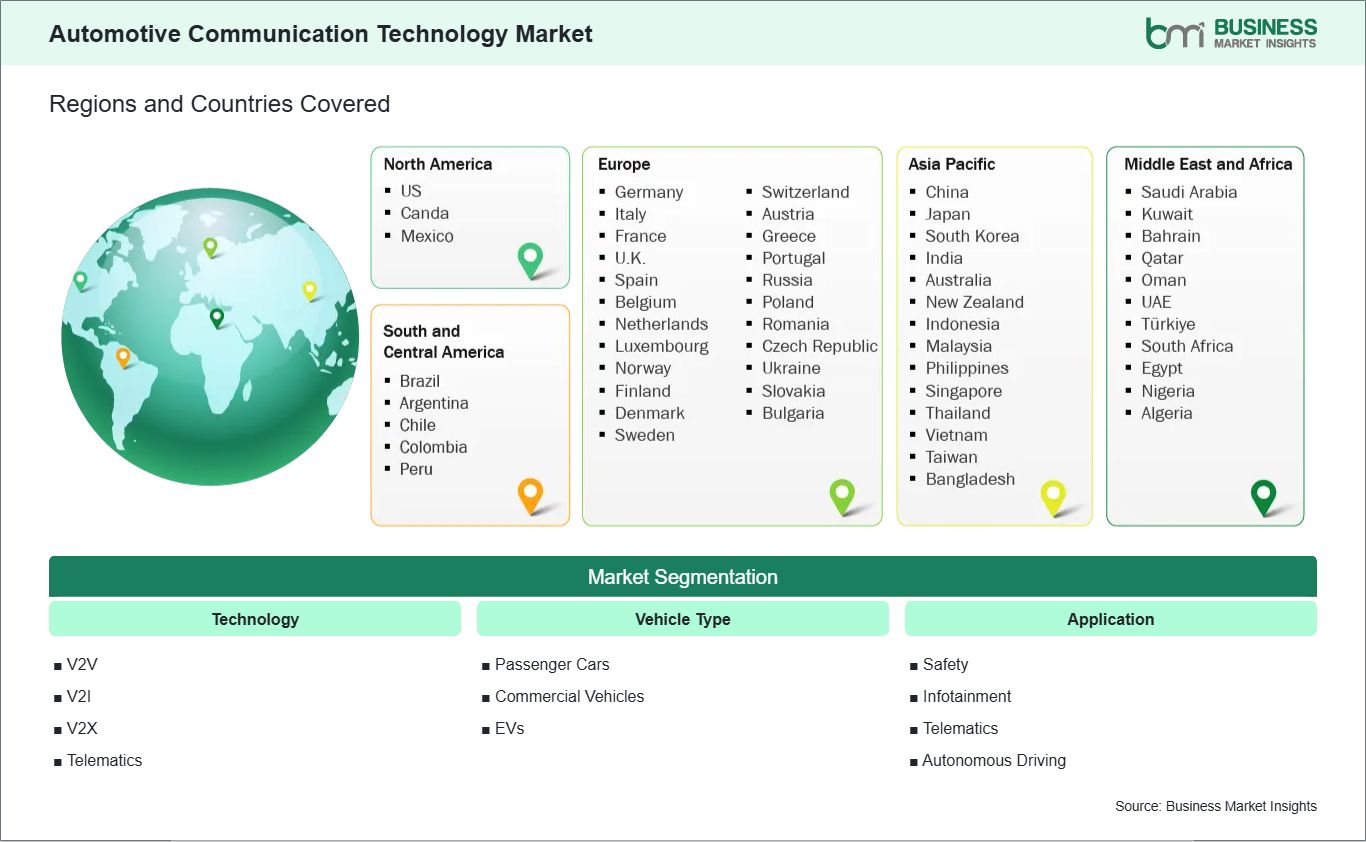
The Automotive Communication Technology market is segmented based on technology, vehicle type, and application. These segments help address varying communication requirements across modern transportation ecosystems.
By Technology
- V2V: Enables direct communication between vehicles to improve road safety and traffic coordination.
- V2I: Facilitates information exchange between vehicles and roadside infrastructure for efficient traffic management.
- V2X: Supports comprehensive communication among vehicles, infrastructure, pedestrians, and networks.
- Telematics: Provides vehicle tracking, diagnostics, fleet management, and remote monitoring capabilities.
By Vehicle Type
- Passenger Cars: Major adopters of connected services, navigation systems, and advanced safety features.
- Commercial Vehicles: Utilize communication technologies for fleet optimization, route management, and vehicle monitoring.
- EVs: Increasingly integrate connected platforms for battery management, charging coordination, and software updates.
By Application
- Safety: Supports collision avoidance, emergency notifications, and driver assistance functions.
- Infotainment: Enhances connectivity, navigation, and in-vehicle entertainment experiences.
- Telematics: Enables vehicle diagnostics, performance monitoring, and fleet management.
- Autonomous Driving: Relies on real-time communication for situational awareness and decision-making.
Market Forces
Automotive Communication Technology Market Drivers and Opportunities
Growing Demand for Connected and Intelligent Mobility
The automotive industry is undergoing a major transformation toward connected and intelligent transportation systems. Consumers increasingly expect vehicles to provide seamless connectivity, real-time navigation, remote diagnostics, and enhanced safety features. As a result, automotive manufacturers are integrating advanced communication technologies into new vehicle platforms. Government agencies and transportation authorities are also promoting connected vehicle ecosystems to improve road safety and reduce traffic congestion. Communication technologies enable vehicles to exchange information with nearby vehicles and infrastructure, helping drivers respond more effectively to changing road conditions. The growing deployment of advanced driver assistance systems further increases the need for reliable communication networks.
The expansion of electric mobility and digital transportation services is also contributing to market growth. Connected communication systems support battery management, predictive maintenance, and software updates for electric vehicles. These developments are making communication technologies a critical component of future mobility solutions, strengthening their importance across passenger and commercial transportation sectors.
Expansion of 5G and Autonomous Vehicle Ecosystems
The emergence of 5G networks is creating significant opportunities for the Automotive Communication Technology market. High-speed, low-latency communication enables vehicles to exchange data more efficiently, supporting advanced connected vehicle applications and autonomous driving functions. Improved network performance allows faster decision-making and enhanced coordination between vehicles and transportation infrastructure. The development of smart cities is creating additional opportunities for communication technology providers. Urban transportation systems increasingly depend on connected infrastructure, intelligent traffic management, and real-time monitoring capabilities. Automotive communication platforms play an essential role in enabling these services.
Autonomous vehicle development is another important growth area. Self-driving systems require continuous communication with surrounding vehicles, infrastructure, and cloud platforms to operate safely and efficiently. Advances in artificial intelligence, edge computing, and cloud-based analytics are further expanding the capabilities of connected vehicle ecosystems. These trends are expected to generate new opportunities for innovation and long-term market expansion.
Size and Share Analysis
Automotive Communication Technology Market Size and Share Analysis
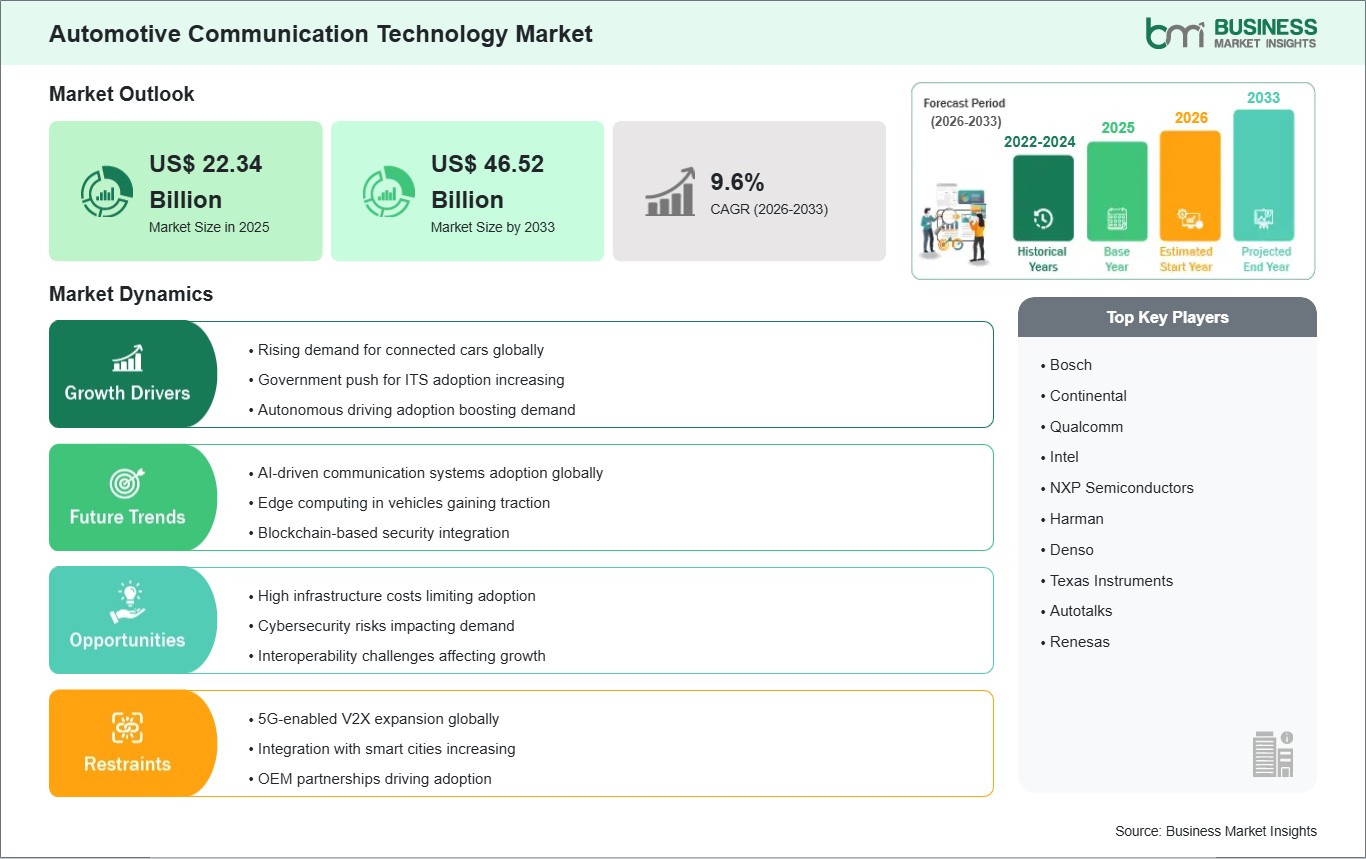
The Automotive Communication Technology Market size is expected to reach US$ 46.52 billion by 2033 from US$ 22.34 billion in 2025. The market is estimated to record a CAGR of 9.6% from 2026 to 2033.
By technology, telematics currently accounts for a significant share of the market due to its widespread use in fleet management, vehicle diagnostics, navigation, and connected services. V2X technologies are witnessing increasing adoption as governments and transportation agencies focus on improving road safety and traffic efficiency. V2V and V2I solutions are also gaining momentum as connected mobility infrastructure continues to develop globally.
By vehicle type, passenger cars represent a major portion of market demand because of the growing integration of connected services, infotainment systems, and advanced driver assistance technologies. Commercial vehicles continue to adopt communication platforms for operational efficiency and fleet optimization, while EVs are emerging as an important growth segment due to their reliance on connected ecosystems and software-driven functionality.
By application, safety remains a dominant segment as vehicle manufacturers prioritize collision avoidance, driver assistance, and emergency communication systems. Infotainment and telematics applications continue to expand with rising consumer demand for connected experiences, while autonomous driving applications are expected to create significant opportunities as vehicle automation technologies advance.
Report Coverage
Automotive Communication Technology Market Report Coverage and Deliverables
The "Automotive Communication Technology Market Size and Forecast (2022-2033)" report provides a detailed analysis of the market covering below areas:
- Market size and forecast at global, regional, and country levels for all the key market segments covered under the scope
- Market trends, as well as market dynamics such as drivers, restraints, and key opportunities
- Market analysis covering key market trends, global and regional framework, major players, regulations, and recent market developments
- Industry landscape and competition analysis covering market concentration, heat map analysis, prominent players, and recent developments for the market
- Detailed company profiles, including SWOT analysis
Geographic Insights
Automotive Communication Technology Market Geographic Insights
The Automotive Communication Technology Market shows diverse regional adoption patterns influenced by transportation digitization initiatives, connected vehicle infrastructure investments, regulatory frameworks, and advancements in automotive electronics.
North America represents a mature market for automotive communication technologies due to strong adoption of connected vehicles, advanced driver assistance systems, and intelligent transportation solutions. The United States leads regional development through investments in connected mobility infrastructure, autonomous vehicle testing programs, and advanced telematics platforms. Canada continues to support connected transportation projects and smart road initiatives, encouraging broader adoption of V2X technologies. The region benefits from established telecommunications networks, strong automotive innovation capabilities, and increasing deployment of cloud-based vehicle communication platforms. Growing interest in autonomous mobility and electric vehicles further supports demand for advanced communication technologies.
Asia Pacific is experiencing rapid growth driven by expanding vehicle production, smart city developments, and increasing digital transformation across transportation networks. China remains a key market with large-scale investments in connected vehicle ecosystems, intelligent traffic systems, and next-generation communication infrastructure. Japan continues to advance vehicle connectivity through innovations in automotive electronics and autonomous driving technologies. South Korea is strengthening its position through the deployment of advanced 5G networks and connected mobility initiatives. India is also witnessing growing adoption of telematics and vehicle connectivity solutions as transportation modernization efforts accelerate. The region's expanding automotive manufacturing base and technology infrastructure support continued market development.
Industry Activity
Recent Developments
The Automotive Communication Technology Market is analyzed using a mix of primary and secondary research sources, including corporate publications, industry associations, and verified databases. This approach ensures accurate tracking of innovation trends and strategic developments influencing the market.
- In January 2026, Qualcomm Technologies announced expanded collaborations with multiple automotive manufacturers to accelerate the deployment of connected vehicle platforms powered by advanced telematics, V2X communication, and software-defined vehicle technologies. The initiative aims to enhance vehicle connectivity, safety functions, and intelligent mobility applications across global markets.
- In September 2025, Ericsson and industry partners expanded cooperation on 5G-enabled connected vehicle ecosystems to support next-generation automotive communication applications. The collaboration focused on low-latency communication, intelligent transportation systems, and enhanced vehicle-to-everything connectivity for future mobility solutions.
Trust & Transparency
Research Methodology
The market analysis combines proprietary research with secondary data from government agencies, company disclosures, regulatory filings, industry databases and expert interviews. Market estimates are validated through data triangulation, cross-market benchmarking and analyst
review.
View Full Research Methodology
Key Sources Referred:
World Bank - Global Trade IndicatorsWorld Trade Organization (WTO)International Monetary Fund (IMF)International Trade Administration (ITA)Company WebsitesCompany Annual ReportsCompany Investor Presentations