Market Summary
Executive Summary and Global Market Analysis
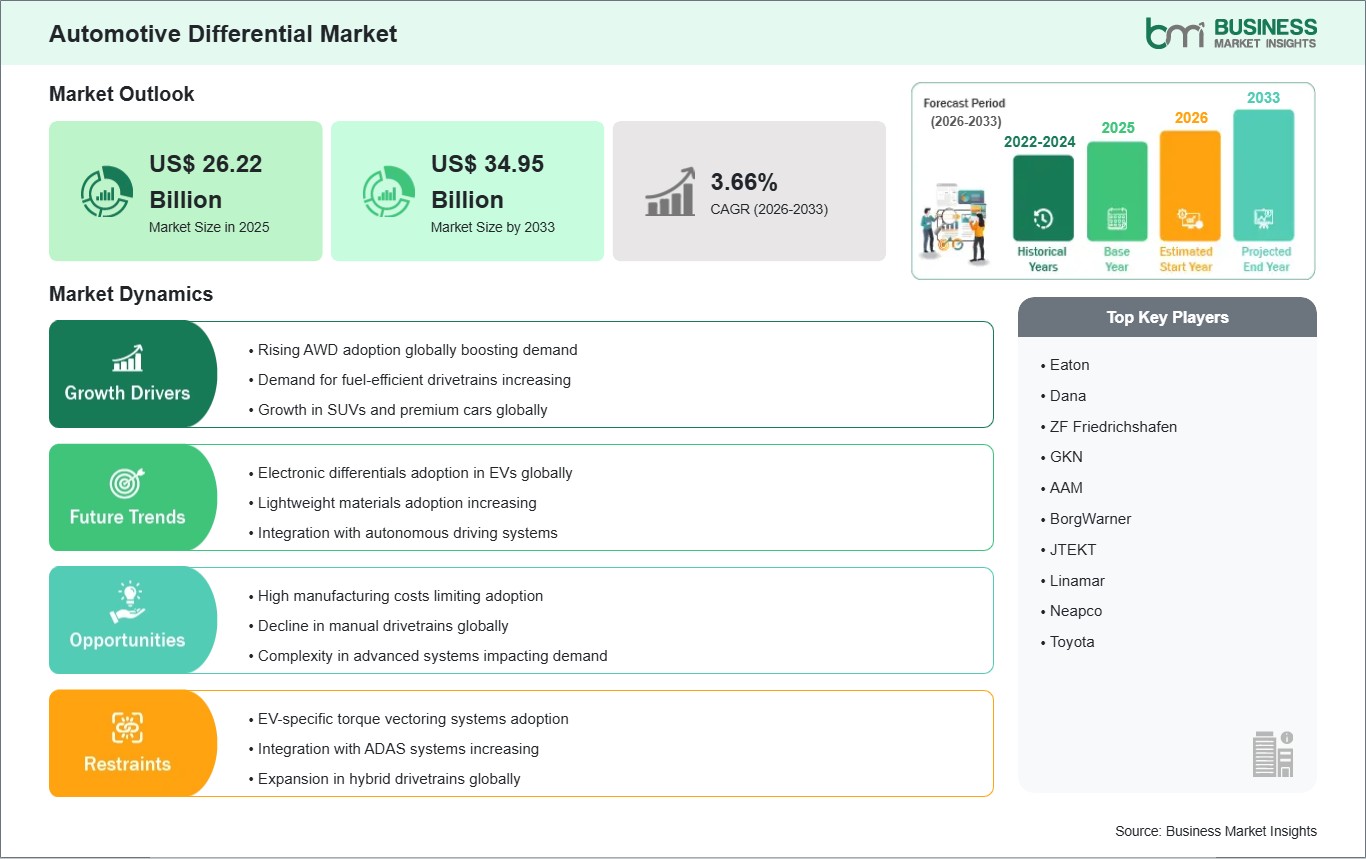
Automotive differentials are critical drivetrain components that allow wheels on the same axle to rotate at different speeds while maintaining vehicle stability and traction during turns. These systems are widely used across passenger cars, commercial vehicles, and electric vehicles to improve handling, safety, and driving performance. The Automotive Differential market continues to evolve as vehicle manufacturers focus on efficiency, driving comfort, and advanced mobility technologies. Growing production of vehicles equipped with all-wheel-drive systems, increasing consumer demand for better traction control, and advancements in drivetrain engineering are supporting market expansion. The adoption of torque vectoring and electronically controlled differential systems is becoming more common, particularly in premium and performance-oriented vehicles.
The market faces several challenges despite steady demand. The transition toward electric vehicles is changing drivetrain architectures, reducing the need for traditional differential configurations in some vehicle platforms. Manufacturers must invest in lightweight materials and advanced designs to improve efficiency while meeting strict fuel economy and emission regulations. The integration of sophisticated differential systems also increases production complexity and development costs. In addition, fluctuations in raw material prices and supply chain disruptions can affect component manufacturing and profitability. These factors create pressure on suppliers and automakers to optimize costs while maintaining performance standards.
The market continues to offer growth opportunities through innovations in intelligent drivetrain systems and electrified mobility solutions. Advanced torque vectoring technologies are enhancing vehicle dynamics, safety, and energy efficiency. Increasing demand for sport utility vehicles, crossover vehicles, and all-wheel-drive platforms is creating new opportunities for differential manufacturers. The development of lightweight components, smart sensors, and electronically controlled systems is further supporting innovation. As vehicle automation and connectivity continue to expand, differential systems are expected to become increasingly integrated with broader vehicle control architectures, supporting the long-term growth of the Automotive Differential market.
Segment Analysis
Automotive Differential Market Segmentation
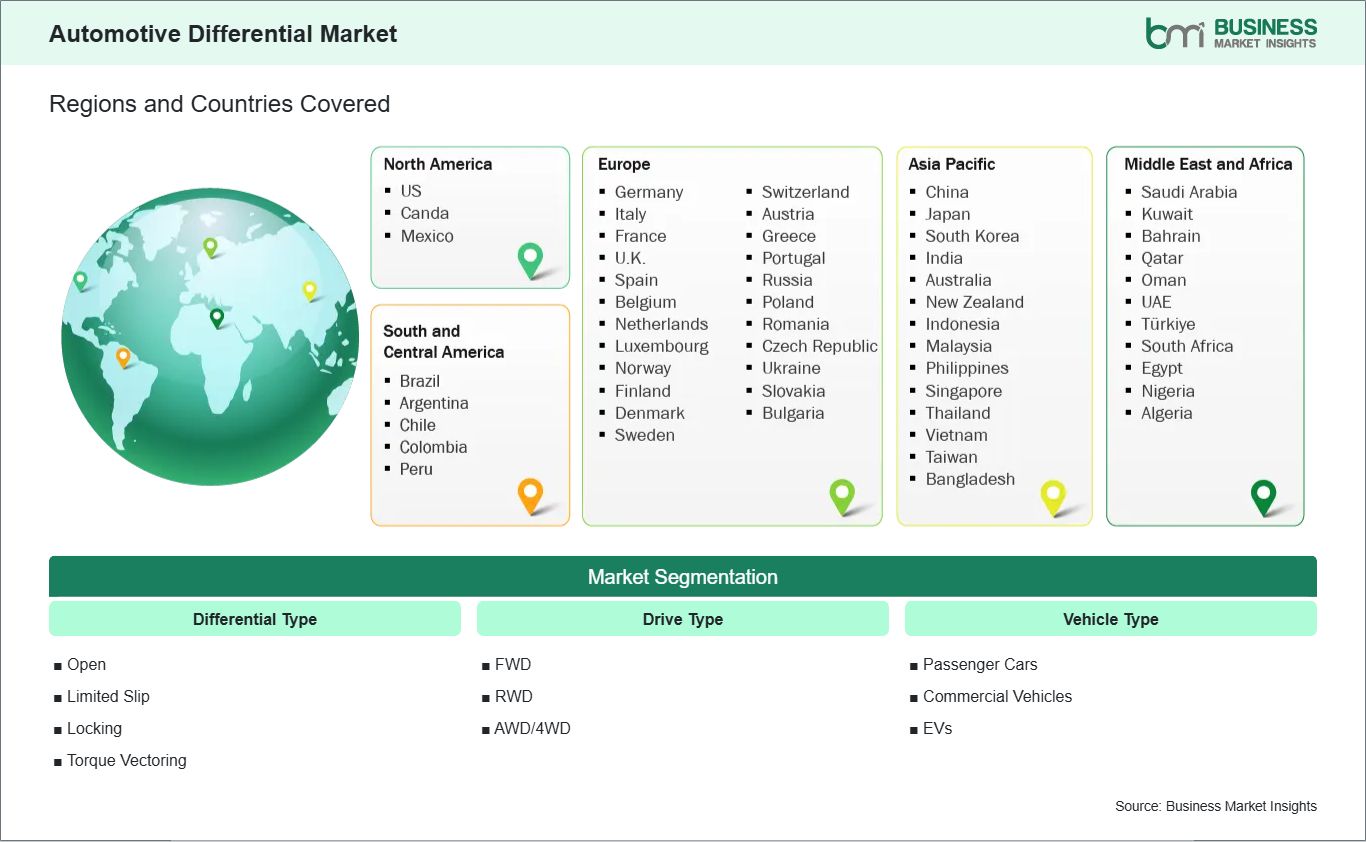
The Automotive Differential market is segmented based on differential type, drive type, and vehicle type, reflecting varying vehicle performance requirements and drivetrain configurations.
By Differential Type
- Open Differential: Widely used due to simple design and cost-effective performance
- Limited Slip Differential: Enhances traction by distributing torque more effectively between wheels
- Locking Differential: Preferred for off-road and heavy-duty vehicle applications
- Torque Vectoring Differential: Supports advanced vehicle handling and dynamic stability control
By Drive Type
- FWD: Common in compact and passenger vehicles due to efficiency and lower manufacturing costs
- RWD: Widely used in performance and commercial vehicles for balanced power delivery
- AWD/4WD: Increasingly adopted in SUVs and premium vehicles for improved traction and control
By Vehicle Type
- Passenger Cars: Largest application segment driven by high vehicle production volumes
- Commercial Vehicles: Utilized for durability and load-handling requirements
- EVs: Growing adoption of advanced differential systems to support electric drivetrain performance
Market Forces
Automotive Differential Market Drivers and Opportunities
Growing Demand for Advanced Vehicle Traction and Stability Systems
The increasing focus on vehicle safety, driving comfort, and performance is driving demand for advanced differential systems across the automotive industry. Consumers increasingly expect vehicles to provide better traction, stability, and control under varying road conditions. This trend has encouraged automakers to integrate advanced differential technologies that can optimize power distribution between wheels and improve vehicle handling. Regulatory emphasis on road safety and vehicle performance standards has further accelerated the adoption of sophisticated drivetrain components. Modern vehicles increasingly incorporate electronic stability control, traction control systems, and torque vectoring technologies that rely on efficient differential operation. The growing popularity of SUVs, crossover vehicles, and all-wheel-drive platforms is also contributing to market growth, as these vehicles require advanced differential systems to maintain performance and safety.
Additionally, advancements in materials engineering and electronic controls are enabling manufacturers to develop lighter and more efficient differential solutions. These developments support improved fuel efficiency while enhancing vehicle dynamics, making advanced differential systems increasingly important across a wide range of vehicle categories.
Expansion of Intelligent and Electrified Drivetrain Technologies
The transition toward intelligent mobility and vehicle electrification is creating new opportunities for the Automotive Differential market. Manufacturers are investing in advanced drivetrain architectures that integrate electronic controls, sensors, and software-driven performance optimization. These technologies enable differential systems to respond more effectively to changing road conditions and driver inputs. Electric vehicles represent a significant area of opportunity as automakers seek innovative solutions to improve efficiency, range, and driving dynamics. Advanced torque vectoring systems and electronically controlled differentials can enhance energy management and vehicle stability while supporting improved driving experiences. The development of smart drivetrain systems is also enabling greater integration between differential components and broader vehicle control systems.
Furthermore, the growth of autonomous driving technologies is expected to increase demand for highly responsive drivetrain components. Differential systems capable of communicating with vehicle sensors and control units can contribute to safer and more efficient vehicle operation. As connected and automated vehicles become more prevalent, manufacturers have opportunities to develop next-generation differential technologies that support future mobility requirements.
Size and Share Analysis
Automotive Differential Market Size and Share Analysis
The Automotive Differential market size is expected to reach US$ 34.95 billion by 2033 from US$ 26.22 billion in 2025. The market is estimated to record a CAGR of 3.66% from 2026 to 2033.
By differential type, open differentials account for a significant share due to their widespread use in conventional passenger vehicles and cost-effective operation. Limited slip differentials continue to gain adoption in vehicles requiring improved traction and handling performance. Locking differentials remain important in commercial and off-road vehicle applications, while torque vectoring differentials are witnessing increasing demand owing to advancements in vehicle dynamics and electronic control systems.
By drive type, front-wheel-drive vehicles hold a substantial share because of their dominance in mass-market passenger vehicles. Rear-wheel-drive systems maintain strong demand in commercial and performance-oriented vehicles. All-wheel-drive and four-wheel-drive platforms are expanding steadily due to growing consumer preference for SUVs, crossover vehicles, and vehicles designed for enhanced stability and all-weather performance.
By vehicle type, passenger cars represent the largest demand segment supported by global production volumes and continuous technological advancements. Commercial vehicles contribute significantly due to durability and performance requirements. Electric vehicles are emerging as a key growth area as manufacturers introduce innovative drivetrain solutions designed to improve efficiency, handling, and vehicle control.
Report Coverage
Automotive Differential Market Report Coverage and Deliverables
The "Automotive Differential Market Size and Forecast (2022-2033)" report provides a detailed analysis of the market covering below areas:
- Market size and forecast at global, regional, and country levels for all the key market segments covered under the scope
- Market trends, as well as market dynamics such as drivers, restraints, and key opportunities
- Market analysis covering key market trends, global and regional framework, major players, regulations, and recent market developments
- Industry landscape and competition analysis covering market concentration, heat map analysis, prominent players, and recent developments for the market
- Detailed company profiles, including SWOT analysis
Geographic Insights
Automotive Differential Market Geographic Insights
The Automotive Differential Market shows diverse regional adoption patterns influenced by vehicle production levels, drivetrain technology advancements, consumer preferences, and regulatory requirements related to vehicle safety and efficiency.
North America, being a developed region, has a mature automotive industry and a strong presence of passenger vehicles, pickup trucks, and sport utility vehicles. The region comprises the United States and Canada, where demand for all-wheel-drive and four-wheel-drive vehicles remains high. Automotive manufacturers continue to invest in advanced drivetrain technologies to improve vehicle performance, traction, and safety. Well-established automotive supply chains and technological capabilities support the adoption of advanced differential systems across multiple vehicle categories.
Asia Pacific is growing significantly, driven by expanding vehicle production and increasing adoption of modern automotive technologies. The region comprises countries such as China, India, and Japan, where rising vehicle ownership and industrial growth are supporting demand for drivetrain components. Manufacturers in the region are focusing on improving vehicle efficiency, safety, and performance while supporting the transition toward electric mobility. Government initiatives promoting automotive manufacturing and technological innovation are further contributing to market development.
Both regions are contributing significantly to the growth of the Automotive Differential Market, focusing on vehicle performance improvements, drivetrain innovation, and increasing adoption of advanced mobility technologies. Continuous investments in automotive manufacturing and the expansion of electric vehicle production are expected to support future market growth across these regions.
Industry Activity
Recent Developments
The Automotive Differential Market is analyzed using a mix of primary and secondary research sources, including corporate publications, industry associations, and verified databases. This approach ensures accurate tracking of innovation trends and strategic developments influencing the market.
- In January 2026, American Axle & Manufacturing (AAM) announced enhancements to its electric drive unit portfolio featuring integrated differential technologies designed for next-generation electric vehicles. The development supports improved drivetrain efficiency, vehicle performance, and electrification initiatives across the automotive sector.
- In September 2025, Dana Incorporated expanded its e-Drive technology portfolio through new drivetrain solutions incorporating advanced differential and torque management capabilities. The development was aimed at supporting electric and hybrid vehicle manufacturers seeking improved vehicle efficiency and traction performance.
Trust & Transparency
Research Methodology
The market analysis combines proprietary research with secondary data from government agencies, company disclosures, regulatory filings, industry databases and expert interviews. Market estimates are validated through data triangulation, cross-market benchmarking and analyst
review.
View Full Research Methodology
Key Sources Referred:
World Bank - Global Trade IndicatorsWorld Trade Organization (WTO)International Monetary Fund (IMF)International Trade Administration (ITA)Company WebsitesCompany Annual ReportsCompany Investor Presentations