
Automotive Radar Market Outlook: Size, Share, Trends, Growth Analysis, Competitive Landscape & Forecast, 2026-2033

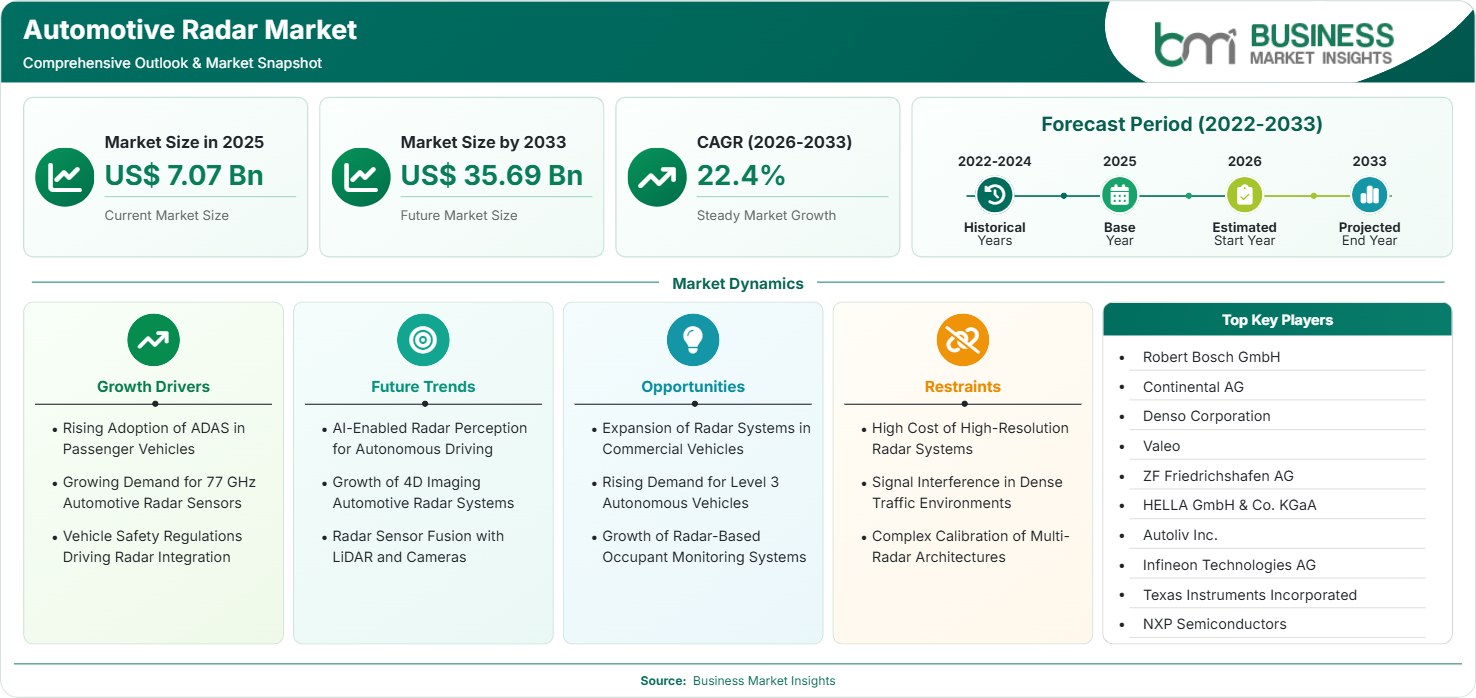
The Automotive Radar Market size was valued at US$ 7.07 Billion in 2025 and is projected to reach US$ 35.69 Billion by 2033, growing at a CAGR of 22.4% during 2026–2033. Growth is driven by increasing adoption of advanced driver assistance systems (ADAS), rising vehicle safety regulations, expanding autonomous driving initiatives, growing integration of collision avoidance technologies, and continuous advancements in radar sensor performance and affordability.

Report Coverage
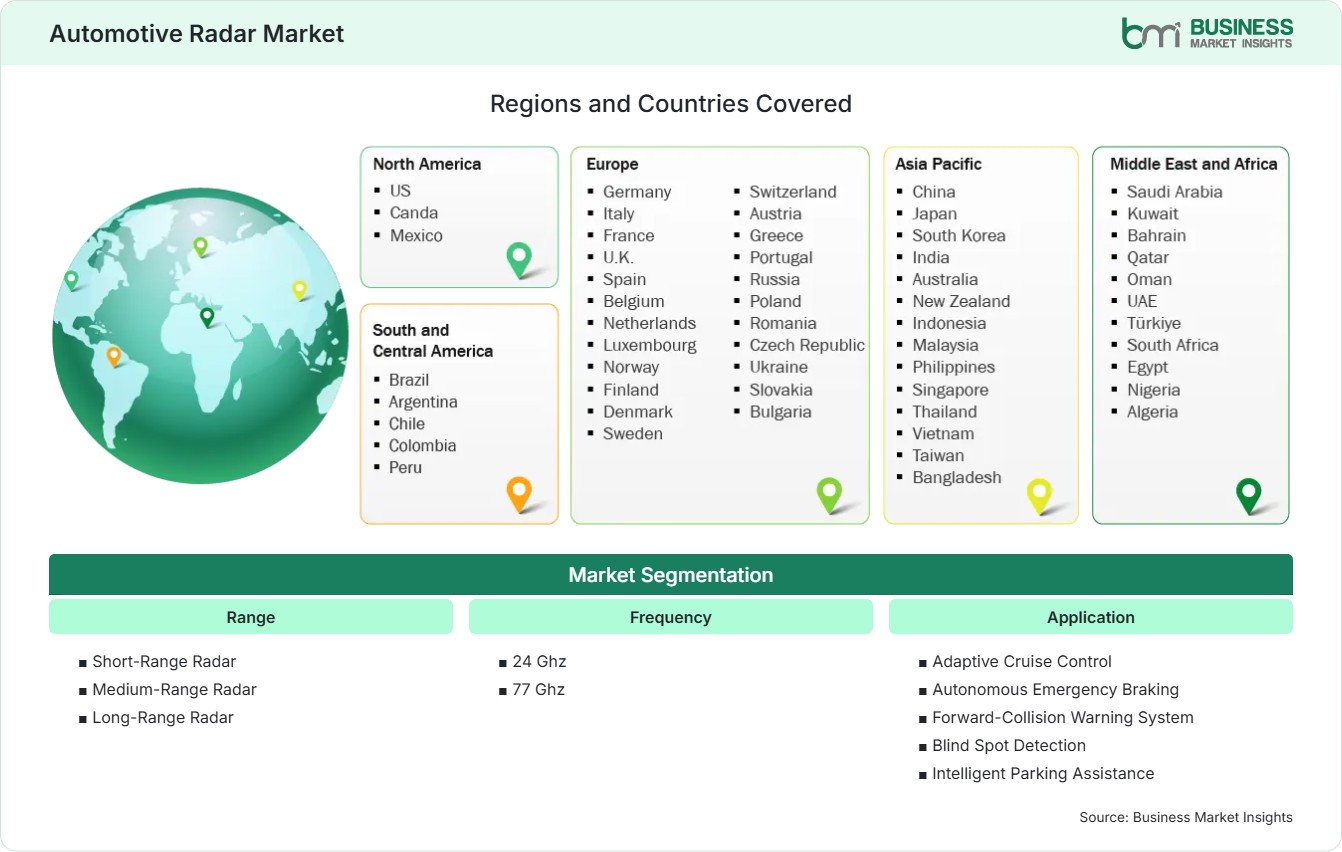
  • Range: Short-Range Radar, Medium-Range Radar, Long-Range Radar
  • Frequency: 24 Ghz, 77 Ghz
  • Application: Adaptive Cruise Control, Autonomous Emergency Braking, Forward-Collision Warning System, Blind Spot Detection, Intelligent Parking Assistance
US$ 7.07 Bn Market size in 2025
US$ 35.69 Bn Market Size by 2033
22.4% CAGR, 2026 - 2033
2026-2033 Forecast Period

AI Overview

Automotive Radar Market Summary

  • North America Region: North America holds a market share of 29%–32% in 2025, growing at a CAGR of 21.0%–21.8% during 2026–2033. Demand is supported by strong ADAS adoption, stringent vehicle safety standards, and increasing deployment of semi-autonomous vehicle technologies. The U.S. remains the dominant market, advancing at a CAGR of 21.3%–22.1%.
  • Fastest Growing Region: Asia Pacific accounts for 38%–41% of revenue in 2025 and is projected to register a CAGR of 24.0%–24.8% through 2033. Expanding vehicle production, increasing ADAS penetration, and strong investments in intelligent mobility technologies continue supporting market development.
  • Leading Segment: Long-Range Radar holds an Automotive Radar Market share of 41%–45% in 2025 and is expected to grow at a CAGR of 22.8%–23.6%. Demand is driven by increasing deployment in adaptive cruise control and highway driving assistance systems.
  • High Growth Segment: Autonomous Emergency Braking (AEB) accounts for 23%–27% of market revenue in 2025 and is projected to register a CAGR of 24.5%–25.3% during the forecast period. Regulatory support and growing emphasis on collision prevention systems continue supporting expansion.
  • Key Market Opportunity: Rising development of Level 3 and Level 4 autonomous vehicles, combined with growing integration of radar, camera, and LiDAR sensor fusion technologies, is creating substantial opportunities for automotive radar manufacturers.
  • Major Market Players: Robert Bosch GmbH, Continental AG, Denso Corporation, Valeo, ZF Friedrichshafen AG, HELLA GmbH & Co. KGaA, Autoliv Inc., Infineon Technologies AG, Texas Instruments Incorporated, and NXP Semiconductors.
Strategic Insights

Automotive Radar Market: Strategic Insights

Automotive Radar Market Strategic Framework
FREE PDF
Request your free sample
Request free sample
Stakeholder View

Key Takeaways

  • The market ecosystem includes semiconductor manufacturers, radar module suppliers, automotive OEMs, Tier-1 suppliers, ADAS developers, software providers, and vehicle technology integrators.
  • Long-range radar remains among the most attractive opportunities due to its critical role in adaptive cruise control, highway autonomy, and collision avoidance systems.
  • Product innovation increasingly focuses on 4D imaging radar, sensor fusion platforms, artificial intelligence integration, and higher-resolution object detection capabilities.
  • Asia Pacific provides the strongest growth potential supported by high vehicle production volumes, increasing ADAS adoption, and growing intelligent transportation investments.
  • Radar sensors continue transforming vehicle safety architectures by enabling real-time environmental sensing and advanced driver assistance functionalities.
  • Autonomous emergency braking, blind spot detection, and intelligent parking assistance systems remain key demand generators across passenger and commercial vehicle segments.
  • A key automotive radar market trend is the rapid shift toward 77 GHz and 79 GHz high-frequency radar platforms, offering improved detection accuracy, longer sensing range, enhanced resolution, and better performance in complex driving environments.
Geographic Outlook

Automotive Radar Market Regional Highlights

North America Automotive Radar Market

North America accounted for 29%–32% of global revenue in 2025 and is projected to expand at a CAGR of 21.0%–21.8% through 2033. Growth is supported by increasing deployment of advanced driver assistance systems, strong regulatory focus on vehicle safety, and growing investments in autonomous driving technologies. The Automotive Radar Market share in the region continues to benefit from rapid integration of radar-enabled safety functions across passenger and commercial vehicles.

  • Automotive manufacturers are increasingly integrating radar sensors to enhance collision avoidance and driver assistance capabilities.
  • Growing adoption of semi-autonomous driving features continues accelerating radar demand across premium and mid-range vehicle segments.
  • Stringent safety standards are encouraging broader deployment of radar-based braking and warning systems.
  • Technology partnerships between OEMs and semiconductor suppliers continue supporting product innovation.
  • Increasing consumer demand for safety-focused vehicles remains a key growth contributor.

US Automotive Radar Market

The United States represented 25%–28% of global revenue in 2025 and is anticipated to register a CAGR of 21.3%–22.1% during the forecast period. Demand is driven by strong ADAS adoption, increasing autonomous mobility initiatives, and rapid deployment of radar-based safety technologies. Growing incorporation of advanced sensing solutions across passenger cars and commercial fleets continues supporting market growth.

  • Vehicle manufacturers continue expanding radar deployment in adaptive cruise control and collision prevention systems.
  • Autonomous vehicle testing programs are driving demand for high-performance radar platforms.
  • Consumer preference for advanced safety features continues influencing purchasing decisions.
  • Investments in intelligent transportation and connected vehicle ecosystems support long-term radar adoption.

Europe Automotive Radar Market

Europe held 26%–29% of global revenue in 2025 and is projected to grow at a CAGR of 21.5%–22.3% through 2033. Stringent vehicle safety regulations, increasing penetration of ADAS technologies, and strong automotive manufacturing capabilities continue supporting Automotive Radar Market expansion. Germany remains the leading market with a CAGR of 21.6%–22.4%, while France is the fastest-growing country, expanding at a CAGR of 22.2%–23.0%.

  • Regulatory mandates continue accelerating integration of radar-based safety features across vehicle categories.
  • Automotive OEMs are increasingly incorporating multiple radar sensors to support higher levels of driving automation.
  • Germany maintains market leadership through advanced automotive engineering and strong vehicle production capabilities.
  • France is witnessing accelerated growth due to increasing adoption of intelligent mobility technologies.
  • Sensor fusion innovation continues strengthening demand for advanced radar platforms.

Asia Pacific Automotive Radar Market

Asia Pacific accounted for 38%–41% of global revenue in 2025 and is expected to remain the fastest-growing region, registering a CAGR of 24.0%–24.8% through 2033. The automotive radar market forecast suggests that expanding vehicle production, strong investments in automotive electronics, and increasing penetration of ADAS technologies are driving market growth. China remains the largest regional market with a CAGR of 23.8%–24.6%, while India records the highest growth at 24.8%–25.6%.

  • Rising production of passenger vehicles continues increasing demand for radar-enabled safety systems.
  • China benefits from large-scale automotive manufacturing and growing autonomous vehicle development initiatives.
  • India is witnessing rapid adoption of advanced safety technologies across new vehicle models.
  • Semiconductor investments continue strengthening regional radar component supply chains.
  • Government support for intelligent transportation systems is creating additional growth opportunities.

Rest of World Automotive Radar Market

The Rest of World region accounted for 6%–9% of global revenue in 2025 and is expected to register a CAGR of 20.5%–21.3% through 2033. The market growth is supported by increasing modernization of vehicle safety systems, rising automotive technology adoption, and growing demand for advanced driver assistance features. Demand remains particularly strong in premium vehicle segments and fleet modernization programs.

Brazil is the leading market in South & Central America and is forecast to grow at a CAGR of 20.7%–21.5%. In the Middle East & Africa, the United Arab Emirates is expected to be the fastest-growing country with a CAGR of 21.0%–21.8%.

  • Brazil continues benefiting from increasing adoption of safety technologies within passenger vehicle fleets.
  • The United Arab Emirates is witnessing growing demand for premium vehicles equipped with advanced radar systems.
  • Fleet modernization initiatives are contributing to radar deployment across commercial vehicle segments.
  • Vehicle safety awareness continues improving adoption of ADAS-enabled technologies.
  • Automotive technology investments are strengthening demand across emerging regional markets.
Global Market Geography
FREE PDF
Request your free sample
Request free sample
Segment Analysis

Automotive Radar Market Segmentation

Range

Range-based radar systems play a critical role in enabling advanced driver assistance and automated driving functions across modern vehicles. Long-Range Radar leads the segment with a 41%–45% share in 2025 and is projected to grow at a CAGR of 22.8%–23.6% through 2033. The market scope continues expanding as automakers increase deployment of radar technologies to enhance vehicle safety, highway driving assistance, and autonomous mobility capabilities.

  • Short-Range Radar: Widely utilized for parking assistance, blind spot monitoring, cross-traffic alert systems, and close-range object detection applications.
  • Medium-Range Radar: Supports lane change assistance, collision warning systems, and medium-distance environmental sensing across passenger and commercial vehicles.
  • Long-Range Radar: Dominates adoption due to its critical role in adaptive cruise control, forward collision warning, and highway automation functions.

Frequency

Frequency selection significantly influences radar performance, detection capabilities, and application suitability. The market continues transitioning toward higher-frequency platforms to support increased resolution and enhanced object detection capabilities. Automotive Radar Market trends indicate strong momentum toward next-generation radar architectures designed to support autonomous and highly automated driving environments.

  • 24 GHz: Continues serving specific automotive applications where cost efficiency and short-range sensing capabilities remain important.
  • 77 GHz: Leads market adoption due to superior resolution, extended detection range, reduced interference, and compatibility with advanced ADAS applications.

Application

Application demand continues expanding as vehicle manufacturers integrate advanced safety technologies as standard features across multiple vehicle segments. Autonomous Emergency Braking (AEB) accounts for 23%–27% market share in 2025 and is projected to register the fastest growth at a CAGR of 24.5%–25.3% through 2033. Automotive Radar Market share gains are increasingly supported by regulatory mandates and growing consumer demand for active safety systems.

  • Adaptive Cruise Control (ACC): Utilizes radar sensors to maintain safe following distances and improve driving comfort during highway operation.
  • Autonomous Emergency Braking (AEB): Detects potential collisions and automatically activates braking systems to reduce accident severity.
  • Forward-Collision Warning System (FCWS): Provides early alerts to drivers regarding potential front-end collision risks.
  • Blind Spot Detection (BSD): Enhances situational awareness by monitoring adjacent lanes and detecting nearby vehicles.
  • Intelligent Parking Assistance: Supports automated parking maneuvers and obstacle detection during low-speed vehicle operations.
Market Forces

Automotive Radar Market Dynamics

Key Market Drivers

Rising Adoption of ADAS in Passenger Vehicles

The growing integration of advanced driver assistance systems is one of the strongest drivers for the automotive radar market globally. Consumers increasingly prioritize safety features such as adaptive cruise control, collision avoidance, and lane assistance technologies when purchasing vehicles. Automakers are responding by expanding ADAS availability across both premium and mass-market vehicle segments. Radar sensors provide reliable environmental perception under diverse weather and lighting conditions, making them essential components within modern safety architectures. As vehicle automation levels increase and safety features become standard equipment, radar deployment is expected to accelerate significantly throughout the forecast period.

Growing Demand for 77 GHz Automotive Radar Sensors

The transition from 24 GHz systems toward 77 GHz radar platforms is creating substantial growth opportunities across the automotive industry. Higher-frequency radar sensors provide superior resolution, enhanced object detection accuracy, and longer sensing ranges required for advanced ADAS functions. Automakers increasingly favor 77 GHz technology because it supports multiple safety features through a single sensing platform. Ongoing innovation in radar chipsets, antenna design, and signal processing is further improving system performance. As automated driving capabilities expand, demand for high-performance 77 GHz radar sensors continues to increase across passenger and commercial vehicle markets.

Vehicle Safety Regulations Driving Radar Integration

Governments and regulatory agencies worldwide are strengthening vehicle safety requirements to reduce road accidents and improve occupant protection. Regulations supporting collision avoidance systems, automatic emergency braking, and advanced safety technologies are encouraging automakers to integrate radar sensors into a growing number of vehicle models. Compliance with these standards is driving investments in advanced sensing technologies across the automotive value chain. As regulatory frameworks evolve and become more stringent, radar-equipped vehicle production is expected to increase steadily, supporting long-term market expansion across both developed and emerging automotive markets.

Key Market Opportunities

Expansion of Radar Systems in Commercial Vehicles

Commercial vehicle manufacturers are increasingly deploying radar technologies to improve operational safety, fleet efficiency, and driver assistance capabilities. Trucks, buses, and logistics vehicles benefit significantly from collision warning, blind spot monitoring, and adaptive cruise control functions. Fleet operators are prioritizing technologies that help reduce accidents, lower insurance costs, and improve vehicle utilization. Regulatory emphasis on commercial vehicle safety is also supporting broader radar adoption. As fleet modernization initiatives continue worldwide, demand for advanced radar systems within commercial transportation applications is expected to grow substantially.

Rising Demand for Level 3 Autonomous Vehicles

The automotive industry is progressing toward higher levels of driving automation, creating significant opportunities for advanced radar technologies. Level 3 autonomous vehicles require accurate environmental sensing, redundancy, and reliable object detection capabilities under diverse driving conditions. Radar sensors play a critical role within sensor fusion architectures that combine cameras, LiDAR, and radar technologies. Growing investments by automakers and technology companies in automated driving platforms continue driving demand for sophisticated radar solutions. As commercialization of Level 3 vehicles expands, radar adoption is expected to accelerate across global automotive markets.

Growth of Radar-Based Occupant Monitoring Systems

Radar technology is increasingly finding applications beyond external vehicle sensing. Occupant monitoring systems utilize radar sensors to detect passenger presence, analyze movement, and improve in-cabin safety functions. These solutions support child presence detection, occupant classification, and enhanced airbag deployment strategies. Automakers are exploring in-cabin radar technologies to improve safety compliance and passenger protection capabilities. Growing focus on intelligent vehicle interiors and enhanced occupant safety is expected to generate new opportunities for radar suppliers and automotive technology developers.

Market Restraints and Challenges

High Cost of High-Resolution Radar Systems

Factor: Advanced radar systems require sophisticated semiconductor components, high-performance processing capabilities, and complex engineering to achieve high-resolution sensing performance. Impact: Elevated system costs can limit adoption in entry-level and cost-sensitive vehicle categories. Automakers may face challenges balancing safety feature integration with vehicle affordability requirements. Higher development and production costs can also affect supplier margins and slow deployment across certain regional markets.

Signal Interference in Dense Traffic Environments

Factor: Increasing deployment of radar-equipped vehicles creates the potential for signal congestion and interference, particularly within highly populated urban traffic environments. Impact: Signal interference can affect detection accuracy, target discrimination, and overall system reliability under specific operating conditions. Manufacturers must invest in advanced processing algorithms, filtering techniques, and interference mitigation technologies to maintain optimal system performance. These technical challenges can increase development complexity and product costs while extending validation timelines.

Company Analysis

Competitive Landscape

The market remains highly competitive with the presence of major automotive technology providers, semiconductor manufacturers, radar module developers, and Tier-1 automotive suppliers. Companies are focusing on 77 GHz radar innovation, sensor fusion technologies, high-resolution imaging radar systems, and autonomous driving solutions. Growing adoption of ADAS technologies continues shaping Automotive Radar Market analysis and competitive strategies across the automotive value chain.

Company Name

Overview

Products and Services Relevant to this Market

Robert Bosch GmbH

Global automotive technology leader with extensive ADAS and sensor expertise.

Automotive radar sensors, ADAS solutions, vehicle safety technologies.

Continental AG

Automotive supplier focused on intelligent mobility and advanced sensing systems.

Radar modules, driver assistance systems, autonomous driving technologies.

Denso Corporation

Major automotive component manufacturer supplying advanced electronics globally.

Automotive radar sensors, ADAS components, vehicle electronics.

Valeo

Automotive technology company specializing in advanced safety and automation solutions.

Radar systems, parking assistance, driver assistance technologies.

ZF Friedrichshafen AG

Global mobility technology provider serving passenger and commercial vehicle markets.

Radar sensors, autonomous driving systems, active safety solutions.

HELLA GmbH & Co. KGaA

Automotive electronics and lighting specialist with strong radar development capabilities.

77 GHz radar systems, ADAS sensors, vehicle safety electronics.

Autoliv Inc.

Automotive safety company focused on active and passive safety technologies.

Radar-based safety systems, collision avoidance solutions, ADAS technologies.

Infineon Technologies AG

Semiconductor leader supplying automotive radar chipsets and sensing technologies.

Radar ICs, automotive semiconductors, sensing solutions.

Texas Instruments Incorporated

Semiconductor company supporting automotive sensing and processing applications.

Radar processors, automotive chips, signal processing solutions.

NXP Semiconductors

Automotive semiconductor provider with strong radar technology portfolio.

Radar chipsets, vehicle networking solutions, ADAS semiconductors.

Industry Activity

Recent Developments

July 2026

Arbe Robotics announced that its high-resolution radar technology was selected by a leading global defense and homeland security system integrator as the exclusive radar solution for multiple civilian and defense programs, expanding the company's presence beyond automotive applications into defense, homeland security, and critical infrastructure projects.

April 2026

Robert Bosch GmbH expanded its next-generation automotive radar portfolio to support higher levels of vehicle automation and advanced safety applications. The new solutions are designed to enhance environmental sensing, improve driving assistance capabilities, and support the transition toward autonomous mobility.

January 2026

Continental AG advanced the development of high-resolution radar technologies to improve object detection accuracy and sensor fusion performance. The innovation strengthens vehicle perception systems, enabling more reliable obstacle detection and enhanced safety across complex driving environments.

May 2025

Valeo announced that it had been selected by a premium global automaker to supply its next-generation imaging radar system for SAE Level 3 automated driving, supporting hands-free, eyes-off highway driving at speeds of up to 130 km/h, with production scheduled to begin in 2028.

Trust & Transparency

Research Methodology

The market analysis combines proprietary research with secondary data from government agencies, company disclosures, regulatory filings, industry databases and expert interviews. Market estimates are validated through data triangulation, cross-market benchmarking and analyst review.

View Full Research Methodology

Questions Answered

Frequently Asked Questions

What challenge has the greatest long-term impact on the industry?

The high cost of advanced high-resolution radar systems remains a major challenge because it affects deployment across cost-sensitive vehicle segments and emerging automotive markets.

What advantages does 77 GHz radar offer?

It provides higher resolution, improved object detection accuracy, longer sensing range, and better performance for advanced driver assistance and autonomous driving applications.

Why is Asia Pacific the fastest-growing region in the Automotive Radar Market?

The region benefits from large-scale vehicle production, increasing ADAS penetration, strong automotive electronics investments, and rising adoption of intelligent mobility technologies.

Which range segment leads the market?

Long-Range Radar leads the market due to its critical role in adaptive cruise control, collision avoidance systems, and highway driving assistance applications.

What is driving growth in the Automotive Radar Market report?

Increasing adoption of ADAS technologies, stricter vehicle safety regulations, rising demand for autonomous driving features, and rapid advancements in radar sensor performance are the primary growth drivers.

Access the Full Automotive Radar Market Report

Get segment-level forecasts, regional estimates, competitive benchmarking, company profiles and downloadable Excel datasets.

Access the full Automotive Radar Market Report
350 pages PDF & Excel | 2026-08-03