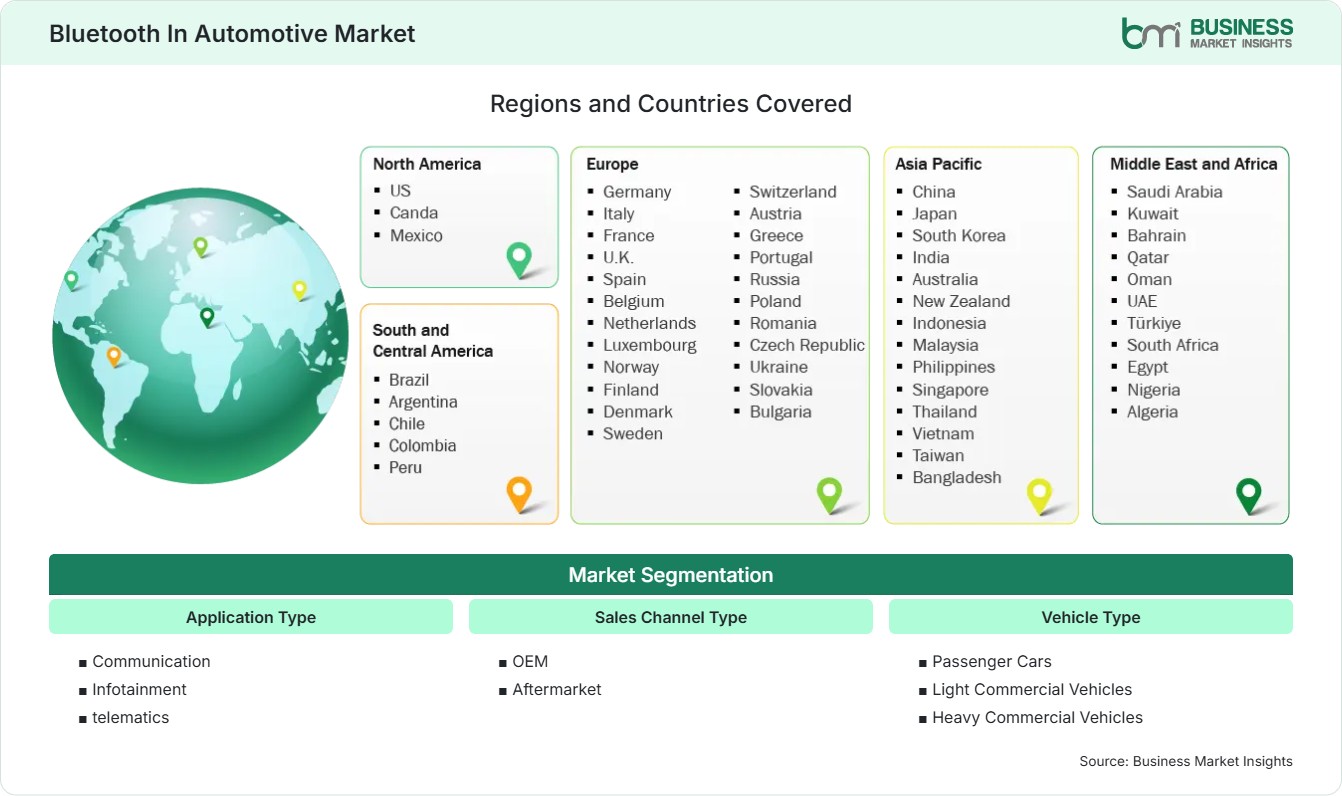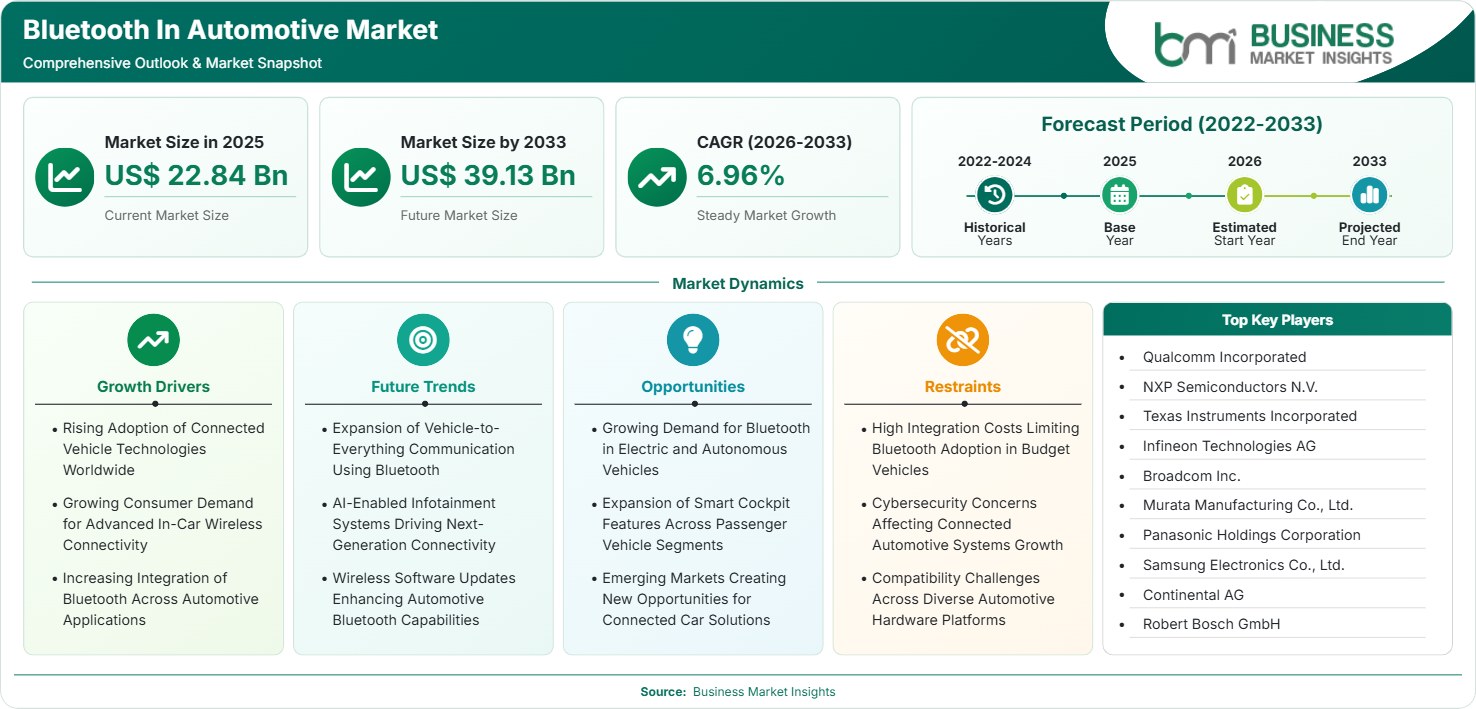
Bluetooth In Automotive Market Regional Highlights
North America Bluetooth in Automotive Market
North America represented a 31%–35% share in 2025 and is projected to expand at a 6.5%–7.5% CAGR during 2026–2033. The region benefits from mature smartphone ecosystems, premium connected vehicles, investment in software-defined vehicles, and strong semiconductor capabilities. The US accounts for most regional demand, while Canada offers incremental opportunities through connected-fleet and passenger-vehicle adoption.
- Automakers are increasing digital cockpit capabilities, encouraging Bluetooth integration with voice assistants, wireless audio, smartphone ecosystems, and personalized in-vehicle services across premium and mass-market vehicle platforms.
- Bluetooth-enabled digital key technologies are gaining relevance as OEMs seek convenient smartphone-based access while combining Bluetooth with UWB and secure authentication for improved reliability.
- Strong regional semiconductor and technology capabilities support innovation in connectivity chipsets, automotive processors, cybersecurity, and wireless modules, strengthening domestic supply opportunities.
US Bluetooth in Automotive Market
The US held a 27%–31% share of global demand in 2025 and is forecast to register a 6.5%–7.5% CAGR through 2033. High smartphone penetration, premium vehicle electronics, connected fleet applications, and strong OEM technology investment underpin demand.
- High adoption of connected and premium vehicles supports Bluetooth-enabled infotainment, wireless audio, hands-free communication, digital keys, and personalized cockpit experiences across major OEM platforms.
- Collaboration between semiconductor suppliers and automotive technology providers is accelerating integrated cockpit computing, connectivity, and ADAS architectures, increasing demand for automotive-grade wireless components.
- Commercial fleets increasingly use connected telematics and diagnostics, creating additional demand for reliable short-range wireless communication alongside cellular and cloud connectivity infrastructure.
Europe Bluetooth in Automotive Market
Europe captured a 25%–29% share in 2025 and is expected to grow at a 6.0%–7.0% CAGR through 2033. Germany leads regional adoption, supported by premium OEMs and sophisticated vehicle electronics, while France and Italy maintain substantial installed bases. Poland represents a higher-growth manufacturing location at 7.5%–8.5% CAGR, benefiting from expanding automotive production and supplier investments.
- Germany remains the leading European Bluetooth in Automotive market, with premium automakers accelerating connected cockpit, digital access, infotainment, and software-defined vehicle development across increasingly centralized electronic architectures.
- Poland offers higher growth potential as automotive manufacturing and component supply networks expand, supporting demand for embedded Bluetooth modules and integrated vehicle connectivity solutions.
- European EV adoption is increasing demand for connected vehicle functions, wireless diagnostics, digital access, and energy-management technologies integrated into increasingly software-intensive vehicle platforms.
- European cybersecurity requirements are encouraging automotive suppliers to embed secure authentication, encrypted communication, and protected wireless connectivity into connected vehicle architectures.
Asia Pacific Bluetooth in Automotive Market
Asia Pacific held a 34%–38% Bluetooth in Automotive market share in 2025 and is projected to achieve an 8.0%–9.0% CAGR through 2033, making it the fastest-growing region. China leads regional volume, while Japan and South Korea remain important technology centers. India is emerging rapidly at 9.0%–10.0% CAGR as connected passenger vehicles, smartphone integration, and domestic automotive manufacturing expand. EV production further accelerates wireless connectivity deployment.
- China combines substantial vehicle production with rapid EV adoption, connected-cockpit deployment, digital-access innovation, and strong domestic technology ecosystems, thereby supporting broad Bluetooth integration.
- India offers high-growth potential as passenger vehicle connectivity expands, smartphone integration becomes mainstream, and automakers introduce increasingly sophisticated infotainment and telematics capabilities.
- Japanese OEMs and suppliers contribute advanced automotive electronics expertise, supporting applications spanning infotainment, telematics, digital access, and connected vehicle functions.
- South Korea benefits from advanced automotive electronics, semiconductor capabilities, and technology integration, strengthening opportunities for Bluetooth-enabled cockpit and connected mobility solutions.
Rest of World Bluetooth in Automotive Market
South & Central America accounted for 7%–10% and will register a CAGR of 6.5%–7.5% over 2025–2033, driven by connected passenger cars and retrofits. Brazil dominates the region in terms of demand, while Mexico sees growth driven by the integration of automotive manufacturing. The Middle East and Africa accoaccounted for7% in tof the marketof market share and are expected to grow at a CAGR of 6.0%–7.0%, led by GCC premium vehicles and South African automotive activity.
- Brazil provides the largest regional opportunity as connected infotainment penetration increases and consumers seek smartphone integration, hands-free communication, streaming, and aftermarket connectivity upgrades.
- Mexico's automotive manufacturing base creates opportunities for embedded Bluetooth components as global OEM supply chains increasingly integrate connected electronics into locally produced vehicles.
- The Gulf Bluetooth in Automotive market benefits from premium-vehicle penetration and high consumer expectations for advanced infotainment, digital access, wireless audio, and connected-cockpit functionality.
- South Africa is an important African automotive hub where connected-vehicle adoption and vehicle-electronics modernization can support the gradual penetration of Bluetooth technology.