Market Summary
Executive Summary and Global Market Analysis
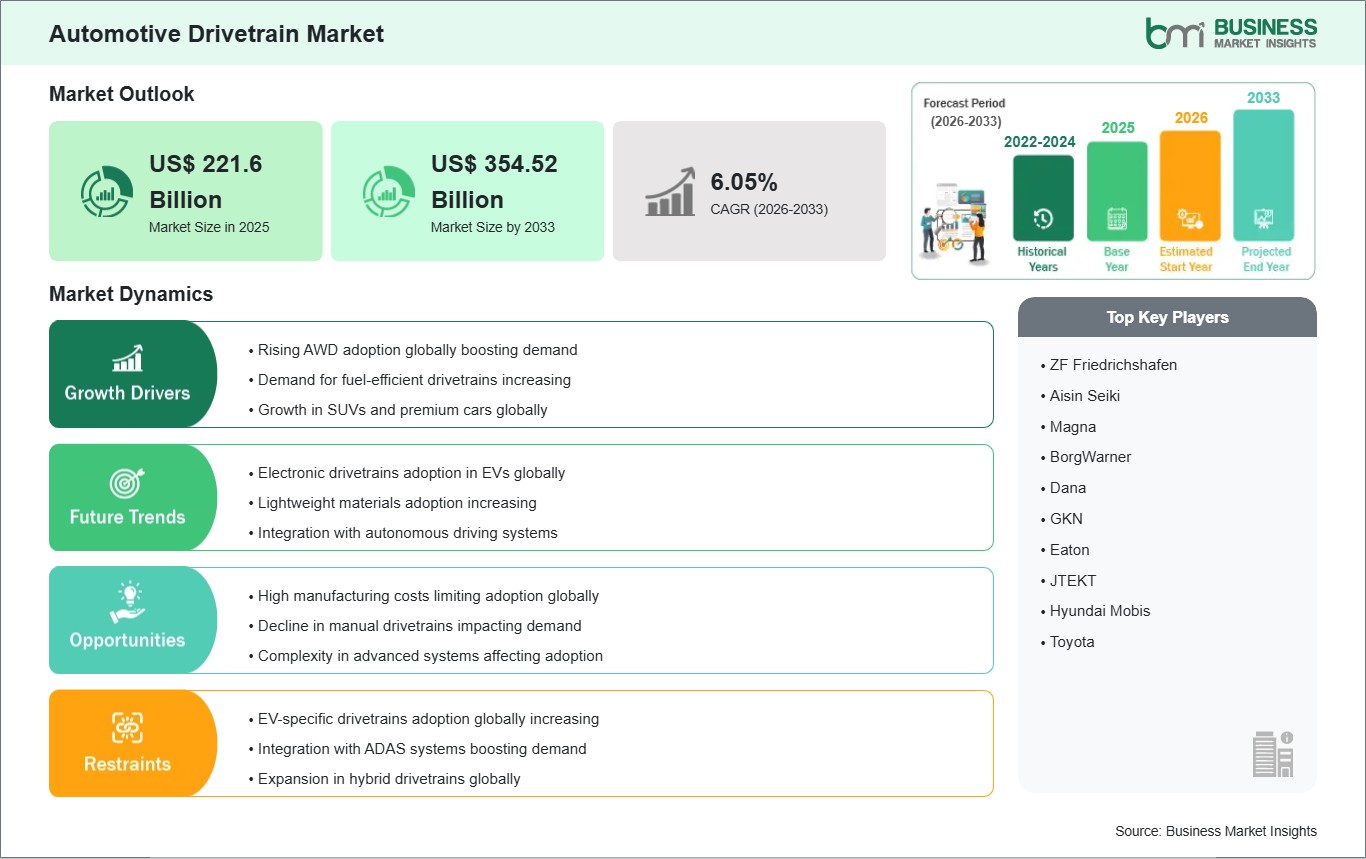
Automotive drivetrain is a system of components that transfers power from the vehicle’s engine or electric motor to the wheels, enabling vehicle movement and performance. Key drivetrain components include transmissions, differentials, driveshafts, and axles. These systems play an important role in improving vehicle efficiency, traction, handling, and driving comfort. The Automotive Drivetrain market is expanding as vehicle manufacturers focus on fuel efficiency, electrification, and advanced mobility solutions. The increasing adoption of electric vehicles, all-wheel-drive systems, and lightweight drivetrain technologies is supporting market growth. Passenger vehicles, commercial fleets, and emerging electric mobility platforms continue to drive demand for advanced drivetrain systems across global automotive markets.
Several challenges influence the Automotive Drivetrain market. The transition from conventional internal combustion engine vehicles to electric vehicles requires significant drivetrain redesign and manufacturing investments. Advanced drivetrain technologies often involve higher development and production costs, creating challenges for cost-sensitive vehicle segments. Supply chain disruptions affecting automotive components and raw materials can also impact production schedules. In addition, increasing technological complexity requires manufacturers to invest in research, testing, and workforce development to meet evolving performance and regulatory requirements.
Despite these challenges, the market is expected to witness steady growth due to ongoing innovation in drivetrain technologies. Opportunities are emerging from the development of electric drivetrains, integrated e-axles, torque vectoring systems, and intelligent power distribution technologies. Vehicle manufacturers are increasingly focusing on improving energy efficiency, vehicle performance, and driving dynamics through advanced drivetrain architectures. The growing adoption of connected and autonomous vehicles is also creating demand for more sophisticated drivetrain control systems. Continued investments in electric mobility, sustainable transportation, and advanced vehicle engineering are expected to support long-term growth in the Automotive Drivetrain market.
Segment Analysis
Automotive Drivetrain Market Segmentation
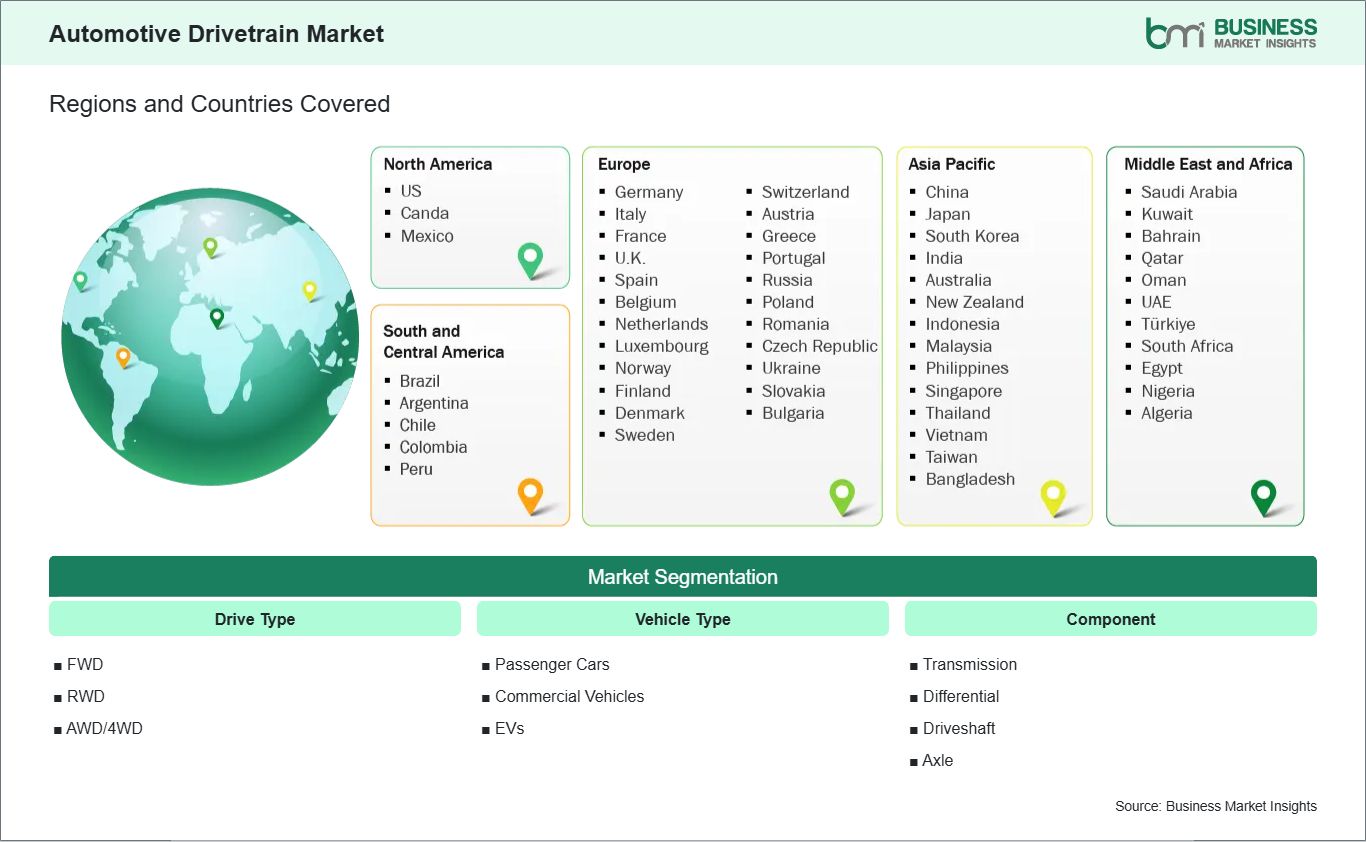
The Automotive Drivetrain market is segmented based on drive type, vehicle type, and component, reflecting the diverse requirements of modern vehicle platforms.
By Drive Type
- FWD: Widely adopted in passenger vehicles due to fuel efficiency, compact design, and lower manufacturing costs.
- RWD: Preferred for performance vehicles and commercial applications requiring better weight distribution and towing capability.
- AWD/4WD: Increasingly used in SUVs, off-road vehicles, and premium vehicles to improve traction, stability, and driving performance.
By Vehicle Type
- Passenger Cars: Account for a significant share due to large production volumes and increasing demand for fuel-efficient mobility solutions.
- Commercial Vehicles: Utilize durable drivetrain systems to support heavy-duty transportation and logistics operations.
- EVs: Growing rapidly as electric mobility adoption increases and manufacturers develop specialized electric drivetrain architectures.
By Component
- Transmission: Essential for managing power delivery and vehicle efficiency across different driving conditions.
- Differential: Enables smooth wheel rotation and improves vehicle handling during cornering and varying road conditions.
- Driveshaft: Transfers power between drivetrain components while supporting vehicle performance and reliability.
- Axle: Provides structural support and power transmission to vehicle wheels.
Market Forces
Automotive Drivetrain Market Drivers and Opportunities
Growing Demand for Fuel-Efficient and Electrified Vehicles
The increasing global focus on fuel efficiency, emissions reduction, and sustainable transportation is a major factor driving the Automotive Drivetrain market. Governments across various regions continue to implement stricter vehicle efficiency and emission regulations, encouraging automakers to develop advanced drivetrain systems. Modern drivetrains are designed to optimize power delivery, reduce energy losses, and improve overall vehicle performance.
The growing adoption of electric vehicles has accelerated the demand for innovative drivetrain technologies that support efficient energy utilization and enhanced driving range. Manufacturers are integrating lightweight materials, advanced transmission systems, and intelligent power management solutions to meet evolving market requirements. Consumer demand for improved driving experiences, lower operating costs, and environmentally responsible transportation solutions further supports drivetrain innovation. As automotive manufacturers continue to invest in next-generation vehicle platforms, drivetrain technologies remain a critical component in achieving performance, efficiency, and regulatory compliance objectives.
Expansion of Advanced Electric Drivetrain Technologies
Significant opportunities are emerging from the rapid development of electric drivetrain systems and intelligent vehicle architectures. Electric vehicles require specialized drivetrain solutions that differ substantially from traditional mechanical systems, creating new opportunities for innovation and product development. Integrated e-axles, electric drive units, and advanced torque vectoring technologies are becoming increasingly important in next-generation vehicle designs.
The expansion of connected and autonomous vehicle technologies is also creating demand for smarter drivetrain control systems capable of responding to real-time driving conditions. Manufacturers are investing in software-driven power management and predictive drivetrain technologies to improve vehicle performance and efficiency. In addition, growing investments in smart mobility infrastructure and sustainable transportation initiatives are encouraging the adoption of advanced drivetrain solutions. As vehicle electrification continues to expand globally, opportunities for high-performance, lightweight, and intelligent drivetrain systems are expected to increase significantly throughout the forecast period.
Size and Share Analysis
Automotive Drivetrain Market Size and Share Analysis
The Automotive Drivetrain Market size is expected to reach US$ 354.52 billion by 2033 from US$ 221.6 billion in 2025. The market is estimated to record a CAGR of 6.05% from 2026 to 2033.
By drive type, FWD systems account for a significant share due to their widespread use in passenger vehicles and their ability to deliver efficient performance with lower manufacturing costs. AWD/4WD systems continue to gain traction as demand rises for SUVs, crossover vehicles, and premium vehicle segments that require enhanced stability and traction. RWD systems maintain importance in commercial vehicles and performance-oriented automotive applications.
By vehicle type, passenger cars represent a major portion of market demand due to high production volumes and increasing integration of advanced drivetrain technologies. Commercial vehicles continue to contribute significantly as fleet operators seek durable and efficient power transmission systems. The EV segment is experiencing strong growth as manufacturers develop specialized electric drivetrain platforms designed to maximize energy efficiency and vehicle performance.
By component, transmissions remain a key revenue-generating segment due to their central role in power management and vehicle operation. Differentials, driveshafts, and axles continue to witness steady demand across conventional and electric vehicle platforms. Growing investments in vehicle electrification, intelligent mobility solutions, and advanced automotive engineering are expected to support the continued expansion of the Automotive Drivetrain market.
Report Coverage
Automotive Drivetrain Market Report Coverage and Deliverables
The "Automotive Drivetrain Market Size and Forecast (2022-2033)" report provides a detailed analysis of the market covering below areas:
- Market size and forecast at global, regional, and country levels for all the key market segments covered under the scope
- Market trends, as well as market dynamics such as drivers, restraints, and key opportunities
- Market analysis covering key market trends, global and regional framework, major players, regulations, and recent market developments
- Industry landscape and competition analysis covering market concentration, heat map analysis, prominent players, and recent developments for the market
- Detailed company profiles, including SWOT analysis
Geographic Insights
Automotive Drivetrain Market Geographic Insights
The Automotive Drivetrain Market shows diverse regional adoption patterns influenced by vehicle production levels, electrification trends, regulatory requirements, and advancements in automotive engineering.
North America, being a developed automotive market, has a strong presence of vehicle manufacturers and technology providers focused on advanced drivetrain systems. The region comprises the United States and Canada, where demand for high-performance vehicles, pickup trucks, SUVs, and electric vehicles continues to support drivetrain innovation. Manufacturers are increasingly integrating advanced transmission systems, all-wheel-drive technologies, and electric drive units to improve vehicle efficiency and performance. The region benefits from established automotive infrastructure, research capabilities, and investments in next-generation mobility solutions.
Asia Pacific is witnessing significant growth in the Automotive Drivetrain Market due to rapid vehicle production, increasing vehicle ownership, and expanding electric mobility initiatives. The region comprises countries such as China, India, Japan, and South Korea, which are major automotive manufacturing hubs. Growing demand for passenger vehicles, commercial transportation, and electric vehicles is encouraging the adoption of advanced drivetrain technologies. Governments across the region continue to support vehicle electrification and fuel-efficiency improvements through various industrial and environmental initiatives. Strong manufacturing ecosystems and expanding supply chains further contribute to market development.
Both regions are contributing significantly to the growth of the Automotive Drivetrain Market through investments in vehicle electrification, technological innovation, and production expansion. Continued advancements in drivetrain efficiency, intelligent power management, and sustainable transportation solutions are expected to support future market growth across developed and emerging automotive markets.
Industry Activity
Recent Developments
The Automotive Drivetrain Market is analyzed using a mix of primary and secondary research sources, including corporate publications, industry associations, and verified databases. This approach ensures accurate tracking of innovation trends and strategic developments influencing the market.
- In March 2026, BorgWarner announced a major production milestone, successfully scaling up its localized manufacturing cells to deliver integrated 800V Silicon Carbide (SiC) eAWD e-Axle systems for a premium European electric vehicle platform. The high-performance drivetrain assembly consolidates a hair-pin electric motor, a high-efficiency rotor, a dual-stage gearbox, and advanced power electronics into a unified, lightweight package. The product rollout highlights a massive tier-one competitive trend focused on optimizing structural power density to extend electric vehicle range and reduce mechanical architecture footprints.
- In December 2025, GKN Automotive launched its next-generation modular eDrive platform, engineered to service a diverse range of vehicle segments from compact city cars to large passenger SUVs. The updated drivetrain layout utilizes a highly flexible, pre-validated software stack that enables automotive OEMs to toggle seamlessly between variable rear-wheel and all-wheel drive powertrain calibrations without altering physical assembly lines. The technology launch directly addresses the automotive sector's engineering requirement to compress vehicle development cycles and lower upfront platform tooling costs.
Trust & Transparency
Research Methodology
The market analysis combines proprietary research with secondary data from government agencies, company disclosures, regulatory filings, industry databases and expert interviews. Market estimates are validated through data triangulation, cross-market benchmarking and analyst
review.
View Full Research Methodology
Key Sources Referred:
World Bank - Global Trade IndicatorsWorld Trade Organization (WTO)International Monetary Fund (IMF)International Trade Administration (ITA)Company WebsitesCompany Annual ReportsCompany Investor Presentations