Market Summary
Executive Summary and Global Market Analysis
Automotive e-compressors are electrically powered compressors used in vehicle air-conditioning, refrigeration, and thermal management systems. Unlike conventional belt-driven compressors, e-compressors operate independently of the engine, making them highly suitable for electric and hybrid vehicles. These systems help maintain cabin comfort, regulate battery temperature, and support efficient vehicle performance. The Automotive E-Compressor market is expanding as vehicle manufacturers increasingly adopt electrified powertrains and advanced thermal management solutions. Growing demand for energy-efficient climate control systems, improved passenger comfort, and optimized battery performance is encouraging wider use of e-compressors across passenger and commercial vehicles.
Several factors may create challenges for market growth. The development and integration of advanced e-compressor systems require significant investment in electronics, power management, and thermal control technologies. High manufacturing costs can limit adoption in price-sensitive vehicle segments. In addition, vehicle manufacturers must address concerns related to energy consumption, system durability, and compatibility with evolving vehicle architectures. Supply chain complexities involving electronic components and rare materials may also affect production timelines. These challenges can increase development costs and influence purchasing decisions in certain markets.
Despite these constraints, the Automotive E-Compressor market is expected to benefit from continuous innovation in electric mobility and vehicle thermal management. Opportunities are emerging through the development of compact, lightweight, and high-efficiency compressor technologies that improve overall vehicle performance. Growing adoption of electric vehicles, expansion of fast-charging infrastructure, and increasing emphasis on battery safety are creating new demand for advanced thermal systems. Manufacturers are also focusing on smart compressor controls, integrated cooling systems, and environmentally friendly refrigerants. As electrification continues across passenger and commercial transportation, the demand for reliable and energy-efficient e-compressor solutions is expected to strengthen, supporting long-term market growth and technological advancement.
Segment Analysis
Automotive E-Compressor Market Segmentation
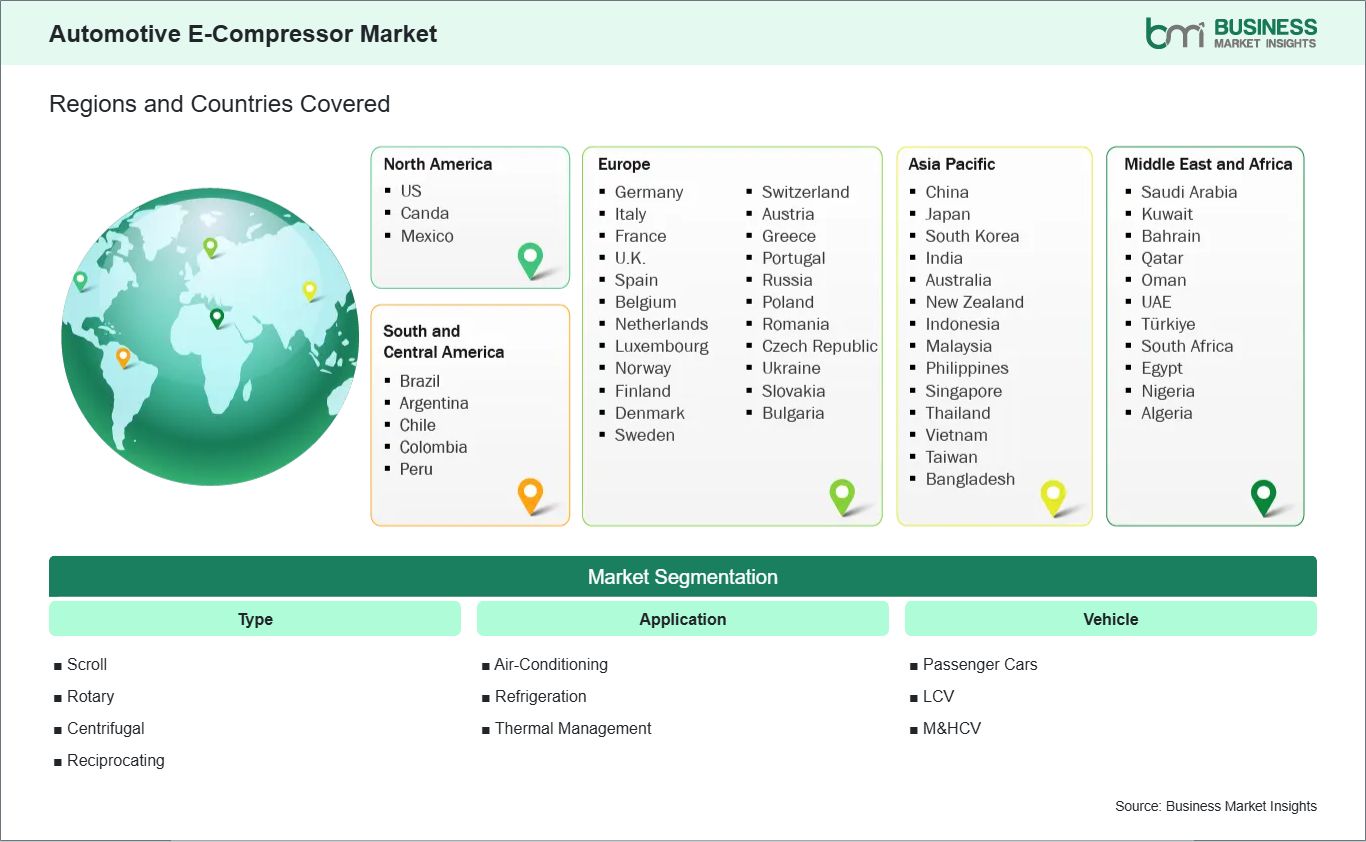
The Automotive E-Compressor market is segmented based on type, application, and vehicle category, reflecting the growing demand for efficient thermal management systems across modern vehicles.
By Type
- Scroll: Widely used due to high efficiency, low noise levels, and compact design
- Rotary: Preferred for reliable performance and cost-effective operation
- Centrifugal: Suitable for high-capacity cooling applications in advanced vehicle systems
- Reciprocating: Utilized in specific applications requiring robust compression performance
By Application
- Air-Conditioning: Represents significant demand due to passenger comfort requirements
- Refrigeration: Used in temperature-controlled transportation and specialty vehicles
- Thermal Management: Increasingly important for battery cooling and power electronics protection
By Vehicle
- Passenger Cars: Largest adoption segment driven by growing vehicle electrification
- LCV: Expanding use for efficient cabin cooling and operational reliability
- M&HCV: Growing demand supported by electrification and advanced thermal management requirements
Market Forces
Automotive E-Compressor Market Drivers and Opportunities
Rising Adoption of Electric and Hybrid Vehicles
The increasing adoption of electric and hybrid vehicles is a major factor supporting the Automotive E-Compressor market. Unlike conventional vehicles that use engine-driven compressors, electric vehicles require electrically powered compressors to operate air-conditioning and thermal management systems. As governments continue to encourage vehicle electrification through emissions regulations and sustainability initiatives, manufacturers are integrating advanced thermal management technologies into their vehicle platforms.
Efficient battery temperature control has become increasingly important for maintaining driving range, charging performance, and battery life. E-compressors help regulate battery temperatures while simultaneously supporting passenger cabin comfort. This dual functionality makes them an essential component in modern electric vehicles. In addition, advancements in power electronics and vehicle architecture are enabling more efficient compressor systems with improved performance characteristics. Growing investments in electric mobility infrastructure and increasing consumer acceptance of electric vehicles are expected to further strengthen demand for e-compressor technologies across global automotive markets.
Development of Advanced Thermal Management Systems
The growing focus on advanced thermal management systems presents significant opportunities for the Automotive E-Compressor market. Modern vehicles contain increasingly complex electronic systems, batteries, and power components that require precise temperature regulation. E-compressors are becoming an important part of integrated thermal management solutions designed to improve efficiency and operational reliability.
Manufacturers are developing intelligent thermal systems that combine battery cooling, cabin conditioning, and power electronics temperature management into a unified architecture. These innovations can improve energy utilization while enhancing overall vehicle performance. Emerging technologies such as predictive thermal controls, connected vehicle systems, and smart sensors are creating new possibilities for more efficient compressor operation. Furthermore, the adoption of environmentally friendly refrigerants and compact compressor designs is opening additional growth opportunities. As vehicle manufacturers continue to prioritize energy efficiency, sustainability, and user comfort, demand for next-generation e-compressor technologies is expected to increase across passenger and commercial vehicle segments.
Size and Share Analysis
Automotive E-Compressor Market Size and Share Analysis
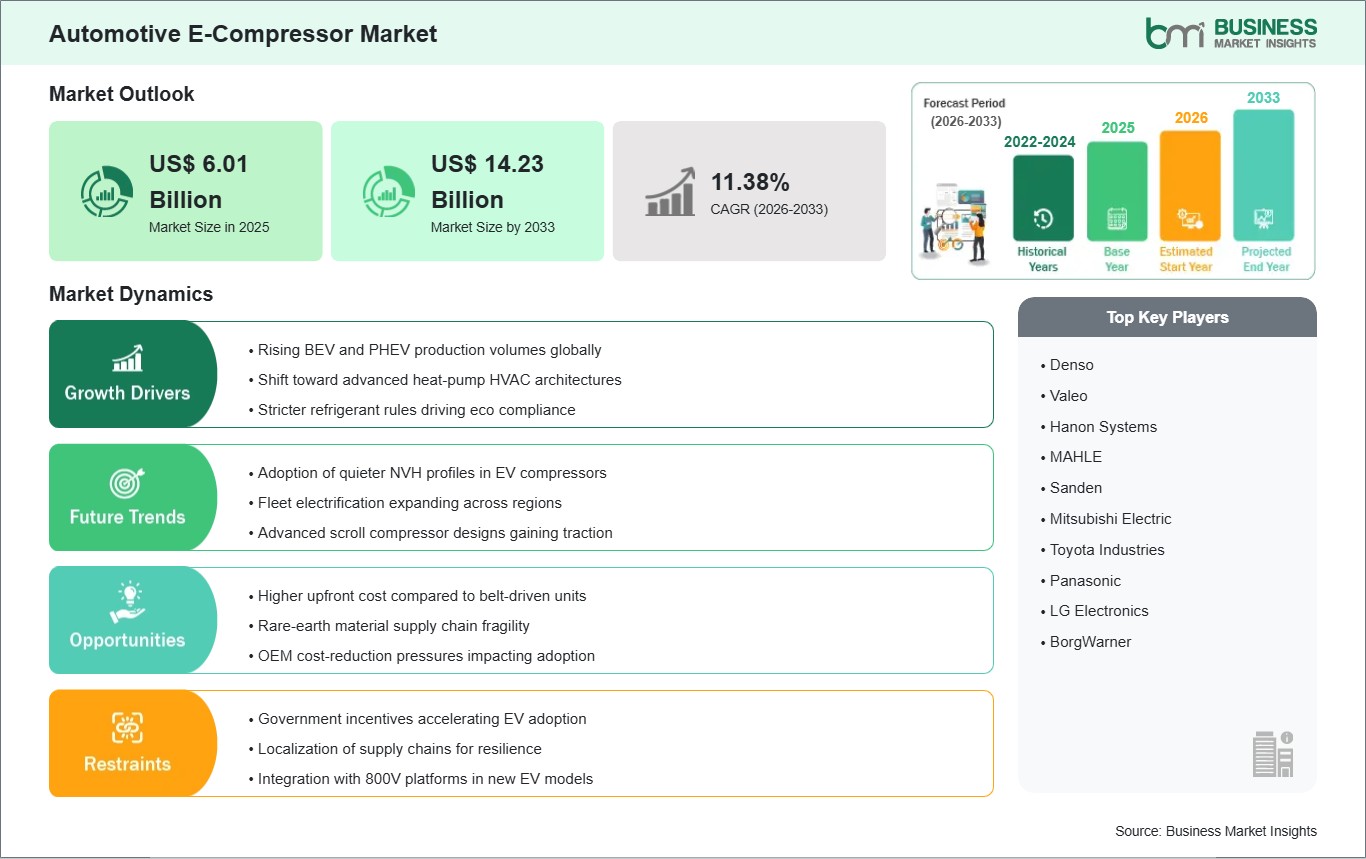
The Automotive E-Compressor market size is expected to reach US$ 14.23 billion by 2033 from US$ 6.01 billion in 2025. The market is estimated to record a CAGR of 11.38% from 2026 to 2033.
By type, scroll compressors account for a significant share of the market due to their high operational efficiency, compact design, and low noise characteristics. Rotary compressors maintain strong demand because of their reliability and cost-effectiveness, while centrifugal and reciprocating compressors are utilized in specialized cooling and thermal management applications requiring specific performance capabilities.
By application, air-conditioning remains the leading segment owing to its widespread use in maintaining passenger comfort across vehicle categories. Thermal management is experiencing rapid growth due to increasing electrification and the need for battery cooling systems. Refrigeration applications continue to expand in specialized transportation and commercial vehicle operations where temperature control is critical.
Report Coverage
Automotive E-Compressor Market Report Coverage and Deliverables
The "Automotive E-Compressor Market Size and Forecast (2022-2033)" report provides a detailed analysis of the market covering below areas:
- Market size and forecast at global, regional, and country levels for all the key market segments covered under the scope
- Market trends, as well as market dynamics such as drivers, restraints, and key opportunities
- Market analysis covering key market trends, global and regional framework, major players, regulations, and recent market developments
- Industry landscape and competition analysis covering market concentration, heat map analysis, prominent players, and recent developments for the market
- Detailed company profiles, including SWOT analysis
Geographic Insights
Automotive E-Compressor Market Geographic Insights
The Automotive E-Compressor Market shows diverse regional adoption patterns influenced by vehicle electrification, thermal management requirements, automotive manufacturing capabilities, and environmental regulations.
North America, being a technologically advanced automotive market, demonstrates strong adoption of automotive e-compressors across electric and hybrid vehicle platforms. The region comprises the United States and Canada, where vehicle manufacturers continue investing in electrification technologies and advanced thermal management systems. The region focuses on improving vehicle efficiency, battery performance, and passenger comfort. Strong research capabilities, established automotive supply chains, and supportive regulatory frameworks contribute to the widespread adoption of e-compressor technologies. Increasing consumer demand for electric vehicles further supports market expansion across passenger and commercial transportation segments.
Asia Pacific is experiencing significant growth driven by rapid expansion of electric vehicle production and automotive manufacturing activities. The region comprises countries such as China, Japan, South Korea, and India, which are actively investing in vehicle electrification and battery technologies. The region focuses on enhancing vehicle performance, improving energy efficiency, and supporting sustainable transportation initiatives. Strong manufacturing infrastructure and growing investments in advanced automotive components are encouraging wider adoption of e-compressors. Government programs supporting electric mobility and increasing demand for modern vehicle comfort systems are further contributing to market growth.
Both regions are contributing significantly to the growth of the Automotive E-Compressor Market, focusing on vehicle electrification, advanced thermal management technologies, improved energy efficiency, and increasing demand for high-performance automotive climate control systems.
Industry Activity
Recent Developments
The Automotive E-Compressor Market is analyzed using a mix of primary and secondary research sources, including corporate publications, industry associations, and verified databases. This approach ensures accurate tracking of innovation trends and strategic developments influencing the market.
- In February 2026, DENSO Corporation announced the development of advanced thermal management technologies designed to improve efficiency in electric vehicle climate control systems. The innovation supports optimized energy consumption and enhanced battery temperature regulation. The development reflects growing industry focus on integrated thermal management solutions for electric mobility.
- In October 2025, Hanon Systems expanded its collaboration activities related to electric vehicle thermal management solutions, including advanced compressor and heat pump technologies. The initiative focused on improving energy efficiency and vehicle range through integrated thermal management systems. The development highlights continued innovation in automotive climate control technologies.
Trust & Transparency
Research Methodology
The market analysis combines proprietary research with secondary data from government agencies, company disclosures, regulatory filings, industry databases and expert interviews. Market estimates are validated through data triangulation, cross-market benchmarking and analyst
review.
View Full Research Methodology
Key Sources Referred:
World Bank - Global Trade IndicatorsWorld Trade Organization (WTO)International Monetary Fund (IMF)International Trade Administration (ITA)Company WebsitesCompany Annual ReportsCompany Investor Presentations