
Automotive Restoration Market Outlook: Size, Share, Trends, Growth Analysis, Competitive Landscape & Forecast, 2026-2033

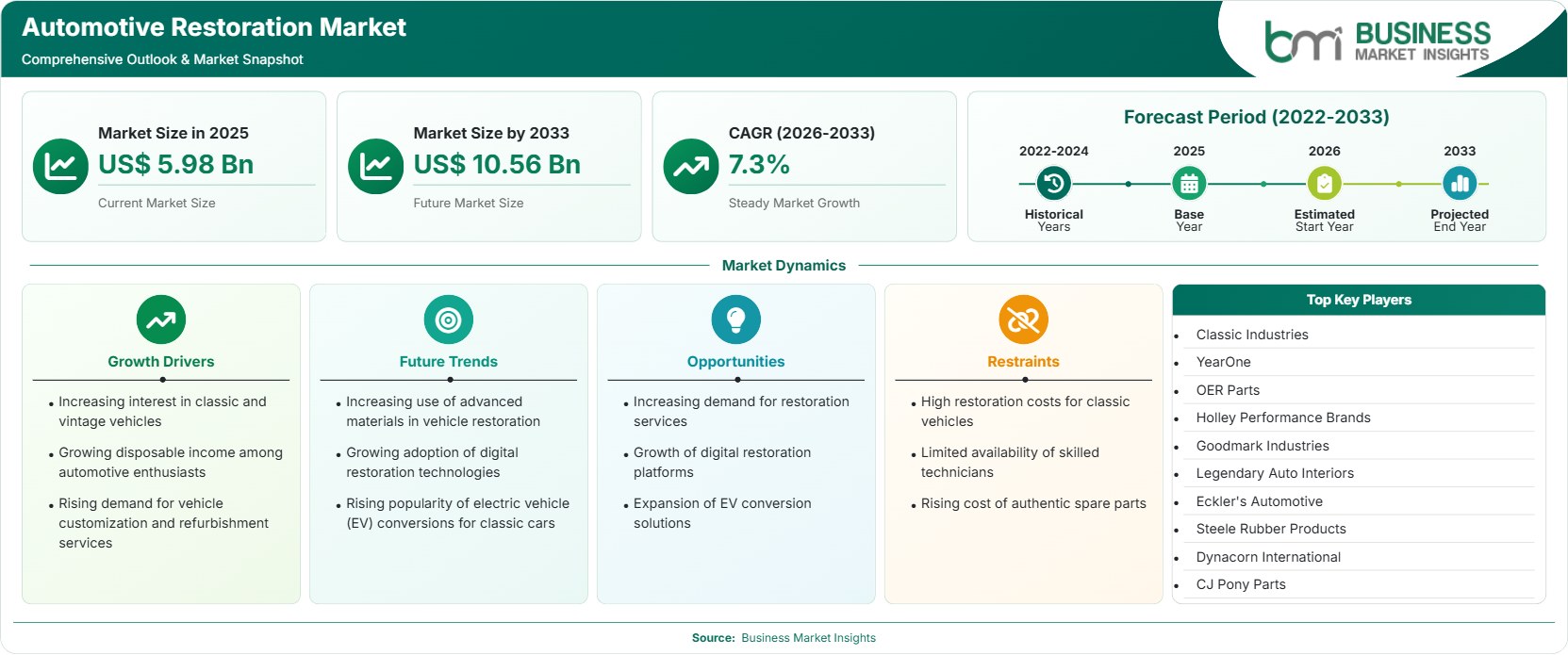
The Automotive Restoration Market size was valued at US$ 5.98 Billion in 2025 and is projected to reach US$ 10.56 Billion by 2033, growing at a CAGR of 7.3% during 2026–2033, driven by increasing collector interest, vehicle personalization trends, heritage preservation initiatives, and rising investment in classic vehicle refurbishment and customization services.

Report Coverage
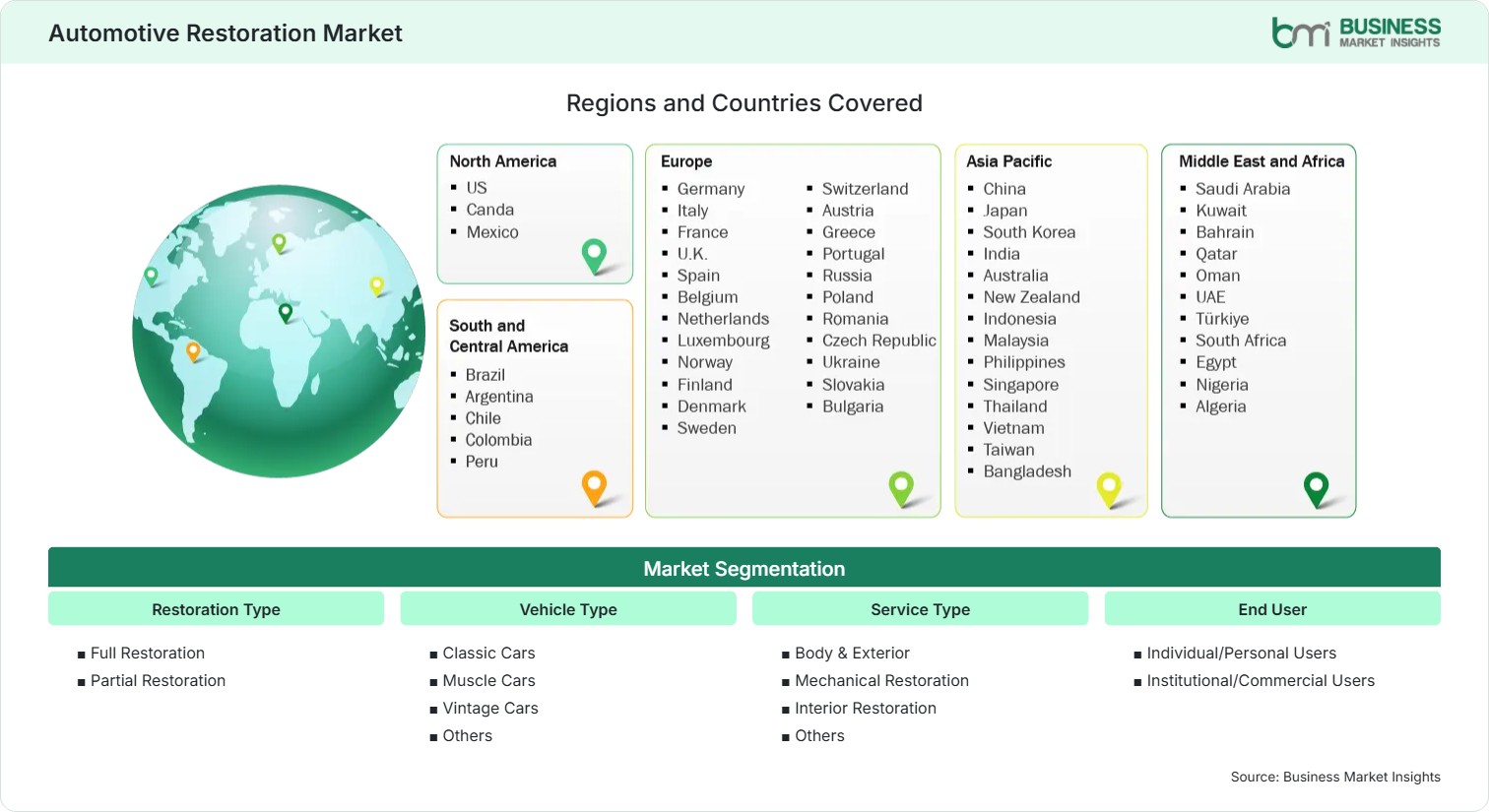
  • Restoration Type: Full Restoration, Partial Restoration
  • Vehicle Type: Classic Cars, Muscle Cars, Vintage Cars, Others
  • Service Type: Body & Exterior, Mechanical Restoration, Interior Restoration, Others
  • End User: Individual/Personal Users, Institutional/Commercial Users
US$ 5.98 Bn Market size in 2025
US$ 10.56 Bn Market Size by 2033
7.3% CAGR, 2026 - 2033
2026-2033 Forecast Period

01 AI Overview

Automotive Restoration Market Summary

  • North America Region: North America holds a 42%–45% share in 2025, growing with a CAGR of 6.8%–7.5% influenced by strong collector communities, established restoration networks, auction activity, and customization demand. The US Automotive Restoration market demonstrates a 6.9%–7.6% CAGR from 2026–2033, supported by classic car ownership, enthusiast clubs, and specialized restoration workshops.
  • Fastest Growing Region: Asia Pacific accounts for a 18%–21% share in 2025, expanding at a CAGR of 8.2%–9.0% supported by increasing luxury vehicle ownership, rising enthusiast communities, growing disposable incomes, and expanding interest in heritage automotive investments.
  • Leading Segment: Full Restoration represents a 55%–58% share in 2025, growing at a CAGR of 7.0%–7.8% due to collector demand for historically accurate rebuilds, premium vehicle preservation, and high-value classic automobile restoration projects.
  • High Growth Segment: Electric Vehicle Conversion Solutions within restoration services represent a developing opportunity, advancing at a CAGR of 9.0%–10.0% due to sustainability preferences, regulatory pressure, and demand for modernized classic vehicle ownership experiences.
  • Key Market Opportunity: Expansion of digital restoration platforms, online parts marketplaces, and EV conversion technologies creates opportunities for restoration providers to reach global enthusiasts and deliver advanced vehicle refurbishment solutions.
  • Major Market Players: Classic Industries, YearOne, OER Parts, Holley Performance Brands, Goodmark Industries, Legendary Auto Interiors, Eckler's Automotive, Steele Rubber Products, Dynacorn International, CJ Pony Parts
02 Strategic Insights

Automotive Restoration Market: Strategic Insights

automotive-restoration-market-market-strategic-framework
FREE PDF
Request your free sample
Request free sample
03 Stakeholder View

Key Takeaways

  • The market value chain is expanding beyond traditional workshops through specialized parts suppliers, digital marketplaces, restoration technology providers, and collector-focused service ecosystems.
  • Full restoration projects remain the highest-value opportunity, while partial restoration and customization services provide broader accessibility for emerging enthusiasts and cost-conscious owners.
  • Technology adoption, including 3D scanning, digital fabrication, advanced coatings, and EV conversion systems, is reshaping restoration methods and improving project capabilities.
  • North America remains the strongest investment region due to established collector networks, a large classic vehicle ownership base, and mature aftermarket infrastructure.
  • Strategic partnerships between restoration companies, component manufacturers, and digital platforms are increasing as businesses seek broader customer reach and improved supply chain efficiency.
04 Geographic Outlook

Automotive Restoration Market Regional Highlights

North America Automotive Restoration Market

North America accounted for a 42%–45% Automotive Restoration Market share in 2025 and is projected to grow at a CAGR of 6.8%–7.5% between 2026–2033. The region dominates due to strong classic car ownership culture, established aftermarket suppliers, and high participation in automotive events. The United States represents the largest contributor, supported by collector investments and specialized restoration expertise.

  • Strong collector communities continue supporting demand for complete restoration projects involving iconic automotive models.
  • Established aftermarket suppliers provide availability of reproduction parts, improving restoration feasibility for older vehicles.
  • Auction markets and automotive events encourage investment in restored vehicles as collectible assets.
  • Restoration workshops are adopting digital technologies to improve accuracy and project efficiency.

US Automotive Restoration Market

The US accounted for a 35%–38% share in 2025 and is expected to register a CAGR of 6.9%–7.6% during 2026–2033. The country remains the primary global hub for classic vehicle restoration due to a large enthusiast population, strong aftermarket ecosystem, and availability of restoration specialists. Demand is supported by muscle cars, vintage automobiles, and collector vehicles.

  • Muscle car restoration continues attracting enthusiasts seeking historically accurate vehicle rebuilds.
  • Online parts platforms are improving accessibility to specialized components and restoration materials.
  • Premium collectors are increasing spending on professional restoration services and customization projects.

Europe Automotive Restoration Market

Europe represented a 25%–28% share in 2025 and is forecast to expand at a CAGR of 6.5%–7.2% through 2033. The region benefits from strong automotive heritage, luxury vehicle ownership, and preservation of historically significant models. Germany, the United Kingdom, Italy, and France remain leading Automotive Restoration markets due to established automotive cultures and premium vehicle collections.

  • European restoration specialists focus on maintaining the authenticity of historically important vehicle models.
  • Germany benefits from strong engineering expertise and availability of specialized automotive restoration services.
  • The United Kingdom continues to support classic vehicle preservation through enthusiast communities and events.
  • Italy remains important due to luxury sports car heritage and collector interest.

Asia Pacific Automotive Restoration Market

Asia Pacific held an 18%–21% share in 2025 and is expected to achieve a CAGR of 8.2%–9.0% from 2026–2033. The region represents the fastest-growing market due to increasing disposable incomes, expanding luxury vehicle ownership, and rising interest in collectible automobiles. China, Japan, India, and Southeast Asian countries are emerging contributors.

  • Rising wealth among automotive enthusiasts is increasing demand for premium restoration services.
  • Japan’s strong automotive culture supports demand for heritage and performance vehicle restoration.
  • India is experiencing growing interest in vintage vehicle preservation and collector events.
  • Digital platforms are improving access to restoration parts and specialist services.

Rest of World Automotive Restoration Market

Rest of World accounted for a 9%–12% share in 2025 and is projected to grow at a CAGR of 7.5%–8.3% during 2026–2033. South America and Middle East markets are developing through luxury vehicle ownership, collector activities, and increasing investment in automotive heritage. Regional growth remains supported by specialized restoration services.

  • Middle Eastern collectors are investing in premium classic vehicles and high-value restoration projects.
  • Latin American markets show increasing interest in preserving historic automotive models.
  • Growing automotive tourism events are supporting restoration awareness and enthusiast participation.
  • Regional workshops are adopting global sourcing networks for restoration components.
global-market-geography
FREE PDF
Request your free sample
Request free sample
05 Segment Analysis

Automotive Restoration Market Segmentation

Restoration Type

The restoration type segment represents the core service structure of the Automotive Restoration Market, influenced by vehicle condition, owner objectives, budget considerations, and collector expectations. Full Restoration accounted for a 55%–58% share in 2025 and is projected to grow at a CAGR of 7.0%–7.8% from 2026–2033 due to increasing demand for complete historical preservation, premium refurbishment, and high-value collector vehicle restoration projects.

  • Full Restoration: The process of Full Restoration entails restoring vehicles completely, including the mechanical parts, body, and interiors, to original specs. The need for it stems from enthusiasts' desire to preserve vehicles and the asset's increased value.
  • Partial Restoration: Partial Restoration focuses on targeted improvements such as mechanical upgrades, exterior repairs, or interior refurbishment. It attracts owners seeking improved performance, appearance, and reliability without complete rebuilding.

Vehicle Type

The vehicle type segmentation is based on the preferences of collectors, historical value, and potential profitability of various automobiles. Classic Cars hold their dominant position owing to extensive collector interest and restoration networks that exist for this category of cars. Moreover, Muscle Cars and Vintage Cars have been increasingly attracting the attention of collectors seeking to purchase historic vehicles with unique designs.

  • Classic Cars: Classic Cars are a popular segment of vehicles that require restoration and have the support of the collector community and various car events.
  • Muscle Cars: Muscle Cars attract enthusiasts due to performance heritage, customization potential, and strong aftermarket availability for restoration parts and mechanical upgrades.
  • Vintage Cars: Vintage Cars require specialized restoration expertise due to their age, limited component availability, and the demand to maintain original design characteristics.

Service Type

The service type segmentation includes all restoration operations, varying from structural restorations to aesthetic operations. Restoration of body and exterior is still relevant considering the need for visible vehicle transformations, whereas restoration of mechanicals and interiors ensures functional and owner-value-added services. Increasing demand for customization services drives an integrated approach that combines several types of services into a single package.

  • Body & Exterior: Body and Exterior restoration services include painting, structural restoration, corrosion protection, and aesthetic improvements to the vehicle. The need for this service type is driven by owners' desire for high-quality vehicle restoration.
  • Mechanical Restoration: Mechanical Restoration focuses on the engine, transmission, suspension, and vehicle performance. This service type is still relevant to increase the reliability and performance of restored vehicles.
  • Interior Restoration: Interior Restoration includes upholstery, dashboard, trim components, and other interior components. Increasing demand is generated by owners' desire for authentic interiors and comfort.

End User

The End-user segment categories are driven by the needs of individual collectors, enthusiastic individuals, enterprises, and institutions. Individual customers make up the largest market segment, since they own classic automobiles. Commercial customers are now using more restoration projects for exhibitions, museums, rentals, and automobile experiences.

  • Individual/Personal Users: Individual customers create restoration needs due to their passion for classic cars and automobile customization.
  • Institutional/Commercial Users: Institutional and commercial customers use restoration projects for museums, automobile shows, heritage exhibitions, and automotive businesses.
06 Market Forces

Automotive Restoration Market Dynamics

Key Market Drivers

Increasing Interest in Classic and Vintage Vehicles

The market is driven by rising enthusiasm for classic and vintage vehicles among collectors, hobbyists, and younger automotive enthusiasts. The rising interest among people in automotive shows, collector auctions, and heritage events is prompting them to preserve historically significant cars. According to the Automotive Restoration Market Trends, there is an increase in demand for professional refurbishment services that keep the original design intact while improving reliability. This is further encouraged by online networks, through which people can showcase their car restoration projects to the world. This has created an environment of increased interaction between the car owners, restorers, and parts suppliers.

Growing Disposable Income Among Automotive Enthusiasts

Increasing disposable income among vehicle enthusiasts is enabling higher spending on premium restoration projects, customization, and collectible automobile ownership. Wealth growth in emerging economies is creating new customer groups interested in acquiring and restoring heritage vehicles. Highly valued restorations are now seen as lifestyle purchases and collectible additions. Customers with the means are seeking specialized restoration techniques, genuine parts, and customization services that enhance the uniqueness of their cars. Restoration firms are addressing these demands by offering more high-end services and custom solutions.

Rising Demand for Vehicle Customization and Refurbishment Services

Vehicle owners now prefer unique restoration services that blend old-fashioned style with modern utility. Customers are moving from classic restoration to personalized restoration services that include performance enhancements, interior improvements, enhanced safety features, and the integration of new technology. Restoration companies are coming up with flexible services to cater to different customer requirements. The rise in the culture of automobile customization, backed by car enthusiast forums and the automotive aftermarket industry, is creating more opportunities for specialty restoration firms. These trends are encouraging innovation in materials, manufacturing methods, and restoration processes across the automotive aftermarket ecosystem.

Key Market Opportunities

Increasing Demand for Restoration Services

Growth in the number of hobbyists around the world opens doors for restoration companies to add new service lines and access new markets. The increase in classic-car ownership, collector activity, and awareness of automotive history are factors contributing to the demand for restoration services. Such growth can be leveraged by offering bundled services that include sourcing, restoring, maintaining, and customizing automobiles, and by expanding specialized workshops and partnerships with automobile parts suppliers. The Automotive Restoration Market forecast will also be driven by consumers' perception of restored automobiles as an emotional asset, a collectible investment, and a form of personal expression.

Growth of Digital Restoration Platforms

Digital restoration platforms offer a new opportunity to bridge car owners, restoration experts, and parts suppliers through online ecosystems. Digital restoration platforms enable access to hard-to-find parts, information on the restoration process, project management tools, and specialized services. Online marketplaces decrease geographic limitations and help enthusiasts manage their restoration projects more effectively. Companies specializing in digital cataloging, online consultation services, and online communities may increase customer engagement.

Expansion of EV Conversion Solutions

The idea of electric vehicle conversion offers a new prospect for restoration companies looking to integrate their classic designs with contemporary requirements. There is increasing interest among owners of classic vehicles in converting them to electric power to improve efficiency and reduce emissions. Restoration companies ready to leverage their expertise in battery technology, engineering, and modification can explore new markets. It is an opportunity for companies to preserve automotive history while modifying automobiles to meet future mobility requirements.

Market Restraints and Challenges

High Restoration Costs for Classic Vehicles

Factor: Restoration projects often require expensive components, specialized labor, rare materials, and extended timelines, increasing overall project costs. Impact: High expenses can limit participation among budget-conscious vehicle owners and restrict market expansion to premium customers. Complex restoration requirements for older vehicles may involve unpredictable repairs, sourcing challenges, and significant customization expenses. These factors can make restoration projects financially demanding compared with purchasing newer vehicles. Companies must improve cost management, sourcing efficiency, and service transparency to maintain customer interest while delivering high-quality restoration outcomes.

Limited Availability of Skilled Technicians

Factor: The shortage of experienced restoration specialists with knowledge of older vehicle systems and traditional craftsmanship creates workforce limitations. Impact: Limited technician availability can increase project completion times, raise labor costs, and restrict restoration capacity. Many classic vehicles require specialized skills involving mechanical reconstruction, body fabrication, upholstery, and historical accuracy. As experienced professionals retire, companies face challenges transferring technical knowledge to new workers. Investment in training programs, apprenticeships, and modern restoration education will be important for maintaining industry capability.

07 Company Analysis

Competitive Landscape

The Automotive Restoration market analysis report shows that the business environment is highly fragmented, comprising specialty parts producers, restoration service providers, aftermarket companies, and digital automotive platforms. The firms have emphasized increasing product availability, enhancing restoration accuracy, offering tailor-made solutions, and building connections with automobile enthusiasts.

Company Name

Overview

Products and Services relevant to this market

Classic Industries

Supplier specializing in restoration parts for classic vehicles.

Restoration components, body parts, interiors, electrical and trim products.

YearOne

Automotive aftermarket company serving restoration enthusiasts.

Classic vehicle parts, performance components, restoration accessories.

OER Parts

Manufacturer of reproduction restoration components.

Interior parts, exterior components, replacement vehicle accessories.

Holley Performance Brands

Automotive performance company with restoration solutions.

Engine components, fuel systems, performance and restoration products.

Goodmark Industries

Provider of classic vehicle restoration body components.

Sheet metal parts, body panels, restoration components.

Legendary Auto Interiors

Specialist in classic vehicle interior restoration products.

Upholstery kits, interior components, restoration materials.

Eckler's Automotive

Supplier serving classic and collector vehicle owners.

Restoration parts, accessories, vehicle-specific components.

Steele Rubber Products

Manufacturer of automotive rubber restoration products.

Weatherstripping, seals, rubber restoration components.

Dynacorn International

Producer of reproduction classic vehicle parts.

Replacement bodies, sheet metal components, restoration products.

CJ Pony Parts

Automotive aftermarket retailer specializing in performance vehicles.

Classic vehicle parts, accessories, restoration and customization products.

08 Industry Activity

Recent Developments

April 2026

ECD Automotive Design launched "The Gallery by ECD," a new division offering bespoke paint and upholstery services for all vehicle makes and models, expanding the company's restoration and customization capabilities beyond its traditional classic vehicle restoration business.

January 2026

ECD Automotive Design introduced its Heritage Product Line, a restoration program focused on factory-authentic Land Rover Defender builds that preserve original styling while incorporating carefully selected modern engineering improvements, expanding its classic vehicle restoration portfolio.

December 2025

ECD Automotive Design announced an agreement to integrate production from a regional 4×4 restoration shop into its Florida manufacturing facility, allocating at least 10% of its annual production capacity to third-party restoration builds to improve factory utilization and expand restoration services.

July 2025

ECD Automotive Design unveiled "Ghost," its first fully restored and re-engineered 1967 Ford Mustang Fastback, marking the company's expansion into the American muscle car restoration market alongside its Land Rover and Jaguar restoration business.

10 Trust & Transparency

Research Methodology

The market analysis combines proprietary research with secondary data from government agencies, company disclosures, regulatory filings, industry databases and expert interviews. Market estimates are validated through data triangulation, cross-market benchmarking and analyst review.

View Full Research Methodology

11 Questions Answered

Frequently Asked Questions

What factors should investors consider in this Automotive Restoration Market report?

Investors should evaluate restoration expertise availability, parts supply networks, collector demographics, technology adoption, customization demand, and regional growth opportunities within enthusiast communities.

What impact will EV conversions have on vehicle restoration?

EV conversions enable classic vehicles to combine traditional design with modern electric technology. This creates opportunities for sustainability-focused restoration while improving performance, efficiency, and future usability.

How are digital platforms changing restoration services?

Digital platforms improve access to restoration specialists, replacement components, technical information, and project management solutions. They allow enthusiasts to connect globally with suppliers and restoration professionals.

Why are classic vehicles considered valuable restoration assets?

Classic vehicles often represent automotive heritage, limited production history, and collector appeal. Professional restoration can enhance vehicle condition, preserve historical significance, and increase long-term ownership value.

What is driving growth in the Automotive Restoration Market?

Growth is supported by increasing collector interest, rising investment in classic vehicles, customization demand, improved digital access to restoration parts, and growing adoption of modern technologies within restoration processes.

Access the Full Automotive Restoration Market Report

Get segment-level forecasts, regional estimates, competitive benchmarking, company profiles and downloadable Excel datasets.

Access the full Automotive Restoration Market Report
350 pages PDF & Excel | 2026-07-28