Market Summary
Executive Summary and Global Market Analysis
The EV battery testing market focuses on evaluating battery safety, performance, durability, and charging efficiency in electric vehicles. Testing procedures support battery validation during product development, manufacturing, and operation. These testing systems help manufacturers meet regulations and ensure battery reliability in different operating conditions. The market includes various testing technologies that assist automotive manufacturers, battery developers, and component suppliers. The growth of electric vehicle production is increasing the need for effective battery testing infrastructure in global automotive supply chains.
Manufacturers are focusing on testing systems that can spot thermal stability issues, charging inconsistencies, and lifecycle performance limits. Regulatory authorities are also tightening battery safety standards for transportation applications. Automotive companies are integrating better testing environments to improve product consistency and lower risks linked to battery failures.
Market segmentation shows the wide variety of testing methods and deployment needs within the industry. Electrochemical testing remains important because it verifies battery performance and assesses lifespan. Thermal and mechanical testing systems are essential for safety evaluations in extreme conditions. Hybrid testing platforms are attracting attention because they merge different analytical tools into a single testing setup.
Technological advances are improving automation, simulation precision, and real-time battery monitoring. Testing facilities are adopting digital analytics and software for better validation accuracy. Application areas are still growing in grid-connected mobility infrastructure, commercial electric transportation, and industrial battery systems. Testing procedures are changing to accommodate new battery chemistries and fast-charging designs.
Segment Analysis
EV Battery Testing Market Segmentation
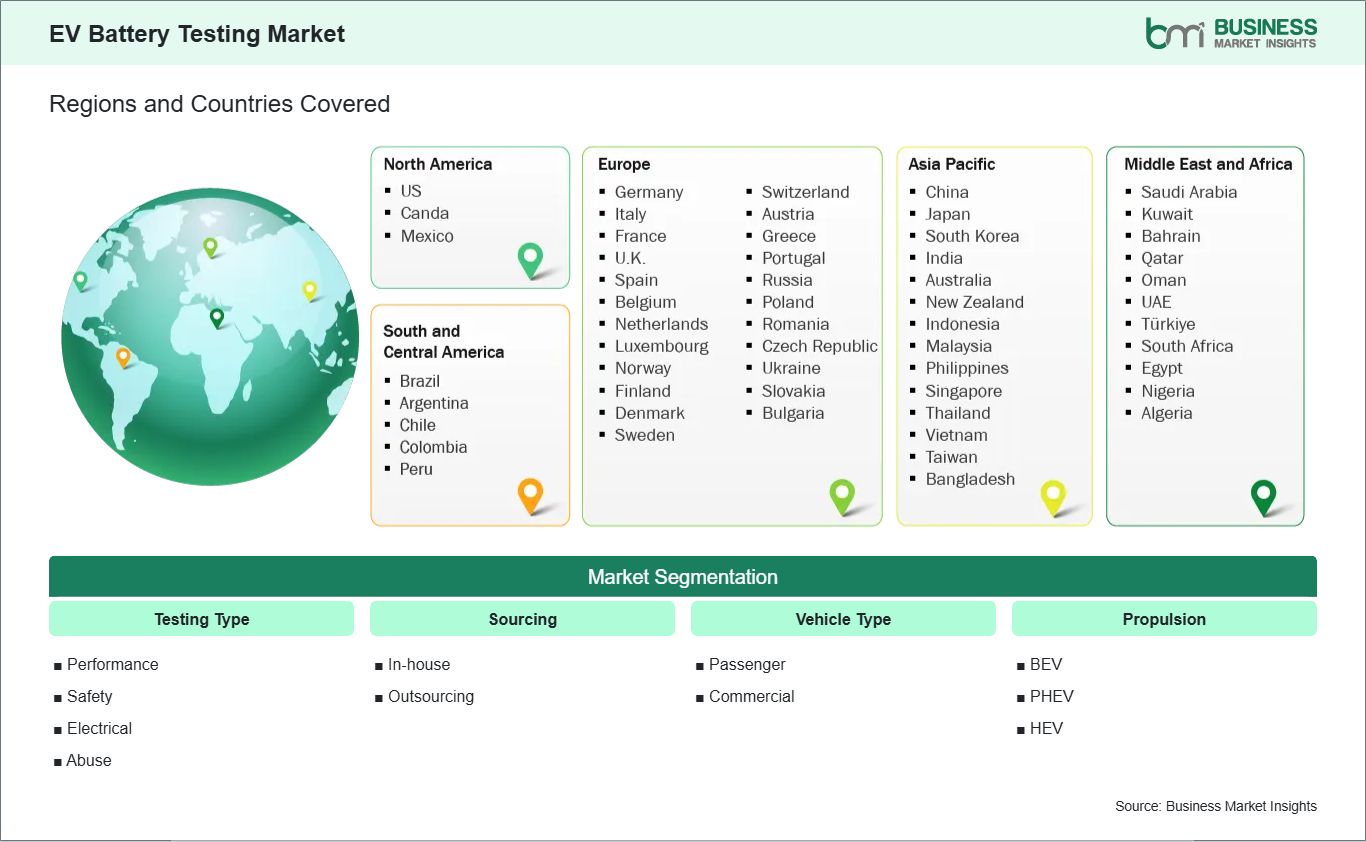
The EV battery testing market is segmented by testing type, sourcing, vehicle type, propulsion type, and battery chemistry
By Testing Type
- Performance – Evaluates capacity, efficiency, cycle life, and charging behavior under defined conditions.
- Safety – Assesses thermal stability, fire resistance, and failure response during stress conditions.
- Electrical – Examines voltage consistency, resistance, insulation integrity, and power output stability.
- Abuse – Tests extreme conditions such as overcharge, short circuit, crash impact, and thermal runaway risk.
By Sourcing
- In-house – Conducted by OEMs and battery developers within internal laboratories for rapid validation and control.
- Outsourcing – Performed by third-party testing organizations for certification, compliance, and independent verification.
By Vehicle Type
- Passenger – Focuses on compact battery systems used in electric cars and urban mobility solutions.
- Commercial – Evaluates high-capacity batteries used in buses, trucks, and logistics vehicles.
By Propulsion Type
- BEV – Battery Electric Vehicles relies fully on rechargeable battery systems for propulsion.
- PHEV – Plug-in Hybrid Electric Vehicles combines battery and internal combustion systems.
- HEV – Hybrid Electric Vehicles uses battery support alongside engine-based propulsion systems.
By Battery Chemistry
- Li-ion – Widely used chemistry offers balanced energy density and lifecycle performance.
- LFP – Lithium Iron Phosphate chemistry known for thermal stability and safety characteristics.
- Solid-state – Next-generation chemistry offering higher energy density and improved safety potential.
Market Forces
EV Battery Testing Market Drivers and Opportunities
Expansion of Electric Vehicle Production
Automotive manufacturers are boosting electric vehicle production in both passenger and commercial sectors. This shift is leading to greater demands for battery testing systems that can verify safety, efficiency, and charging performance. Battery developers are also enhancing testing procedures to improve reliability over the product's lifecycle and minimize inconsistencies. Manufacturers increasingly rely on sophisticated testing environments to support large-scale battery production and changing vehicle designs.
Regulatory agencies are tightening battery safety standards and transportation compliance requirements in major automotive markets. Testing procedures are becoming more detailed as battery systems integrate higher energy densities and fast-charging options. Advances in simulation software and automated testing equipment are also improving validation accuracy. These changes highlight the importance of testing infrastructure in strategies for expanding electric mobility.
Advancement of Automated Battery Testing Platforms
Automation in battery testing environments is creating opportunities for better operational efficiency and consistent analysis. Modern testing platforms can handle large volumes of tests while minimizing manual work during validation processes. Automotive manufacturers are adopting smart monitoring systems that support real-time performance analysis and predictive diagnostics. This shift is promoting new ideas in software-driven testing systems and digital battery evaluation technologies.
Future growth in the industry may increase the need for testing platforms that support next-generation battery chemistries and ultra-fast charging systems. The global deployment of electric vehicles is also driving more investment in battery research and validation infrastructure. Testing providers could benefit from rising interest in cloud-based analytics and remote monitoring features. Long-term growth in the industry will likely support integrated testing frameworks that combine automation, simulation, and performance tracking functions.
Size and Share Analysis
EV Battery Testing Market Size and Share Analysis
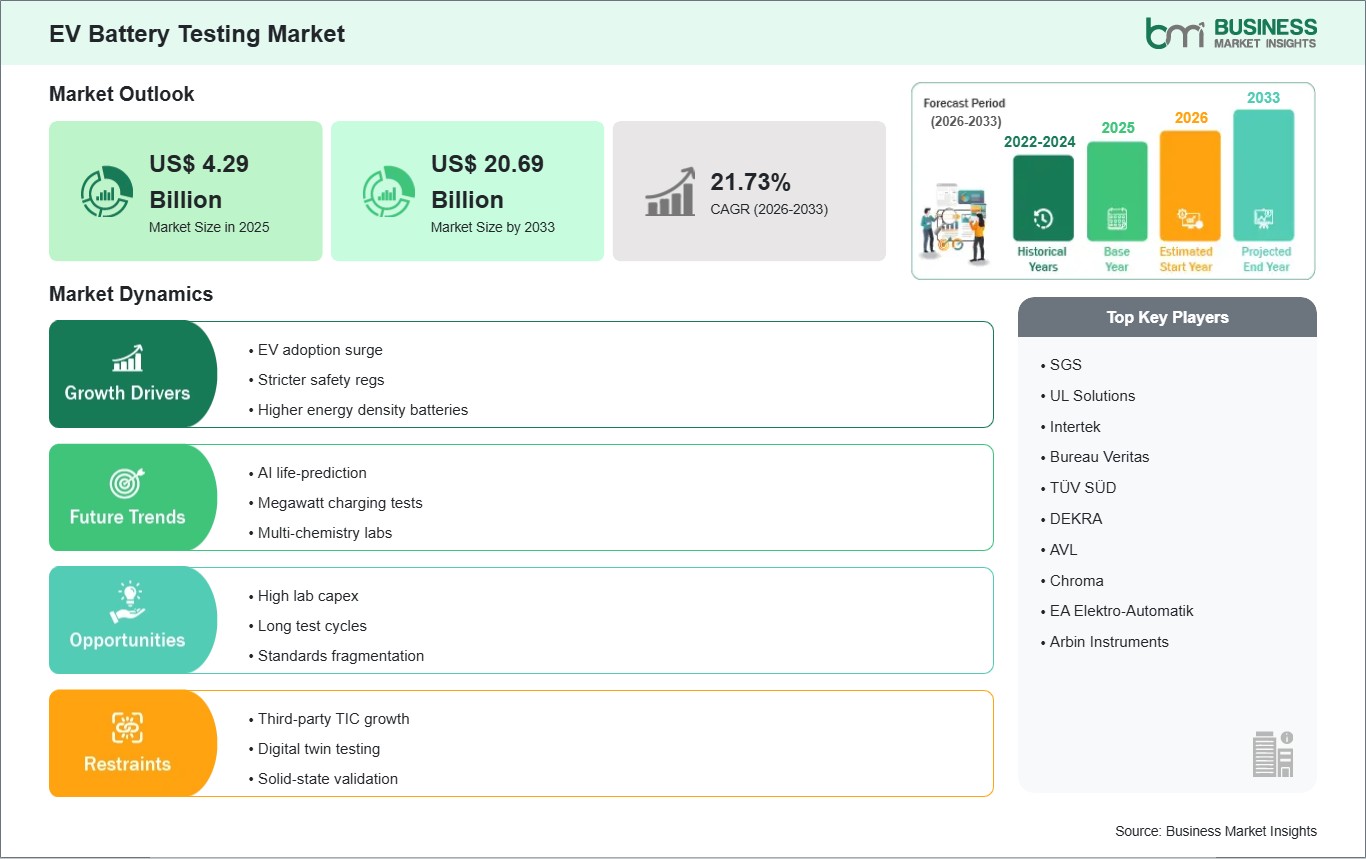
The EV Battery Testing Market is projected to grow from US$ 4.29 Billion in 2025 to US$ 20.69 Billion by 2033 , registering a CAGR of 21.73% from 2026 to 2033.
This growth reflects increased electric vehicle production and tighter battery validation standards across global automotive supply chains. Manufacturers are enhancing their testing infrastructure to boost product reliability and meet regulatory requirements. Electrochemical testing technologies hold a strong position in the market because they help assess battery life cycles and analyze charging performance. Thermal and mechanical testing systems are crucial for validating safety in demanding operating conditions.
Hybrid testing platforms are gaining traction as manufacturers look for solutions that integrate various analytical capabilities into a single testing environment. Commercial and industrial applications account for a significant amount of testing activity due to the growth of electric transportation fleets and the integration of energy storage. Grid-connected battery systems also need thorough validation procedures to ensure consistent operation and compatibility with the infrastructure. The rising use of advanced battery technologies further increases the demand for reliable and scalable testing operations.
Report Coverage
EV Battery Testing Market Report Coverage and Deliverables
The "EV Battery Testing Market Size and Forecast (2022-2033)" report provides a detailed analysis of the market covering below areas:
- Market size and forecast at global, regional, and country levels for all market segments covered under the scope
- Market trends, as well as drivers, restraints, and opportunities
- Market analysis covering key trends, global and regional framework, major players, regulations, and recent developments
- Industry landscape and competition analysis covering market concentration, heat map analysis, prominent players, and recent developments for the EV battery testing market
- Detailed company profiles, including SWOT analysis
Geographic Insights
EV Battery Testing Market Geographic Insights
The EV battery testing market shows different adoption patterns across regions. These patterns are influenced by electric vehicle manufacturing activity, battery safety regulations, and investments in automotive technology. Countries with established electric mobility programs are improving their testing infrastructure. This supports battery validation and compliance procedures. Regional automotive supply chains also affect testing requirements and the deployment of technology. Industry players are expanding testing capabilities to keep up with new battery designs and charging technologies. North America has significant market activity due to more electric vehicle production and battery research initiatives. The United States continues to invest in battery validation infrastructure to support automotive innovation and transportation electrification. Canada is also enhancing its battery testing capabilities through clean mobility programs and industrial energy technologies. Automotive manufacturers in the region are focusing on advanced testing systems to meet regulatory and operational needs.
Asia Pacific is a major hub for the industry due to its extensive battery manufacturing and electric vehicle production. China is expanding its battery testing facilities to support local electric vehicle development and manufacturing for export. Japan and South Korea are focused on battery technologies and precise testing methods. India is also improving its battery testing, along with adopting electric vehicles and developing local manufacturing. Europe is focusing on battery safety and sustainable transportation goals in the automotive sector. Germany, France, and the United Kingdom are investing in testing systems that support advanced electric vehicle development. Emerging markets in Latin America are beginning to assess battery validation infrastructure to support transportation electrification. Countries in the Middle East and Africa are also looking into battery testing capabilities for industrial modernization and energy transition plans.
Industry Activity
Recent Developments
The EV battery testing market is evaluated by gathering qualitative and quantitative data post primary and secondary research, which includes important corporate publications, association data, and databases. A few of the key developments in the EV battery testing market are:
- In March 2024, UL Solutions expanded its electric vehicle battery testing services. This growth included improved laboratory capabilities for battery safety checks, thermal performance analysis, and regulatory compliance assessments. The company enhanced its testing facilities to meet the increasing industry demands for battery reliability, charging safety, and lifecycle evaluations in electric mobility applications.
- In February 2025, TÜV Rheinland improved its battery testing and certification services for electric mobility in automotive markets. The company expanded its technical services to support safety assessments, performance validation, and compliance procedures that match the evolving electric vehicle regulations.
Trust & Transparency
Research Methodology
The market analysis combines proprietary research with secondary data from government agencies, company disclosures, regulatory filings, industry databases and expert interviews. Market estimates are validated through data triangulation, cross-market benchmarking and analyst
review.
View Full Research Methodology
Key Sources Referred:
International Energy Agency (IEA) S. Department of Energy (DOE) European Commission International Electrotechnical Commission (IEC) Society of Automotive Engineers (SAE International) International Organization for Standardization (ISO) Company Websites Company Annual Reports Company Investor Presentations