
Sustainable Automotive Manufacturing Market Outlook: Size, Share, Trends, Growth Analysis, Competitive Landscape & Forecast, 2026-2033

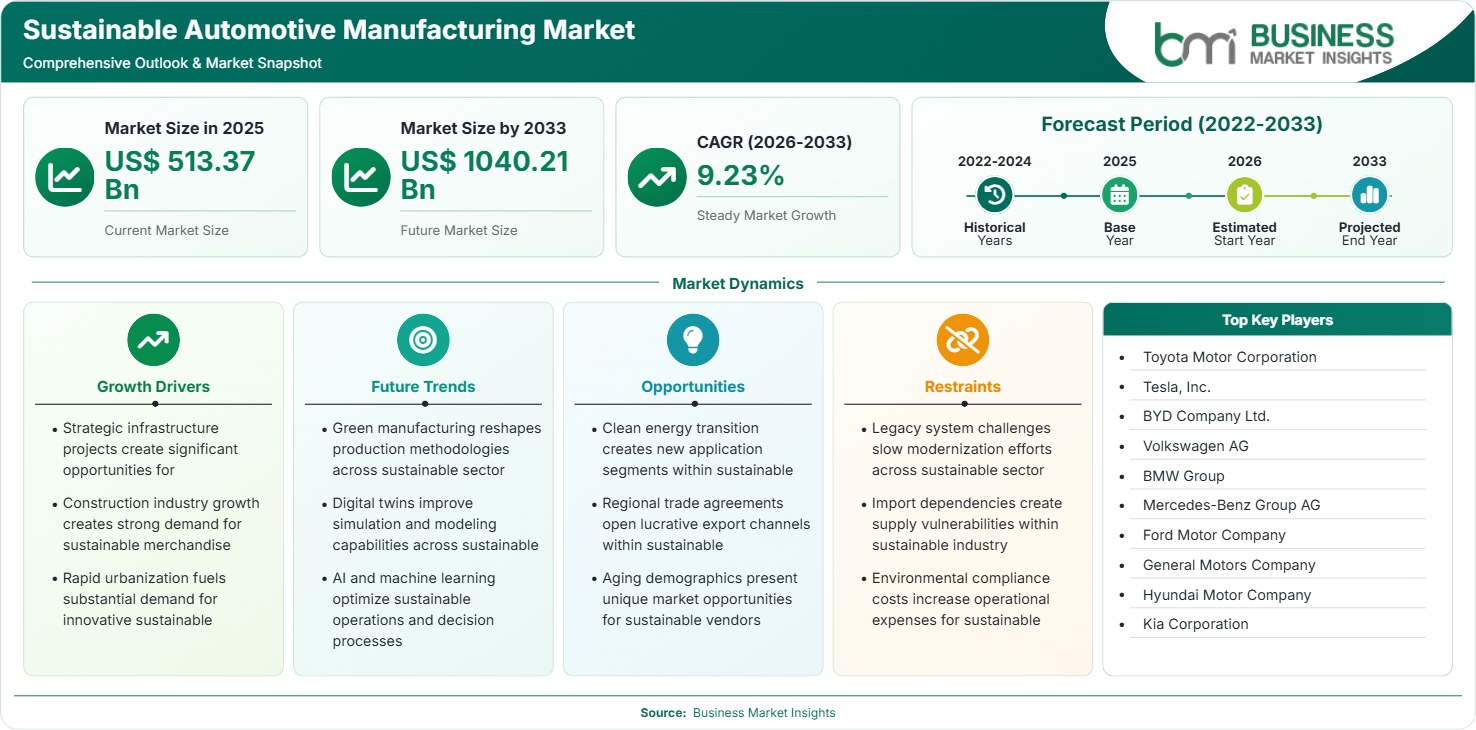
The Sustainable Automotive Manufacturing Market size was valued at US$ 513.37 Billion in 2025 and is projected to reach US$ 1040.21 Billion by 2033, growing at a CAGR of 9.23% during 2026–2033. Increasing electrification, circular manufacturing practices, renewable energy integration, lightweight recyclable materials, and stringent global carbon reduction regulations are accelerating investments in sustainable vehicle production while creating significant opportunities across advanced manufacturing technologies, supply chain decarbonization, and resource-efficient industrial ecosystems.

Report Coverage
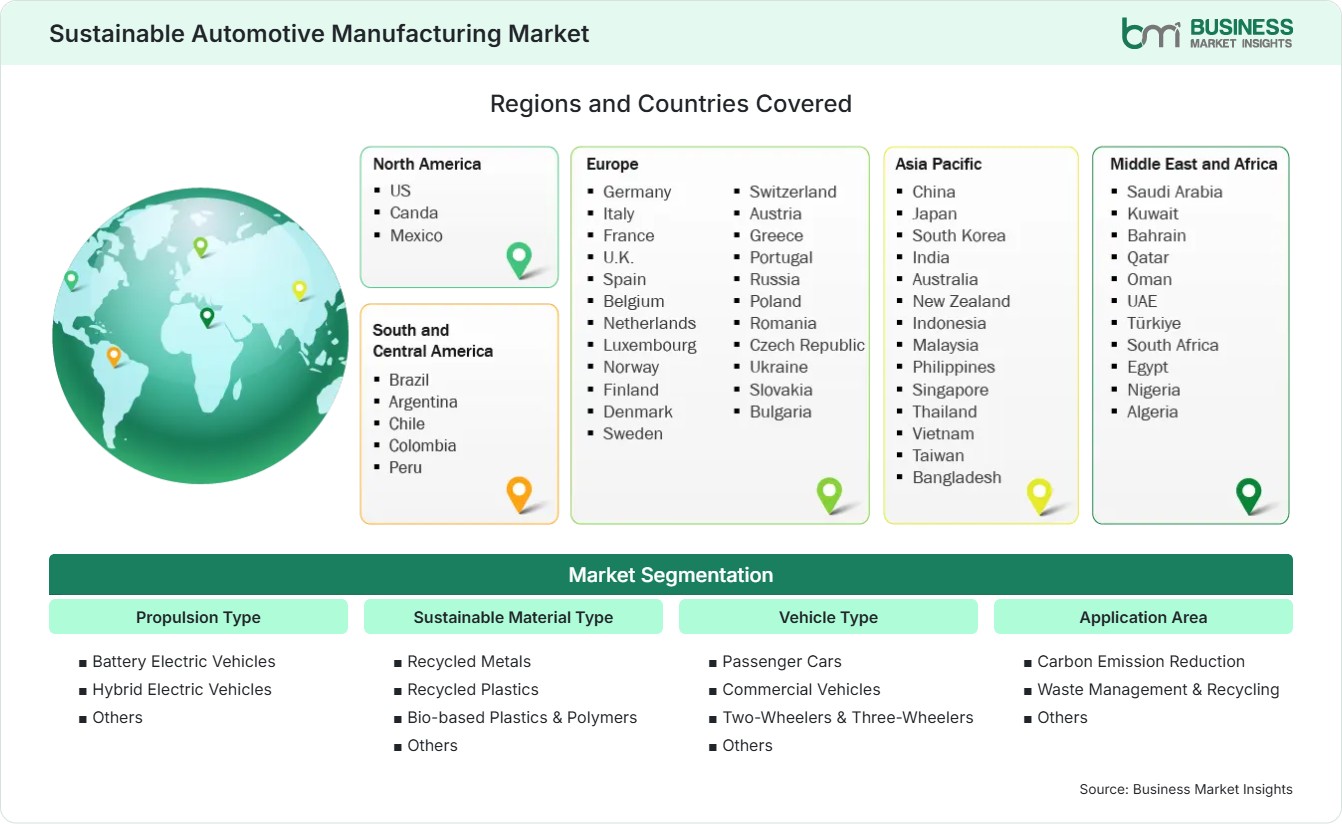
  • Propulsion Type: Battery Electric Vehicles , Hybrid Electric Vehicles , Others
  • Sustainable Material Type: Recycled Metals, Recycled Plastics, Bio-based Plastics & Polymers, Others
  • Vehicle Type: Passenger Cars, Commercial Vehicles, Two-Wheelers & Three-Wheelers, Others
  • Application Area: Carbon Emission Reduction, Waste Management & Recycling, Others
  • Manufacturing Technology: Energy-efficient Manufacturing Systems, Others
US$ 513.37 Bn Market size in 2025
US$ 1040.21 Bn Market Size by 2033
9.23% CAGR, 2026 - 2033
2026-2033 Forecast Period

AI Overview

Sustainable Automotive Manufacturing Market Summary

  • North America Region: North America holds 31%–34% market share in 2025, growing with a CAGR of 8.6%–9.0% during 2026–2033, supported by clean manufacturing investments, EV production expansion, renewable energy adoption, digital factories, supply chain localization, and stricter emission compliance requirements driving sustainable industrial transformation. The U.S. dominates regional investments through large-scale EV manufacturing expansion, clean energy incentives, and smart factory modernization, advancing at a CAGR of 8.7%–9.1%.
  • Fastest Growing Region: Asia Pacific accounts for 29%–32% market share in 2025 and is projected to expand at a CAGR of 10.3%–10.8% during 2026–2033, driven by accelerating electric vehicle production, government sustainability incentives, battery localization, renewable-powered manufacturing, industrial automation, and rapidly expanding automotive supply chains.
  • Leading Segment: Passenger Cars represent 49%–53% market share in 2025 and are expected to register a CAGR of 9.1%–9.5%, supported by electrification initiatives, lightweight materials, digital manufacturing, carbon reduction targets, premium sustainable features, and continuous investments in environmentally responsible production facilities globally.
  • High Growth Segment: Battery Electric Vehicles (BEVs) account for 33%–37% market share in 2025 while expanding at a CAGR of 11.5%–12.2%, fueled by zero-emission mobility policies, battery technology improvements, renewable-powered manufacturing plants, expanding charging ecosystems, and increasing consumer demand for environmentally responsible transportation.
  • Key Market Opportunity: Expanding closed-loop manufacturing ecosystems integrating recycled metals, renewable energy, AI-driven production optimization, and battery recycling infrastructure creates long-term opportunities for automotive manufacturers seeking lower emissions, operational efficiency, regulatory compliance, and resilient global supply chains.
  • Major Market Players: Toyota Motor Corporation, Tesla, Inc., BYD Company Limited, Volkswagen AG, BMW AG, Mercedes-Benz Group AG, Ford Motor Company, General Motors Company, Hyundai Motor Company, Kia Corporation, Volvo Car Corporation, Stellantis N.V., Nissan Motor Co., Ltd., Honda Motor Co., Ltd., and Renault Group.
Strategic Insights

Sustainable Automotive Manufacturing Market: Strategic Insights

Sustainable Automotive Manufacturing Market Strategic Framework
FREE PDF
Request your free sample
Request free sample
Stakeholder View

Key Takeaways

  • The automotive sustainability ecosystem is increasingly shifting toward integrated value chains where renewable energy suppliers, battery manufacturers, material recyclers, digital technology providers, and OEMs collaborate to improve resource efficiency while reducing lifecycle emissions.
  • Battery electric vehicle production, recycled material utilization, and energy-efficient manufacturing systems present the strongest long-term commercial opportunities as governments continue strengthening environmental compliance requirements and industrial decarbonization initiatives.
  • Artificial intelligence, digital twins, industrial IoT platforms, predictive maintenance, and advanced manufacturing analytics are improving production efficiency, minimizing material waste, lowering energy consumption, and supporting measurable sustainability performance across vehicle manufacturing facilities.
  • Asia Pacific offers the strongest investment potential owing to expanding EV production capacity, battery manufacturing ecosystems, favorable industrial policies, localized supply chains, and significant investments in renewable-powered automotive manufacturing infrastructure.
  • Strategic partnerships between automotive manufacturers, battery suppliers, renewable energy providers, and recycling companies are accelerating capital investments, technology commercialization, circular economy initiatives, and long-term sustainability competitiveness throughout the global automotive industry.
  • Future competitive differentiation will increasingly depend on transparent ESG reporting, carbon-neutral manufacturing capabilities, sustainable procurement strategies, and advanced lifecycle management solutions that meet evolving regulatory and consumer expectations.
Geographic Outlook

Sustainable Automotive Manufacturing Market Regional Highlights

North America Sustainable Automotive Manufacturing Market

North America accounts for 31%–34% of the global market share in 2025 and is projected to register a CAGR of 8.6%–9.0% during 2026–2033. Regional leadership is supported by accelerating EV production, renewable-powered manufacturing facilities, smart factory investments, and government incentives promoting industrial decarbonization. Automotive manufacturers continue integrating recycled materials, digital production systems, and energy-efficient manufacturing technologies to improve operational performance while reducing lifecycle emissions. The Sustainable Automotive Manufacturing Market share remains supported by established automotive supply chains, strong R&D capabilities, and increasing investments in battery manufacturing infrastructure.

  • The United States continues expanding gigafactory investments, renewable-powered manufacturing, battery localization, and digital factory modernization, enabling manufacturers to improve production efficiency while reducing operational emissions and strengthening domestic automotive supply chains.
  • Canada is strengthening sustainable automotive manufacturing through clean electricity availability, critical mineral development, battery material processing, and strategic investments supporting regional electric vehicle production ecosystems and environmentally responsible industrial expansion.
  • Mexico benefits from nearshoring strategies, competitive manufacturing costs, expanding EV assembly capacity, and increasing supplier localization, attracting international investments focused on sustainable automotive production and low-carbon export manufacturing.
  • Advanced robotics, AI-enabled quality control, predictive maintenance, and industrial IoT deployment continue improving factory productivity while minimizing energy consumption, manufacturing waste, and production downtime across regional automotive facilities.
  • Growing collaborations between automotive manufacturers, renewable energy developers, battery suppliers, and recycling companies accelerate industrial sustainability initiatives while enhancing long-term supply chain resilience.

US Sustainable Automotive Manufacturing Market

The United States represents 73%–77% of the North American Sustainable Automotive Manufacturing Market value in 2025 while advancing at a CAGR of 8.7%–9.1% through 2033. Federal clean manufacturing incentives, Inflation Reduction Act investments, battery production expansion, and smart manufacturing technologies continue strengthening sustainable automotive production capabilities. Major OEMs are modernizing manufacturing plants through renewable electricity adoption, digital production optimization, and circular economy initiatives that improve competitiveness while reducing industrial carbon emissions.

  • Federal incentives continue encouraging domestic battery manufacturing, renewable energy integration, and localized supply chains, strengthening long-term competitiveness while reducing dependence on imported automotive components and raw materials.
  • Digital twins, AI-driven manufacturing optimization, industrial automation, and predictive analytics enable manufacturers to reduce material waste, improve production accuracy, and increase operational efficiency across automotive facilities.
  • Automotive manufacturers continue expanding closed-loop recycling systems that recover aluminum, steel, plastics, and battery materials, reducing resource dependency while supporting long-term sustainability objectives.
  • Public-private partnerships accelerate innovation across hydrogen technologies, battery recycling, advanced lightweight materials, and sustainable manufacturing technologies supporting future vehicle production.

Europe Sustainable Automotive Manufacturing Market

Europe captures 26%–29% of the global market in 2025 and is forecast to expand at a CAGR of 8.8%–9.3% during the forecast period. Strict climate regulations, carbon neutrality targets, renewable electricity adoption, and circular economy legislation continue encouraging sustainable automotive manufacturing investments across the region. Germany remains the largest Sustainable Automotive Manufacturing Market, while Eastern European manufacturing hubs continue attracting investments supporting electric vehicle production and sustainable industrial modernization.

  • Germany leads regional production through advanced engineering capabilities, large-scale EV manufacturing investments, and renewable-powered automotive facilities, expanding at an estimated CAGR of 8.8%–9.2%.
  • France strengthens sustainable automotive production through circular manufacturing initiatives, battery manufacturing expansion, and supportive industrial decarbonization programs improving long-term competitiveness.
  • Spain and Poland continue emerging as attractive manufacturing destinations owing to expanding supplier ecosystems, renewable energy availability, and favorable industrial investment policies supporting sustainable vehicle production.
  • European manufacturers increasingly deploy recycled aluminum, bio-based polymers, renewable electricity, and green hydrogen technologies to reduce lifecycle manufacturing emissions while improving regulatory compliance.
  • Digital manufacturing platforms enable better resource optimization, production flexibility, and carbon footprint monitoring across automotive production facilities throughout the region.

Asia Pacific Sustainable Automotive Manufacturing Market

Asia Pacific represents 29%–32% of global revenue during 2025 while registering the fastest expansion at a CAGR of 10.3%–10.8% through 2033. Rapid EV adoption, battery manufacturing leadership, supportive government incentives, expanding renewable energy infrastructure, and localized supply chains continue strengthening sustainable automotive manufacturing investments across regional economies. China dominates current production capacity, while India and Southeast Asia emerge as major investment destinations supporting long-term Sustainable Automotive Manufacturing Market growth through expanding industrial ecosystems.

  • China maintains regional leadership through integrated battery manufacturing, renewable-powered industrial facilities, advanced automation, and government-backed sustainability initiatives supporting large-scale automotive production.
  • India records one of the fastest regional expansion rates at approximately 11.0%–11.6% CAGR, supported by production-linked incentives, EV manufacturing investments, and expanding domestic automotive supply chains.
  • Japan and South Korea continue investing in hydrogen technologies, battery innovation, recyclable materials, and AI-enabled manufacturing systems supporting premium sustainable automotive production.
  • Southeast Asian countries increasingly attract foreign direct investments through competitive manufacturing costs, expanding renewable energy generation, and supportive automotive industrial policies.
  • Regional manufacturers continue strengthening battery recycling infrastructure, closed-loop material recovery, and digital factory deployment, improving operational sustainability and resource efficiency.

Rest of World Sustainable Automotive Manufacturing Market

The Rest of World region accounts for 10%–13% of the global Sustainable Automotive Manufacturing Market in 2025 while expanding at a CAGR of 8.9%–9.4% during the forecast period. South & Central America continue benefiting from renewable energy availability, while Middle East & Africa increasingly attract sustainable manufacturing investments through industrial diversification strategies and clean energy development.

Brazil leads South & Central America through expanding automotive manufacturing capacity and renewable electricity utilization. Within the Middle East & Africa, the United Arab Emirates and Saudi Arabia continue supporting industrial sustainability through clean manufacturing investments, green hydrogen initiatives, and automotive supply chain localization strategies.

  • Brazil continues modernizing automotive manufacturing facilities using renewable electricity, advanced automation, and resource-efficient production technologies supporting lower industrial emissions and stronger export competitiveness.
  • Saudi Arabia accelerates automotive industrial diversification through EV manufacturing investments, renewable energy integration, and strategic partnerships supporting sustainable industrial development.
  • The United Arab Emirates promotes smart manufacturing, clean industrial infrastructure, and green mobility initiatives, encouraging international automotive manufacturers to establish regional production capabilities.
  • South Africa remains an important automotive manufacturing hub through export-oriented production, supplier modernization, and increasing adoption of environmentally responsible manufacturing practices.
  • Growing renewable energy deployment, industrial digitalization, and circular manufacturing initiatives continue improving long-term sustainability performance across emerging automotive manufacturing economies.
Global Market Geography
FREE PDF
Request your free sample
Request free sample
Segment Analysis

Sustainable Automotive Manufacturing Market Segmentation

Propulsion Type

The Propulsion Type segment represents the technological foundation of sustainable vehicle production, supported by accelerating electrification strategies, battery innovation, and stringent emission regulations. This segment accounts for 42%–46% market share in 2025 and is projected to register a CAGR of 10.1%–10.6% during the forecast period. The Sustainable Automotive Manufacturing Market scope continues expanding as manufacturers prioritize electrified powertrains, localized battery supply chains, and energy-efficient production systems to achieve long-term sustainability objectives.

  • Battery Electric Vehicles (BEVs): BEVs dominate sustainability-focused manufacturing investments through zero-tailpipe emission platforms, renewable-powered assembly plants, advanced battery integration, and increasing adoption driven by supportive government incentives and expanding charging infrastructure.
  • Hybrid Electric Vehicles (HEVs): HEVs remain important for markets transitioning toward full electrification, offering lower emissions, improved fuel efficiency, and enabling manufacturers to gradually expand sustainable production capabilities while meeting evolving regulatory standards.

Sustainable Material Type

Sustainable materials are becoming central to next-generation automotive production as manufacturers reduce lifecycle emissions and improve resource efficiency. The segment captures 29%–33% share of the Sustainable Automotive Manufacturing Market in 2025 while advancing at a CAGR of 9.8%–10.3% through 2033. Rising investments in recycled feedstocks, lightweight materials, and circular manufacturing practices continue strengthening sustainable automotive production across developed and emerging markets.

  • Recycled Metals: Recycled aluminum and steel reduce energy consumption during manufacturing, lower carbon emissions, improve material recovery rates, and support circular economy objectives across global automotive production facilities.
  • Recycled Plastics: Automotive manufacturers increasingly incorporate recycled plastics into interior components, exterior panels, and structural applications, improving sustainability while reducing dependence on virgin petroleum-based raw materials.
  • Bio-based Plastics & Polymers: Bio-derived polymers support lightweight vehicle development while lowering environmental impact, encouraging broader adoption across interior trims, packaging materials, and selected structural automotive applications.

Vehicle Type

Passenger and commercial mobility continue driving investments in environmentally responsible automotive production supported by digital manufacturing, lightweight materials, and renewable-powered facilities. This segment holds 49%–53% Sustainable Automotive Manufacturing Market share during 2025 and is expected to expand at a CAGR of 9.1%–9.5% throughout the assessment period as global manufacturers strengthen sustainable production capabilities.

  • Passenger Cars: Passenger vehicle manufacturers continue adopting recyclable materials, AI-enabled production systems, renewable electricity, and lightweight engineering solutions to improve sustainability performance while meeting increasing consumer demand for environmentally responsible mobility.
  • Commercial Vehicles: Fleet electrification, logistics decarbonization, hydrogen technologies, and durable recyclable materials continue supporting sustainable manufacturing investments across medium-duty and heavy-duty commercial vehicle production facilities.
  • Two-Wheelers & Three-Wheelers: Rapid urban mobility expansion and electrification across developing economies encourage manufacturers to integrate sustainable materials, efficient manufacturing systems, and localized component sourcing into production operations.

Application Area

Application-driven sustainability initiatives continue reshaping automotive manufacturing by emphasizing environmental performance, resource optimization, and regulatory compliance. The segment contributes 34%–38% Sustainable Automotive Manufacturing Market share in 2025 while growing at a CAGR of 9.4%–9.9% through 2033. Organizations increasingly invest in integrated sustainability programs to improve operational efficiency and long-term environmental performance.

  • Carbon Emission Reduction: Manufacturers deploy renewable electricity, energy-efficient equipment, carbon capture initiatives, and optimized logistics to reduce manufacturing emissions while supporting global climate commitments.
  • Waste Management & Recycling: Closed-loop recycling systems recover metals, plastics, batteries, and production waste, improving resource utilization while minimizing landfill disposal and manufacturing-related environmental impacts.

Manufacturing Technology

Manufacturing technologies continue evolving through industrial automation, AI-enabled production optimization, and digital sustainability management. The segment accounts for 37%–41% Sustainable Automotive Manufacturing Market share in 2025 and is projected to register a CAGR of 10.2%–10.7% during the forecast period. Increasing investments in intelligent production infrastructure support improved productivity, lower emissions, and greater manufacturing flexibility.

  • Energy-efficient Manufacturing Systems: Smart machinery, AI-driven process optimization, predictive maintenance, digital twins, renewable-powered equipment, and industrial IoT platforms reduce operational energy consumption while improving manufacturing efficiency and sustainability performance.
Market Forces

Sustainable Automotive Manufacturing Market Dynamics

Key Market Drivers

Accelerating Global Decarbonization Policies and Net-Zero Manufacturing Commitments

In countries around the world, governments are continually enhancing policies on industrial decarbonization through measures like vehicle emission reduction, carbon pricing systems, renewable energy policies, and the requirement of mandatory ESG reporting. As pointed out by the International Energy Agency (IEA), there is an increasing growth in electric vehicle use and the generation of renewable energy. These regulatory developments are driving investments in renewable-powered manufacturing plants, battery recycling, sustainable sourcing, and digital energy management systems. Sustainable Automotive Manufacturing Market growth is increasingly supported by manufacturers pursuing science-based emission reduction targets while improving production efficiency, minimizing operational risks, and enhancing long-term competitiveness through environmentally responsible manufacturing practices.

Industry 4.0 Technologies Transforming Sustainable Vehicle Production

Artificial intelligence, industrial IoT, robotics, machine vision, predictive maintenance, and digital twin technologies are reshaping automotive manufacturing operations. Smart factories improve production accuracy, optimize energy utilization, reduce manufacturing waste, and enable real-time process monitoring across production lines. The results of digital manufacturing trends across the world, according to the findings of major industrial companies, show that manufacturing industries that use intelligent production technology gain increased efficiency and effectiveness. This combination of automation technology and renewable energy technology helps improve sustainability continuously in addition to providing flexible manufacturing capabilities for production of complex electric/hybrid cars.

Growing Adoption of Circular Economy Practices Across Automotive Supply Chains

Automotive manufacturers increasingly prioritize circular economy principles through recycled aluminum, recycled steel, recovered plastics, remanufactured components, and battery material recovery initiatives. Many organizations like the World Economic Forum are still advocating for the use of circular economic approaches in the industry that eliminate reliance on resources and lower carbon emissions from the process of manufacture. The use of closed-loop material reclamation processes enhances availability of raw materials while minimizing costs of production and negative effects of extraction of virgin materials. The rise of commercialization of battery recycling technology, sustainable purchasing practices, and life cycle assessments will further support circular manufacturing efforts.

Key Market Opportunities

Expansion of Renewable Energy-Powered Automotive Manufacturing Facilities

Automotive manufacturers continue investing in manufacturing facilities powered by solar, wind, hydroelectric, and other renewable energy sources to reduce operational emissions and improve long-term cost efficiency. Increasing availability of clean electricity enables production facilities to significantly lower carbon intensity while meeting investor and regulatory sustainability expectations. Countries offering green industrial incentives are attracting large-scale investments in renewable-powered automotive production clusters. Sustainable Automotive Manufacturing Market Forecasts increasingly indicate that renewable energy integration will become a primary competitive differentiator as manufacturers pursue carbon-neutral production, improve ESG performance, strengthen energy security, and reduce long-term operational costs across global manufacturing networks.

Battery Recycling and Critical Mineral Recovery Infrastructure

Growing electric vehicle production creates substantial opportunities for battery recycling facilities capable of recovering lithium, nickel, cobalt, graphite, and other valuable materials. Advanced recycling technologies reduce dependence on primary mining while strengthening supply chain security for battery manufacturers. Governments across North America, Europe, and Asia Pacific continue introducing policies supporting domestic recycling infrastructure and circular battery ecosystems. Investments in automated battery disassembly, hydrometallurgical recovery technologies, and material traceability platforms are expected to improve resource efficiency while creating new revenue streams throughout sustainable automotive manufacturing value chains.

Advanced Sustainable Materials Supporting Lightweight Vehicle Production

Manufacturers continue increasing investments in lightweight recycled metals, bio-based polymers, renewable composites, and sustainable engineering materials that improve vehicle efficiency while lowering lifecycle emissions. Innovation of material technology will help car manufacturing firms to decrease the weight of the car, increase the range of batteries and also make sustainable production without any risk of compromising safety and strength. The consistent research in the field of recyclable composite material, low carbon steel and advanced polymers will provide ample opportunity for firms in the creation of eco-friendly material.

Market Restraints and Challenges

High Capital Requirements for Sustainable Manufacturing Modernization

Factor: Transitioning conventional automotive plants into low-carbon smart manufacturing facilities requires substantial investments in renewable energy systems, digital automation, advanced robotics, battery production capabilities, and recycling infrastructure.

Impact: The cost of large initial investments is one of the greatest obstacles faced by manufacturers in the competitive automotive industry. Small and medium-sized suppliers often face financial difficulties that prevent them from investing in new technologies and sustainable development. In addition to long payback times for investment, the volatility of raw material prices and uncertainty regarding regulatory changes make it even harder to allocate capital. Thus, manufacturing becomes modernized at different rates in different regions around the world.

Critical Raw Material Supply Risks and Supply Chain Complexity

Factor: Sustainable automotive manufacturing increasingly depends on stable supplies of lithium, cobalt, nickel, rare earth elements, recycled metals, and advanced battery materials that remain vulnerable to geopolitical disruptions and mining constraints.

Impact: Issues such as shortages in supplies, fluctuation in prices, restrictions on exports, and lack of capacity in processing can result in increased production cost and delay in manufacturing time. The automakers have been coping with this issue using diversification of suppliers, local supply chain, management of inventories, and investment in recycling processes. Nevertheless, creating a robust supply chain is not an easy task due to the continuous development in the circular economy system.

Company Analysis

Competitive Landscape

The competitive environment is characterized by investments in electrified production, renewable-powered manufacturing facilities, circular economy initiatives, digital factory transformation, and sustainable material innovation. Sustainable Automotive Manufacturing Market analysis indicates that leading manufacturers are strengthening ESG strategies, battery localization, low-carbon supply chains, and smart manufacturing technologies to improve operational efficiency and meet evolving environmental regulations.

Company Name

Overview

Products and Services Relevant to this Market

Toyota Motor Corporation

Global automotive manufacturer focused on carbon neutrality through hybrid, battery electric, hydrogen technologies, and sustainable manufacturing operations across worldwide production facilities.

Battery electric vehicles, hybrid vehicles, hydrogen fuel cell vehicles, renewable manufacturing initiatives, recyclable materials, digital production systems, and circular economy programs.

Tesla, Inc.

Leading electric vehicle manufacturer emphasizing vertically integrated production, renewable-powered gigafactories, and advanced battery manufacturing technologies.

Electric vehicles, battery systems, energy storage solutions, AI-driven manufacturing, battery recycling initiatives, renewable-powered factories, and sustainable supply chain solutions.

BYD Company Limited

Chinese automotive and battery manufacturer integrating EV production with battery manufacturing and sustainable industrial operations.

Electric passenger vehicles, commercial EVs, batteries, energy storage, renewable manufacturing technologies, and integrated sustainable mobility solutions.

Volkswagen AG

Global automotive group investing heavily in electrification, digital manufacturing, renewable energy integration, and carbon-neutral production facilities.

Electric vehicles, sustainable production technologies, battery manufacturing, recyclable materials, smart factories, and circular manufacturing initiatives.

BMW AG

Premium automotive manufacturer advancing low-carbon production through renewable energy usage, recycled materials, and digital manufacturing technologies.

Premium electric vehicles, sustainable materials, lightweight engineering, digital manufacturing platforms, and lifecycle carbon reduction solutions.

Mercedes-Benz Group AG

Luxury vehicle manufacturer implementing carbon-neutral production strategies supported by renewable energy and sustainable supply chain management.

Electric vehicles, green manufacturing systems, recyclable materials, battery technologies, smart production facilities, and ESG-focused manufacturing solutions.

Ford Motor Company

Global automaker expanding EV production while modernizing manufacturing facilities using renewable energy and advanced industrial automation.

Electric vehicles, battery manufacturing, intelligent factories, sustainable logistics, recycled materials, and low-carbon production technologies.

General Motors Company

Automotive manufacturer pursuing all-electric mobility supported by battery innovation and sustainable industrial transformation initiatives.

Electric vehicles, Ultium battery technologies, renewable-powered manufacturing, digital production systems, and battery recycling investments.

Hyundai Motor Company

Global manufacturer investing in electrification, hydrogen technologies, and environmentally responsible automotive production systems.

Battery electric vehicles, hydrogen fuel cell vehicles, sustainable manufacturing technologies, renewable energy integration, and recyclable automotive materials.

Kia Corporation

Automotive company accelerating sustainable mobility through electrification, smart manufacturing, and environmentally responsible production processes.

Electric vehicles, lightweight vehicle platforms, intelligent manufacturing systems, renewable-powered production, and circular material initiatives.

Volvo Car Corporation

Premium automotive manufacturer pursuing climate-neutral operations through electrification and circular manufacturing strategies.

Electric vehicles, sustainable material innovation, battery recycling, renewable manufacturing operations, and carbon reduction technologies.

Stellantis N.V.

Multinational automotive group implementing global decarbonization strategies through electrification, digital manufacturing, and sustainable sourcing.

Electric vehicles, battery production, smart manufacturing, recycled materials, renewable energy utilization, and sustainable automotive technologies.

Nissan Motor Co., Ltd.

Global automotive company expanding sustainable vehicle manufacturing through EV innovation and resource-efficient production systems.

Electric vehicles, battery technologies, renewable manufacturing initiatives, intelligent production systems, and recyclable component solutions.

Honda Motor Co., Ltd.

Automotive manufacturer investing in carbon-neutral manufacturing, electrification, hydrogen technologies, and renewable industrial infrastructure.

Hybrid vehicles, electric vehicles, hydrogen technologies, energy-efficient manufacturing, lightweight materials, and sustainable mobility solutions.

Renault Group

European automotive manufacturer emphasizing circular economy practices and low-carbon industrial transformation.

Electric vehicles, battery recycling, sustainable production systems, renewable-powered manufacturing, and circular automotive value chain solutions.

Trust & Transparency

Research Methodology

The market analysis combines proprietary research with secondary data from government agencies, company disclosures, regulatory filings, industry databases and expert interviews. Market estimates are validated through data triangulation, cross-market benchmarking and analyst review.

View Full Research Methodology

Questions Answered

Frequently Asked Questions

What does the Sustainable Automotive Manufacturing Market Report cover?

The report provides comprehensive insights into market size, regional outlook, competitive landscape, segmentation, emerging technologies, sustainability strategies, investment opportunities, industry trends, and long-term market forecasts.

What technologies are transforming sustainable automotive production?

Artificial intelligence, industrial IoT, robotics, digital twins, predictive maintenance, renewable-powered manufacturing systems, battery recycling technologies, and advanced lightweight materials are significantly improving production efficiency and environmental performance.

Which vehicle segment dominates the market?

Passenger cars remain the leading vehicle segment because of high production volumes, rapid electrification, increasing consumer demand, and continuous investments in sustainable manufacturing technologies worldwide.

Which region is expected to witness the fastest growth?

Asia Pacific is expected to record the fastest growth due to expanding electric vehicle manufacturing, battery production investments, government incentives, renewable energy adoption, and rapidly developing automotive supply chains.

What is driving demand for the Sustainable Automotive Manufacturing Market?

Demand is primarily driven by stricter environmental regulations, electric vehicle adoption, renewable energy integration, circular manufacturing practices, digital factory technologies, and growing corporate commitments toward carbon-neutral industrial operations.

Access the Full Sustainable Automotive Manufacturing Market Report

Get segment-level forecasts, regional estimates, competitive benchmarking, company profiles and downloadable Excel datasets.

Access the full Sustainable Automotive Manufacturing Market Report
350 pages PDF & Excel | 2026-08-31
Similar Research

Related Market Reports