
EV Battery Housing Market Outlook: Size, Share, Trends, Growth Analysis, Competitive Landscape & Forecast, 2026-2033

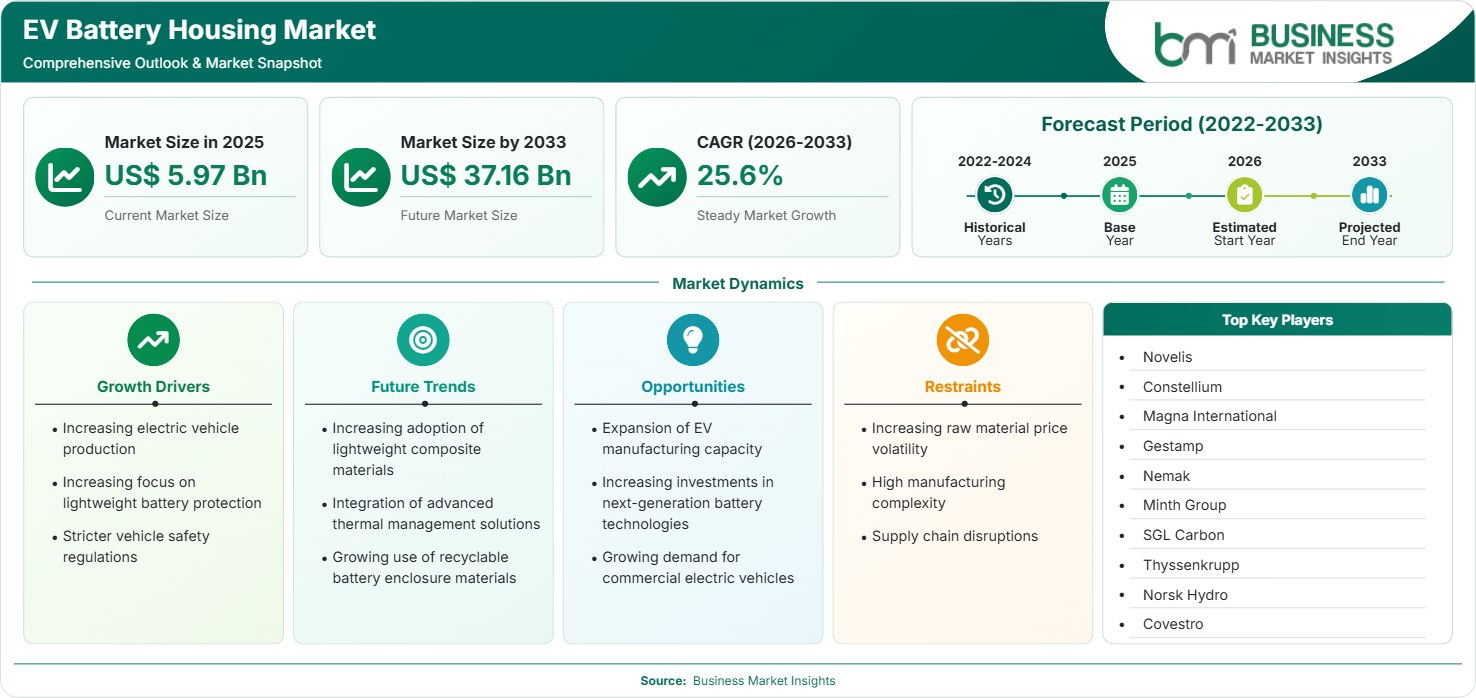
The EV Battery Housing Market size was valued at US$ 5.97 Billion in 2025 and is projected to reach US$ 37.16 Billion by 2033, growing at a CAGR of 25.6% from 2026 to 2033. Rising electric vehicle production, lightweight battery protection requirements, stringent vehicle safety regulations, next-generation battery technologies, commercial EV expansion, and manufacturing capacity investments are accelerating market growth.

Report Coverage
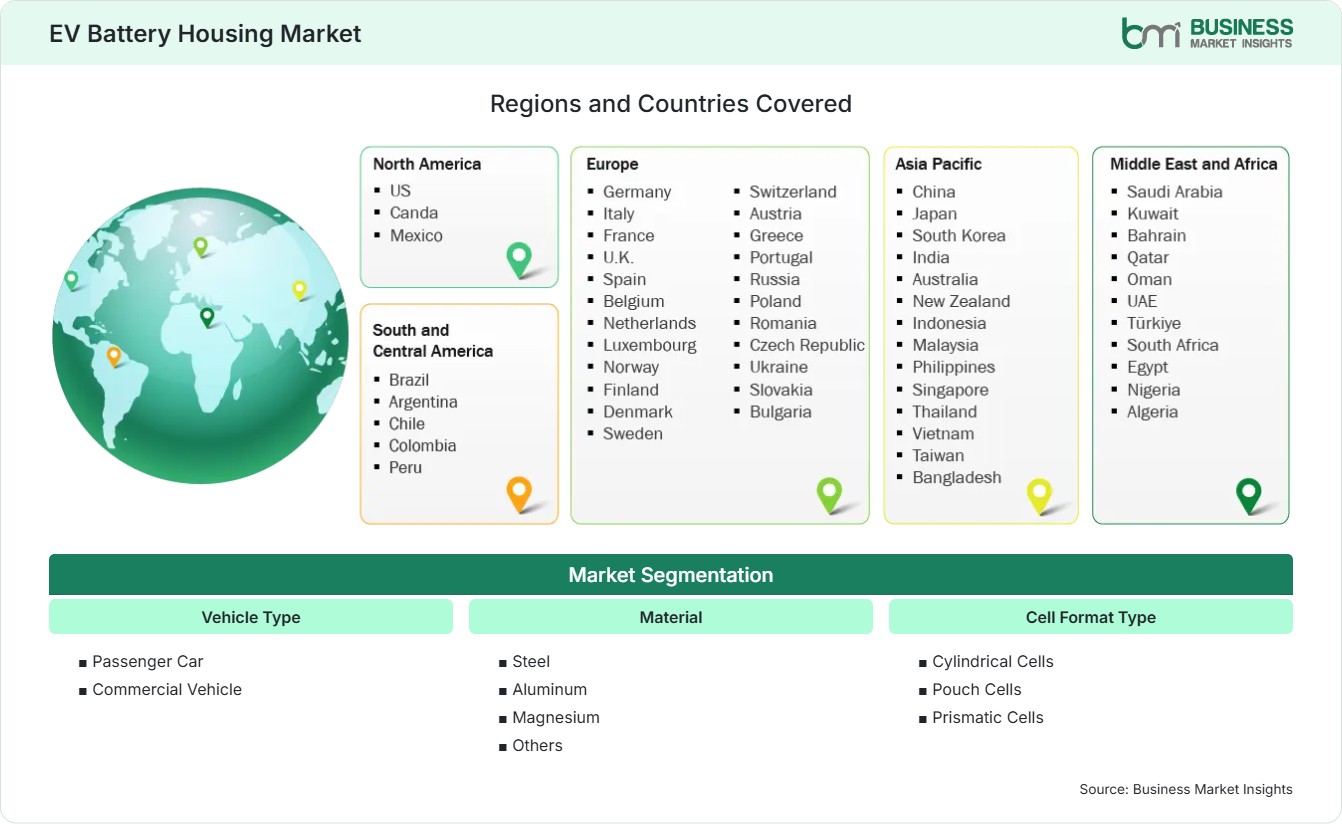
  • Vehicle Type: Passenger Car, Commercial Vehicle
  • Material: Steel, Aluminum, Magnesium, Others
  • Cell Format Type: Cylindrical Cells, Pouch Cells, Prismatic Cells
US$ 5.97 Bn Market size in 2025
US$ 37.16 Bn Market Size by 2033
25.6% CAGR, 2026 - 2033
2026-2033 Forecast Period

01 AI Overview

EV Battery Housing Market Summary

  • North America Region: North America holds a market share of 24%–27% in 2025 and is projected to grow at a CAGR of 25.0%–25.8% during 2026–2033. Growth is supported by expanding EV manufacturing, battery gigafactory investments, lightweight material adoption, and government incentives. The US market is expanding at a CAGR of 25.2%–26.0% owing to increasing domestic battery production and EV assembly investments.
  • Fastest Growing Region: Asia Pacific accounts for 48%–51% market share in 2025 and is expected to grow at a CAGR of 26.2%–27.0% during 2026–2033. Growth is driven by large-scale EV production, battery manufacturing expansion, government electrification policies, and strong automotive supply chains.
  • Leading Segment: Passenger Car represents 74%–77% market share in 2025 and is projected to grow at a CAGR of 25.4%–26.2% during 2026–2033. Growth is supported by increasing passenger EV sales, battery safety requirements, and lightweight structural component adoption.
  • High Growth Segment: Aluminum accounts for 46%–49% share in 2025 and is estimated to grow at a CAGR of 26.8%–27.6% through 2026–2033. Adoption is increasing because of lightweight construction, corrosion resistance, thermal management performance, and vehicle efficiency improvements.
  • Key Market Opportunity: Expansion of EV manufacturing facilities, commercialization of advanced battery technologies, lightweight materials, and increasing demand for commercial electric vehicles are creating substantial growth opportunities.
  • Major Market Players: Novelis, Constellium, Magna International, Gestamp, Nemak, Minth Group, SGL Carbon, Thyssenkrupp, Norsk Hydro, Covestro.
02 Strategic Insights

EV Battery Housing Market: Strategic Insights

EV Battery Housing Market Strategic Framework
FREE PDF
Request your free sample
Request free sample
03 Stakeholder View

Key Takeaways

  • The market ecosystem consists of automotive OEMs, battery manufacturers, metal producers, material suppliers, engineering companies, and component manufacturers.
  • Passenger electric vehicles and aluminum battery housings represent the strongest commercial opportunities as automakers pursue lightweight, high-performance battery systems.
  • Innovation is focused on structural battery packs, lightweight alloys, composite materials, integrated thermal management, and modular enclosure platforms.
  • Asia Pacific offers the strongest investment opportunity due to large-scale EV production, battery manufacturing capacity, and government-supported electrification initiatives.
  • Strategic partnerships between automotive manufacturers and material suppliers are accelerating battery housing innovation and production scalability.
  • Long-term competitiveness will depend on manufacturing efficiency, material innovation, battery safety performance, and sustainable production technologies.
04 Geographic Outlook

EV Battery Housing Market Regional Highlights

North America EV Battery Housing Market

North America accounted for a 24%–27% share of the EV Battery Housing Market in 2025 and is projected to grow at a CAGR of 25.0%–25.8% during 2026–2033. The regional market is supported by expanding electric vehicle manufacturing, increasing investments in battery gigafactories, and growing adoption of lightweight structural materials. Strong government incentives and automotive localization strategies continue to encourage domestic battery pack and component production.

  • The United States leads regional demand through expanding EV production, battery manufacturing investments, and increasing adoption of lightweight aluminum battery enclosures.
  • Canada is strengthening its position with investments in battery supply chains, critical minerals, and electric vehicle manufacturing facilities.
  • Automotive suppliers are increasing production of advanced battery housing systems to support localized EV manufacturing across North America.
  • Government incentives promoting zero-emission vehicles continue encouraging investments in battery manufacturing and component production.

US EV Battery Housing Market

The US represented a 20%–23% share of the market in 2025 and is expected to grow at a CAGR of 25.2%–26.0% through 2026–2033. Market expansion is driven by large-scale EV assembly investments, expansion of battery manufacturing capacity, and rising demand for advanced battery protection systems. Growing localization of EV supply chains is accelerating adoption of innovative battery enclosure technologies.

  • Battery gigafactory investments are increasing demand for lightweight battery housing components manufactured using advanced materials.
  • Domestic EV production expansion is strengthening partnerships between automotive OEMs and battery enclosure manufacturers.
  • Growing investments in commercial electric vehicles are supporting demand for durable structural battery protection systems.
  • Federal clean mobility incentives continue supporting local battery component manufacturing and supply chain resilience.

Europe EV Battery Housing Market

Europe held a 22%–25% share of the EV Battery Housing Market in 2025 and is forecast to grow at a CAGR of 24.8%–25.6% during 2026–2033. Strong vehicle emission regulations, battery manufacturing investments, and rapid EV adoption continue driving demand for lightweight battery housing solutions. Germany leads the regional market, while Hungary and Poland are emerging as high-growth manufacturing hubs.

  • Germany remains the largest regional market through strong automotive manufacturing and battery technology investments.
  • Hungary is attracting gigafactory developments supporting battery housing and EV component production.
  • Poland continues expanding battery supply chains through increasing investments in EV manufacturing infrastructure.
  • European automakers are accelerating adoption of lightweight materials to improve driving range and battery efficiency.

Asia Pacific EV Battery Housing Market

Asia Pacific captured a 48%–51% of the EV Battery Housing Market share in 2025 and is projected to record a CAGR of 26.2%–27.0% during 2026–2033. The region dominates global production through large-scale battery manufacturing, strong automotive supply chains, and supportive government electrification policies. China leads regional production, while India and Southeast Asia continue expanding manufacturing capabilities.

  • China dominates regional production through integrated battery manufacturing, EV assembly, and material processing capabilities.
  • India is expanding battery manufacturing capacity supported by production-linked incentive programs and EV adoption.
  • Japan continues investing in advanced battery technologies and lightweight automotive materials.
  • South Korea strengthens regional competitiveness through battery innovation and global EV component exports.

Rest of World EV Battery Housing Market

Rest of World accounted for a 5%–8% share of the EV Battery Housing Market in 2025 and is expected to grow at a CAGR of 23.8%–24.6% during 2026–2033. South America and the Middle East & Africa are gradually increasing EV adoption through supportive policies, the development of charging infrastructure, and investments in localized automotive manufacturing.

  • Brazil is strengthening electric vehicle manufacturing through supportive industrial policies and automotive investments.
  • The UAE is encouraging EV adoption with sustainable mobility initiatives and charging infrastructure expansion.
  • South Africa is gradually developing electric mobility supply chains through automotive sector modernization.
  • Emerging economies are increasing investments in localized battery component manufacturing and clean transportation technologies.
Global Market Geography
FREE PDF
Request your free sample
Request free sample
05 Segment Analysis

EV Battery Housing Market Segmentation

Vehicle Type

Vehicle Type segmentation includes Passenger Car and Commercial Vehicle. Passenger Car represented the largest segment in 2025 due to strong global electric passenger vehicle sales, increasing battery production, and growing consumer demand for longer driving range. Commercial Vehicle adoption is accelerating with fleet electrification and government sustainability initiatives. The segment is projected to grow at a CAGR of 25.4%–26.2% during 2026–2033, supported by continued expansion in EV production and advancements in battery safety.

  • Passenger Car: Passenger cars account for the highest demand as manufacturers increasingly integrate lightweight battery housings to improve vehicle efficiency, safety, and driving range.
  • Commercial Vehicle: Commercial vehicles are adopting durable battery enclosure systems capable of supporting larger battery packs, heavy-duty operations, and enhanced thermal protection.

Material

Material segmentation includes Steel, Aluminum, Magnesium, and Others. Aluminum held the leading position in 2025 due to its lightweight nature, corrosion resistance, structural strength, and thermal conductivity. Steel remains preferred for cost-sensitive applications, while magnesium adoption is increasing in premium lightweight vehicle platforms. The segment is expected to grow at a CAGR of 25.9%–26.7% during 2026–2033, supported by advancements in lightweight automotive materials and sustainable manufacturing.

  • Steel: Steel battery housings provide high structural strength, crash resistance, and cost-effective solutions for various electric vehicle platforms.
  • Aluminum: Aluminum enables lightweight battery protection, improved thermal performance, corrosion resistance, and enhanced overall vehicle efficiency.
  • Magnesium: Magnesium materials offer significant weight reduction while supporting structural integrity in advanced electric vehicle battery enclosure applications.

Cell Format Type

Cell Format Type segmentation includes Cylindrical Cells, Pouch Cells, and Prismatic Cells. Prismatic Cells represented the leading segment in 2025 owing to their high packaging efficiency, structural stability, and widespread adoption by automotive battery manufacturers. Pouch Cells are witnessing increasing demand for high-energy-density battery packs. The segment is projected to grow at a CAGR of 26.1%–26.9% during 2026–2033, driven by innovation in battery technology and the development of next-generation EV platforms.

  • Cylindrical Cells: Cylindrical cell battery housings support robust structural performance and are widely utilized in high-volume electric vehicle production.
  • Pouch Cells: Pouch cell battery systems require flexible enclosure designs supporting lightweight construction and efficient thermal management.
  • Prismatic Cells: Prismatic cell battery housings enable compact battery packaging, enhanced structural stability, and efficient integration into modern electric vehicle platforms.
06 Market Forces

EV Battery Housing Market Dynamics

Key Market Drivers

Increasing Electric Vehicle Production

The rapid expansion of global electric vehicle production is significantly increasing demand for battery housing systems that provide structural integrity, impact protection, and thermal management. Automotive manufacturers are expanding production capacity to meet rising consumer demand and stricter emission regulations. The market growth is supported by growing investments in battery gigafactories, localized EV manufacturing, and platform electrification strategies. EV Battery Housing Market trends indicate increasing adoption of modular battery enclosures that improve manufacturing efficiency while enhancing battery safety, durability, and vehicle performance. Continuous growth in passenger and commercial EV production is expected to sustain demand for advanced battery housing solutions.

Increasing Focus on Lightweight Battery Protection

Automakers are increasingly adopting lightweight materials to improve vehicle range, battery efficiency, and overall performance without compromising structural safety. The EV battery housing market growth is supported by aluminum, magnesium, and advanced composite materials, which are replacing conventional designs to reduce vehicle weight while maintaining crash resistance and thermal protection. Battery manufacturers are working on developing new forming processes and structural optimization methods to enable the future designs of battery packs. The use of lightweight battery cases can also help save energy, which is why such battery components are important for car manufacturers to use their batteries to the fullest.

Stricter Vehicle Safety Regulations

Strict regulations are continuously being introduced to protect batteries from mechanical impact, heat, water damage, vibrations, and occupant safety. This has spurred the development of battery housings that can withstand these elements. Ongoing evolution of international safety standards for vehicles is driving manufacturers to adopt materials and technologies to effectively enclose batteries. Strict regulations are helping spur innovation while at the same time ensuring steady demand for battery housings.

Key Market Opportunities

Expansion of EV Manufacturing Capacity

Rapid expansion of global electric vehicle manufacturing facilities presents significant opportunities for battery housing suppliers. Automotive OEMs and battery manufacturers are establishing new production plants across Asia Pacific, North America, and Europe to strengthen regional supply chains and meet growing EV demand. Every new manufacturing facility requires localized sourcing of structural battery components, creating opportunities for material suppliers and enclosure manufacturers. Companies capable of delivering scalable, lightweight, and cost-efficient battery housing solutions will benefit from long-term supply agreements with major automotive manufacturers and battery producers.

Increasing Investments in Next-Generation Battery Technologies

The progress made with solid-state, high-energy-density, and structural battery packs opens up possibilities for innovative battery enclosure designs. Future battery systems demand housings with improved heat performance, enhanced crash resistance, and compatibility with new cell structures. Companies are developing novel material technologies, cooling mechanisms, and structure-based designs to make new-generation battery packs. As battery technology continues to advance, companies that can produce innovative, lightweight enclosures will have an edge in the global electric-vehicle market.

Growing Demand for Commercial Electric Vehicles

Growing trends towards the electrification of buses, delivery vans, trucks, and industrial vehicles create an ever-increasing need for reliable battery enclosure units that protect large batteries in harsh operating conditions. Electric commercial vehicle manufacturers are actively investing in such vehicles to decrease expenses on operation and meet the requirements of emission standards. It calls for the development of battery enclosures that would ensure high durability, thermal stability, resistance, and long-lasting performance. Developers of solutions for commercial vehicles would benefit from this trend immensely.

Market Restraints and Challenges

Increasing Raw Material Price Volatility

Factor: Battery housing production depends heavily on aluminum, steel, magnesium, engineering polymers, and specialty materials whose prices fluctuate because of supply chain disruptions, geopolitical events, and energy costs. Impact: Volatile raw material prices increase manufacturing expenses, reduce supplier margins, and create pricing uncertainty for automotive OEMs. Manufacturers are responding by entering into long-term procurement agreements, implementing recycling initiatives, and optimizing materials. However, sustained fluctuations continue to challenge cost planning and profitability across the EV battery housing value chain.

High Manufacturing Complexity

Factor: Battery housings require precision engineering, advanced forming technologies, crash-resistant structures, thermal management integration, and compliance with demanding automotive quality standards. Impact: Manufacturing complexity increases production costs, extends product development cycles, and requires significant investments in specialized equipment and skilled labor. Suppliers must continuously improve manufacturing efficiency while maintaining strict quality requirements for safety-critical components. As battery designs become more sophisticated, production complexity remains a key challenge affecting scalability, operational efficiency, and time-to-market for advanced battery enclosure systems.

07 Company Analysis

Competitive Landscape

The EV Battery Housing Market analysis reflects strong competition among automotive component manufacturers, lightweight material suppliers, metal processing companies, and engineering specialists. Leading participants are investing in lightweight alloys, structural battery enclosure technologies, integrated thermal management systems, and advanced manufacturing processes to support next-generation electric vehicle platforms. Strategic collaborations with automotive OEMs and battery manufacturers continue to strengthen competitive positioning.

Company Name

Overview

Products and Services relevant to this market

Novelis

Global aluminum solutions provider serving automotive and industrial markets.

Automotive aluminum sheets, battery enclosure materials, lightweight structural components, and recycling solutions.

Constellium

Manufacturer of advanced aluminum products for transportation applications.

Aluminum battery housing materials, automotive structural components, and lightweight engineering solutions.

Magna International

Global automotive supplier specializing in vehicle systems and structures.

Battery enclosures, vehicle body structures, thermal protection systems, and EV engineering solutions.

Gestamp

Automotive engineering company focused on lightweight metal components.

Battery housings, chassis systems, body structures, and hot-stamped automotive components.

Nemak

Supplier of lightweight automotive components and structural solutions.

Aluminum battery enclosures, EV structural parts, casting solutions, and lightweight manufacturing.

Minth Group

Automotive component manufacturer specializing in exterior and structural products.

Battery housing assemblies, lightweight structures, precision metal components, and EV solutions.

SGL Carbon

Advanced materials company serving automotive and industrial sectors.

Carbon-based lightweight materials, composite battery enclosures, and thermal management solutions.

Thyssenkrupp

Industrial engineering and materials company supporting automotive manufacturing.

High-strength steel battery housings, structural systems, and engineering services.

Norsk Hydro

Global aluminum producer focused on sustainable manufacturing.

Automotive aluminum products, battery enclosure materials, lightweight extrusion solutions, and recycling technologies.

Covestro

Materials manufacturer specializing in high-performance polymers.

Engineering plastics, composite materials, battery housing polymers, and thermal protection materials.

08 Industry Activity

Recent Developments

April 2025

Hindalco Industries inaugurated a dedicated EV component manufacturing facility in Chakan, India, and delivered its first 10,000 aluminum battery enclosures to Mahindra for BE 6 and XEV 9e electric SUVs. The new facility has an initial annual capacity of 80,000 battery packs and battery enclosures, scalable to 160,000 units.

March 2025

Novelis, Shape Corp., and Metalsa announced a strategic collaboration to develop next-generation aluminum-intensive EV battery enclosures, combining expertise in aluminum alloys, roll forming, and precision assembly to improve battery enclosure design, weight, quality, and manufacturing efficiency.

March 2025

Novelis, Shape Corp., and Metalsa announced a strategic collaboration to develop next-generation aluminium-intensive EV battery enclosures, combining expertise in aluminium alloys, roll forming, and precision assembly to improve lightweight battery housing solutions.

September 2024

Fraunhofer IWU, Compositence and project partners advanced the COOLBat project to develop lightweight EV battery enclosures with integrated cooling structures and lower-carbon materials, targeting a 15% reduction in manufacturing-related CO₂ emissions.

10 Trust & Transparency

Research Methodology

The market analysis combines proprietary research with secondary data from government agencies, company disclosures, regulatory filings, industry databases and expert interviews. Market estimates are validated through data triangulation, cross-market benchmarking and analyst review.

View Full Research Methodology

11 Questions Answered

Frequently Asked Questions

What does the EV Battery Housing Market Report analyze?

The report examines market size, regional outlook, competitive landscape, technological developments, segmentation analysis, and future industry opportunities.

Which region leads the global market share?

Asia Pacific leads due to its extensive electric vehicle production, battery manufacturing ecosystem, strong automotive supply chain, and supportive government electrification policies.

Why are battery housings important in electric vehicles?

Battery housings protect battery packs from mechanical impacts, vibration, moisture, and thermal events while providing structural support and improving overall vehicle safety.

Which material dominates the market?

Aluminum leads the market because it provides an excellent strength-to-weight ratio, corrosion resistance, thermal conductivity, and supports improved vehicle driving range.

What is driving demand for EV battery housings?

Increasing electric vehicle production, stricter battery safety regulations, lightweight vehicle design requirements, and expanding battery manufacturing capacity are the primary growth drivers.

Access the Full EV Battery Housing Market Report

Get segment-level forecasts, regional estimates, competitive benchmarking, company profiles and downloadable Excel datasets.

Access the full EV Battery Housing Market Report
350 pages PDF & Excel | 2026-07-31