
Megawatt Charging System Market Outlook: Size, Share, Trends, Growth Analysis, Competitive Landscape & Forecast, 2026–2033

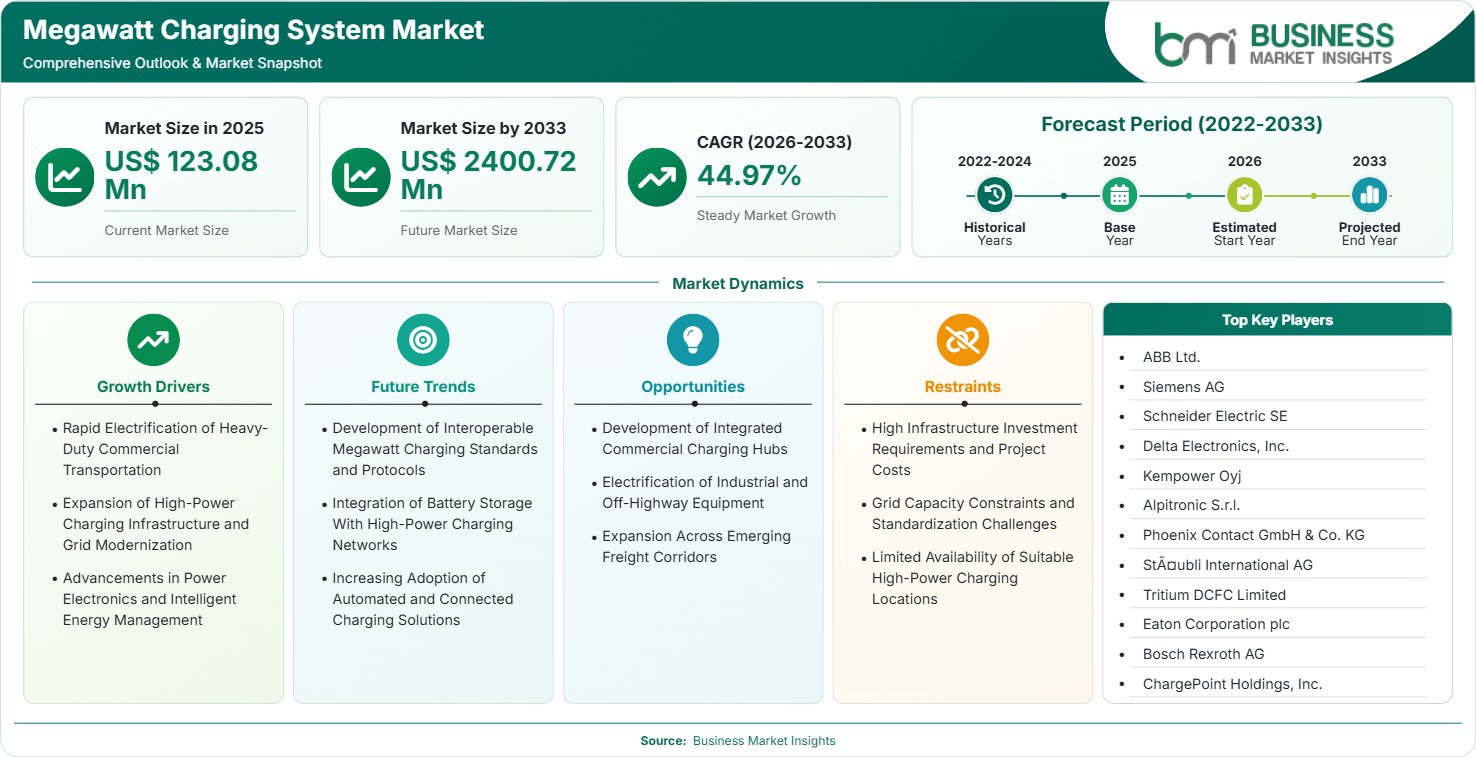
The Megawatt Charging System Market size was valued at US$ 123.08 Million in 2025 and is projected to reach US$ 2400.72 Million by 2033, growing at a CAGR of 44.97% during 2026–2033. Rising electrification of commercial transport, and advancements in high-power charging technologies are creating substantial long-term opportunities across heavy-duty mobility ecosystems.

Report Coverage
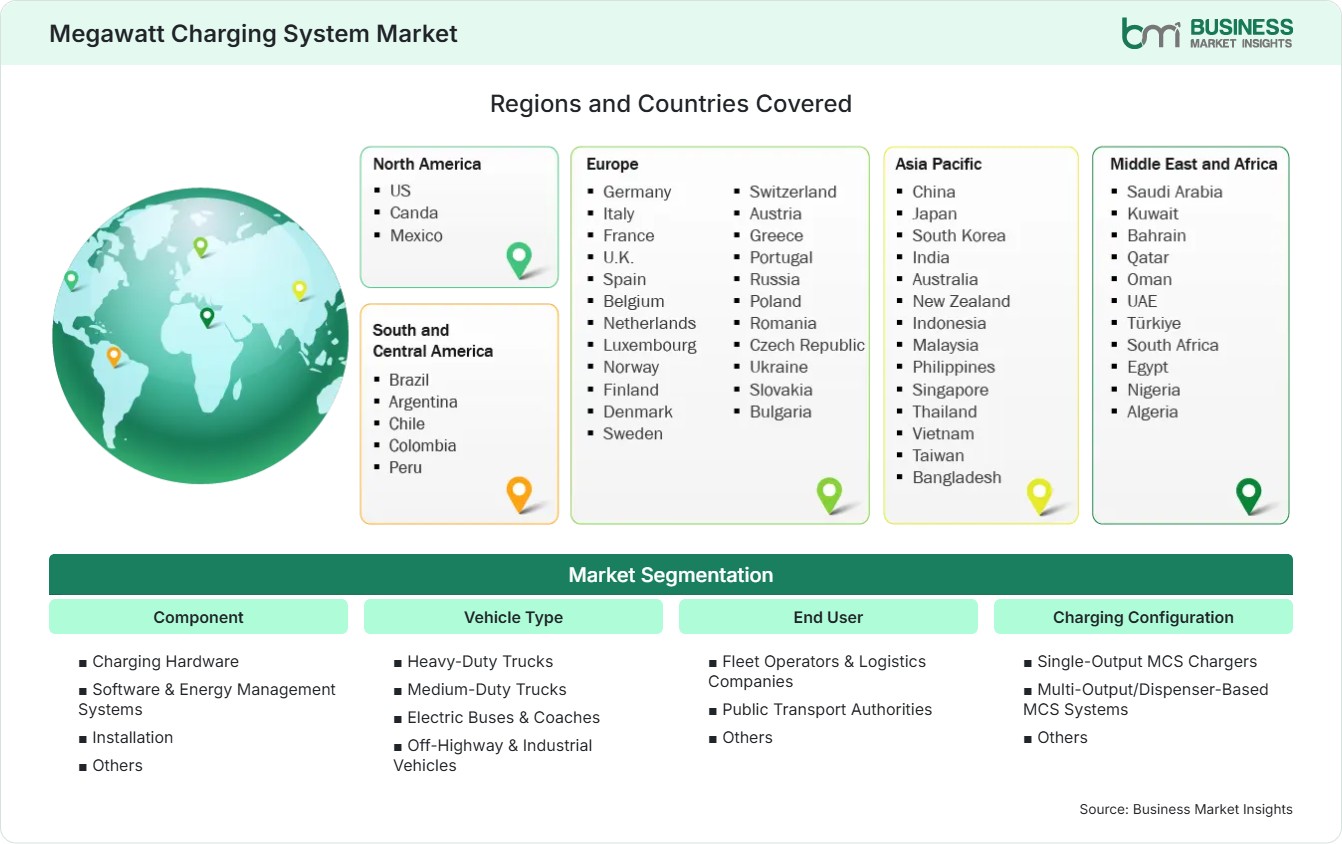
  • Component: Charging Hardware, Software & Energy Management Systems, Installation, Others
  • Vehicle Type: Heavy-Duty Trucks, Medium-Duty Trucks, Electric Buses & Coaches, Off-Highway & Industrial Vehicles
  • End User: Fleet Operators & Logistics Companies, Public Transport Authorities, Others
  • Charging Configuration: Single-Output MCS Chargers, Multi-Output/Dispenser-Based MCS Systems, Others
  • Charger Power Output: 1.0-1.5 MW, 1.5-2.0 MW, Above 2.0 MW
US$ 123.08 Mn Market size in 2025
US$ 2400.72 Mn Market Size by 2033
44.97% CAGR, 2026 - 2033
2026-2033 Forecast Period

AI Overview

Megawatt Charging System Market Summary

  • North America Region: North America holds a market share of 34%–37% in 2025 and is projected to expand at a 43%–46% CAGR during 2026–2033. Fleet electrification mandates, public infrastructure investments, and industrial charging deployments continue accelerating regional demand. The U.S. market benefits from expanding heavy-duty electric truck deployments, federal infrastructure funding, and utility partnerships, supporting an estimated 44%–47% CAGR through 2033.
  • Fastest Growing Region: Asia Pacific accounts for 24%–27% of the market in 2025 and is expected to register a 46%–49% CAGR between 2026–2033. Accelerating commercial, battery innovation, freight modernization, urban transport investments, and industrial automation collectively strengthen long-term regional infrastructure development.
  • Leading Segment: Heavy-Duty Trucks represent 42%–45% market share in 2025 while advancing at a 45%–48% CAGR through 2033. Expanding electric freight operations, operational efficiency improvements, and emission reduction strategies continue driving widespread deployment.
  • High Growth Segment: Software & Energy Management Systems account for 18%–21% of the market in 2025 and are forecast to grow at a 47%–50% CAGR during 2026–2033. Intelligent energy optimization, renewable integration, demand-response capabilities, and digital fleet management accelerate enterprise adoption.
  • Key Market Opportunity: Expansion of integrated charging hubs combining renewable energy, and megawatt-scale charging solutions creates scalable business models supporting commercial fleet electrification across international freight corridors.
  • Major Market Players: ABB Ltd., Siemens AG, Schneider Electric SE, Delta Electronics, Inc., Kempower Oyj, Alpitronic S.r.l., Phoenix Contact GmbH & Co. KG, Stäubli International AG, Tritium DCFC Limited, Eaton Corporation plc, Bosch Rexroth AG, ChargePoint Holdings, Inc., Tesla, Inc., Heliox B.V., and CharIN e.V.
Strategic Insights

Megawatt Charging System Market: Strategic Insights

Megawatt Charging System Market Strategic Framework
FREE PDF
Request your free sample
Request free sample
Stakeholder View

Key Takeaways

  • The developing value chain now comprises more collaborations among charging hardware makers, software makers, and infrastructural service providers, which enhances interoperability, efficiency, and asset management throughout the asset’s life cycle.
  • Long-haul freight, municipal transport, and logistics fleets present the greatest business potential because increased batteries’ size implies need for high power capacity and less downtime during recharging.
  • Innovation trends are moving fast towards energy-efficient systems, predictive maintenance, and artificial intelligence for managing the process and achieving higher charger use efficiency without causing stress on the grid.
  • Asia Pacific offers one of the most compelling long-term investment destinations as commercial vehicle manufacturing, and rapid charging infrastructure deployment accelerate large-scale electrification programs.
  • Strategic partnerships, acquisitions, and joint development agreements between charging technology providers, and energy storage companies are becoming central to expanding integrated charging ecosystems and reducing infrastructure deployment risks.
  • Future competitiveness will increasingly depend on software interoperability, cybersecurity capabilities, and scalable charging architectures capable of supporting continuously increasing battery capacities across commercial transportation applications.
Geographic Outlook

Megawatt Charging System Market Regional Highlights

North America Megawatt Charging System Market

North America accounts for 34%–37% of the global market in 2025 and is projected to expand at a 43%–46% CAGR through 2033. The region benefits from accelerating deployment of electric freight corridors, supportive federal infrastructure programs, and increasing investments by utilities in high-capacity grid modernization. The Megawatt Charging System Market share remains the largest globally because of strong adoption among logistics operators, commercial fleet electrification initiatives, and collaboration between charging technology providers, truck manufacturers, and public infrastructure agencies.

  • Federal infrastructure funding is accelerating installation of ultra-high-power charging stations along interstate freight routes, enabling reliable long-distance commercial vehicle operations while supporting private investment across logistics hubs, ports, and distribution centers.
  • Utilities are increasingly adopting smart energy management, battery storage integration, and demand-response technologies to accommodate megawatt-scale charging loads without compromising grid stability during peak commercial transportation operations.
  • Commercial fleet operators continue replacing diesel-powered heavy-duty trucks with battery-electric alternatives, intelligent fleet management software, and high-power charging systems supporting minimal operational downtime.

US Megawatt Charging System Market

The United States Megawatt Charging System market represents approximately 72%–75% of North American revenue in 2025 and is forecast to register a 44%–47% CAGR through 2033. Large freight transportation networks, zero-emission vehicle incentives, and utility modernization programs continue driving nationwide charging infrastructure deployment.

  • Federal initiatives supporting commercial electric vehicle infrastructure continue attracting investments into interstate freight charging corridors, improving operational efficiency and encouraging private-sector participation across transportation networks.
  • Leading truck manufacturers are collaborating with charging infrastructure providers to develop interoperable charging ecosystems capable of reducing charging duration.
  • Grid modernization investments, renewable energy integration, and battery storage deployment are improving charging reliability.

Europe Megawatt Charging System Market

Europe megawatt charging system market captures 29%–32% of global revenue in 2025 while advancing at a 44%–47% CAGR during the forecast period. Ambitious carbon neutrality objectives, Alternative Fuels Infrastructure Regulation implementation, and coordinated cross-border charging strategies continue accelerating infrastructure deployment. Germany leads regional adoption owing to its commercial vehicle manufacturing base.

  • Germany remains the largest regional market through extensive heavy-duty vehicle production, industrial automation capabilities, and substantial investments in ultra-fast charging infrastructure supporting commercial transportation networks.
  • Finland and the Netherlands are among the fastest-growing national markets, driven by strong renewable energy integration, innovative charging technologies, and government incentives promoting zero-emission freight mobility.
  • Cross-border charging interoperability standards are encouraging infrastructure harmonization across European freight corridors, improving charging accessibility and operational consistency for international logistics operators.

Asia Pacific Megawatt Charging System Market

Asia Pacific megawatt charging system market accounts for 24%–27% of the global market in 2025 and is anticipated to register the highest 46%–49% CAGR through 2033. China maintains regional leadership through extensive electric commercial vehicle production, whereas India and Southeast Asian economies are emerging as attractive investment destinations. The Megawatt Charging System Market growth across the region is supported by expanding manufacturing capacity, and rapid urban transportation electrification.

  • China dominates regional deployment through integrated manufacturing ecosystems, extensive battery production capabilities, and comprehensive commercial vehicle electrification strategies supported by national industrial policies.
  • India is emerging as one of the fastest-growing markets due to expanding logistics infrastructure, supportive government incentives, domestic manufacturing initiatives, and increasing commercial electric vehicle adoption.
  • Japan and South Korea continue investing in advanced power electronics, battery technologies, and smart charging platforms, strengthening innovation across regional charging infrastructure ecosystems.
  • Southeast Asian countries are accelerating electrification of commercial transport through public-private partnerships focused on logistics modernization, and sustainable transportation investments.

Rest of World Megawatt Charging System Market

The Rest of the World contributes 8%–11% of global revenue in 2025 and is expected to grow at a 42%–45% CAGR through 2033. South & Central America are witnessing increasing investments in commercial fleet electrification, particularly across mining and logistics industries. Meanwhile, Middle East & Africa Megawatt Charging System market benefit from smart mobility initiatives, and infrastructure diversification programs designed to reduce transportation emissions while improving long-distance commercial mobility capabilities.

  • Brazil leads South & Central America through expanding commercial electric transportation investments, supported by logistics modernization, renewable electricity availability, and public infrastructure development initiatives.
  • Chile is demonstrating strong momentum because mining electrification projects increasingly require reliable high-power charging infrastructure for heavy industrial transportation equipment.
  • The United Arab Emirates is emerging as the leading Middle Eastern market through smart mobility strategies, sustainability objectives, and investments supporting commercial electric transportation infrastructure.
  • South Africa remains an important African market due to growing commercial fleet modernization, renewable energy adoption, and industrial electrification programs supporting sustainable transportation development.
Global Market Geography
FREE PDF
Request your free sample
Request free sample
Segment Analysis

Megawatt Charging System Market Segmentation

Component

The Component segment accounted for 37%–40% of the market in 2025 and is projected to expand at a 45%–48% CAGR through 2033. Growth is supported by continuous innovation in charging equipment, intelligent energy management platforms, and integrated deployment services. The Megawatt Charging System Market scope continues expanding as charging ecosystems increasingly combine hardware, software, and lifecycle support to improve operational efficiency.

  • Charging Hardware: High-power chargers, liquid-cooled cables, connectors, power conversion systems, and cooling technologies form the backbone of commercial charging infrastructure, enabling rapid energy transfer while improving reliability and reducing charging time for heavy-duty electric vehicles.
  • Software & Energy Management Systems: Intelligent software platforms optimize charging schedules, balance grid loads, monitor charger health, integrate renewable energy resources, and support predictive maintenance, improving infrastructure utilization while lowering operating costs for fleet operators.
  • Installation: Professional installation services include site assessment, electrical integration, commissioning, civil engineering, grid connection planning, and long-term maintenance support, ensuring safe deployment of high-capacity charging infrastructure across commercial transportation facilities.

Vehicle Type

The Vehicle Type segment represented 42%–45% of total revenue in 2025 and is expected to register a 45%–48% CAGR during the forecast period. Growing electrification of freight transportation, public transit modernization, and industrial mobility applications continue accelerating demand for megawatt-scale charging solutions.

  • Heavy-Duty Trucks: Long-haul freight operators increasingly deploy battery-electric trucks requiring ultra-high-power charging solutions to minimize downtime, improve route efficiency.
  • Medium-Duty Trucks: Urban distribution fleets are adopting medium-duty electric trucks supported by depot charging infrastructure, improving operational efficiency.
  • Electric Buses & Coaches: Public transport agencies continue expanding zero-emission bus fleets, increasing demand for reliable high-capacity charging systems supporting scheduled operations.
  • Off-Highway & Industrial Vehicles: Mining, construction, ports, and industrial facilities are integrating electric heavy equipment requiring megawatt-capable charging infrastructure to enhance productivity.

End User

The End User segment captured 48%–51% of the market in 2025 and is forecast to grow at a 44%–47% CAGR through 2033. Increasing commercial fleet electrification, public infrastructure investment, and industrial sustainability initiatives are strengthening adoption among organizations seeking efficient, scalable, and digitally managed charging ecosystems.

  • Fleet Operators & Logistics Companies: Freight companies increasingly invest in depot-based megawatt charging infrastructure integrated with fleet management platforms to maximize vehicle utilization.
  • Public Transport Authorities: Municipal transit agencies are expanding charging infrastructure supporting electric buses and coaches while integrating intelligent energy management solutions to improve operational reliability and reduce urban transportation emissions.

Charging Configuration

The Charging Configuration segment accounted for 31%–34% of global revenue in 2025 and is anticipated to register a 46%–49% CAGR through 2033. Infrastructure providers increasingly deploy scalable charging architectures balancing utilization, and future expansion requirements.

  • Single-Output MCS Chargers: Single-output systems provide dedicated ultra-high-power charging for individual commercial vehicles, and dependable performance across logistics depots and industrial transportation facilities.
  • Multi-Output/Dispenser-Based MCS Systems: Multi-output charging solutions optimize charger utilization by distributing power intelligently among several vehicles, improving operational efficiency while reducing infrastructure costs for high-volume fleet operations.

Charger Power Output

The Charger Power Output segment contributed 27%–30% of market revenue in 2025 and is projected to expand at a 47%–50% CAGR during the forecast period. Increasing battery capacities, reduced charging time requirements, and next-generation heavy-duty electric vehicle platforms continue encouraging development of higher-capacity charging technologies capable of supporting demanding commercial transportation applications.

  • 1.0–1.5 MW: Chargers within this power range support early commercial fleet deployments, balancing charging performance, infrastructure investment requirements, and compatibility with existing heavy-duty electric vehicle platforms across multiple logistics applications.
  • 1.5–2.0 MW: Higher-capacity charging solutions reduce operational downtime for large commercial fleets while supporting growing battery capacities and expanding long-haul transportation requirements with improved charging efficiency.
  • Above 2.0 MW: Ultra-high-power charging technologies are emerging for future heavy industrial applications, enabling faster charging of next-generation commercial vehicles while supporting expanding freight transportation, mining, and specialized industrial electrification projects.
Market Forces

Megawatt Charging System Market Dynamics

Key Market Drivers

Rapid Electrification of Heavy-Duty Commercial Transportation

Decarbonization strategies by governments, stringent emissions regulations, and sustainable fleet policies are pushing the uptake of battery-powered HDVs on a global scale. As reported by the International Energy Agency (IEA), the deployment of electric trucks worldwide continues to increase due to incentives, zero-emission freight transport goals, and infrastructure funding. Megawatt Charging System Market growth will benefit from this trend, as larger batteries require ultra-high-power chargers to maintain efficiency. Logistical businesses pay more attention to the speed of the charging process.

Expansion of High-Power Charging Infrastructure and Grid Modernization

Investments in power distribution infrastructure, smart substations, and renewable energy incorporation are enhancing the deployment environment for megawatt chargers. Utilities are using load balancing technology, battery energy storage systems, and digital monitoring tools to handle the increased demand for electricity for charging commercial vehicle batteries. Interoperability standard bodies such as CharIN keep improving the standards of interconnection between the vehicle and the charger. Increasing collaboration between utilities, chargers, infrastructure builders, and commercial fleets is making the process less complicated.

Advancements in Power Electronics and Intelligent Energy Management

Ongoing innovations in silicon carbide semiconductors, liquid-cooled charging connectors, digital power conversion technology, and AI-based energy management software have greatly enhanced charging efficiency. Intelligent charging systems allow for optimal use of electricity by taking into account the schedule of the car, its battery condition, and the availability of the grid, while reducing operational expenses. Emerging Megawatt Charging System Market trends reveal the use of renewable energy generation and battery storage systems into commercial charging infrastructure.

Key Market Opportunities

Development of Integrated Commercial Charging Hubs

Integrated charging hubs combining megawatt charging stations, renewable electricity generation, battery energy storage, intelligent load balancing, and fleet management software present substantial long-term investment opportunities. Freight operators increasingly require centralized charging facilities capable of serving multiple commercial vehicles with minimal waiting time. The Megawatt Charging System Market Forecasts indicate that integrated charging ecosystems will become critical infrastructure supporting expanding heavy-duty electric transportation.

Electrification of Industrial and Off-Highway Equipment

Beyond freight transportation, mining, construction, ports, agriculture, and large industrial facilities are accelerating adoption of electric heavy equipment to reduce emissions and operating costs. These applications require charging solutions capable of delivering very high power under demanding operating conditions. Equipment manufacturers are introducing battery-electric alternatives with increasing energy capacity, creating demand for megawatt charging infrastructur. Infrastructure providers have opportunities to develop specialized charging systems with enhanced durability, remote monitoring capabilities, and intelligent energy optimization suitable for continuous industrial operations where equipment availability remains a critical performance indicator.

Expansion Across Emerging Freight Corridors

Fast-paced modernization in the areas of logistics in the Asia-Pacific region, the Middle East, Latin America, and certain African countries provide a good basis for the implementation of commercial charging facilities. Transportation modernization, integration of renewable energy and electrification of industry, together with encouragement of the private sector through financial incentives are being implemented by governments. Logistics companies that are expanding their network of regional freight transportation need charging infrastructure which would allow them to move large distances using electric commercial vehicles. Developers who can form alliances with fleet companies, utility providers, and industries will benefit from this trend.

Market Restraints and Challenges

High Infrastructure Investment Requirements

Factor: Deployment of megawatt charging infrastructure requires substantial investment in high-capacity electrical connections, transformers, cooling systems, land acquisition, digital management platforms, and grid upgrades. Impact: These high capital requirements may delay implementation, particularly among small fleet operators and developing markets with limited financial resources. Utility connection timelines and permitting complexity further increase project costs while extending deployment schedules.

Grid Capacity Constraints and Standardization Challenges

Factor: Existing electricity distribution infrastructure in many regions was not designed to support simultaneous megawatt-level charging for multiple commercial vehicles. Impact: Grid limitations may restrict charging availability, increase electricity costs, and delay infrastructure expansion in high-demand logistics corridors. Differences in regional regulations, connector implementation, communication protocols, and utility requirements further complicate international deployment.

Company Analysis

Competitive Landscape

The Megawatt Charging System Market analysis indicates that companies are prioritizing modular charging architectures, liquid-cooled connector technologies, silicon carbide power electronics, intelligent energy management platforms, and strategic partnerships with commercial vehicle manufacturers.

Company Name

Overview

Products and Services Relevant to this Market

ABB Ltd.

Global electrification leader with a strong portfolio in industrial automation, power infrastructure, and electric mobility solutions serving commercial transportation.

Megawatt-capable DC fast charging systems, power conversion equipment, and lifecycle maintenance services.

Siemens AG

Multinational technology company specializing in smart infrastructure, and sustainable transportation technologies across global markets.

High-power charging infrastructure, smart grid technologies, digital energy platforms, and integrated utility solutions.

Schneider Electric SE

International energy management and industrial automation company delivering digital electrical and transportation applications.

Energy management software, electrical distribution systems, smart charging infrastructure, grid optimization technologies, digital monitoring platforms, and infrastructure integration services.

Delta Electronics, Inc.

Leading provider supporting advanced electric vehicle charging infrastructure worldwide.

DC fast chargers, power conversion systems, energy storage integration, cooling technologies, and commercial charging solutions.

Kempower Oyj

Finnish charging technology specialist focused on scalable DC charging platforms designed for commercial fleets, public transportation, and heavy-duty vehicle applications.

Modular DC charging systems, dynamic power distribution software, and depot charging infrastructure.

Alpitronic S.r.l.

European manufacturer recognized for high-performance DC charging technologies emphasizing reliability, modular scalability, and operational efficiency.

Hypercharger platforms, ultra-fast commercial charging equipment, and fleet charging infrastructure solutions.

Phoenix Contact GmbH & Co. KG

Industrial connectivity and automation company providing electrical engineering technologies supporting electric mobility and intelligent infrastructure deployment.

High-power charging connectors, communication interfaces, industrial connectors, and smart infrastructure components.

Stäubli International AG

Global engineering company specializing in advanced electrical connectors, robotics, and industrial automation technologies.

High-current charging connectors, liquid-cooled connector technologies, and mobility infrastructure components.

Tritium DCFC Limited

Developer of DC fast charging technologies focused on high-performance commercial charging infrastructure.

High-power DC chargers, charging network software, remote asset monitoring, and charging infrastructure support services.

Eaton Corporation plc

Global power management company delivering electrical infrastructure solutions and commercial electrification capabilities.

Power distribution systems, electrical protection equipment, energy management technologies, and grid modernization solutions.

Bosch Rexroth AG

Industrial automation and drive technology company supporting advanced manufacturing and electrification through intelligent engineering and motion control solutions.

Industrial automation systems, power electronics, control technologies, and integrated industrial solutions.

ChargePoint Holdings, Inc.

Charging network operator offering cloud-connected charging infrastructure and software platforms.

Fleet charging solutions, charging network software, cloud-based energy management, and infrastructure management tools.

Tesla, Inc.

Electric vehicle manufacturer with vertically integrated charging technologies and expertise in high-power charging infrastructure.

High-power charging technologies, and charging infrastructure engineering capabilities.

Heliox B.V.

Netherlands-based provider of rapid charging systems focused on electric buses, commercial fleets, and heavy-duty transportation applications.

Opportunity charging systems, depot charging infrastructure, power conversion equipment, and fleet charging technologies.

CharIN e.V.

International industry association driving global charging interoperability standards for electric mobility infrastructure.

Charging standards development, interoperability frameworks, and ecosystem coordination supporting megawatt charging deployment.

Trust & Transparency

Research Methodology

The market analysis combines proprietary research with secondary data from government agencies, company disclosures, regulatory filings, industry databases and expert interviews. Market estimates are validated through data triangulation, cross-market benchmarking and analyst review.

View Full Research Methodology

Questions Answered

Frequently Asked Questions

What factors will influence long-term market competitiveness?

Long-term competitiveness will depend on interoperability standards, charging reliability, software intelligence, and continued reductions in charging equipment and installation costs.

What does the Megawatt Charging System Market Report primarily help stakeholders evaluate?

The report helps manufacturers, investors, fleet operators, utilities, infrastructure developers, and policymakers evaluate competitive positioning, and long-term commercial infrastructure strategies supporting heavy-duty transportation electrification.

Which technological innovations are shaping future infrastructure development?

Key innovations include silicon carbide power electronics, liquid-cooled charging connectors, AI-enabled energy management software, and intelligent load balancing for grid optimization.

How does Megawatt Charging System technology differ from conventional DC fast charging?

Megawatt charging systems deliver substantially higher charging power than traditional DC fast chargers, enabling heavy-duty electric trucks and buses with large battery packs to recharge within operationally practical timeframes.

What industries are expected to generate the highest demand for megawatt charging systems?

Heavy-duty freight transportation, municipal transit, mining, construction, ports, logistics, and industrial fleet operations are expected to remain the largest demand generators.

Access the Full Megawatt Charging System Market Report

Get segment-level forecasts, regional estimates, competitive benchmarking, company profiles and downloadable Excel datasets.

Access the full Megawatt Charging System Market Report
350 pages PDF & Excel | 2026-08-17
Similar Research

Related Market Reports