Market Summary
Executive Summary and Global Market Analysis
EV charging cables are defined as conductive cables that create the necessary connection to pass power from the AC/DC electrical charging equipment to the battery of a vehicle. They are engineered to be durable enough to withstand repeated charging cycles and sustain exposure to different environmental conditions while enduring the variable load power levels associated with EV charging for home, commercial, or public applications.
The growth of the EV cable market is also driven by the increasing number of EV charging infrastructure networks and the growing need for reliable EV charging accessories. Manufacturers of EV charging cables are looking to create products that are convenient, durable, and compatible with different types of EV charging standards due to the expansion of charging stations.
The EV charging cable market is segmented by the speed of charging required and the location of the installation. AC types of charging cables are typically used to charge an EV on a routine basis, whereas DC types of cables are used for shorter periods of time and allow for faster charging. The various length categories of cables reflect practical considerations regarding the position of the vehicle, the position of the charger, and the accessibility of the charger for various site layouts.
Increasingly, companies are focusing their product development on flexibility, lightweight materials, and improved durability under high-use conditions. Suppliers support the emerging charging technologies by improving their cable designs through enhanced material and connector integration. The competition among suppliers is based on providing superior product quality, high levels of operational efficiency, and compliance with technical specifications that ensure smooth deployment of new charging systems across an expanding market of charging systems.
Segment Analysis
EV Charging Cables Market Segmentation
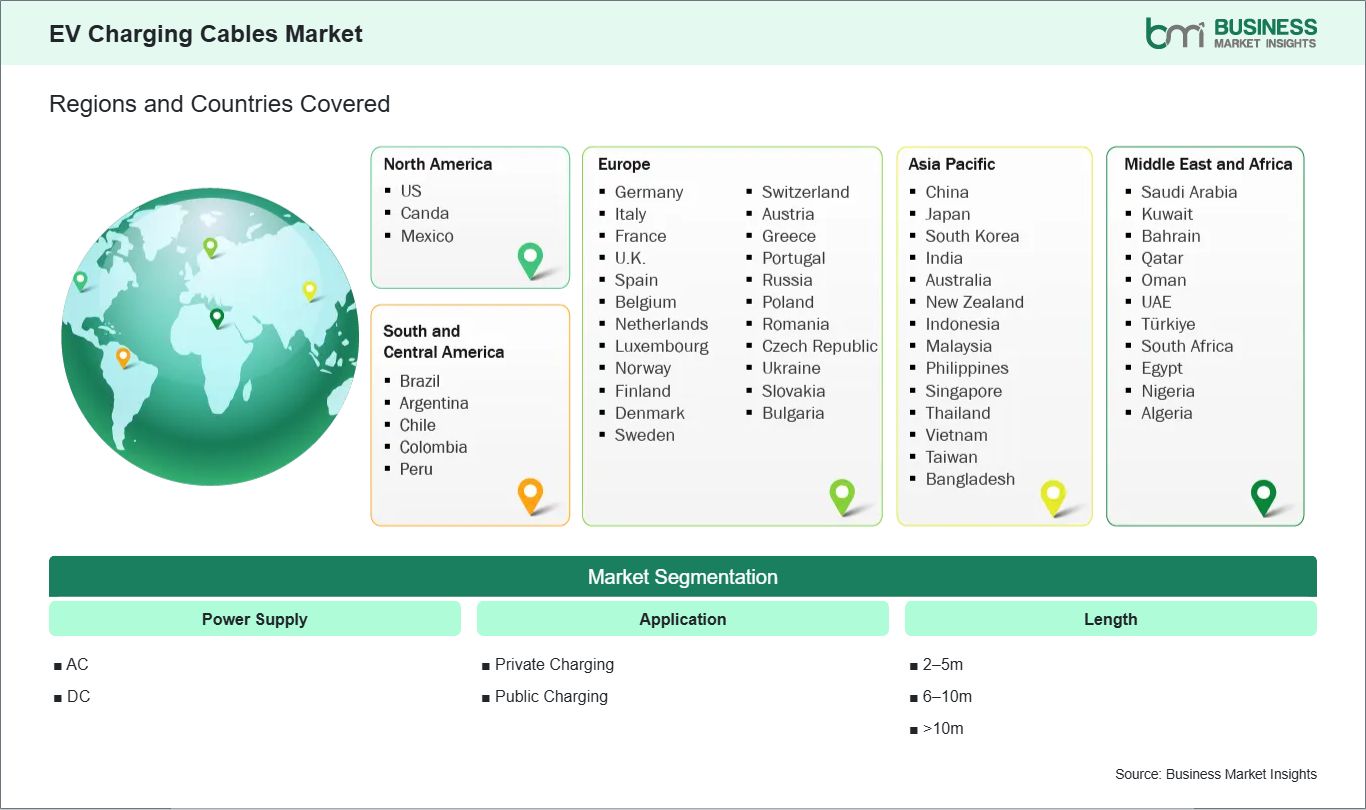
The EV charging cables market is segmented by power supply, application, and length, reflecting differing charging requirements and installation preferences across electric vehicle infrastructure.
By Power Supply
- AC - Supports residential and low-speed charging applications.
- DC - Enables high-speed charging in public infrastructure.
By Application
- Private Charging - Used in home and controlled parking environments.
- Public Charging - Deployed in commercial and highway charging stations.
By Length
- 2-5m - Suitable for compact residential charging setups.
- 6-10m - Balanced reach for mixed-use charging stations.
- >10m - Designed for extended-distance and flexible installations.
Market Forces
EV Charging Cables Market Drivers and Opportunities
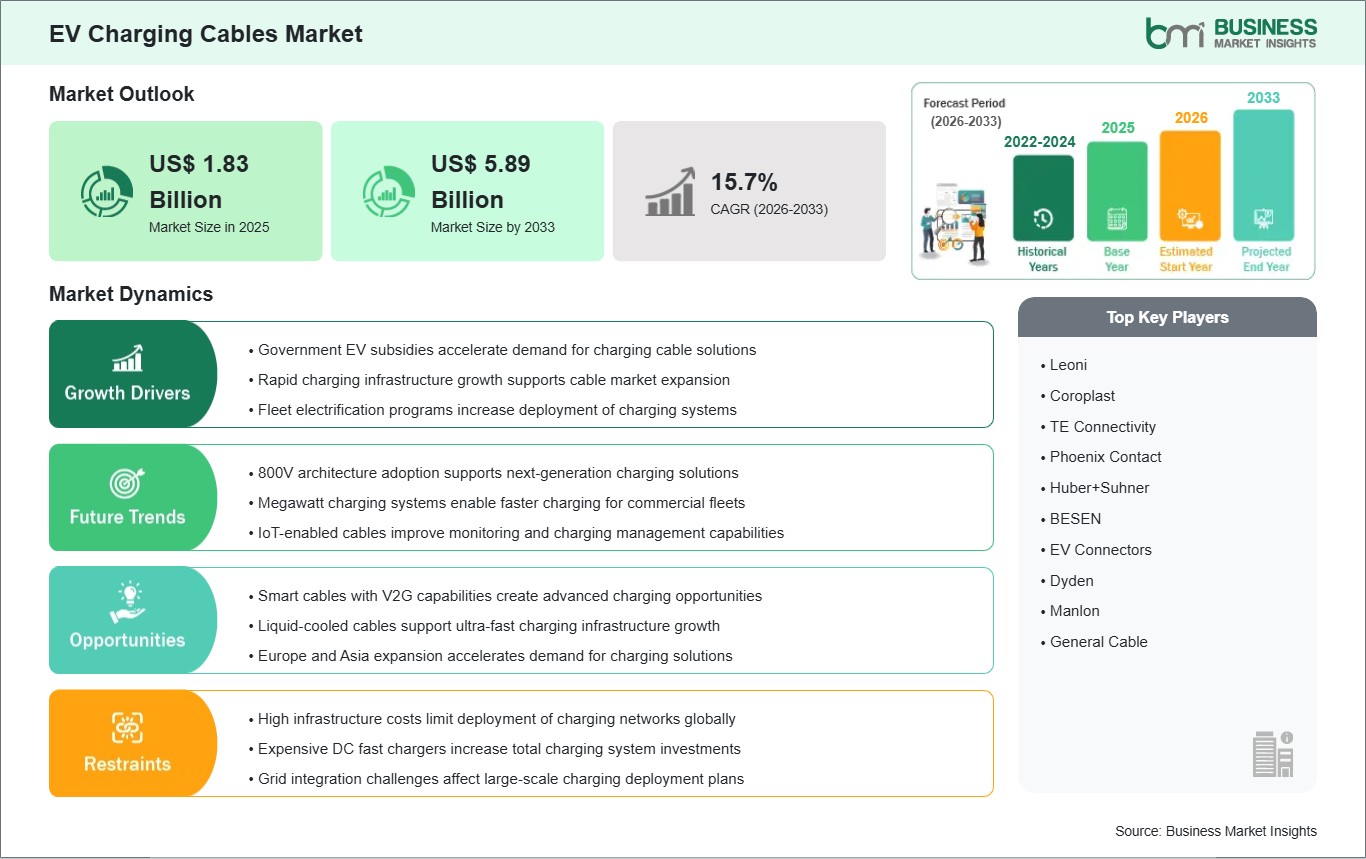
Government EV subsidies
The adoption of electric vehicles is benefiting from numerous government incentives and subsidies to support the installation of charging infrastructure. Through financial support for residential charging stations, commercial chargers and public charging networks, there is an increase in the installation of EV chargers in both urban areas and rural areas. As more charging infrastructure is installed, there will be an increased demand for reliable and compatible EV charging cables. These types of programs will help to bridge the infrastructure gaps that have historically been barriers to the growth of EVs, ultimately laying the foundation for the transition to more environmentally-friendly transportation systems.
In addition to helping consumers purchase vehicles, subsidy programs also influence the creation of supporting infrastructure components. The installation of new charging stations is occurring at an accelerating pace by charging network owners, companies and property owners through government-funded projects aimed at meeting electrification goals. Each new charger requires high-quality, long-lasting and efficient cables to ensure compatibility with multiple charging standards and power options. Investments in EV charging infrastructure will continue to remain strong as governments remain focused on promoting clean mobility and sustainable transport strategies.
Smart cables with V2G
The advent of smart charging cables that enable vehicle-to-grid (V2G) energy exchange are presenting new opportunities within the EV charging cables marketplace. These advanced cables provide two-way energy flow, allowing for the charging of EVs from the grid and the delivery of stored energy back to the grid when necessary. With intelligent communications and monitoring capabilities, smart cables enable bi-directional data sharing between vehicles, charging stations and energy management systems. Improved levels of connectivity increase the efficiency of EV charging, facilitate improved utilization of energy, and enhance the relationship between electric mobility and the wider electricity grid.
As power systems move towards the implementation of distributed storage and grid balancing solutions, the need for V2G-capable charging infrastructure will continue to rise. Smart cables are a critical enabler of EVs operating as mobile energy storage devices that can deliver electricity back to the grid during periods of significant demand. Developments in connectivity technologies, such as 5G and cloud-based charge management platforms, will continue to expand intelligent charging ecosystems. As the number of smart charging infrastructures increases globally, the demand for advanced charging cables capable of supporting V2G functionality, real-time communication and energy management.
Size and Share Analysis
EV Charging Cables Market Size and Share Analysis
The EV charging cables market is projected to grow from US$ 1.83 billion in 2025 to US$ 5.89 billion by 2033, registering a CAGR of 15.7% from 2026 to 2033.
By power supply, DC charging cables hold strong relevance due to rising fast-charging infrastructure deployment and compatibility with high-power charging stations. AC charging systems maintain widespread usage in residential environments and workplace charging setups where charging durations are less time-sensitive. Increasing standardization of charging interfaces supports balanced adoption across both categories while ensuring interoperability across charging networks.
By application, public charging infrastructure represents significant demand due to highway electrification, commercial charging hubs, and urban charging expansion. Private charging adoption is also increasing with residential EV ownership growth and home charging convenience. Infrastructure scalability requirements continue to shape product selection across both segments, with cable durability and safety remaining key considerations.
By length, 2-5m cables are commonly selected for compact charging installations where vehicles park close to charging units. The 6-10m category offers greater flexibility for mixed-use charging environments and varied parking layouts. Cables exceeding 10m are utilized in specialized installations requiring extended reach, supporting operational convenience across larger charging locations.
Report Coverage
EV Charging Cables Market Report Coverage and Deliverables
The "EV Charging Cables Market Size and Forecast (2022-2033)" report provides a detailed analysis of the market covering below areas:
- Market size and forecast at global, regional, and country levels for all key market segments covered under the scope
- Market trends, along with market dynamics such as drivers, restraints, and key opportunities
- Market analysis covering key trends, global and regional frameworks, major players, regulations, and recent developments
- Industry landscape and competitive analysis covering market concentration, heat map analysis, prominent players, and recent developments
- Detailed company profiles, including SWOT analysis
Geographic Insights
EV Charging Cables Market Geographic Insights
The EV charging cables market shows diverse regional adoption patterns influenced by charging connector standards, grid modernization efforts, vehicle ownership trends, and the pace of infrastructure integration. Regional differences emerge from charging behavior, network accessibility, and investment priorities across transportation ecosystems.
North America benefits from an expanding mix of residential charging installations and destination-based charging networks. Demand for durable and high-capacity cables is supported by longer travel distances and the development of corridor charging facilities. Market participants also focus on compatibility across multiple charging platforms to improve user convenience.
Asia Pacific exhibits a dynamic landscape shaped by extensive manufacturing capabilities and dense urban transportation networks. Large-scale deployment of charging stations in residential complexes, commercial districts, and public parking facilities contributes to sustained cable requirements. Product preferences often align with local charging standards and infrastructure configurations.
Europe emphasizes interoperability and standardized charging solutions across cross-border mobility networks. Meanwhile, emerging economies in the Middle East, Africa, and South America are progressively incorporating electric mobility into broader transportation modernization plans. As charging accessibility improves in these regions, opportunities continue to emerge for cable suppliers serving new infrastructure projects.
Industry Activity
Recent Developments
The EV charging cables market is evaluated by gathering qualitative and quantitative data post primary and secondary research, which includes important corporate publications, association data, and databases. Recent developments and news in the market include:
- In September 2025, Foxconn Interconnect Technology, announced that it had initiated construction of a new manufacturing facility in Saudi Arabia through its Smart Mobility joint venture to produce EV chargers and related charging connectivity components, including charging cables.
- In January 2025, ChargePoint, announced that it had introduced new cut-resistant EV charging cables designed with reinforced steel layering to reduce cable theft and improve durability at public charging stations.
Trust & Transparency
Research Methodology
The market analysis combines proprietary research with secondary data from government agencies, company disclosures, regulatory filings, industry databases and expert interviews. Market estimates are validated through data triangulation, cross-market benchmarking and analyst
review.
View Full Research Methodology
Key Sources Referred:
Electric vehicle industry reports Government transportation and EV policy publications Charging infrastructure technology journals Automotive OEM technical documentation Energy and power systems research papers Company annual reports and filings International energy agency mobility outlooks EV charging standards and compliance guidelines