
Electric Vehicle (EV) Charging Cables Market Outlook: Size, Share, Trends, Growth Analysis, Competitive Landscape & Forecast, 2026–2033

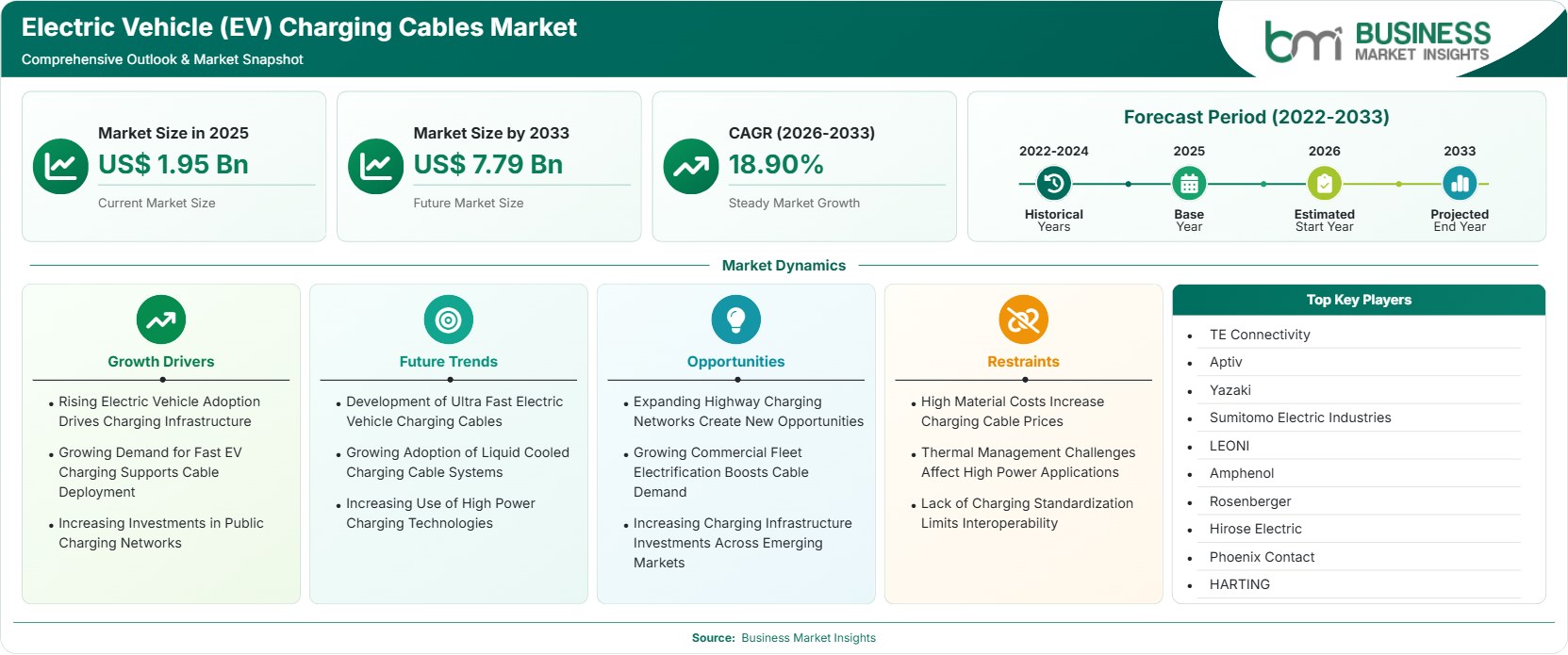
The Electric Vehicle (EV) Charging Cables Market size was valued at US$ 1.95 billion in 2025 and is projected to reach US$ 7.79 billion by 2033, growing at a CAGR of 18.90% during 2026–2033, driven by EV adoption, fast charging, public infrastructure, fleet electrification, and charging-network expansion.

Report Coverage
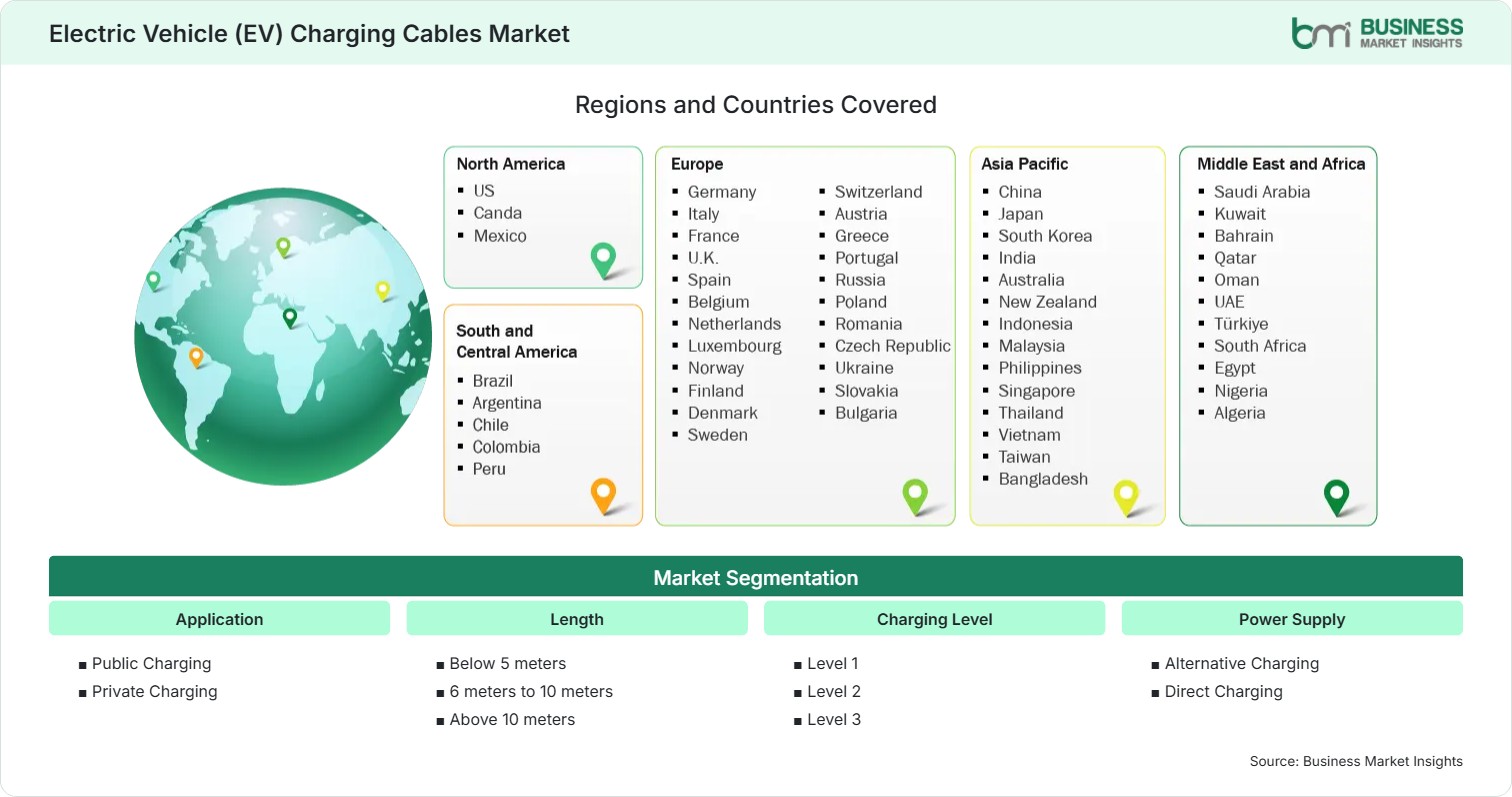
  • Application: Public Charging, Private Charging
  • Length: Below 5 meters, 6 meters to 10 meters, Above 10 meters
  • Charging Level: Level 1, Level 2, Level 3
  • Power Supply: Alternative Charging, Direct Charging
  • Shape: Straight Cable, Coiled Cable
US$ 1.95 Bn Market size in 2025
US$ 7.79 Bn Market Size by 2033
18.90% CAGR, 2026 - 2033
2026-2033 Forecast Period

AI Overview

Electric Vehicle (EV) Charging Cables Market Summary

  • North America: North America holds 23%-26% share in 2025 and grows at a CAGR of 17.4%-18.2%, supported by EV infrastructure expansion, highway charging, fleet electrification, and increasing deployment of high-power charging equipment. The U.S. represents 80%-84% of regional demand, with growth supported by public charging deployment, interstate charging corridors, fleet electrification, and private charging infrastructure.
  • Fastest Growing Region: Asia Pacific holds 39%-42% share in 2025 and expands at a CAGR of 20.1%-21.0%, supported by high EV production, charging infrastructure development, urban electrification, domestic manufacturing, and rapid deployment of public and private charging systems.
  • Leading Segment: Private Charging holds 56%-60% share in 2025 and grows at a CAGR of 17.8%-18.6%, supported by home charging, workplace charging, residential EV ownership, and increasing installation of dedicated charging equipment.
  • High Growth Segment: Direct Charging (DC) holds 42%-46% share in 2025 and grows at a CAGR of 20.5%-21.4%, driven by fast charging, highway infrastructure, commercial fleets, charging hubs, and increasing requirements for high-power energy transfer.
  • Key Market Opportunity: Highway charging corridors, commercial fleet electrification, high-power charging, and infrastructure expansion in emerging economies are creating opportunities for durable, thermally efficient, high-current charging cable technologies.
  • Major Market Players: TE Connectivity, Aptiv, Yazaki, Sumitomo Electric Industries, LEONI, Amphenol, Rosenberger, Hirose Electric, Phoenix Contact, HARTING.
Strategic Insights

Electric Vehicle (EV) Charging Cables Market: Strategic Insights

Electric Vehicle (EV) Charging Cables Market Strategic Framework
FREE PDF
Request your free sample
Request free sample
Stakeholder View

Key Takeaways

  • The value chain is expanding from cable manufacturing toward integrated charging ecosystems involving connector suppliers, charging-equipment manufacturers, infrastructure operators, utilities, installers, automotive manufacturers, and fleet operators.
  • High-power DC charging offers the strongest upside because charging operators increasingly require cables capable of transferring greater power while maintaining manageable weight, flexibility, thermal performance, and user convenience.
  • Product development is moving toward liquid-cooled cables, higher-current connectors, improved insulation, lighter materials, enhanced ergonomics, and cable designs optimized for frequent commercial charging cycles.
  • Asia Pacific provides a compelling investment environment because EV manufacturing, charging-network development, component localization, and urban electrification are progressing simultaneously.
  • Infrastructure investment is increasingly focused on highway charging, fleet depots, public charging hubs, workplace charging, and residential installations, broadening the addressable customer base for cable manufacturers.
  • Competitive differentiation will increasingly depend on current capacity, thermal management, connector durability, cable flexibility, charging-standard compatibility, safety performance, manufacturing scalability, and total lifecycle cost.
Geographic Outlook

Electric Vehicle (EV) Charging Cables Market Regional Highlights

North America Electric Vehicle (EV) Charging Cables Market

North America represents 23%-26% share in 2025 and is projected to grow at a CAGR of 17.4%-18.2% through 2033. Public infrastructure, highway corridors, fleet charging, and residential installations support regional cable demand.

  • Highway charging expansion is increasing requirements for high-current DC cables designed for repeated use, outdoor exposure, temperature variation, mechanical stress, and high-power charging.
  • Fleet electrification is creating dedicated charging demand at logistics centers, transit facilities, delivery depots, and commercial parking locations, increasing requirements for durable charging cables.
  • Residential charging remains an important application as EV ownership expands and households install dedicated charging equipment with appropriate cable lengths and connector configurations.
  • Charging infrastructure operators are prioritizing reliability and uptime, increasing demand for cables with robust connectors, abrasion resistance, weather protection, and manageable handling characteristics.

US Electric Vehicle (EV) Charging Cables Market

The U.S. represents 80%-84% of North American demand in 2025 and grows at a CAGR of 17.2%-18.0%. Public charging expansion, fleet electrification, and residential infrastructure support sustained demand.

  • Public charging investment is increasing requirements for cable assemblies capable of handling frequent connection cycles and demanding outdoor operating environments.
  • Commercial fleets are encouraging depot-based charging deployments, creating demand for longer, durable cables suited to buses, delivery vehicles, trucks, and high-utilization charging environments.
  • Residential installations favor practical cable lengths, ergonomic connectors, thermal safety, and compatibility with widely deployed AC charging equipment.

Europe Electric Vehicle (EV) Charging Cables Market

Europe represents 27%-30% share in 2025 and grows at a CAGR of 18.2%-19.1%. Germany leads regional demand, while France, the Netherlands, Norway, and the United Kingdom provide strong opportunities.

  • Germany benefits from extensive EV manufacturing and charging infrastructure development, supporting demand for both AC and DC cable assemblies across public and private applications.
  • France provides opportunities through highway charging, residential EV adoption, commercial infrastructure, and expanding charging capacity at transportation and retail locations.
  • The Netherlands and Norway have mature EV ecosystems, creating replacement and expansion demand for charging cables, connectors, public chargers, and fleet charging infrastructure.
  • The United Kingdom provides growth opportunities through public charging expansion, workplace installations, residential charging, and highway charging networks serving increasingly diverse EV fleets.

Asia Pacific Electric Vehicle (EV) Charging Cables Market

Asia Pacific represents 39%-42% share in 2025 and expands at a CAGR of 20.1%-21.0%, making it the fastest-growing region. China, Japan, South Korea, and India provide major opportunities.

  • China combines large EV production with extensive charging deployment, creating substantial demand for charging cables across public, private, commercial, and high-power applications.
  • Japan provides opportunities through established automotive manufacturing, charging technology development, residential installations, and increasing requirements for reliable charging infrastructure.
  • South Korea benefits from EV adoption, charging-network expansion, domestic electronics capabilities, and increasing deployment of high-power charging equipment.
  • India is developing rapidly as EV adoption expands across passenger, two-wheeler, commercial, and fleet applications, creating opportunities for localized charging infrastructure and cable production.

Rest of World Electric Vehicle (EV) Charging Cables Market

Rest of World represents 9%-12% share in 2025 and grows at a CAGR of 16.0%-17.5%. Latin America provides leading opportunities, while Middle Eastern and African Electric Vehicle (EV) Charging Cables Markets develop from smaller infrastructure bases.

Latin America is supported by urban electrification, commercial fleets, public charging investment, and increasing EV availability. Brazil and Mexico lead opportunities, while Chile and Colombia provide additional potential as charging infrastructure expands.

  • Brazil provides opportunities across public charging, fleet infrastructure, residential installations, and highway networks as EV availability and charging coverage expand.
  • Mexico benefits from automotive manufacturing, commercial transportation, and proximity to established North American supply chains, supporting charging infrastructure development.
  • Gulf countries are developing high-power charging infrastructure for urban and intercity mobility, creating opportunities for durable cables designed for demanding climatic conditions.
  • South Africa provides longer-term opportunities through fleet electrification, urban charging development, commercial EV adoption, and gradual expansion of public infrastructure.
Global Market Geography
FREE PDF
Request your free sample
Request free sample
Segment Analysis

Electric Vehicle (EV) Charging Cables Market Segmentation

Application

Private Charging represents 56%-60% share in 2025 and grows at 17.8%-18.6% CAGR through 2033, supported by residential and workplace installations. Public Charging is expanding rapidly as highway corridors and urban networks develop.

  • Public Charging: Public charging requires durable cables capable of repeated handling, weather exposure, high utilization, and reliable current transfer across urban, highway, retail, and fleet locations.
  • Private Charging: Private charging supports residential and workplace applications where convenient cable handling, appropriate length, connector compatibility, safety, and reliable daily charging are key requirements.

Length

The 6 meters to 10 meters category represents 45%-49% Electric Vehicle (EV) Charging Cables Market share in 2025 and grows at 18.2%-19.0% CAGR through 2033, balancing vehicle positioning flexibility and cable manageability. Shorter cables support compact installations, while longer configurations serve public and commercial locations.

  • Below 5 meters: Short cables suit compact residential and controlled installations, reducing storage requirements, material consumption, handling weight, and potential cable-management challenges.
  • 6 meters to 10 meters: Mid-length cables provide flexibility for varied vehicle positioning while maintaining manageable weight, making them suitable for residential, workplace, commercial, and public charging.
  • Above 10 meters: Longer cables support charging points with greater parking distance or constrained charger placement, particularly in commercial and fleet environments requiring broader vehicle access.

Charging Level

Level 2 represents 49%-53% share in 2025 and grows at 18.0%-18.8% CAGR through 2033, supported by residential, workplace, commercial, and destination charging. Level 3 offers faster growth through high-power public charging. Level 1 remains relevant for lower-power residential use. Cable specifications increasingly reflect charging speed, thermal performance, safety, and connector requirements.

  • Level 1: Level 1 cables support lower-power charging and remain relevant where vehicles can charge for extended periods without requiring rapid energy replenishment.
  • Level 2: Level 2 cables address residential, workplace, fleet, and destination charging where faster charging and practical installation requirements create broad demand.
  • Level 3: Level 3 cables support high-power DC charging and require advanced thermal management, robust connectors, high current capacity, and durable construction.

Power Supply

Direct Charging (DC) represents 42%-46% Electric Vehicle (EV) Charging Cables Market share in 2025 and grows at 20.5%-21.4% CAGR through 2033, supported by fast charging and commercial infrastructure. Alternative Charging (AC) retains a broad installed base across residential and workplace applications.

  • Alternative Charging (AC): AC charging cables support residential, workplace, and destination charging where lower charging power, long dwell times, affordability, and broad equipment availability remain important.
  • Direct Charging (DC): DC charging cables support rapid energy transfer at public hubs, highway stations, and fleet depots, requiring advanced thermal management and high-current capabilities.

Shape

Straight Cable represents 72%-76% share in 2025 and grows at 18.0%-18.8% CAGR through 2033, supported by broad compatibility and simpler handling across charging environments. Coiled Cable offers packaging and storage benefits where cable management is important.

  • Straight Cable: Straight cables provide broad application compatibility and predictable reach, making them suitable for residential, workplace, public, commercial, and fleet charging environments.
  • Coiled Cable: Coiled cables improve storage and cable management, supporting applications where compact handling, reduced ground contact, and controlled cable positioning are priorities.
Market Forces

Electric Vehicle (EV) Charging Cables Market Dynamics

Key Market Drivers

Rising Electric Vehicle Adoption Drives Charging Infrastructure

The Electric Vehicle (EV) Charging Cables Market growth is highly dependent on the rise in EV adoption, since each installation requires a cable assembly compatible with the vehicle's power output and connector configuration. Growth in the installation of charging stations for residential, workplace, public, fleet, and highway charging is diversifying the needs away from the typical cables used in automobiles. Cable standards are getting tougher because of rising charging power demands and the need for faster charging. This includes better-insulated cables with flexible conductors, robust connector enclosures, thermal management systems, and cables that combine high current-handling with lightweight properties.

Growing Demand for Fast EV Charging Supports Cable Deployment

The Electric Vehicle (EV) Charging Cables Market trend is increasingly influenced by the need for fast charging, especially for highway infrastructure, commercial operations, and heavily used public facilities. High-powered charging leads to more heat and additional demands on conductors, insulation, connectors, cooling, and ergonomics. A liquid-cooled system could be designed to enable high-powered charging while controlling the cable's size and handling. Improvements in connector design, thermal management, and overall durability are being implemented to support high-powered charging applications. This necessitates a new technological evolution in the cable market segment.

Increasing Investments in Public Charging Networks

Public charging investments are increasing the quantity and geographic coverage of charge points on highways, in cities, at retailers, in parking facilities, and in transportation hubs. Every installation will have different cable assemblies that are needed depending on environmental factors, frequency of use, charging protocols, and energy levels. Public infrastructure relies even more heavily on availability since broken or malfunctioning cables could impact charger availability. Therefore, durability of connectors, resistance to wear, protection against the elements, flexibility of use, and reliability of energy transmission are important aspects of the cable design. High-usage environments may necessitate cable design capable of enduring daily plug cycles and higher temperature levels.

Key Market Opportunities

Expanding Highway Charging Networks Create New Opportunities

The Electric Vehicle (EV) Charging Cables Market forecast is driven by the growth in highway charging, which depends on the availability of reliable charging at high power for long trips of electric vehicles. The highway stations are inclined towards DC cables due to their capability of high-power transmission, durability, ability to withstand outdoor conditions, and ease of use near vehicles. The liquid cooling cable concept can be used where high power leads to high mass and heat dissipation problems in the cable. Differentiation can be achieved by suppliers in terms of the ease of handling the connectors, temperature control, wear and tear resistance, and serviceability.

Growing Commercial Fleet Electrification Boosts Cable Demand

The electrification of commercial fleets is leading to the need for centralized charging infrastructure in depots, logistics hubs, warehousing, transit points, and delivery centers. Fleet managers seek reliable charging since the downtime associated with vehicles impacts their efficiency and cost-effectiveness. Cables intended for these types of installations will have to endure repetitive connections, handling, weather exposure, and sustained operation. Longer cable lengths allow for flexibility where the charger caters to several vehicle positions, while higher DC power cables facilitate quick turnaround. This is an area in which suppliers can offer solutions.

Increasing Charging Infrastructure Investments Across Emerging Markets

The charging infrastructures are being built up in the developing countries due to the rising penetration of electric vehicles, and there will be an opportunity to use modern cables without any restrictions from the older system in place. The suppliers can target these developing nations by having localized manufacturing and distribution channels, installer training, modularity, and cost-efficient cable assemblies. The residential and office charging stations could serve as the starting point for the demand creation, followed by public charging stations, fleet depots, and highway systems. Product strategies need to consider the local electricity grid, vehicle technology mix, charging standards, climate, and cost.

Market Restraints and Challenges

High Material Costs Increase Charging Cable Prices

Factor: The use of copper and other conductive materials, special insulation, shield, connector material, cooling system, and protection materials is very significant in the cables. Impact: Higher material cost may result in higher prices of the cables and exert some pressure on the manufacturers of charging equipment, charging network operators, and the users of the charging equipment. Higher-power products may incur higher costs since increased current-carrying capability may need increased size of conductor, special insulation, better connectors, and a liquid cooling system. Price sensitivity becomes an issue in new charging marketplaces where charging infrastructure is economically difficult to develop.

Thermal Management Challenges Affect High Power Applications

Factor: high-power charging generates substantial heat within conductors and connector interfaces, creating thermal constraints that can limit current capacity, cable flexibility, dimensions, and continuous charging performance. Impact: inadequate thermal management can reduce charging speed, increase component degradation, and compromise operational reliability. Manufacturers are developing improved conductor designs, temperature sensing, optimized insulation, heat dissipation methods, and liquid-cooled cable architectures to address these requirements. Thermal performance becomes especially important at highway charging hubs and commercial fleet depots where cables can experience repeated high-power charging cycles.

Company Analysis

Competitive Landscape

The Electric Vehicle (EV) Charging Cables Market analysis centers on connector manufacturers, automotive component suppliers, electrical technology companies, and specialized interconnection providers. Competition is shifting toward high-current performance, charging-standard compatibility, thermal management, durability, ergonomics, and manufacturing scalability.

Company Name

Overview

Products and Services relevant to this market

TE Connectivity

Global connectivity and sensor technology company serving automotive and industrial electrical applications.

EV charging connectors, cable assemblies, terminals, sensors, high-voltage interconnection, and charging components.

Aptiv

Automotive technology supplier specializing in electrical architecture, connectivity, electronics, and vehicle electrification.

High-voltage connectors, charging cable assemblies, EV electrical architecture, terminals, and interconnection systems.

Yazaki

Major automotive supplier specializing in wiring systems, electrical distribution, connectors, and electrification components.

EV charging cables, high-voltage connectors, wiring systems, terminals, and vehicle charging components.

Sumitomo Electric Industries

Diversified technology manufacturer with extensive expertise in automotive wiring and high-voltage connectivity.

Charging cables, high-voltage wiring, connectors, automotive harnesses, and EV interconnection technologies.

LEONI

Automotive supplier focused on wiring systems, cable technologies, and electrical distribution solutions.

EV charging cables, high-voltage wiring, cable systems, connectors, and vehicle electrification components.

Amphenol

Global interconnection technology manufacturer serving automotive, industrial, and transportation applications.

EV charging connectors, cable assemblies, high-voltage interconnects, terminals, and charging infrastructure components.

Rosenberger

Connectivity specialist providing high-frequency, high-voltage, and automotive interconnection solutions.

EV charging connectors, high-voltage cable assemblies, charging interfaces, and automotive interconnection systems.

Hirose Electric

Connector manufacturer supplying compact and high-reliability interconnection technologies.

EV connectors, high-voltage interconnection components, terminals, cable assemblies, and automotive connectors.

Phoenix Contact

Electrical engineering company developing industrial and e-mobility charging infrastructure technologies.

AC and DC charging cables, charging connectors, charging controllers, infrastructure components, and high-power charging solutions.

HARTING

Connectivity technology company providing industrial and mobility-related electrical connection solutions.

EV charging connectors, cable assemblies, charging infrastructure components, high-voltage connectivity, and related accessories.

Trust & Transparency

Research Methodology

The market analysis combines proprietary research with secondary data from government agencies, company disclosures, regulatory filings, industry databases and expert interviews. Market estimates are validated through data triangulation, cross-market benchmarking and analyst review.

View Full Research Methodology

Questions Answered

Frequently Asked Questions

What does the Electric Vehicle (EV) Charging Cables Market report indicate about future competition?

The report indicates that competition will focus on high-current capability, thermal management, durability, charging-standard compatibility, connector performance, cable ergonomics, and manufacturing scalability. Suppliers capable of supporting both conventional AC installations and advanced high-power DC infrastructure can strengthen their competitive positioning.

Why are commercial fleets creating new opportunities for charging cable suppliers?

Commercial fleets require reliable charging at depots and logistics facilities, where vehicles can undergo frequent charging cycles and operators prioritize uptime. This creates demand for rugged cables, longer cable configurations, high-power DC solutions, and products designed for intensive daily use.

How are fast-charging technologies influencing EV charging cable development?

Fast charging is increasing requirements for higher current capacity, advanced thermal management, improved connector interfaces, durable insulation, and flexible cable construction. Liquid-cooled cables and integrated temperature monitoring are becoming increasingly relevant for demanding high-power charging applications.

Which applications present the strongest opportunity in the market?

Public charging, highway charging, commercial fleet depots, workplace charging, and residential installations provide strong opportunities. High-power DC applications offer particularly attractive potential because charging operators increasingly require cables capable of reliable high-current transfer and repeated charging cycles.

What factors are improving Electric Vehicle (EV) Charging Cables Market return on investment?

EV adoption, public charging expansion, fast-charging deployment, fleet electrification, and highway charging networks are improving investment opportunities. Higher charging utilization also creates recurring demand for durable cable assemblies, replacement products, and advanced high-current solutions designed for demanding charging environments.

Access the Full Electric Vehicle (EV) Charging Cables Market Report

Get segment-level forecasts, regional estimates, competitive benchmarking, company profiles and downloadable Excel datasets.

Access the full Electric Vehicle (EV) Charging Cables Market Report
350 pages PDF & Excel | 2026-08-19
Similar Research

Related Market Reports