
Window Lift Motors Market Outlook: Size, Share, Trends, Growth Analysis, Competitive Landscape & Forecast, 2026-2033

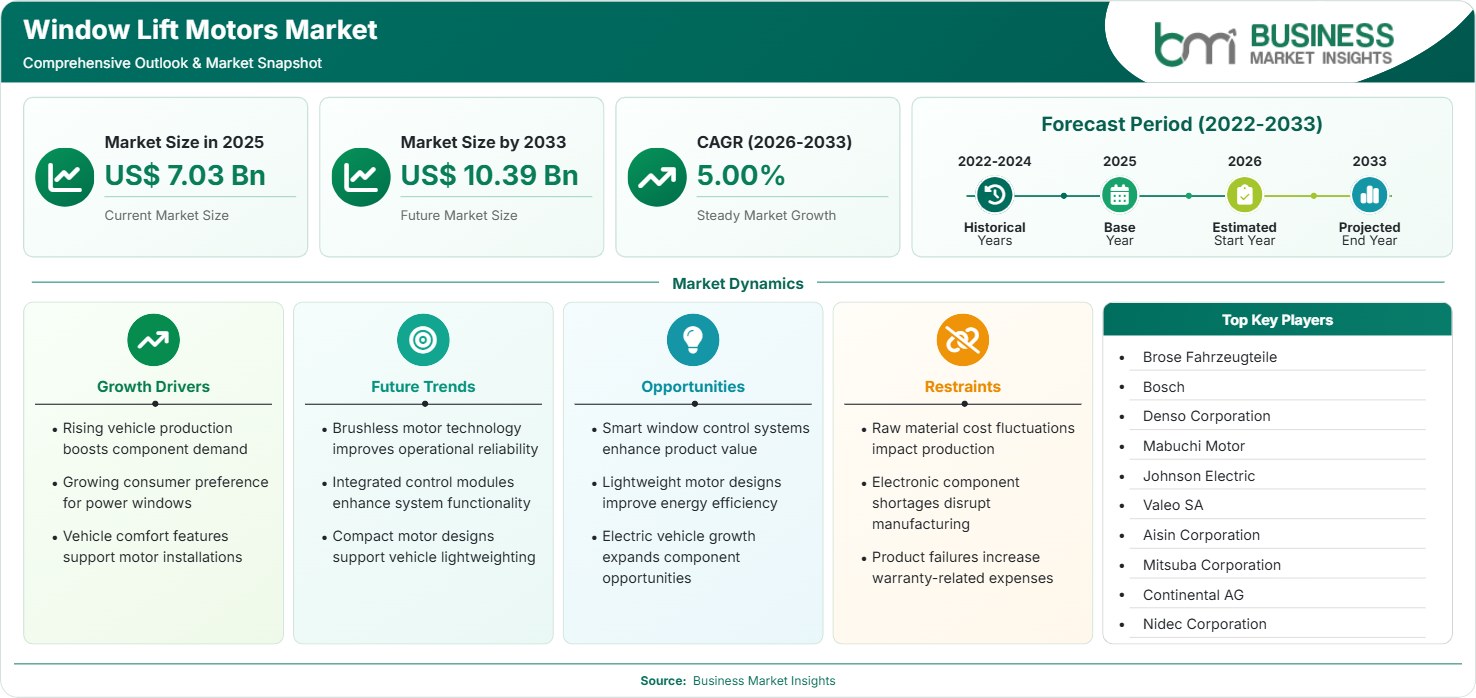
The Window Lift Motors Market size was valued at US$ 7.03 billion in 2025 and is projected to reach US$ 10.39 billion 2033, growing at a CAGR of 5.00% during 2026–2033. Rising vehicle production, increasing adoption of power window systems, and growing demand for enhanced passenger comfort features are supporting component integration across passenger and commercial vehicles.

Report Coverage
  • Mechanism Type: Cable-Type Regulator Systems, Scissor-Type Regulator Systems
  • Vehicle Type: Hatchbacks & Sedans, SUVs, LCVs, HCVs
  • Door Position: Front Window Lift Motors, Rear Window Lift Motors
  • Sales Channel: OEM, Aftermarket
  • Motor Type: Brushed DC Motor, Brushless DC Motor
US$ 7.03 Bn Market size in 2025
US$ 10.39 Bn Market Size by 2033
5.00% CAGR, 2026 - 2033
2026-2033 Forecast Period

AI Overview

Window Lift Motors Market Summary

  • North America Region: North America holds 27%–30% market share in 2025 and is projected to grow at a CAGR of 4.6%–5.1% during 2026–2033. Increasing vehicle ownership, demand for premium comfort systems, and advanced automotive electronics support regional expansion. The U.S. represents the major contributor with a CAGR of 4.7%–5.2%, driven strong automotive production, replacement demand, and adoption of advanced vehicle features.
  • Fastest Growing Region: Asia Pacific accounts for 40%–43% market share in 2025 and is expected to register a CAGR of 5.5%–6.0% during 2026–2033. Expanding vehicle manufacturing, rising middle-class income, and increasing installation of automated vehicle components are strengthening regional demand.
  • Leading Segment: Cable-Type Regulator Systems account for 55%–58% market share in 2025 and are expected to grow at a CAGR of 4.8%–5.3%, supported compact design, lower weight, cost efficiency, and widespread use across passenger vehicles.
  • High Growth Segment: Brushless DC (BLDC) Motor segment captures 32%–35% market share in 2025 and is projected to expand at a CAGR of 6.0%–6.5%, driven higher efficiency, durability, reduced maintenance, and increasing electrification trends.
  • Key Market Opportunity: Increasing vehicle electrification, smart window technologies, lightweight component development, and demand for efficient automotive systems are creating opportunities for manufacturers to introduce advanced motor solutions.
  • Major Market Players: Brose Fahrzeugteile, Bosch, Denso Corporation, Mabuchi Motor, Johnson Electric, Valeo SA, Aisin Corporation, Mitsuba Corporation, Continental AG, and Nidec Corporation.
Strategic Insights

Window Lift Motors Market: Strategic Insights

Window Lift Motors Market Strategic Framework
FREE PDF
Request your free sample
Request free sample
Stakeholder View

Key Takeaways

  • Automotive production growth remains a fundamental demand driver as window lift motors are increasingly integrated into passenger cars, SUVs, and commercial vehicles as standard equipment.
  • Electric vehicles and premium vehicle segments provide strong growth opportunities due to increasing demand for efficient motors, smart controls, and advanced comfort technologies.
  • Brushless DC motor adoption is accelerating as manufacturers prioritize energy efficiency, durability, lower maintenance requirements, and compatibility with modern vehicle architectures.
  • Asia Pacific presents the strongest investment opportunity due to expanding automotive manufacturing bases, rising vehicle ownership, and increasing component localization initiatives.
  • Strategic partnerships between automotive suppliers and OEMs are increasing as companies focus on improving motor efficiency, reducing weight, and developing next-generation vehicle systems.
  • Aftermarket demand remains important due to vehicle aging, replacement requirements, and increasing availability of replacement window lift components through digital sales channels.
Geographic Outlook

Window Lift Motors Market Regional Highlights

North America Window Lift Motors Market

North America represents 27%–30% Window Lift Motors Market share in 2025 and is expected to grow at a CAGR of 4.6%–5.1% during 2026–2033. The region benefits from strong automotive manufacturing, high adoption of power-operated vehicle features, and consistent replacement demand. The United States remains the dominant contributor due to established vehicle production facilities and consumer preference for advanced comfort technologies. Automotive suppliers continue investing in efficient motor designs and integrated electronic systems.

  • Increasing demand for SUVs and premium vehicles supports higher installation rates of powered window systems.
  • Automotive manufacturers continue adopting lightweight components to improve vehicle efficiency and performance.
  • Replacement demand from aging vehicle fleets supports aftermarket motor sales across regional markets.
  • Advanced vehicle electronics integration encourages development of smarter window control systems.

US Window Lift Motors Market

The U.S. accounts for 82%–85% of North American demand and is projected to register a CAGR of 4.7%–5.2% during 2026–2033. Strong automotive production, high vehicle ownership, and increasing consumer expectations for convenience features continue supporting market expansion.

  • Growing preference for premium vehicle features increases demand for automated window systems.
  • Domestic automotive suppliers continue improving production capabilities through advanced manufacturing technologies.
  • Electric vehicle adoption creates opportunities for efficient motor components.
  • Strong aftermarket networks support replacement and repair demand.

Europe Window Lift Motors Market

Europe holds 24%–27% window lift motors market share in 2025 and is projected to grow at a CAGR of 4.5%–5.0% during 2026–2033. The region benefits from advanced automotive manufacturing, strict vehicle efficiency standards, and strong demand for premium vehicles. Germany remains the leading market, while Eastern European countries are witnessing increasing component manufacturing investments.

  • Vehicle manufacturers increasingly integrate efficient motor systems into new vehicle platforms.
  • European suppliers focus on lightweight automotive components to improve energy efficiency.
  • Electric vehicle production supports demand for advanced window control systems.
  • Premium automotive brands continue adopting advanced comfort technologies.

Asia Pacific Window Lift Motors Market

Asia Pacific dominates with 40%–43% market share in 2025 and is expected to achieve the highest CAGR of 5.5%–6.0% during 2026–2033. Growth is supported expanding automotive production, increasing vehicle ownership, and rising adoption of power-operated features in emerging economies. China, India, and Japan remain major contributors due to strong automotive manufacturing ecosystems.

  • China continues leading regional demand through large-scale vehicle production and component manufacturing.
  • India offers growth opportunities due to increasing passenger vehicle production and localization initiatives.
  • Japan maintains strong demand through advanced automotive technology development.
  • Southeast Asian countries attract investments in automotive component manufacturing facilities.

Rest of World Window Lift Motors Market

The Rest of World region accounts for 7%–10% window lift motors market share in 2025 and is projected to grow at a CAGR of 4.8%–5.3% during 2026–2033. Latin America, Middle East, and Africa are witnessing gradual automotive expansion, increasing vehicle imports, and rising demand for replacement components.

  • Brazil and Mexico continue supporting regional automotive component demand through manufacturing activities.
  • Middle Eastern markets show increasing adoption of premium vehicles with advanced comfort features.
  • African automotive markets are gradually expanding through vehicle imports and assembly initiatives.
  • Aftermarket distribution networks continue improving accessibility of replacement motor components.

Global Market Geography
FREE PDF
Request your free sample
Request free sample
Segment Analysis

Window Lift Motors Market Segmentation

Mechanism Type

The mechanism type segment defines the structural design, operational efficiency, and installation suitability of window lift motor systems across different vehicle platforms. It accounted for 55%–58% market share in 2025 and is expected to expand at a CAGR of 4.8%–5.3% during 2026–2033. Automakers increasingly prefer compact and reliable regulator mechanisms that provide smooth operation, reduced noise, and improved durability. Continuous improvements in automotive component engineering are shaping the Window Lift Motors Market scope encouraging development of efficient and lightweight lifting systems.

  • Cable-Type Regulator Systems: Widely adopted due to compact construction, lower weight, flexible installation options, and cost advantages. These systems are commonly used in modern passenger vehicles requiring efficient space utilization and reliable window operation.
  • Scissor-Type Regulator Systems: Maintain demand in specific vehicle applications due to robust mechanical structure, high load-handling capability, and durability. They remain suitable for vehicles requiring stronger window support mechanisms and long service life.

Vehicle Type

The vehicle type segment reflects demand variations based on production volumes, consumer preferences, and adoption of comfort features across automotive categories. This segment accounted for 62%–65% market share in 2025 and is projected to grow at a CAGR of 5.0%–5.5% during 2026–2033. Passenger vehicles remain the primary demand contributor, while commercial vehicle adoption continues increasing due to improved cabin comfort requirements and fleet modernization initiatives.

  • Hatchbacks & Sedans: Represent a major application area due to widespread integration of power windows, increasing consumer expectations, and high global production volumes across compact and mid-size passenger vehicles.
  • SUVs: Experience strong adoption as rising consumer preference for larger vehicles increases demand for advanced comfort features, including automated window systems and integrated electronic controls.
  • LCVs: Gain demand from commercial operators seeking improved driver convenience, operational efficiency, and enhanced cabin features across delivery vans and light transportation vehicles.
  • HCVs: Adoption is supported fleet modernization programs and increasing focus on driver comfort in heavy-duty trucks used for long-distance transportation and logistics operations.

Door Position

Door position segmentation highlights variations in motor demand based on vehicle architecture, passenger usage patterns, and installation requirements. The segment accounted for 58%–61% market share in 2025 and is expected to register a CAGR of 4.9%–5.4% during 2026–2033. Front doors generally require higher-performance systems due to frequent operation, while rear applications continue expanding with increasing vehicle feature standardization.

  • Front Window Lift Motors: Hold significant demand as front windows experience frequent usage and require durable motors capable of supporting repeated operation during daily vehicle use.
  • Rear Window Lift Motors: Continue gaining adoption as automakers increasingly provide power-operated windows across rear passenger areas, improving comfort and convenience in family and premium vehicles.

Sales Channel

The sales channel segment reflects the distribution pathway through which window lift motors reach automotive manufacturers and replacement markets. It accounted for 70%–73% market share in 2025 and is projected to grow at a CAGR of 4.6%–5.1% during 2026–2033. OEM demand remains dominant due to increasing vehicle production, while aftermarket channels benefit from vehicle aging and replacement requirements.

  • OEM: Represents the leading channel as automotive manufacturers integrate window lift motors during vehicle assembly. Long-term supplier partnerships and quality requirements support consistent OEM demand growth.
  • Aftermarket: Expands through rising vehicle maintenance needs, replacement requirements, independent repair networks, and increasing availability of automotive components through online distribution platforms.

Motor Type

Motor type segmentation highlights technological differences influencing efficiency, durability, and vehicle integration capabilities. The segment accounted for 32%–35% window lift motors market share in 2025 and is anticipated to achieve a CAGR of 6.0%–6.5% during 2026–2033. Automakers are increasingly evaluating advanced motor technologies to improve energy efficiency, reduce maintenance requirements, and support next-generation vehicle platforms.

  • Brushed DC Motor: Maintains widespread adoption due to affordability, proven reliability, simple design, and suitability for conventional vehicle applications requiring cost-effective window operation systems.
  • Brushless DC (BLDC) Motor: Gains momentum because of higher efficiency, longer operational life, lower maintenance requirements, and compatibility with electric vehicles and advanced automotive electronic architectures.
Market Forces

Window Lift Motors Market Dynamics

Key Market Drivers

Rising vehicle production boosts component demand

Global vehicle manufacturing expansion continues creating consistent demand for automotive comfort components, including powered window systems. The growing adoption of advanced vehicle features represents a key Window Lift Motors Market trend, encouraging suppliers to enhance motor efficiency, durability, and compact design. Increasing passenger vehicle, SUV, and commercial vehicle production is supporting higher demand for reliable window lift solutions across multiple automotive platforms. Automakers are collaborating with component manufacturers to improve product performance, optimize costs, and develop lightweight systems. These advancements are strengthening market growth as suppliers focus on delivering efficient, durable, and technologically advanced motor solutions for modern vehicles.

Growing consumer preference for power windows

Consumer expectations for enhanced driving comfort and convenience are increasing the adoption of power window systems across entry-level and premium vehicles. Automobile makers are increasingly turning to automatic window systems rather than manual ones as comfort is being standardized across automobile segments. Disposable income levels are increasing, and consumers are showing more inclination toward vehicles that have good vehicle interiors. Therefore, car manufacturers are now incorporating efficient window lift motors in their vehicles. This is because suppliers are developing window lift motors with reduced noise levels and increased durability and efficiency.

Vehicle comfort features support motor installations

Modern vehicles increasingly incorporate electronic comfort technologies, creating additional demand for efficient window lift motor systems. Advancements such as automatic window closure, anti-crush features, centralized controls, and onboard electronic components are making windows more complex and valuable. The automobile industry is focusing on enhancing the passenger experience while ensuring energy efficiency and the reliability of parts. Suppliers are coming up with more sophisticated motors that can easily interface with the control system of the car. The ongoing evolution of car interiors and the growing need for intelligent comfort features will create opportunities for component suppliers.

Key Market Opportunities

Smart window control systems enhance product value

Smart windows are opening up new opportunities to create smarter products, as they can provide greater functionality through advanced control, safety benefits, and enhanced connectivity within the vehicle's electronics system. Suppliers are designing motors that will work effectively with automated control, sensor operation, and connected car systems. This is highly applicable to modern cars with increasing electronic components. Window Lift Motors Market Forecasts indicate that demand for advanced window solutions will increase as automakers continue enhancing vehicle automation and passenger convenience features. Companies investing in intelligent motor technologies can capture opportunities across premium vehicles and next-generation automotive platforms.

Lightweight motor designs improve energy efficiency

The automotive industry is increasingly focused on reducing vehicle weight to improve fuel efficiency and extend electric vehicle driving range. Window lift motors which incorporate light weight materials and compact design are becoming increasingly popular in the automotive industry. Suppliers of such parts are working on new engineering concepts to help minimize motor size while retaining the required strength. This will help promote efficiency in window lifting mechanisms for both passenger cars and commercial cars. There is now increased emphasis on producing lighter automotive components, and this creates new opportunities for firms that can produce high-performance motors.

Electric vehicle growth expands component opportunities

The increasing adoption of electric vehicles is creating additional demand for efficient electrical components, including advanced window lift motors. Electric vehicles require optimized energy management systems in which low-power, durable components contribute to improved overall efficiency. Motor development for suitability with the EV design, advanced electronics, and endurance operation is under way. Increased funding for EV manufacturing, charging stations, and batteries is prompting suppliers to focus on producing components for use in automobiles. This trend will provide new avenues of growth for window lift motor manufacturers in the future.

Market Restraints and Challenges

Raw material cost fluctuations impact production

Factor: The window lift motor production process relies on materials such as steel, copper, magnets, plastics, and electronics, which are subject to price fluctuations due to supply issues and global market trends. Impact: Price increases on the input side could lead to higher production costs, squeezed supplier margins, and pricing problems for manufacturers working under automobile industry contracts. Businesses have been responding with improved sourcing practices and production processes, but ongoing price changes remain an issue in the automotive parts industry.

Electronic component shortages disrupt manufacturing

Factor: Increasing dependence on electronic control units, sensors, and semiconductor-based components creates vulnerability to supply shortages and production disruptions. Impact: Limited availability of electronic components can delay manufacturing schedules, increase procurement costs, and affect timely delivery of window lift motor systems to automotive manufacturers. Suppliers are working to strengthen supply networks, improve inventory planning, and develop alternative sourcing strategies to reduce disruption risks. However, electronic component availability remains an important challenge as vehicle systems become increasingly dependent on advanced electrical technologies.

Company Analysis

Competitive Landscape

The competitive environment is shaped global automotive component suppliers focusing on efficient motor technologies, lightweight designs, improved durability, and integration with advanced vehicle electronics. Window Lift Motors Market analysis highlights that leading companies are strengthening OEM partnerships, expanding manufacturing capabilities, and developing innovative motor solutions to support passenger vehicles, commercial vehicles, and electric mobility platforms.

Company Name

Overview

Products and Services relevant to this market

Brose Fahrzeugteile

Global automotive supplier specializing in mechatronic systems, vehicle access solutions, and comfort technologies for global vehicle manufacturers.

Window regulators, electric window lift systems, door modules, smart access systems, and integrated automotive mechatronic solutions.

Bosch

Global automotive technology provider offering electrical, electronic, and mobility solutions for modern vehicle platforms.

Window lift drives, electric motors, automotive electronics, control units, and vehicle comfort systems.

Denso Corporation

Japanese automotive supplier developing advanced components for passenger vehicles and commercial mobility applications.

Compact electric motors, vehicle electronics, power window components, and integrated automotive system solutions.

Mabuchi Motor

Leading motor manufacturer specializing in compact, efficient, and reliable electric motor technologies.

Automotive power window motors, DC motors, door lock motors, and customized motor solutions.

Johnson Electric

Global motion solutions provider delivering electric motor technologies for automotive applications.

Window lift motors, actuator systems, automotive motion products, and customized electric drive solutions.

Valeo SA

Automotive technology company focused on electrification, comfort systems, and intelligent mobility solutions.

Window lift systems, electric actuators, automotive electronics, comfort technologies, and vehicle control solutions.

Aisin Corporation

Major automotive supplier providing body, drivetrain, and mobility-related technologies worldwide.

Power window systems, automotive motors, door components, and integrated vehicle body solutions.

Mitsuba Corporation

Japanese automotive component manufacturer specializing in electrical systems and motor-driven technologies.

Window lift motors, automotive electrical components, actuator systems, and comfort-related motor products.

Continental AG

Global automotive technology company developing electronics and vehicle system solutions.

Automotive actuators, electronic control systems, electric motors, and intelligent vehicle comfort technologies.

Nidec Corporation

Global electric motor manufacturer providing precision motor solutions across automotive industries.

Automotive motors, BLDC motors, compact drive systems, and energy-efficient motor technologies.

Trust & Transparency

Research Methodology

The market analysis combines proprietary research with secondary data from government agencies, company disclosures, regulatory filings, industry databases and expert interviews. Market estimates are validated through data triangulation, cross-market benchmarking and analyst review.

View Full Research Methodology

Questions Answered

Frequently Asked Questions

What does the Window Lift Motors Market Report provide?

The Market Report provides insights into market size, segmentation, regional trends, competitive developments, technology advancements, growth opportunities, and future industry outlook for automotive window lift systems.

Why is the aftermarket channel important for window lift motors?

The aftermarket channel benefits from increasing vehicle age, replacement requirements, repair activities, and wider availability of automotive components through independent distributors and online sales platforms.

How are electric vehicles influencing window lift motor development?

Electric vehicle expansion is encouraging manufacturers to develop lightweight, energy-efficient, and electronically integrated motors that support improved vehicle efficiency and advanced mobility architectures.

Which mechanism type is widely used in automotive window lift systems?

Cable-type regulator systems are widely adopted because they provide compact construction, lightweight design, flexible installation, and cost advantages across multiple passenger and commercial vehicle platforms.

What factors are increasing demand for window lift motors?

Growing vehicle production, rising consumer preference for powered comfort features, and increasing adoption of electronic vehicle systems are driving demand for reliable window lift motor solutions.

Access the Full Window Lift Motors Market Report

Get segment-level forecasts, regional estimates, competitive benchmarking, company profiles and downloadable Excel datasets.

Access the full Window Lift Motors Market Report
350 pages PDF & Excel | 2026-08-21