Market Summary
Executive Summary and Global Market Analysis
Electric CV traction motors are critical drivetrain components that convert electrical energy into mechanical power for electric commercial vehicles, including pickups, trucks, vans, and buses. These motors directly influence vehicle efficiency, acceleration performance, energy consumption, and overall operational reliability. As commercial transportation increasingly shifts toward electrification, traction motors are becoming a fundamental technology within next-generation mobility platforms.
The market is experiencing rapid expansion due to accelerating adoption of electric commercial vehicles across logistics, public transportation, industrial operations, and municipal fleets. Growing environmental concerns and transportation decarbonization targets are encouraging vehicle manufacturers to integrate advanced traction motor technologies capable of delivering higher efficiency and improved power density. The increasing deployment of battery-electric commercial vehicles is further strengthening demand for high-performance motor systems.
Manufacturers are focusing on developing compact, lightweight, and energy-efficient traction motors to enhance vehicle range and reduce total operating costs. Permanent Magnet Synchronous Motors (PMSMs) continue to dominate deployment due to their superior efficiency and power density, while advancements in Switched Reluctance Motors (SRMs) and induction motor technologies are expanding the range of available solutions for commercial applications.
Technological innovation remains a defining characteristic of the industry landscape. Integration of advanced cooling systems, high-speed motor architectures, and intelligent motor control technologies is improving operational efficiency and durability. Developments in materials engineering and electromagnetic design are also enabling higher torque output while reducing energy losses.
Segment Analysis
Electric CV Traction Motor Market Segmentation
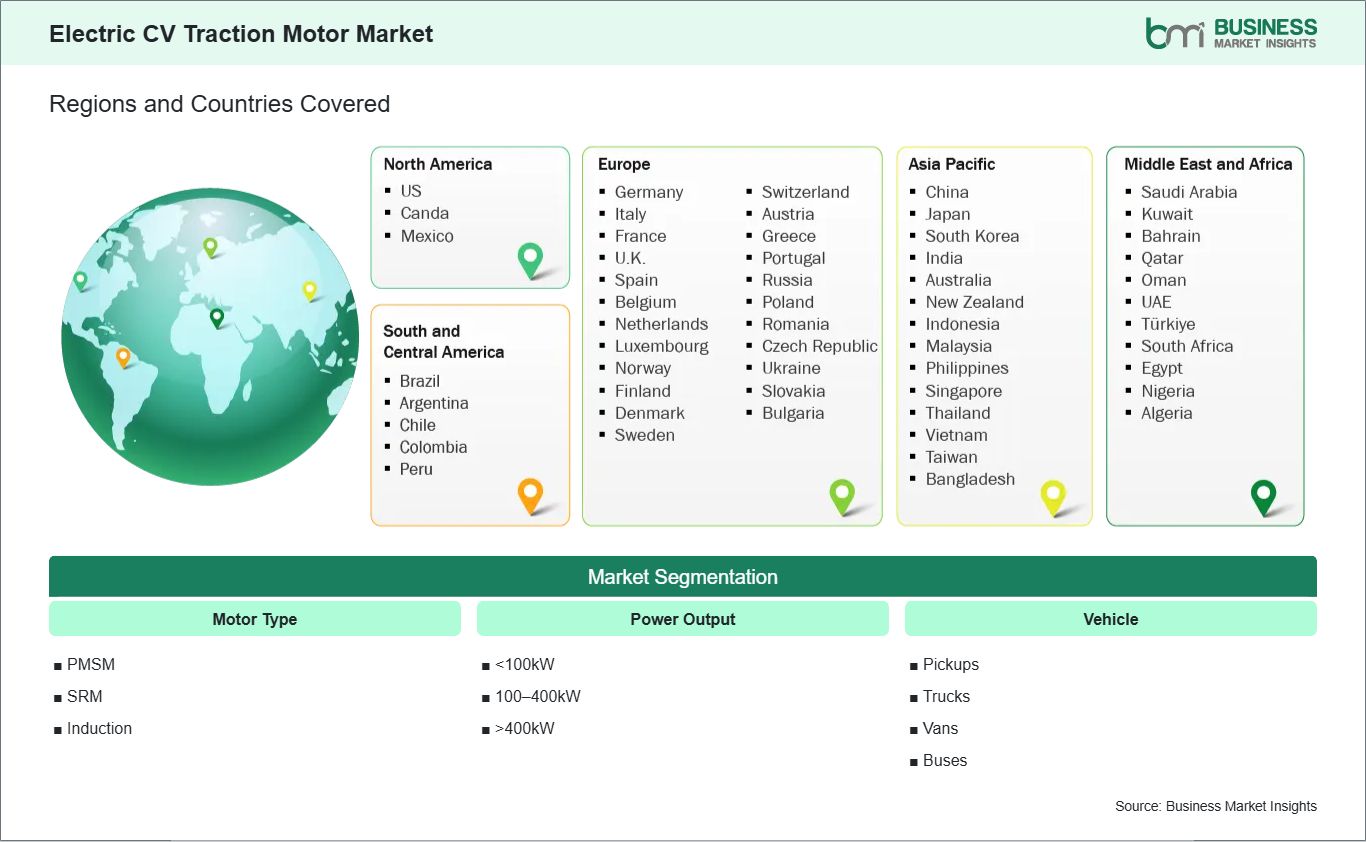
The electric CV traction motor market is segmented based on motor type, power output, and vehicle, reflecting the increasing demand for high-performance electric propulsion systems across commercial transportation applications.
By Motor Type
- PMSM: Dominates the market owing to high efficiency, superior torque density, compact design, and strong performance across a wide operating range.
- SRM: Gaining attention due to lower manufacturing costs, reduced dependence on rare-earth materials, and robust performance in demanding operating environments.
- Induction: Widely utilized in applications requiring durability, reliability, and relatively simple motor construction for commercial vehicle operations.
By Power Output
- <100kW: Primarily deployed in electric vans, urban delivery vehicles, and light-duty commercial transportation applications.
- 100 - 400kW: Represents a major market segment supporting medium-duty trucks, commercial vans, and transit buses requiring balanced performance and efficiency.
- >400kW: Increasingly adopted in heavy-duty trucks and high-capacity commercial transportation platforms requiring maximum power output and payload capability.
By Vehicle
- Pickups: Growing adoption driven by electrification initiatives in utility, municipal, and fleet vehicle operations.
- Trucks: Account for a substantial share due to rising investments in electric freight transportation and logistics fleet modernization.
- Vans: Widely utilized for last-mile delivery applications supported by expanding e-commerce and urban logistics activities.
- Buses: Experiencing strong demand through public transportation electrification programs and government-backed clean mobility initiatives.
Market Forces
Electric CV Traction Motor Market Drivers and Opportunities
Stringent Emission Regulations
Regulatory agencies in North America, Europe, and parts of Asia Pacific are developing increasingly stringent restrictions on vehicle emissions, thereby increasing demand for electric commercial vehicles (ECVs) with providing traction motors to meet compliance and help improve sustainability performance in response to regulatory agencies implementing additional carbon reduction and vehicle emissions standards. This additional emphasis on stringent vehicle emissions compliance continues to be a large influence in the development of existing ECV products and increasing their use globally.
Fleets are rapidly transitioning away from conventional, internal combustion engine (ICE) vehicles, meeting both current and future regulatory compliance requirements by operating electric drive ECVs. This transition helps commercial fleet operators achieve their sustainability and corporate responsibility goals while also providing compliance with evolving product requirements related to governmental policies and regulations worldwide.
Increasingly stringent emissions compliance regulations are driving manufacturers to develop and produce advanced traction motor technologies that improve energy consumption and reduce operational emissions. As the regulatory environment continues to evolve, the demand for high-performance traction motors used in electric-drive ECVs will continue to increase during the forecast period.
Integration of High-Efficiency Motors
Fleet operators are increasingly looking at enhancing their drivetrain systems in order to maximize the range of their vehicles, lower their electricity demand and increase the overall economics of owning an electric commercial vehicle.
Advances in electric propulsion motors, along with improvements in magnetic material, motor winding technologies and electronic systems allow manufacturers to design very efficient propulsions systems that are able to reduce energy consumption while providing improved performance through reduced energy loss.
All of these innovations are enabling manufacturers to meet their customer's demands for improved productivity and operating efficiency of their vehicles.
The continued growth of fully integrated electric drive systems - where the motor, inverter and transmission technologies are one complete unit - is helping drive the adoption of high efficiency traction motors as well. The fully integrated electric drive systems simplify vehicle architecture and improve the performance and reliability of the drivetrain.
As electrification of commercial vehicles continues to accelerate worldwide, the demand for high efficiency traction motors will provide significant growth opportunities in all categories of vehicles.
Size and Share Analysis
Electric CV Traction Motor Market Size and Share Analysis
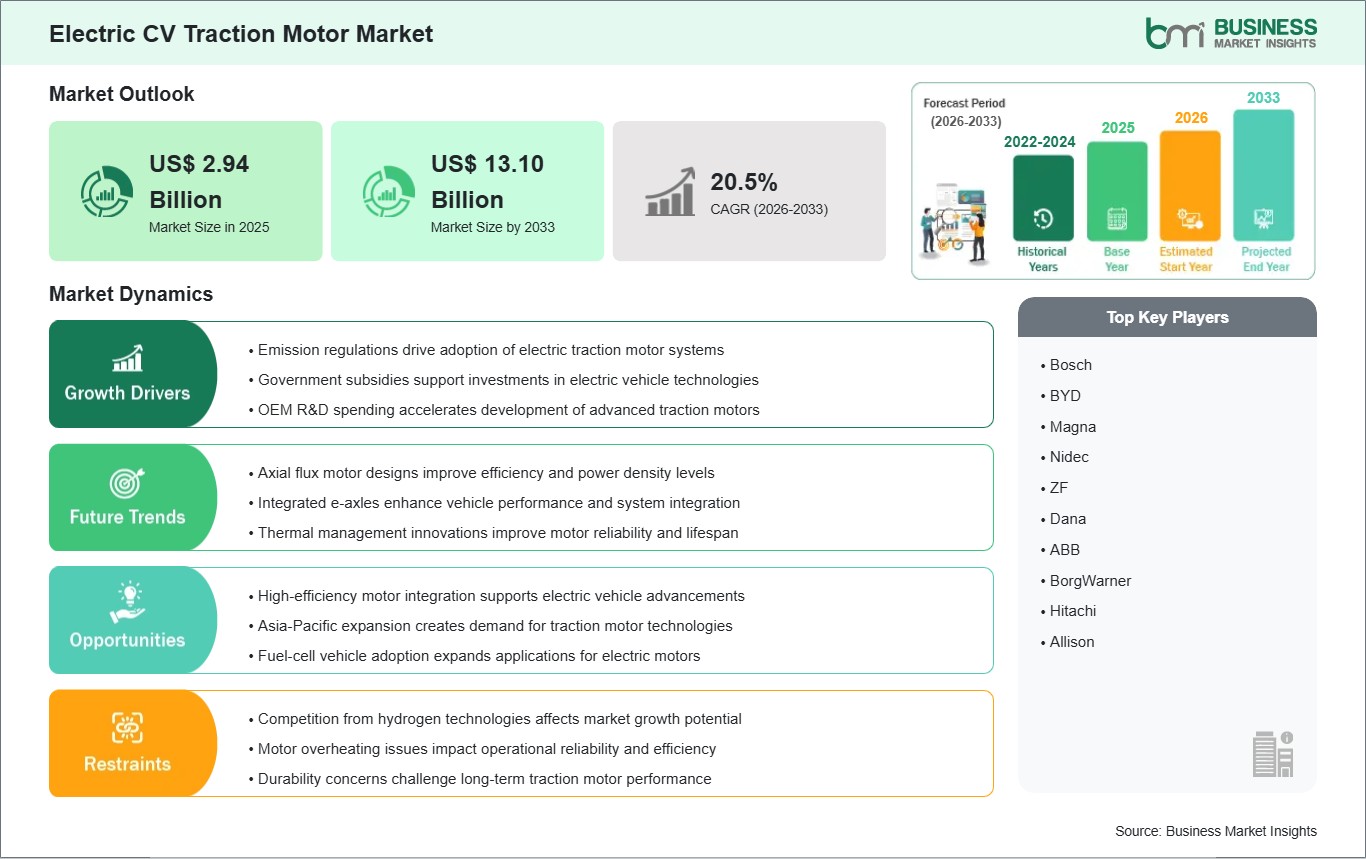
The electric CV traction motor market is projected to grow from US$ 2.94 billion in 2025 to US$ 13.10 billion by 2033, registering a CAGR of 20.5% from 2026 to 2033.
By motor type, PMSM holds the largest market share due to its superior efficiency, high torque density, and widespread adoption in battery-electric commercial vehicles. SRM technology is gaining momentum as manufacturers seek alternatives to rare-earth magnet dependency, while induction motors continue to serve various heavy-duty applications.
By power output, the 100 - 400kW segment accounts for a significant share due to its suitability across a broad range of commercial vehicle platforms. Demand for >400kW motors is increasing rapidly as heavy-duty electric truck deployment expands globally.
By vehicle, trucks dominate market demand owing to accelerating freight transportation electrification initiatives. Vans maintain strong adoption supported by last-mile delivery growth, while buses represent a major segment driven by public transportation electrification programs worldwide.
Report Coverage
Electric CV Traction Motor Market Report Coverage and Deliverables
The "Electric CV Traction Motor Market Size and Forecast (2022 - 2033)" report provides a detailed analysis of the market covering below areas:
- Market size and forecast at global, regional, and country levels for all key market segments covered under the scope
- Market trends, along with market dynamics such as drivers, restraints, and key opportunities
- Market analysis covering key trends, global and regional frameworks, major players, regulations, and recent developments
- Industry landscape and competitive analysis covering market concentration, heat map analysis, prominent players, and recent developments
- Detailed company profiles, including SWOT analysis
Geographic Insights
Electric CV Traction Motor Market Geographic Insights
The market for electric CV traction motors varies widely from region to region, driven in large part by commercial vehicle electrification rates, the existence of government support programs, the capabilities of industrial manufacturers, and infrastructure development. The patterns of how demand for this product will arise continue to change with the transportation industry continuing to move towards long-term decarbonization strategies.
North America is still an important market for electric CV traction motors due to the investment in deploying electric trucks and fleet electrification and the development of innovative vehicle manufacturing programs. Commercial operators are focusing on using efficient propulsion technologies to achieve sustainability goals and reduce operational costs, which will also drive demand for electric CV traction motors.
Asia Pacific is poised to be the fastest-growing geographical region for electric CV traction motors because of well-established electric vehicle manufacturing ecosystems, the rise of major commercial transportation networks, and aggressive government-led electrification initiatives. Countries in Asia Pacific including China, India, Japan and South Korea are making substantial investments in electric mobility technology, especially for the manufacture of components domestically.
Europe continues to see strong demand for electric CV traction motors as a result of stringent emissions regulations, ambitious climate change goals and widespread adoption of electric buses and commercial vehicle fleets. Regional demand for advanced traction motor technologies is increasing due to additional investments in electric freight transport.
Emerging markets in the Middle East and Africa as well as South and Central America will continue to increase the adoption of electric commercial vehicles through their efforts to modernize public transit and promote sustainable mobility.
Industry Activity
Recent Developments
The electric CV traction motor market is evaluated by gathering qualitative and quantitative data post primary and secondary research, which includes important corporate publications, association data, and databases. Recent developments and news in the market include:
- In April 2025, BorgWarner showcased its latest commercial vehicle (CV) electrification technologies at the Advanced Clean Transportation (ACT) Expo 2025 in Anaheim, USA. The highlight was the launch of the iM‑575 integrated inverter‑motor drive module, combining BorgWarner's HVH320‑216 high‑voltage hairpin motor with the Cascadia Motion 350 inverter.
- In May 2025, BorgWarner announced a major expansion of its electric drive motor portfolio, unveiling scalable Integrated Drive Modules (iDMs) for EVs and hybrids. New models include iDM146 for compact EVs and iDM220 for high‑performance EVs (up to 350 kW). BorgWarner also introduced its HVH320 motor (2024 launch) delivering up to 575 kW power and 1,650 Nm torque, alongside its third‑generation S‑winding technology for hybrids, which reduces size and improves reliability.
Trust & Transparency
Research Methodology
The market analysis combines proprietary research with secondary data from government agencies, company disclosures, regulatory filings, industry databases and expert interviews. Market estimates are validated through data triangulation, cross-market benchmarking and analyst
review.
View Full Research Methodology
Key Sources Referred:
International Energy Agency (IEA) - Global EV Outlook International Energy Agency (IEA) - Advanced Electric Drive Technologies International Monetary Fund (IMF) World Bank - Transport and Infrastructure Indicators International Trade Administration (ITA) World Trade Organization (WTO) International Council on Clean Transportation (ICCT) European Automobile Manufacturers Association (ACEA)