
Electric Vehicle Motor Market Outlook: Size, Share, Trends, Growth Analysis, Competitive Landscape & Forecast, 2026-2033

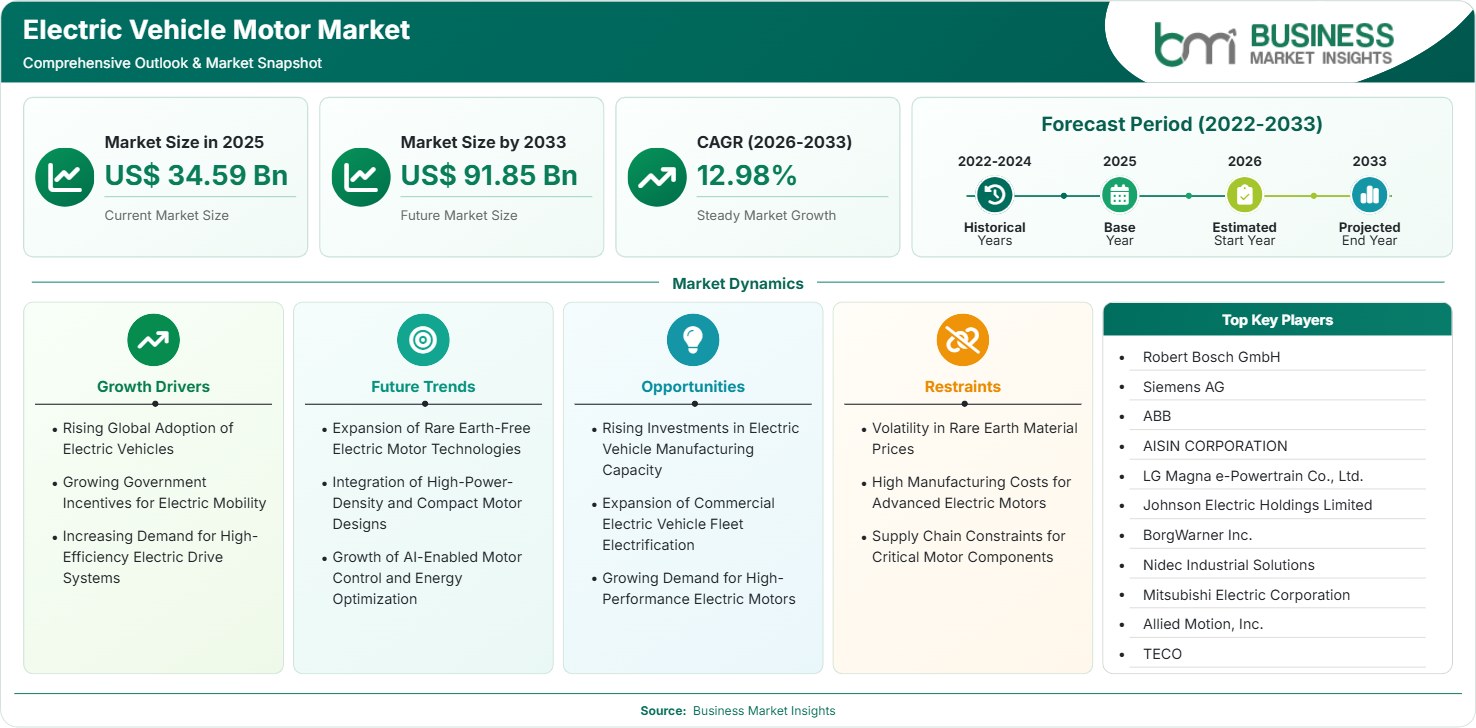
The Electric Vehicle Motor Market size was valued at US$ 34.59 Billion in 2025 and is projected to reach US$ 91.85 Billion by 2033, growing at a CAGR of 12.98% during 2026–2033. Rising electric vehicle adoption, increasing investments in transportation electrification, growing regulatory support for zero-emission mobility, and rapid advancements in motor efficiency and powertrain technologies are supporting market growth globally.

Report Coverage
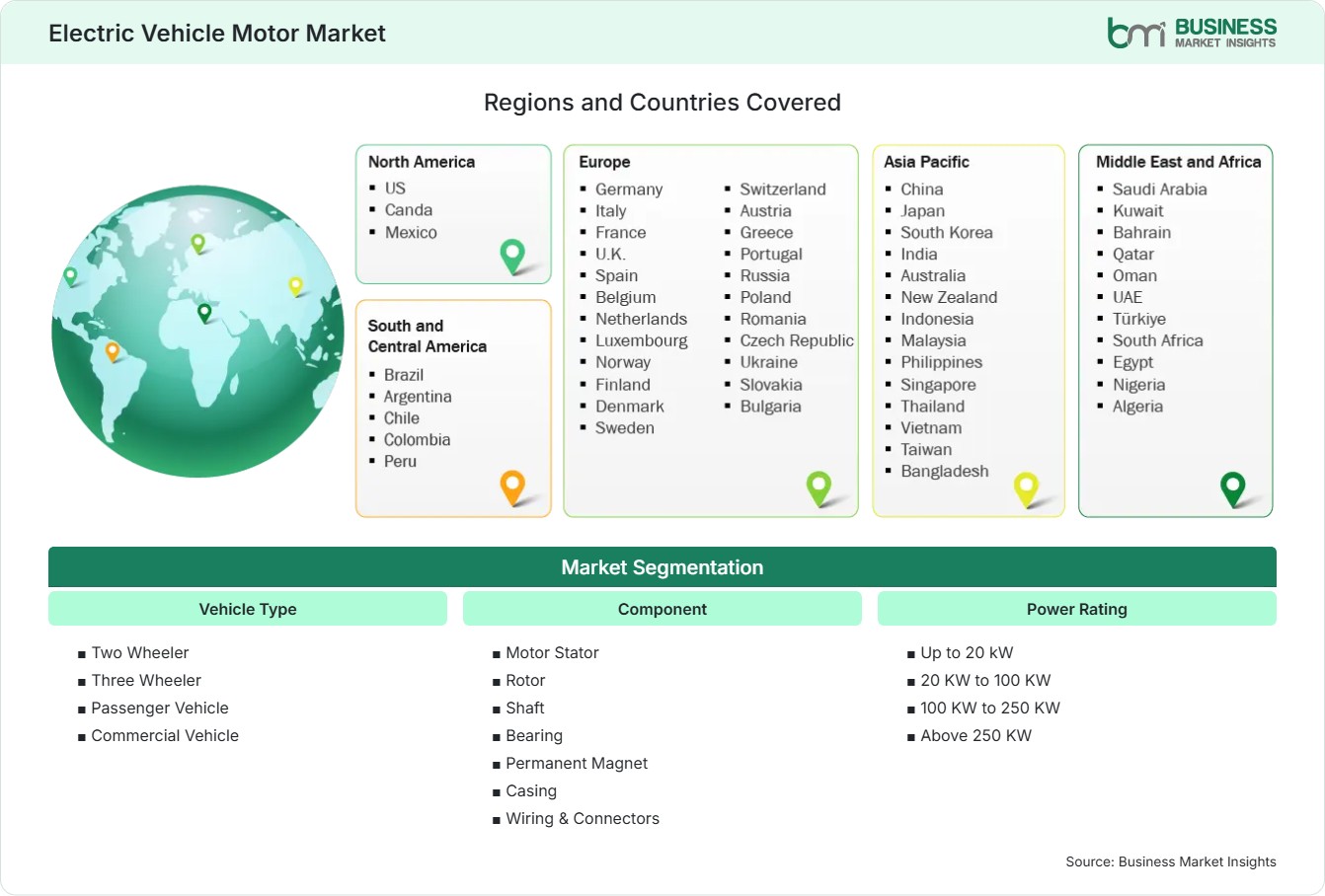
  • Vehicle Type: Two Wheeler, Three Wheeler, Passenger Vehicle, Commercial Vehicle
  • Component: Motor Stator, Rotor, Shaft, Bearing, Permanent Magnet, Casing, Wiring & Connectors
  • Power Rating: Up to 20 kW, 20 KW to 100 KW, 100 KW to 250 KW, Above 250 KW
US$ 34.59 Bn Market size in 2025
US$ 91.85 Bn Market Size by 2033
12.98% CAGR, 2026 - 2033
2026-2033 Forecast Period

AI Overview

Electric Vehicle Motor Market Summary

  • North America Region: North America holds a electric vehicle motor market share of 34%–37% in 2025, growing with a CAGR of 12.4%–13.1% during 2026–2033. Strong EV adoption, supportive government incentives, and expanding automotive electrification investments continue supporting regional leadership. The U.S. market is expected to register a CAGR of 12.6%–13.3%.
  • Fastest Growing Region: Asia Pacific accounts for 33%–36% share in 2025 and is projected to grow at a CAGR of 13.8%–14.5% through 2033. Expanding EV manufacturing capacity, government incentives, and increasing consumer adoption continue driving regional growth.
  • Leading Segment: Passenger Vehicle represents 48%–51% share in 2025 and is expected to grow at a CAGR of 13.4%–14.1% through 2033. Rising electric passenger car production and growing consumer acceptance continue supporting segment dominance.
  • High Growth Segment: 20 kW to 100 kW accounts for 34%–37% share in 2025 and is forecast to grow at a CAGR of 13.9%–14.6% during 2026–2033. Extensive utilization across passenger EVs and light electric mobility platforms continues accelerating segment growth.
  • Key Market Opportunity: Expansion of high-efficiency electric drivetrains, advanced permanent magnet motor technologies, commercial EV electrification, and next-generation mobility solutions is creating substantial growth opportunities.
  • Major Market Players: Robert Bosch GmbH, Siemens AG, ABB, AISIN CORPORATION, LG Magna e-Powertrain Co., Ltd., Johnson Electric Holdings Limited, BorgWarner Inc., Nidec Industrial Solutions, Mitsubishi Electric Corporation, Allied Motion, Inc., and TECO Corporation.
Strategic Insights

Electric Vehicle Motor Market: Strategic Insights

Electric Vehicle Motor Market Strategic Framework
FREE PDF
Request your free sample
Request free sample
Stakeholder View

Key Takeaways

  • Electric vehicle motors remain fundamental components driving the global transition toward sustainable transportation.
  • Passenger vehicles continue representing the largest source of EV motor demand.
  • Mid-range power motors remain highly utilized across mainstream electric vehicle applications.
  • Permanent magnet technologies continue supporting superior motor efficiency and performance.
  • Government incentives and emissions regulations remain major market catalysts.
  • North America remains the leading electric vehicle motor market due to advanced EV adoption and technological development.
  • Asia Pacific is projected to witness the fastest growth owing to strong EV manufacturing expansion.
  • Electrification of passenger and commercial mobility is expected to create significant future opportunities.
Geographic Outlook

Electric Vehicle Motor Market Regional Highlights

North America Electric Vehicle Motor Market

North America accounts for 34%–37% Electric Vehicle Motor Market share in 2025 and is projected to grow at a CAGR of 12.4%–13.1% through 2033. The region benefits from expanding EV adoption, strong automotive innovation, supportive regulatory frameworks, and growing investments in domestic battery and EV component manufacturing.

  • Automotive manufacturers continue investing in advanced electric propulsion technologies.
  • Government incentives are encouraging broader EV adoption across consumer and commercial sectors.
  • Demand for high-efficiency drive motors is increasing alongside growth in electric vehicle production.
  • Investments in domestic EV supply chains continue supporting regional growth.
  • Electrification initiatives are accelerating across passenger and commercial transportation sectors.
  • Strategic partnerships between OEMs and technology providers continue strengthening innovation.

US Electric Vehicle Motor Market

The United States contributes approximately 88%–92% of North American revenue and is expected to register a CAGR of 12.6%–13.3% through 2033. The country remains the largest market due to strong EV sales growth, supportive policy initiatives, and increasing investment in domestic manufacturing capabilities.

  • Automotive OEMs continue expanding electric vehicle portfolios across multiple segments.
  • Advanced motor technologies are improving vehicle performance and energy efficiency.
  • Localized component manufacturing initiatives continue reducing supply chain dependencies.
  • Growing charging infrastructure investments are supporting EV adoption.
  • Electrification commitments by automakers continue driving market expansion.

Europe Electric Vehicle Motor Market

Europe represents 24%–27% of global revenue in 2025 and is anticipated to expand at a CAGR of 13.0%–13.7% through 2033. Strong environmental regulations, ambitious emissions targets, and extensive EV adoption continue supporting regional growth. Germany remains the leading market while Poland demonstrates stronger growth momentum.

  • Germany continues leading regional demand through strong automotive manufacturing capabilities and EV production.
  • Poland is among the fastest-growing markets and is estimated to register a CAGR of 13.9%–14.6% during the forecast period, supported by automotive component manufacturing expansion.
  • Automakers are accelerating investments in EV production facilities.
  • Demand for energy-efficient propulsion systems continues increasing.
  • Government sustainability initiatives continue supporting market development.
  • Expansion of charging networks is strengthening consumer EV adoption.

Asia Pacific Electric Vehicle Motor Market

Asia Pacific accounts for 33%–36% of global revenue in 2025 and is expected to achieve the fastest CAGR of 13.8%–14.5% through 2033. Rapid EV adoption, large-scale automotive manufacturing, favorable government policies, and strong battery production capabilities continue supporting strong regional growth.

  • China remains the largest regional market due to extensive EV manufacturing capabilities and robust domestic demand.
  • India is projected to achieve approximately 14.7%–15.4% CAGR, supported by government incentives, expanding EV production, and rising consumer adoption.
  • Automotive manufacturers continue increasing investment in electric mobility programs.
  • Demand for advanced motor technologies continues expanding across passenger and commercial vehicles.
  • Electrification targets are encouraging long-term market growth.
  • Local manufacturing initiatives continue strengthening regional competitiveness.

Rest of World Electric Vehicle Motor Market

Rest of World accounts for 8%–11% of global revenue in 2025 and is projected to expand at a CAGR of 11.7%–12.4% through 2033. Increasing awareness regarding sustainable mobility, government electrification programs, and expanding EV infrastructure are supporting market growth across Latin America, the Middle East, and Africa.

  • Brazil continues generating demand through growing EV adoption and automotive industry development.
  • The UAE is witnessing increasing deployment of sustainable transportation technologies.
  • Saudi Arabia is expected to achieve approximately 12.6%–13.3% CAGR through 2033, supported by transportation modernization and sustainability initiatives.
  • Government support programs are encouraging EV adoption.
  • Commercial fleet electrification is creating new opportunities.
  • Mobility transformation initiatives continue supporting long-term market expansion.
Global Market Geography
FREE PDF
Request your free sample
Request free sample
Segment Analysis

Electric Vehicle Motor Market Segmentation

Vehicle Type

The vehicle type segment represents the major categories of electric vehicles utilizing electric propulsion motors across personal mobility, public transportation, and commercial logistics applications. This segment accounts for approximately 48%–51% share in 2025 and is projected to grow at a CAGR of 13.4%–14.1% through 2033. The expanding Electric Vehicle Motor Market Scope is supported by increasing EV adoption, stringent emissions regulations, growing investments in charging infrastructure, and rising consumer demand for sustainable transportation solutions.

  • Two Wheeler: Electric two-wheelers continue witnessing significant adoption due to affordability, urban mobility requirements, and supportive government incentives.
  • Three Wheeler: Three-wheel electric vehicles are increasingly deployed in passenger transportation and last-mile delivery operations, particularly across emerging markets.
  • Passenger Vehicle: Passenger vehicles dominate the market due to rising consumer adoption of electric cars, expanding EV model availability, and continuous advancements in vehicle performance.
  • Commercial Vehicle: Commercial vehicles are experiencing strong growth as fleet operators increasingly adopt electric buses, trucks, and delivery vehicles to reduce operating costs and emissions.

Component

The component segment highlights the major parts utilized in electric vehicle motor systems to deliver efficient power generation, energy conversion, and propulsion performance. This segment accounts for approximately 29%–32% share in 2025 and is expected to register a CAGR of 13.8%–14.5% through 2033. Current Electric Vehicle Motor Market Trends indicate increasing demand for lightweight motor architectures, advanced magnetic materials, integrated e-powertrain systems, and high-efficiency motor designs.

  • Motor Stator: The stator serves as a critical component that generates the electromagnetic field required for motor operation and efficiency optimization.
  • Rotor, Shaft, and Bearing: These components play vital roles in power transmission, rotational motion, and mechanical durability.
  • Permanent Magnet: Permanent magnets remain essential for high-performance motor systems due to their ability to improve power density and efficiency.
  • Casing: Motor casings provide structural protection, thermal management, and operational reliability across demanding environments.
  • Wiring & Connectors: Wiring systems and connectors continue gaining importance as EV manufacturers emphasize performance, safety, and electrical efficiency.

Power Rating

The power rating segment reflects the primary motor output categories utilized across different vehicle classes and performance requirements. This segment accounts for approximately 34%–37% share in 2025 and is forecast to grow at a CAGR of 13.9%–14.6% through 2033.

  • Up to 20 kW: These motors are predominantly utilized in electric two-wheelers, small mobility vehicles, and entry-level transportation solutions.
  • 20 kW to 100 kW: This segment leads the market due to widespread deployment across passenger electric vehicles and light commercial applications.
  • 100 kW to 250 kW: These motors support premium passenger vehicles, SUVs, and higher-performance electric transportation platforms.
  • Above 250 kW: High-power motors are increasingly utilized in luxury EVs, sports vehicles, heavy-duty commercial vehicles, and specialized transportation applications.
Market Forces

Electric Vehicle Motor Market Dynamics

Key Market Drivers

Rising Global Adoption of Electric Vehicles

The rapid growth of electric vehicle adoption worldwide remains the most significant driver for the electric vehicle motor market. Governments, consumers, and automotive manufacturers are increasingly supporting the transition toward electric mobility to reduce carbon emissions and dependence on fossil fuels. Expanding EV model availability, improving battery technologies, and growing charging infrastructure are encouraging wider market penetration across both developed and emerging economies. Since electric motors serve as the primary propulsion technology in EVs, rising vehicle production volumes are directly increasing demand for advanced and high-efficiency motor systems globally.

Growing Government Incentives for Electric Mobility

Favorable policies, subsidies, tax benefits, and emissions norms are being adopted by the government of many countries to promote the use of electric vehicles. The adoption of these policies is pushing auto manufacturers to produce more EVs, along with urging customers to move towards electric modes of transport. Investments made by the government in building up the charging infrastructure are also playing an important role in the market growth. As governments are setting up high environmental targets and carbon reduction policies, there is bound to be higher demand for electric vehicle motors.

Increasing Demand for High-Efficiency Electric Drive Systems

Automotive companies are now placing increased emphasis on high-efficiency electric motors that can deliver improved range, performance, and efficiency for the automobile. High power density motors coupled with high efficiency allow the manufacturers to make improvements in the efficiency and performance of the vehicle overall, thus meeting customer expectations regarding performance and range. New advancements in electric motor technology, cooling systems, and power electronics are making the propulsion system more efficient. With each new advance in technology and performance of the vehicle, there is greater demand for new electric motors.

Key Market Opportunities

Rising Investments in Electric Vehicle Manufacturing Capacity

Automobile companies operating globally are making huge investments in their electric vehicle production plants, battery production units, and their component production facilities in order to cope up with rising market demands. Such investments have been creating numerous opportunities for electric motor manufacturers and suppliers. New manufacturing plants need the capability to supply reliable motors to accommodate rising vehicle production. With further investment and the introduction of new electric vehicle models by automobile companies, suppliers capable of providing advanced motor solutions can definitely cash in on them.

Expansion of Commercial Electric Vehicle Fleet Electrification

The companies that operate transportation commercially are increasingly turning towards electrification of their fleets in order to save on fuel costs, meet emission standards, and pursue sustainability goals. Electric buses, delivery trucks, logistics trucks, and heavy trucks need strong and reliable electric motors which are designed to work in harsh conditions. There is an increasing trend towards electrification of fleet of vehicles among the sectors of public transportation, logistics e-commerce, and industrial transportation. This is a great chance for manufacturers of electric motors to benefit from the growing market.

Growing Demand for High-Performance Electric Motors

Automotive manufacturers are focusing on developing electric vehicles that offer enhanced acceleration, improved driving dynamics, higher range, and superior energy efficiency. This trend is increasing demand for advanced electric motors with higher power density, reduced weight, and improved thermal management capabilities. Premium passenger vehicles, performance EVs, and next-generation mobility platforms are particularly driving demand for technologically advanced propulsion systems. Long-term Electric Vehicle Motor Market Forecast projections remain highly favorable as consumers and manufacturers continue prioritizing performance-oriented electric transportation solutions while expanding adoption across global markets.

Market Restraints and Challenges

Volatility in Rare Earth Material Prices

Factor: Many high-performance electric motors depend on rare earth materials, particularly those used in permanent magnet motor technologies. Fluctuations in rare earth supply, geopolitical concerns, and changing commodity market conditions can create significant pricing volatility across the supply chain.

Impact: Rising material costs can increase motor manufacturing expenses, reduce profit margins, and create procurement challenges for suppliers and automotive manufacturers. Price instability may also affect long-term production planning and investment decisions within the industry.

High Manufacturing Costs for Advanced Electric Motors

Factor: Advanced electric motors require precision engineering, high-quality magnetic materials, sophisticated production techniques, and extensive research and development investments. These requirements contribute to higher manufacturing costs compared with conventional propulsion technologies.

Impact: Elevated production costs can increase overall EV prices and potentially slow adoption in price-sensitive markets. Manufacturers must continuously improve production efficiency and technological innovation to balance performance requirements with affordability objectives.

Company Analysis

Competitive Landscape

The Electric Vehicle Motor Market Analysis is characterized by strong competition among electric motor manufacturers, automotive technology providers, industrial automation companies, and e-powertrain solution developers. Market participants are focusing on high-efficiency motor systems, integrated e-axles, permanent magnet motor technologies, lightweight motor architectures, and advanced powertrain optimization solutions to strengthen their market positions. Rising electric vehicle adoption, expanding vehicle electrification programs, and increasing demand for energy-efficient propulsion technologies continue driving innovation across the market. Companies are investing in motor performance enhancement, manufacturing scale expansion, power density improvements, and next-generation propulsion technologies to support evolving mobility requirements.

Company Name

Overview

Products and Services relevant to this market

Robert Bosch GmbH

Automotive technology provider serving global vehicle manufacturers.

Electric drive motors, e-axles, integrated powertrain systems, and EV propulsion technologies.

Siemens AG

Industrial technology and electrification solutions company.

Electric motors, drive systems, industrial automation technologies, and mobility solutions.

ABB

Electrification and automation company serving transportation and industrial markets.

EV motors, traction systems, electric drive technologies, and industrial motor solutions.

AISIN CORPORATION

Automotive components manufacturer specializing in mobility solutions.

Electric drive units, e-powertrain systems, traction motors, and vehicle propulsion technologies.

LG Magna e-Powertrain Co., Ltd.

Joint venture focused on electric vehicle propulsion technologies.

Electric motors, inverters, integrated e-drive systems, and EV powertrain solutions.

Johnson Electric Holdings Limited

Manufacturer of electric motors and motion systems.

Electric drive motors, motion control components, automotive motor systems, and propulsion technologies.

BorgWarner Inc.

Automotive supplier specializing in propulsion and drivetrain technologies.

Electric motors, e-propulsion systems, integrated drive modules, and powertrain technologies.

Nidec Industrial Solutions

Motor and industrial systems provider serving diverse industries.

Traction motors, EV motor systems, industrial motors, and motion control solutions.

Mitsubishi Electric Corporation

Global manufacturer of electrical and automotive technologies.

Electric vehicle motors, traction systems, automotive electronics, and propulsion components.

Allied Motion, Inc.

Motion control and precision motor solutions provider.

Electric motors, motion systems, traction motor technologies, and specialized propulsion solutions.

TECO Corporation

Industrial motor and energy solutions company.

Electric motors, drive systems, industrial propulsion technologies, and electrification products.

Trust & Transparency

Research Methodology

The market analysis combines proprietary research with secondary data from government agencies, company disclosures, regulatory filings, industry databases and expert interviews. Market estimates are validated through data triangulation, cross-market benchmarking and analyst review.

View Full Research Methodology

Questions Answered

Frequently Asked Questions

How are permanent magnets influencing EV motor development?

Permanent magnets significantly improve motor efficiency, power density, torque output, and overall vehicle performance, making them essential components in many modern electric vehicle propulsion systems.

What does this Electric Vehicle Motor Market Report cover?

The market report covers vehicle type analysis, component assessment, power rating evaluation, regional trends, competitive landscape analysis, market drivers, opportunities, restraints, challenges, and future growth prospects through 2033.

Why does the 20 kW to 100 kW segment lead the market?

The 20 kW to 100 kW segment leads because it is widely used in passenger electric vehicles and light commercial EVs, balancing efficiency, performance, and cost requirements.

2. Which vehicle type segment dominates the market?

Passenger Vehicles dominate the market due to increasing production of electric cars, rising consumer adoption of EVs, and expanding model availability across mass-market and premium segments.

1. What is driving growth in the Electric Vehicle Motor market?

Rising global adoption of electric vehicles, growing government incentives for electric mobility, increasing demand for high-efficiency electric drive systems, and expanding EV manufacturing capacity are major factors driving market growth.

Access the Full Electric Vehicle Motor Market Report

Get segment-level forecasts, regional estimates, competitive benchmarking, company profiles and downloadable Excel datasets.

Access the full Electric Vehicle Motor Market Report
350 pages PDF & Excel | 2026-08-21
Similar Research

Related Market Reports