
AC Servo Motor Market Outlook: Size, Share, Trends, Growth Analysis, Competitive Landscape & Forecast, 2026-2033

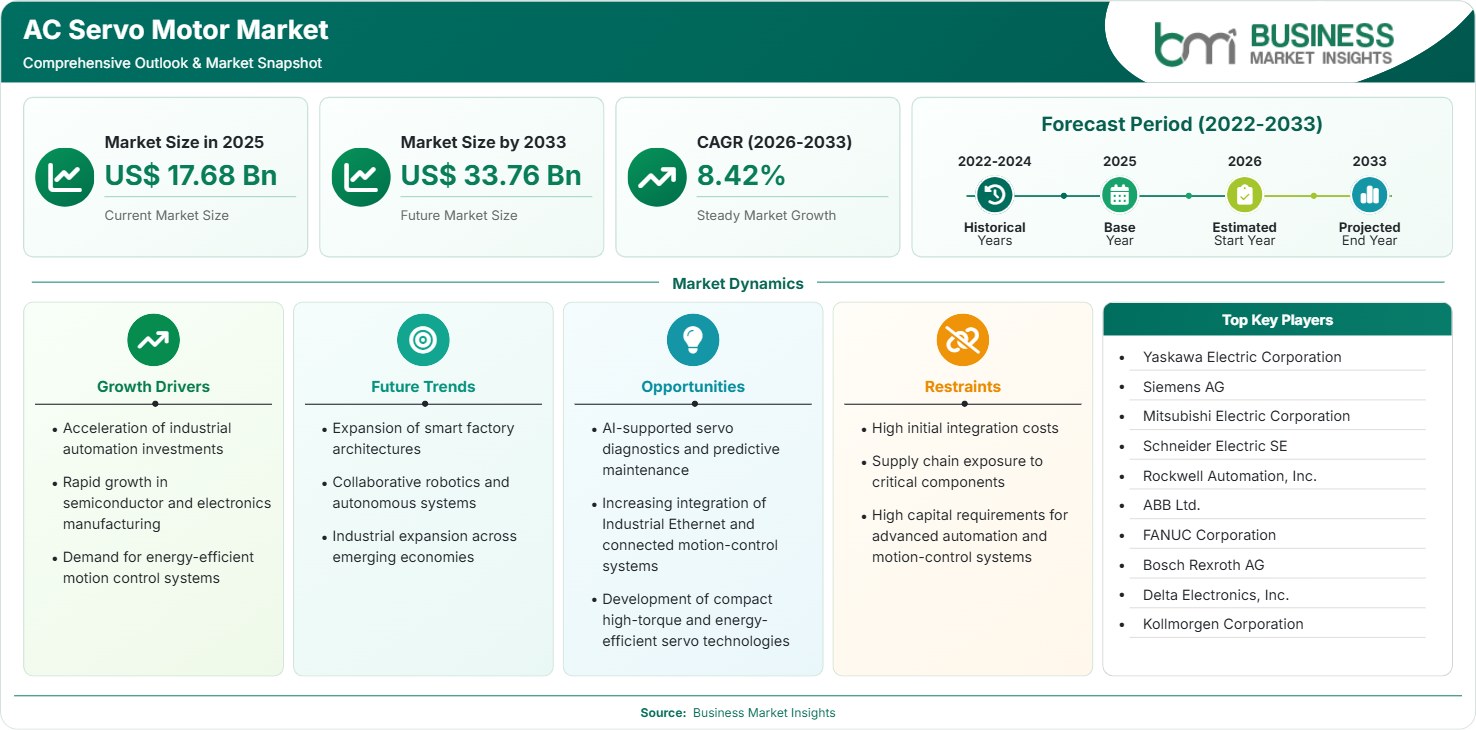
The AC Servo Motor Market size was valued at US$ 17.68 Billion in 2025 and is projected to reach US$ 33.76 Billion by 2033, growing at a CAGR of 8.42% during 2026–2033. Key growth drivers include factory automation, robotics deployment, semiconductor manufacturing expansion, and energy-efficient motion control systems. Opportunities arise from Industry 4.0 integration, AI-enabled predictive maintenance, and advanced industrial Ethernet adoption.

Report Coverage
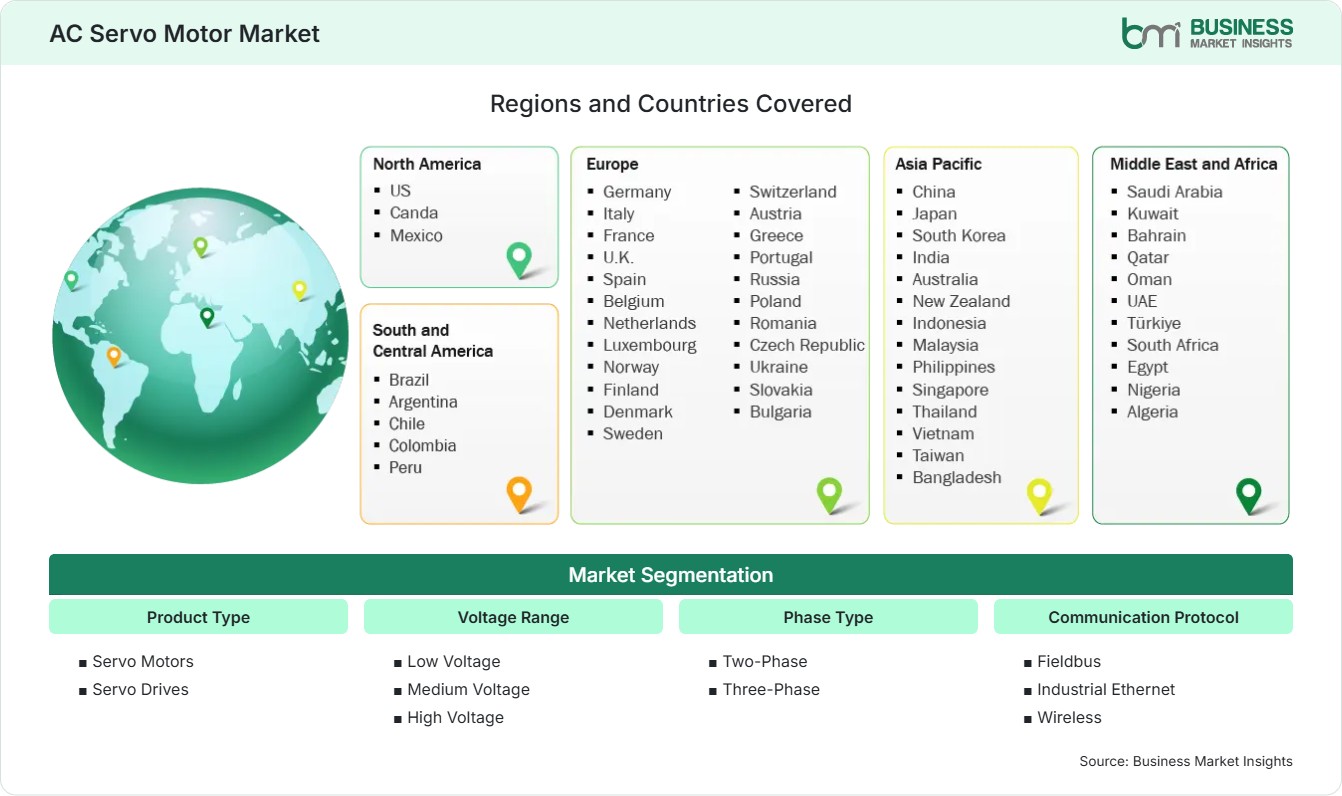
  • Product Type: Servo Motors, Servo Drives
  • Voltage Range: Low Voltage, Medium Voltage, High Voltage
  • Phase Type: Two-Phase, Three-Phase
  • Communication Protocol: Fieldbus, Industrial Ethernet, Wireless
  • End-Use Industry: Aerospace & Defense, Automotive and Transportation, Semiconductor and Electronics, Printing & Packaging, Food & Beverage, Chemicals and Petrochemicals
US$ 17.68 Bn Market size in 2025
US$ 33.76 Bn Market Size by 2033
8.42% CAGR, 2026 - 2033
2026-2033 Forecast Period

AI Overview

AC Servo Motor Market Summary

  • North America Region: North America holds an AC Servo Motor Market share of 31%–34% in 2025, growing at a CAGR of 7.4%–8.0% during 2026–2033. Growth is supported by reshoring initiatives, robotics investments, semiconductor capacity expansion, smart manufacturing deployment, energy-efficiency upgrades, motion-control modernization, industrial software integration, predictive maintenance adoption, workforce shortages, and automation spending. The U.S. market benefits from electronics, aerospace, and industrial automation investments, advancing at a CAGR of 7.6%–8.2%.
  • Fastest Growing Region: Asia Pacific holds a market share of 37%–40% in 2025, growing at a CAGR of 9.5%–10.2% during 2026–2033. Growth is fueled by industrial automation, electronics production, EV manufacturing, machine-tool demand, smart factories, government incentives, robotics deployment, factory digitization, export-oriented production, and manufacturing localization.
  • Leading Segment: Servo Motors (Synchronous and Induction) account for 56%–59% share of the AC Servo Motor Market in 2025 and grow at 8.0%–8.6% CAGR. Adoption is driven by precision positioning, high torque performance, advanced automation requirements, energy efficiency standards, robotics integration, semiconductor equipment growth, packaging modernization, machine reliability, and productivity optimization.
  • High Growth Segment: Industrial Ethernet holds 28%–31% share in 2025 and expands at 10.0%–10.8% CAGR. Expansion is supported by real-time connectivity, Industry 4.0 architectures, intelligent motion control, remote diagnostics, cloud integration, smart manufacturing networks, data-driven operations, predictive maintenance, and interoperability requirements.
  • Key Market Opportunity: Rising deployment of collaborative robots, autonomous production systems, and digital manufacturing platforms is creating sustained demand for highly responsive motion-control technologies across electronics, automotive, healthcare, and logistics facilities worldwide.
  • Major Market Players: Yaskawa Electric Corporation, Siemens AG, Mitsubishi Electric Corporation, Schneider Electric SE, Rockwell Automation, Inc., ABB Ltd., FANUC Corporation, Bosch Rexroth AG, Delta Electronics, Inc., Kollmorgen Corporation.
Strategic Insights

AC Servo Motor Market: Strategic Insights

AC Servo Motor Market Strategic Framework
FREE PDF
Request your free sample
Request free sample
Stakeholder View

Key Takeaways

  • Supply chains increasingly favor integrated motor-drive-controller ecosystems, creating value for vendors offering interoperable automation platforms and lifecycle service capabilities.
  • Semiconductor manufacturing, EV battery production, and precision packaging applications present the strongest medium-term expansion opportunities due to stringent motion-control requirements.
  • Innovation is shifting toward AI-supported diagnostics, compact high-torque designs, digital twins, and intelligent servo systems optimized for Industry 4.0 environments.
  • Asia Pacific offers the most compelling investment case, supported by manufacturing localization, electronics exports, and rapid industrial robotics adoption.
  • Strategic acquisitions increasingly target industrial software, intelligent controls, and motion-system integration capabilities rather than standalone motor manufacturing assets.
  • Sustainability objectives are accelerating replacement demand for older motion-control systems with energy-efficient servo technologies meeting stricter industrial standards.
Geographic Outlook

AC Servo Motor Market Regional Highlights

North America AC Servo Motor Market

North America accounts for 31%–34% of the AC Servo Motor Market share in 2025 and is projected to grow at 7.4%–8.0% CAGR through 2033. Industrial reshoring, semiconductor investments, aerospace manufacturing, and warehouse automation continue supporting deployment. Motion-control modernization across automotive assembly and packaging sectors remains important. Capacity expansion in advanced manufacturing facilities and adoption of smart-factory technologies maintain stable demand for high-performance servo systems across the region.

  • Semiconductor fabrication investments continue increasing demand for precision positioning solutions across wafer processing and inspection equipment.
  • Labor shortages encourage automation investments, strengthening adoption of intelligent motion-control and robotics systems.
  • Industrial cybersecurity initiatives support upgrades toward modern network-enabled automation architectures.
  • Logistics automation and e-commerce fulfillment facilities stimulate deployment of high-performance servo technologies.

US AC Servo Motor Market

The U.S. represents 74%–78% of North American share and advances at 7.6%–8.2% CAGR of the AC Servo Motor Market. Federal support for manufacturing competitiveness, electronics production, and industrial modernization supports adoption. Aerospace, defense, medical technology, and semiconductor sectors contribute significantly to demand while digital manufacturing investments expand deployment of advanced automation systems.

  • Advanced semiconductor projects create strong demand for highly accurate motion-control platforms.
  • Aerospace manufacturing increasingly incorporates intelligent automation and precision machinery.
  • Warehouse robotics and autonomous logistics systems expand industrial application scope.
  • Smart-factory investment continues supporting digital connectivity and predictive maintenance initiatives.

Europe AC Servo Motor Market

Europe’s market share is expected to be 24%–27% in 2025 and to grow at a CAGR of 7.8%–8.4%. Germany is the largest market, but fast growth is observed in manufacturing centers across Eastern Europe. Electric vehicle development, machine tool upgrades, and the sustainability drive are driving the adoption of motion control solutions.

  • Germany leads regional demand through industrial automation and machinery manufacturing.
  • Poland and Czechia demonstrate faster investment growth linked to production relocation trends.
  • Energy-efficiency targets stimulate modernization of industrial drive systems.
  • Collaborative robotics deployment expands across packaging and electronics facilities.

Asia Pacific AC Servo Motor Market

The Asia-Pacific region is projected to account for 37% to 40% of the market share by 2025, with the highest CAGR of 9.5% to 10.2% for the AC Servo Motor Market. Electronics manufacturing, electric vehicle production, and the use of robotics are boosting adoption in China, Japan, South Korea, and India. The region enjoys an abundance of industry infrastructure and export-based manufacturing systems.

  • China remains the largest country market due to broad industrial automation investment.
  • India exhibits one of the highest regional growth rates through manufacturing expansion and industrial digitization.
  • Electronics and semiconductor production strengthen high-precision equipment demand.
  • Government smart-manufacturing programs encourage advanced factory modernization.
  • EV battery and automotive investments increase motion-control system deployment.

Rest of World AC Servo Motor Market

The Rest of World region maintains an 8%–10% share and grows at 8.3%–9.0% CAGR. Brazil and Mexico drive activity in South and Central America through automotive and packaging industries. Saudi Arabia, UAE, and South Africa support growth through industrial diversification and infrastructure modernization programs. Increasing automation awareness and manufacturing investment improve long-term demand prospects.

  • Mexico benefits from nearshoring-related manufacturing capacity additions.
  • Brazil supports steady adoption across food processing and industrial machinery sectors.
  • Gulf economies invest in industrial diversification and smart-manufacturing initiatives.
  • Mining automation increases demand for precise motion-control systems.
  • Packaging and processing industries remain major adoption sectors.
Global Market Geography
FREE PDF
Request your free sample
Request free sample
Segment Analysis

AC Servo Motor Market Segmentation

Product Type

The Product Type accounts for a large share of demand, and in 2025, Servo Motors will hold a 56%–59% share, growing at a CAGR of 8.0%–8.6%. The AC Servo Motor Market scope, in terms of the Product Type segment, is driven by robotics, machine tools, semiconductor machinery, and packaging automation solutions.

  • Servo Motors (Synchronous and Induction): Widely used in precision automation because of superior controllability, high efficiency, and robust integration across industrial production environments.
  • Servo Drives: Enable accurate motor control, diagnostic visibility, and advanced communication capabilities while supporting modern smart-factory architectures.

Voltage Range

Voltage-driven demand accounts for the operational requirements of industries. Low-voltage systems are predominantly used in most installations, whereas medium and high-voltage systems are gaining popularity in heavy industries.

  • Low Voltage: Favored in robotics, packaging, electronics assembly, and compact automation systems emphasizing efficiency and precision.
  • Medium Voltage: Supports larger machinery installations requiring greater operational capability and improved system reliability.
  • High Voltage: Increasingly deployed in specialized industrial settings characterized by heavy-duty motion requirements.

Phase Type

Three-phase systems represent the primary deployment category because of efficiency and power benefits, while two-phase variants remain relevant across selected positioning applications.

  • Two-Phase: Suitable for controlled motion applications where compact design and moderate power requirements are important.
  • Three-Phase: Preferred across industrial automation owing to superior operating efficiency, torque delivery, and reliability.

Communication Protocol

Industrial Ethernet is becoming the fastest-growing protocol category. AC Servo Motor Market trends increasingly indicate demand for a connected, data-driven automation environment.

  • Fieldbus: Maintains widespread utilization through proven industrial reliability and established infrastructure.
  • Industrial Ethernet: Enables real-time communication, scalability, and seamless Industry 4.0 connectivity.
  • Wireless: Gaining traction where installation flexibility and remote monitoring capabilities are priorities.

End-Use Industry

Industrial automation requirements continue to spur adoption in a wide range of manufacturing industries. Electronics, automotive, and packaging are especially notable among these.

  • Aerospace & Defense: Requires exceptional positioning accuracy for advanced manufacturing processes.
  • Automotive and Transportation: Supports robotics, assembly automation, and EV production systems.
  • Semiconductor and Electronics: Relies heavily on ultra-precise motion control for fabrication equipment.
  • Printing & Packaging: Improves speed, consistency, and operational productivity.
  • Food & Beverage: Expands usage through hygienic and automated production systems.
  • Chemicals and Petrochemicals: Benefits from process optimization and dependable equipment control.
Market Forces

AC Servo Motor Market Dynamics

Key Market Drivers

Acceleration of Industrial Automation Investments

Automation levels in manufacturing facilities worldwide have continued to increase to enhance efficiency and address staffing shortages. According to the International Federation of Robotics, there was a peak in the global installation rate of operational robots, further boosting demand for high-end precision motion control. Servo drives help ensure accuracy, speed, and repeatability in areas such as robotics, semiconductors, and packaging. Adoption of these advanced motor technologies has been increasing in response to the need for flexible manufacturing systems.

Rapid Growth in Semiconductor and Electronics Manufacturing

Semiconductor manufacturing necessitates highly accurate positioning and consistent processes. There have been massive capital expenditures in North America, Asia, and Europe to enhance chip and advanced packaging capability and electronics manufacturing. Precision equipment combined with servo technology will be essential for wafer testing and handling, lithography, and assembly. Increasing demand for data centers, artificial intelligence infrastructure, and consumer electronics manufacturing will drive investment in equipment and motion control needs.

Demand for Energy-Efficient Motion Control Systems

Efforts to achieve energy efficiency and sustainability are becoming more important for industrial control operators. High-performance servos offer better efficiency than traditional mechanical systems and allow real-time performance tracking. Digital controllers enable optimized power usage and predictive maintenance, helping manufacturers reduce operational expenses. Industrial energy management and CO2 reductions are now priorities of regulation and policy.

Key Market Opportunities

Expansion of Smart Factory Architectures

The adoption of smart factory design architectures is driving considerable growth opportunities in connected manufacturing facilities. With the integration of sensors, industrial Ethernet, edge computing, and AI-based analytics, AC servo drives are becoming intelligent, data-driven components of sophisticated automation systems. Companies providing interoperable and scalable solutions will gain a competitive edge in capturing considerable value from investments in factory modernizations. The AC Servo Motor market forecasts are well supported by long-term initiatives in digital transformation and automation worldwide.

Collaborative Robotics and Autonomous Systems

Collaborative robots are quickly moving out of their customary role in automotive factories and into industries such as electronics, healthcare, logistics, and consumer goods manufacturing. This is mainly because there is a growing need for flexible, safe systems that can work with humans and adapt easily to various situations. Such systems utilize very responsive motion-control technologies to achieve maximum precision and safety. With more deployments underway, it looks like manufacturers of advanced servo motors and motion control technologies stand to gain significantly from repeat orders.

Industrial Expansion Across Emerging Economies

India, Southeast Asia, Mexico, and industrial regions of the Middle East remain attractive destinations for manufacturing investments due to supply chain diversification and capacity expansion. Many plants with automation technologies embedded at the design stage are currently under construction, creating many greenfield opportunities in the automation and technology segment. Favorable government policies, industrial incentives, localization programs, and the development of export-oriented manufacturing clusters will further accelerate industrialization.

Market Restraints and Challenges

High Initial Integration Costs

Factor: Advanced servo systems require controllers, software integration, communication networks, sensors, and specialized commissioning expertise.

Impact: The high upfront investment associated with advanced servo systems can significantly delay purchasing decisions, especially among small and medium-sized manufacturers with limited capital budgets. While these systems offer substantial long-term benefits through improved productivity, precision, and energy efficiency, the initial expenditure often extends equipment replacement cycles. Additionally, integration complexity increases implementation, training, and maintenance costs, creating a significant barrier to adoption in highly cost-sensitive industrial environments.

Supply Chain Exposure to Critical Components

Factor: Servo motor production relies on critical components such as semiconductors, rare-earth magnets, encoders, sensors, and precision electronic assemblies that are sourced through globally distributed supply chains.

Impact: Any disruption caused by geopolitical tensions, transportation delays, raw material shortages, natural disasters, or supplier constraints can significantly increase lead times, raise procurement costs, and delay customer projects. These challenges can affect production schedules and profitability. To mitigate risks, manufacturers must implement supplier diversification, strategic inventory management, long-term sourcing agreements, and supply chain resilience programs to ensure consistent component availability and business continuity.

Company Analysis

Competitive Landscape

The AC Servo Motor Market analysis indicates competition is centered on automation breadth, motion-control performance, digital integration capabilities, and global service networks.

Company Name

Overview

Products and Services relevant to this market

Yaskawa Electric Corporation

Global specialist in motion control, robotics, and industrial automation with strong manufacturing presence.

AC servo motors, servo drives, controllers, robotics motion systems, automation software.

Siemens AG

Industrial technology leader supporting digital manufacturing and advanced automation ecosystems.

Servo motors, SINAMICS drives, industrial Ethernet solutions, motion-control platforms.

Mitsubishi Electric Corporation

Major factory automation provider serving electronics, automotive, and industrial machinery markets.

Servo systems, drives, PLC integration, machine automation solutions.

Schneider Electric SE

Focuses on industrial digitization, energy management, and automation technologies.

Servo drives, motion controllers, industrial networking and control software.

Rockwell Automation, Inc.

Provides integrated automation solutions and manufacturing intelligence platforms.

Servo motors, Kinetix drives, automation software and industrial control systems.

ABB Ltd.

Global industrial technology company with strong robotics and motion portfolios.

Motion products, servo solutions, industrial drives and automation services.

FANUC Corporation

Renowned robotic automation company with extensive manufacturing expertise.

Servo motors, CNC systems, robotics and motion technologies.

Bosch Rexroth AG

Specialist in factory automation and advanced motion-control technologies.

Servo drives, motors, linear motion and control platforms.

Delta Electronics, Inc.

Industrial automation supplier focused on efficiency and digital manufacturing.

Servo systems, industrial networking, drives and intelligent automation products.

Kollmorgen Corporation

Precision motion-control company serving complex industrial applications.

Servo motors, drives, automation controls and engineering services.

Trust & Transparency

Research Methodology

The market analysis combines proprietary research with secondary data from government agencies, company disclosures, regulatory filings, industry databases and expert interviews. Market estimates are validated through data triangulation, cross-market benchmarking and analyst review.

View Full Research Methodology

Questions Answered

Frequently Asked Questions

How does this AC Servo Motor Market Report support strategic planning?

The Market Report provides segmentation, regional trends, competitive assessment, growth factors, and investment insights that help stakeholders evaluate opportunities and prioritize expansion strategies.

What competitive factors differentiate leading suppliers?

Product accuracy, energy efficiency, software integration, communication interoperability, service support, digital diagnostics, and global automation ecosystems are key differentiators.

Which region presents the highest long-term growth potential?

Asia Pacific offers the strongest long-term opportunity due to electronics manufacturing expansion, EV production investments, industrial automation programs, and rising robotics adoption.

Why is Industrial Ethernet growing faster than traditional communication protocols?

Industrial Ethernet supports real-time data exchange, predictive maintenance, cloud connectivity, and scalable automation architectures, making it central to smart-factory deployments.

Which industries generate the greatest demand for AC servo systems?

Semiconductor manufacturing, automotive production, electronics assembly, robotics, packaging, and aerospace industries generate the strongest demand because they require highly accurate speed and position control.

Access the Full AC Servo Motor Market Report

Get segment-level forecasts, regional estimates, competitive benchmarking, company profiles and downloadable Excel datasets.

Access the full AC Servo Motor Market Report
350 pages PDF & Excel | 2026-08-27