
E-Bike Motor Market Outlook: Size, Share, Trends, Growth Analysis, Competitive Landscape & Forecast, 2026-2033

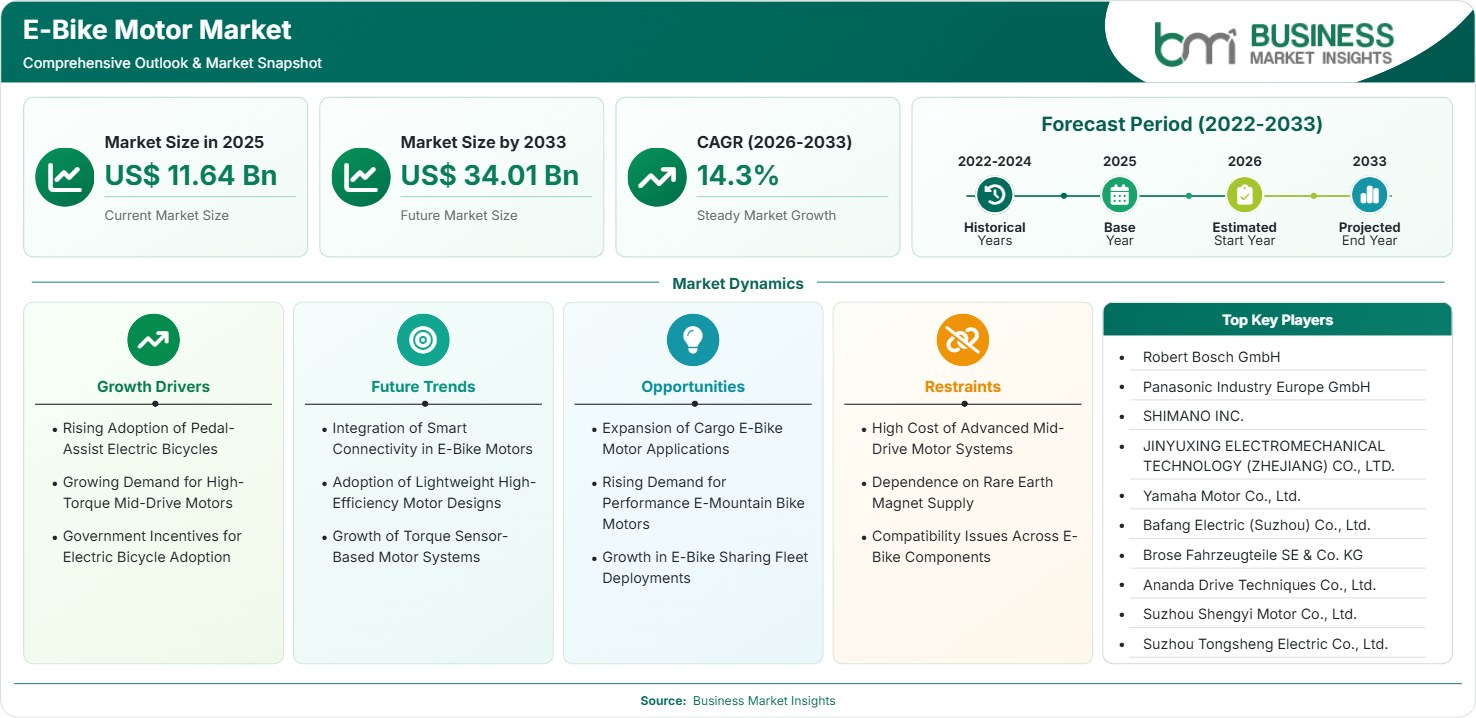
The E-Bike Motor Market size was valued at US$ 11.64 Billion in 2025 and is projected to reach US$ 34.01 Billion by 2033, growing at a CAGR of 14.3% during 2026–2033. Growth is driven by rising adoption of electric bicycles, increasing urban mobility initiatives, expanding cycling infrastructure, growing environmental awareness, and technological advancements in lightweight and high-efficiency motor systems.

Report Coverage
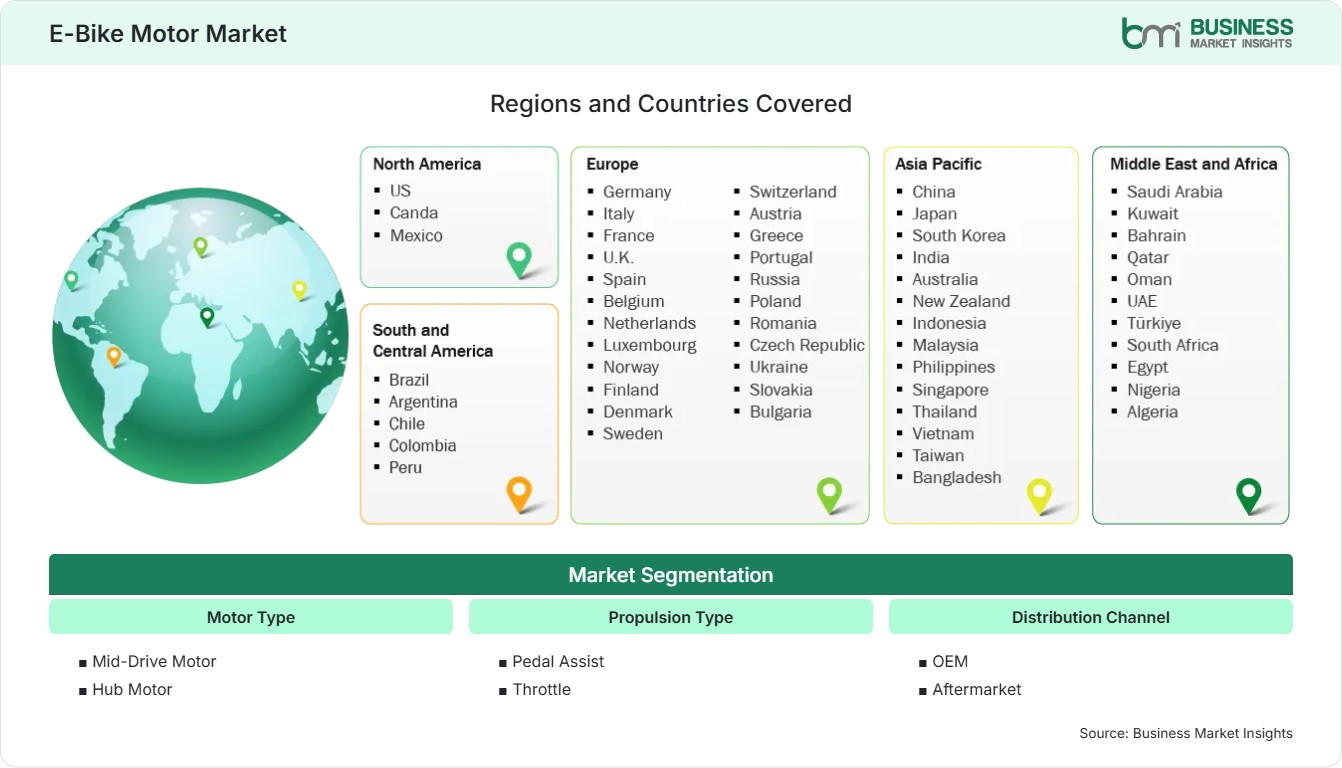
  • Motor Type: Mid-Drive Motor, Hub Motor
  • Propulsion Type: Pedal Assist, Throttle
  • Distribution Channel: OEM, Aftermarket
US$ 11.64 Bn Market size in 2025
US$ 34.01 Bn Market Size by 2033
14.3% CAGR, 2026 - 2033
2026-2033 Forecast Period

01 AI Overview

E-Bike Motor Market Summary

  • North America Region: North America holds a market share of 18%–21% in 2025, growing at a CAGR of 13.0%–14.0% during 2026–2033. Growing e-bike adoption, supportive sustainability initiatives, and expanding recreational cycling activities continue driving market demand. The U.S. remains the dominant regional market, registering a CAGR of 13.2%–14.2%.
  • Fastest Growing Region: Asia Pacific accounts for 41%–44% of revenue in 2025 and is projected to expand at a CAGR of 15.2%–16.2% through 2033. Strong bicycle manufacturing ecosystems, rising urbanization, and increasing consumer acceptance of electric mobility solutions support rapid growth.
  • Leading Segment: Hub Motor holds a market share of 58%–62% in 2025 and is expected to grow at a CAGR of 13.8%–14.8%. Cost-effectiveness, ease of integration, and widespread adoption in commuter e-bikes contribute to segment leadership.
  • High Growth Segment: Pedal Assist accounts for 66%–70% of revenue in 2025 and is projected to register a CAGR of 14.8%–15.8% during the forecast period. Consumer preference for enhanced riding experience, energy efficiency, and regulatory compliance supports expansion.
  • Key Market Opportunity: Growing deployment of connected e-bikes featuring smart diagnostics, battery management systems, performance monitoring, and integrated mobility platforms is creating significant opportunities for advanced motor manufacturers.
  • Major Market Players: Robert Bosch GmbH, Panasonic Industry Europe GmbH, SHIMANO INC., JINYUXING ELECTROMECHANICAL TECHNOLOGY (ZHEJIANG) CO., LTD., Yamaha Motor Co., Ltd., Bafang Electric (Suzhou) Co., Ltd., Brose Fahrzeugteile SE & Co. KG, Ananda Drive Techniques Co., Ltd., Suzhou Shengyi Motor Co., Ltd., and Suzhou Tongsheng Electric Co., Ltd.
02 Strategic Insights

E-Bike Motor Market: Strategic Insights

E-Bike Motor Market Strategic Framework
FREE PDF
Request your free sample
Request free sample
03 Stakeholder View

Key Takeaways

  • The value chain includes motor manufacturers, battery suppliers, bicycle OEMs, distribution partners, software providers, and micro-mobility service operators.
  • Pedal-assist e-bikes offer the strongest growth opportunities due to consumer preference, regulatory acceptance, and superior riding efficiency.
  • Innovation is increasingly focused on lightweight motors, torque optimization, integrated sensors, AI-enabled performance tuning, and smart connectivity features.
  • Asia Pacific remains the most attractive investment region because of large-scale manufacturing capabilities, strong domestic demand, and established supply chains.
  • Strategic partnerships between motor manufacturers and bicycle OEMs continue strengthening product differentiation and market competitiveness.
  • Smart urban mobility initiatives and sustainable transportation programs are accelerating adoption of advanced e-bike motor technologies.
  • The E-Bike Motor Market Trend is shifting toward the adoption of mid-drive motor technologies, driven by increasing consumer demand for improved power distribution, higher energy efficiency, enhanced riding performance, and seamless integration with smart battery management systems and connected mobility features for urban commuting and recreational cycling.
04 Geographic Outlook

E-Bike Motor Market Regional Highlights

North America E-Bike Motor Market

North America accounted for 18%–21% of global revenue in 2025 and is projected to grow at a CAGR of 13.0%–14.0% through 2033. Increasing adoption of electric bicycles for commuting and recreational purposes, expanding cycling infrastructure, and growing awareness of sustainable transportation continue supporting market expansion. The market share in the region is further strengthened by favorable government incentives and rising consumer preference for eco-friendly mobility alternatives.

  • Urban commuters increasingly adopt e-bikes to reduce transportation costs and avoid traffic congestion in major metropolitan areas.
  • Investments in dedicated cycling lanes and bicycle-friendly infrastructure are supporting wider adoption of electric bicycles.
  • Recreational and fitness-oriented consumers continue driving demand for high-performance e-bike motor systems.
  • Growing interest in sustainable mobility solutions is accelerating sales of electric bicycles across residential and commercial applications.
  • Technological advancements in motor efficiency and battery integration continue improving overall riding experience.

US E-Bike Motor Market

The United States represented 15%–18% of global revenue in 2025 and is anticipated to register a CAGR of 13.2%–14.2% during the forecast period. Demand is supported by increasing popularity of e-bikes for urban transportation, outdoor recreation, and last-mile mobility applications. Expanding dealer networks and growing consumer awareness continue fueling E-Bike Motor Market growth across the country.

  • Consumers increasingly prefer electric bicycles as practical alternatives to short-distance vehicle travel.
  • Rising fuel costs and sustainability concerns are encouraging adoption of efficient micro-mobility solutions.
  • Premium e-bike models equipped with advanced motor systems continue gaining traction among enthusiasts.
  • Urban mobility programs and cycling infrastructure developments support long-term market expansion.

Europe E-Bike Motor Market

Europe accounted for 29%–32% of global revenue in 2025 and is projected to expand at a CAGR of 13.8%–14.8% through 2033. Strong cycling culture, supportive environmental regulations, and extensive cycling infrastructure continue driving regional demand. Germany remains the leading market with a CAGR of 14.0%–15.0%, while the Netherlands is the fastest-growing country at a CAGR of 14.5%–15.5% during the forecast period.

  • Government support for sustainable transportation is encouraging broader adoption of electric mobility solutions.
  • Daily commuting by e-bike continues increasing across urban centers due to convenience and cost advantages.
  • Germany benefits from strong consumer demand and the presence of major e-bike component manufacturers.
  • The Netherlands continues witnessing rapid growth due to established cycling habits and favorable infrastructure.
  • Premium and performance-oriented e-bikes are driving demand for advanced mid-drive and hub motor technologies.

Asia Pacific E-Bike Motor Market

Asia Pacific held 41%–44% of global revenue in 2025 and is expected to remain the fastest-growing region, registering a CAGR of 15.2%–16.2% through 2033. The region benefits from large-scale bicycle manufacturing, increasing urbanization, government support for electric mobility, and growing consumer demand for cost-effective transportation. China remains the largest market with a CAGR of 15.0%–16.0%, while India records the highest growth at 16.0%–17.0%.

  • China continues to lead global e-bike production and consumption, supported by extensive manufacturing capabilities.
  • India is experiencing increasing adoption due to urban mobility needs and rising environmental awareness.
  • Regional OEMs are expanding production capacity to meet growing domestic and export demand.
  • E-commerce and delivery services are increasingly adopting electric bicycles for last-mile transportation operations.
  • Government initiatives aimed at reducing urban emissions continue supporting electric mobility adoption.

Rest of World E-Bike Motor Market

The Rest of World region accounted for 7%–9% of global revenue in 2025 and is projected to grow at a CAGR of 13.2%–14.2% through 2033. Market growth is supported by increasing awareness of electric mobility, expanding cycling infrastructure, and rising interest in sustainable transportation alternatives.

Brazil is the leading market in South & Central America and is expected to grow at a CAGR of 13.5%–14.5%. In the Middle East & Africa, the United Arab Emirates is forecast to be the fastest-growing country with a CAGR of 13.8%–14.8%.

  • Brazil continues to witness increasing demand for electric bicycles in urban commuting and recreational applications.
  • The United Arab Emirates is promoting sustainable transportation through smart mobility and green infrastructure initiatives.
  • Rising consumer awareness regarding environmental sustainability is supporting E-bike motor market adoption.
  • Tourism and recreation sectors are generating additional demand for electric bicycle solutions.
  • Expanding distribution networks are improving product accessibility across emerging markets.
Global Market Geography
FREE PDF
Request your free sample
Request free sample
05 Segment Analysis

E-Bike Motor Market Segmentation

Motor Type

Motor type remains a key differentiator in e-bike performance, ride quality, and application suitability. This segment accounted for approximately 58%–62% market share in 2025 and is projected to expand at a CAGR of 13.8%–14.8% through 2033. Manufacturers continue improving motor efficiency, torque output, weight reduction, and integration capabilities to meet evolving consumer expectations. The E-bike motor market forecast indicates continuous expansion across urban commuting, recreational cycling, and cargo transportation applications.

  • Mid-Drive Motor: Mid-drive systems are increasingly preferred for premium bicycles due to superior torque delivery, balanced weight distribution, and enhanced performance on challenging terrains.
  • Hub Motor: Hub motors maintain widespread adoption owing to cost-effectiveness, simple design architecture, lower maintenance requirements, and suitability for commuter e-bikes.

Propulsion Type

Propulsion systems significantly influence user experience, regulatory compliance, and vehicle performance. This segment accounted for approximately 66%–70% market revenue in 2025 and is expected to register a CAGR of 14.8%–15.8% through 2033. Growing acceptance of electric mobility and advancements in intelligent power assistance systems continue supporting market expansion.

  • Pedal Assist: Pedal-assist systems dominate due to improved riding efficiency, enhanced battery utilization, regulatory acceptance, and a more natural cycling experience.
  • Throttle: Throttle-operated systems remain popular among users seeking direct power delivery and reduced physical effort during commuting and recreational use.

Distribution Channel

Distribution channels play a critical role in product availability, innovation adoption, and customer support services. This segment accounted for approximately 72%–76% market share in 2025 and is forecast to expand at a CAGR of 14.0%–15.0% during the forecast period. The E-Bike Motor Market share remains highly influenced by OEM partnerships and integrated e-bike manufacturing strategies.

  • OEM: Original equipment manufacturers dominate demand through integration of advanced motor technologies into new electric bicycle models.
  • Aftermarket: The aftermarket benefits from motor upgrades, replacement demand, customization requirements, and performance enhancement trends among existing e-bike owners.
06 Market Forces

E-Bike Motor Market Dynamics

Key Market Drivers

Rising Adoption of Pedal-Assist Electric Bicycles

Pedal-assist electric bikes are becoming popular among commuting, recreational, and fitness cyclists for their comfortable, energy-efficient ride. Pedal-assist systems provide automatic motor power to cyclists, ensuring they get help while cycling. Regulatory policies have also been introduced in several nations to facilitate bicycle use and encourage the purchase of pedal-assist electric bikes. Other factors that have facilitated the adoption of these electric bikes are urbanization, traffic pollution, and the need for sustainable transport. The producers of electric bike motors are also working to develop torque sensors, control systems, and energy management systems.

Growing Demand for High-Torque Mid-Drive Motors

The market demand for high-torque mid-drive motors is rapidly growing due to the rising trend towards higher-quality e-bikes that offer exceptional performance and efficiency. Mid-drive motors offer evenly distributed load, efficient power transmission, and climbing ability, making them a perfect choice for difficult terrain and lengthy journeys. Moreover, they have optimized drivetrains and therefore offer efficient use of the battery. Such qualities have greatly contributed to their use in trekking, cargo, mountain, and performance e-bikes, which require high torque. Furthermore, there is ongoing development in motor efficiency and miniaturization, along with intelligent power delivery, enabled by sensor integration and control technologies, further strengthening the market potential for high-performance mid-drive e-bike motors.

Government Incentives for Electric Bicycle Adoption

Incentives for the adoption of sustainable transportation are being adopted by various governments around the world. Financial assistance, tax incentives, cycling facilities, and electric mobility are among the factors motivating consumers to purchase e-bikes instead of other modes of transport. These developments are leading to higher penetration rates and increased consumer awareness of the economic and environmental advantages of electric bicycles. Sustainable transportation will continue to be a key growth driver in the forecast period.

Key Market Opportunities

Expansion of Cargo E-Bike Motor Applications

The growing deployment of cargo e-bikes in urban logistics, last-mile deliveries, retail deliveries, and commercial transport represents an opportunity for motor makers in the e-bike market. Companies have begun relying on cargo e-bikes as a cost-effective and eco-friendly alternative to traditional delivery vehicles, especially in urban settings. The applications involve the development of powerful, robust, and energy-efficient motors capable of carrying large loads and providing reliable performance throughout operation. Government incentives for green urban transport and emissions reduction also favor the deployment of cargo e-bikes. Motor makers that have developed robust, reliable motor systems with higher power output and enhanced power control capabilities can benefit from the growing commercial interest in cargo e-bikes.

Rising Demand for Performance E-Mountain Bike Motors

The increasing popularity of electric mountain bikes (e-MTBs) is driving demand for advanced motor technologies that deliver exceptional power, efficiency, and riding performance. Enthusiasts and adventure cyclists seek lightweight, compact motors offering high torque, rapid response, and precise power delivery for steep climbs and challenging off-road terrain. Continuous improvement in motors, torque sensors, and smart control systems will result in greater stability, efficiency, and customer satisfaction. The growing number of consumers participating in outdoor activities, along with the popularity of premium cycling trends, is pushing companies to introduce new drive systems and high-end solutions. This trend is anticipated to help drive sales of higher-end products and create opportunities in the premium e-bike motor market.

Growth in E-Bike Sharing Fleet Deployments

Electric bikes are increasingly being integrated into the urban transport system by shared mobility programs. The operators of the fleets need motor systems that are both efficient and reliable, with the capacity to withstand rigorous daily operation without requiring much maintenance. The growing use of bicycle sharing systems in urban centers is increasing demand for robust motor systems. Those capable of supplying connected motor solutions are likely to benefit from growing investments in shared mobility ecosystems.

Market Restraints and Challenges

High Cost of Advanced Mid-Drive Motor Systems

Factor: Advanced mid-drive motors incorporate sophisticated control systems, sensors, high-performance materials, and precision engineering that increase manufacturing costs. Impact: Elevated product costs can limit adoption among price-sensitive consumers and restrict penetration in developing markets. Premium e-bike pricing may slow purchase decisions, particularly where government incentives are limited. Manufacturers must balance performance improvements with affordability to maintain competitiveness and address broader consumer demand.

Dependence on Rare Earth Magnet Supply

Factor: Many high-efficiency e-bike motors rely on permanent magnets that use rare earth materials, creating dependency on global raw material supply chains. Impact: Supply disruptions, geopolitical factors, and fluctuations in raw material prices can affect production costs and manufacturing stability. Motor manufacturers may face procurement challenges and margin pressure during periods of supply volatility. These risks are encouraging research into alternative motor technologies and diversified sourcing strategies.

07 Company Analysis

Competitive Landscape

The market is characterized by strong competition among global motor manufacturers focusing on efficiency improvements, torque optimization, connectivity features, and lightweight designs. E-bike motor market analysis indicates that OEM partnerships, premium motor technologies, and integration capabilities remain major competitive differentiators.

Company Name

Overview

Products and Services Relevant to this Market

Robert Bosch GmbH

Leading supplier of premium e-bike drive systems and connected mobility technologies.

Mid-drive motors, e-bike drive units, connectivity platforms, control systems.

Panasonic Industry Europe GmbH

Advanced electronics and mobility technology provider serving e-bike manufacturers.

E-bike motors, battery systems, power management solutions.

SHIMANO INC.

Global bicycle component leader with integrated electric bicycle drive technologies.

STEPS drive systems, mid-drive motors, e-bike components.

JINYUXING ELECTROMECHANICAL TECHNOLOGY (ZHEJIANG) CO., LTD.

Manufacturer specializing in electric bicycle motor technologies.

Hub motors, drive systems, electric mobility solutions.

Yamaha Motor Co., Ltd.

Pioneer in electric bicycle drive systems with strong global presence.

Mid-drive motors, e-bike power units, mobility technologies.

Bafang Electric (Suzhou) Co., Ltd.

Major supplier of e-bike drive systems serving OEM markets globally.

Hub motors, mid-drive motors, integrated drive solutions.

Brose Fahrzeugteile SE & Co. KG

Premium motor manufacturer focused on high-performance electric mobility systems.

Mid-drive motors, premium drive systems, e-bike technologies.

Ananda Drive Techniques Co., Ltd.

E-bike motor producer serving global bicycle manufacturers.

Hub motors, mid-drive systems, propulsion technologies.

Suzhou Shengyi Motor Co., Ltd.

Developer of electric bicycle motor systems and drivetrain solutions.

E-bike motors, integrated drive components, propulsion systems.

Suzhou Tongsheng Electric Co., Ltd.

Specialized manufacturer of electric bicycle drive technologies.

Mid-drive motors, pedal-assist systems, electric mobility solutions.

08 Industry Activity

Recent Developments

July 2026

Momentum announced the launch of the Vida E+ EX e-bike, featuring smarter ride technologies including Cruise Mode, an optional 0-Start throttle, enhanced comfort features, and improved urban mobility capabilities for everyday commuting. The new model is designed to provide a smoother and more convenient riding experience while addressing the growing demand for intelligent, user-friendly electric bicycles in urban transportation.

May 2026

Robert Bosch GmbH expanded its performance-oriented eBike drive portfolio with enhanced connectivity capabilities and improved power management features targeting premium electric bicycle segments. The upgraded drive systems enable better battery utilization, seamless integration with digital cycling platforms, and higher overall performance for recreational and performance-focused riders.

January 2026

Yamaha Motor Co., Ltd. introduced upgraded drive unit technologies designed to improve torque delivery, energy efficiency, and riding performance for urban and recreational e-bikes. These advancements strengthen the company's position in the evolving e-bike market by offering smoother power assistance, extended riding range, and improved reliability across diverse cycling conditions.

August 2025

Yamaha Motor Co., Ltd. announced the acquisition of Brose's e-bike drive business to strengthen its position in the European e-bike market, expand its development capabilities, and accelerate the development of next-generation electric bicycle drive systems through Brose's engineering expertise and European operations.

10 Trust & Transparency

Research Methodology

The market analysis combines proprietary research with secondary data from government agencies, company disclosures, regulatory filings, industry databases and expert interviews. Market estimates are validated through data triangulation, cross-market benchmarking and analyst review.

View Full Research Methodology

11 Questions Answered

Frequently Asked Questions

What is the major challenge facing motor manufacturers?

Dependence on rare earth magnet supply and high costs associated with advanced mid-drive motor technologies remain key challenges for the industry.

Which region leads the market?

Asia Pacific leads the market due to extensive bicycle manufacturing capabilities, strong domestic demand, and growing investments in electric mobility solutions.

Why is the pedal-assist segment growing rapidly?

Pedal-assist systems offer better riding efficiency, longer battery range, regulatory acceptance, and a natural cycling experience, making them highly attractive to consumers.

Which motor type dominates the market?

Hub motors lead the market due to their affordability, ease of integration, reliability, and widespread deployment in commuter electric bicycles.

What is driving growth in the E-Bike Motor Market report?

Rising adoption of electric bicycles, supportive government incentives, increasing urban mobility needs, and growing demand for sustainable transportation solutions are the primary growth drivers.

Access the Full E-Bike Motor Market Report

Get segment-level forecasts, regional estimates, competitive benchmarking, company profiles and downloadable Excel datasets.

Access the full E-Bike Motor Market Report
350 pages PDF & Excel | 2026-07-30