
Electric Bike Market Outlook: Size, Share, Trends, Growth Analysis, Competitive Landscape & Forecast, 2026-2033

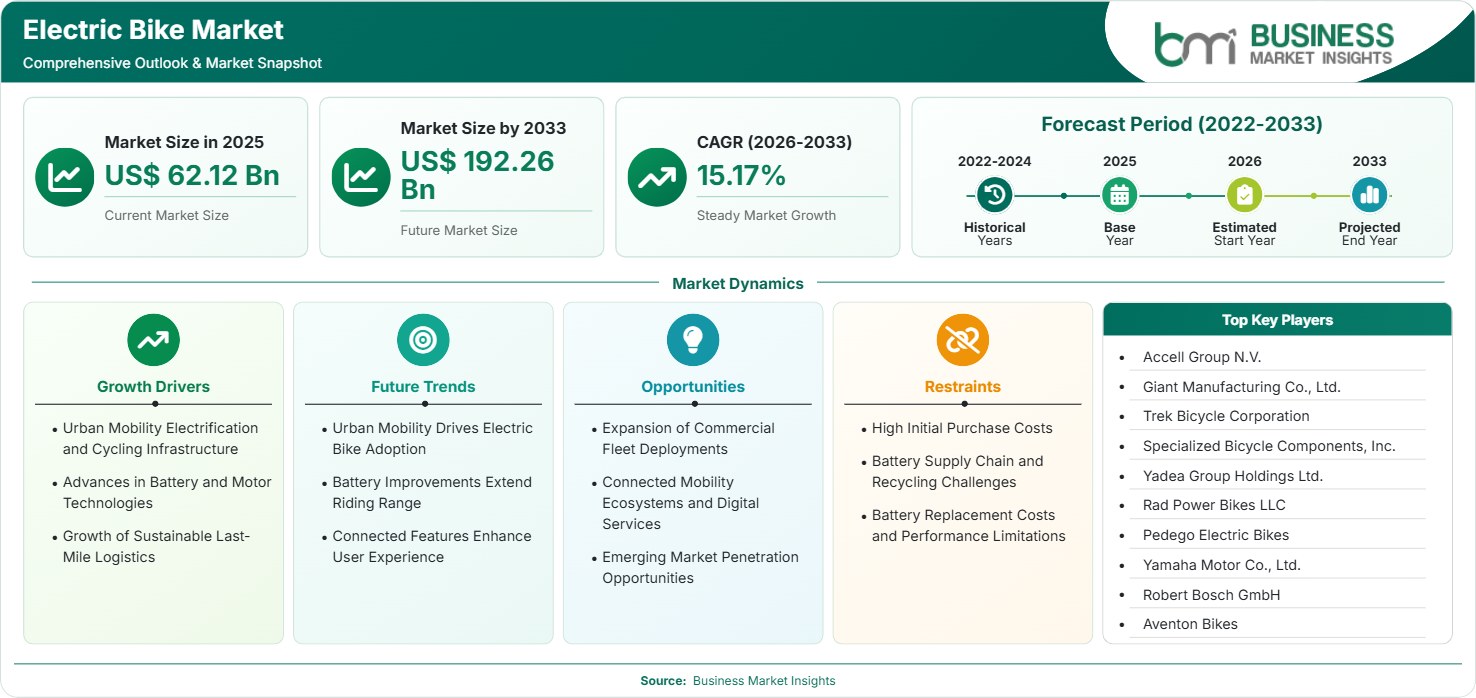
The Electric Bike Market size was valued at US$ 62.12 Billion in 2025 and is projected to reach US$ 192.26 Billion by 2033, growing at a CAGR of 15.17% during 2026–2033. Key drivers include urban mobility electrification, battery cost reductions, cycling infrastructure expansion, and emission-reduction policies. Major opportunities arise from cargo mobility, connected-bike ecosystems, subscription services, and fleet electrification.

Report Coverage
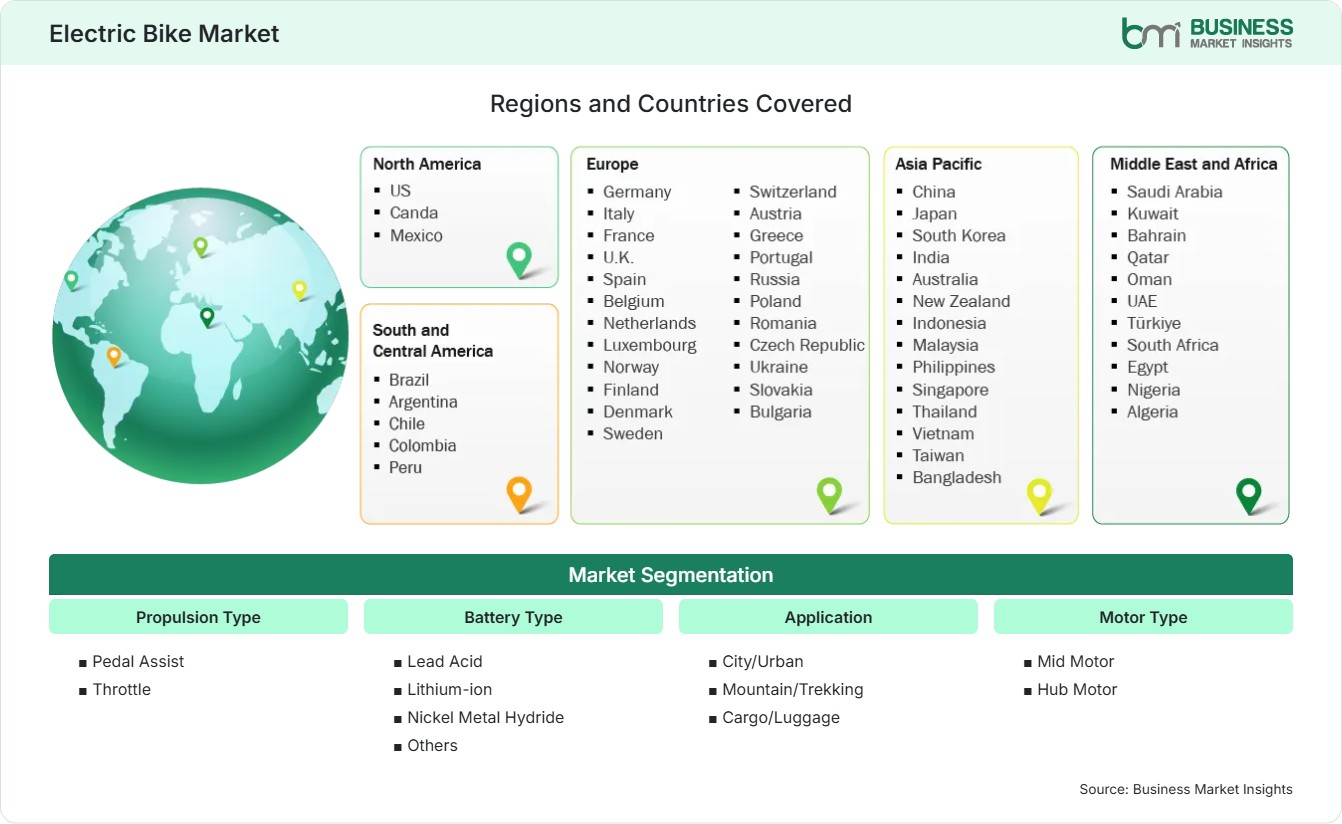
  • Propulsion Type: Pedal Assist, Throttle
  • Battery Type: Lead Acid, Lithium-ion, Nickel Metal Hydride, Others
  • Application: City/Urban, Mountain/Trekking, Cargo/Luggage
  • Motor Type: Mid Motor, Hub Motor
  • Component: Battery, Electric Motors, Motor Controller, Frame with Forks, Others
US$ 62.12 Bn Market size in 2025
US$ 192.26 Bn Market Size by 2033
15.17% CAGR, 2026 - 2033
2026-2033 Forecast Period

AI Overview

Electric Bike Market Summary

  • North America Region: North America holds an Electric Bike Market share of 18%–22% in 2025, advancing at a CAGR of 13%–15% during 2026–2033. Growth is supported by commuter adoption, incentive programs, urban bike-lane expansion, premium product demand, fleet applications, tourism usage, sustainability initiatives, battery improvements, smart mobility integration, and retailer network development. US demand remains robust, supported by urban commuting and recreation, with an estimated CAGR of 13%–15%.
  • Fastest Growing Region: Asia Pacific accounts for 34%–38% share in 2025 and is projected to expand at 16%–18% CAGR. Demand is driven by urbanization, manufacturing strength, affordability, dense population centers, government incentives, delivery services, infrastructure upgrades, digital retail channels, battery localization, and increasing environmental awareness.
  • Leading Segment: Lithium-ion battery systems command 72%–76% share of the Electric Bike Market in 2025 and are forecast to grow at 15%–17% CAGR. Leadership reflects higher energy density, declining unit costs, fast charging, lighter weight, durability improvements, extended range capability, OEM preference, technology maturity, user convenience, and expanding supply availability.
  • High Growth Segment: Cargo/Luggage applications represent 10%–14% share in 2025 and are expected to record 18%–20% CAGR. Expansion is supported by last-mile logistics, e-commerce growth, municipal delivery fleets, operational savings, emission targets, urban accessibility, commercial leasing models, infrastructure readiness, route optimization, and fleet electrification.
  • Key Market Opportunity: Commercial cargo mobility is creating substantial value through last-mile delivery electrification, corporate sustainability mandates, urban access regulations, fleet digitization, battery leasing innovations, and growing demand for efficient low-emission transportation solutions.
  • Major Market Players: Accell Group N.V., Giant Manufacturing Co., Ltd., Trek Bicycle Corporation, Specialized Bicycle Components, Inc., Yadea Group Holdings Ltd., Rad Power Bikes LLC, Pedego Electric Bikes, Yamaha Motor Co., Ltd., Robert Bosch GmbH, Aventon Bikes.
Strategic Insights

Electric Bike Market: Strategic Insights

Electric Bike Market Strategic Framework
FREE PDF
Request your free sample
Request free sample
Stakeholder View

Key Takeaways

  • The value chain is becoming increasingly integrated, with battery suppliers, motor manufacturers, software providers, and bicycle OEMs collaborating to improve performance, safety, and service ecosystems.
  • Cargo and urban mobility applications present the strongest medium-term upside as commercial fleets seek lower operating costs and compliance with sustainability targets.
  • Product innovation is shifting toward connected platforms featuring navigation, predictive maintenance, theft protection, energy management, and smartphone integration capabilities.
  • Asia Pacific offers the most compelling investment case due to manufacturing leadership, favorable demographics, policy support, and rapidly expanding urban mobility requirements.
  • Strategic investments increasingly focus on battery technology, distribution networks, direct-to-consumer channels, and platform-based mobility services, supporting industry consolidation.
  • Circular-economy initiatives involving battery recycling, refurbishment, and second-life applications are emerging as differentiating competitive factors.
Geographic Outlook

Electric Bike Market Regional Highlights

North America Electric Bike Market

North America accounted for 18%–22% of the electric bike market share in 2025 and is expected to grow at a CAGR of 13%–15% through 2033. Adoption is expanding beyond recreational cycling toward daily commuting and delivery operations. Federal, state, and municipal investments in cycling infrastructure continue supporting demand. Premium models remain particularly strong in the region, while commercial applications are accelerating. Retailers are improving after-sales support and financing accessibility, further strengthening adoption among urban consumers.

  • Government incentives and protected cycling-lane projects are encouraging broader commuter adoption across major metropolitan areas.
  • Demand for premium products featuring connected technologies, GPS integration, and advanced battery systems continues rising.
  • Corporate sustainability programs increasingly support employee mobility initiatives and cycling incentives.
  • Growing health awareness and congestion reduction efforts strengthen long-term demand fundamentals.
  • Fleet electrification for food delivery and urban logistics creates new commercial opportunities.

US Electric Bike Market

The United States constitutes 78%-82% of total regional revenues in North America and is estimated to grow at a CAGR of 13%-15%. High levels of consumer expenditure, a well-established culture of recreation activities, and urban mobility initiatives foster market growth. There have been many state-level initiatives towards promoting purchase subsidies and pilot programs that increase affordability. The highest demand persists in metropolitan areas seeking to move away from car dependence, while commercial operators increasingly evaluate electric mobility options for urban logistics.

  • Incentive programs improve accessibility and encourage first-time purchases among urban commuters.
  • Recreational and mountain biking categories remain highly influential across the consumer base.
  • Direct-to-consumer sales channels expand product availability and customer engagement.
  • Fleet operators increasingly adopt electric mobility platforms for lower operating expenses.

Europe Electric Bike Market

Europe holds market shares of 30%-34% in 2025 and is projected to post a 14%-16% CAGR. Good environmental regulations, advanced cycling culture, and rising fuel costs will drive industry demand. Germany is the leading country in the region, while Eastern European markets show some of the highest levels of adoption. Cycling infrastructure and sustainable cities further support long-term market growth. Consumers focus on premium characteristics, energy efficiency, and digital integration.

  • Germany leads regional demand, while Poland and Romania demonstrate faster expansion rates.
  • Carbon-reduction policies and urban transport initiatives support market penetration.
  • Cargo mobility solutions gain traction among municipalities and commercial operators.
  • Premium performance products remain popular within mature cycling markets.
  • Integrated public transportation and cycling networks improve utilization rates.

Asia Pacific Electric Bike Market

The Asia Pacific region commands a market share of 34%-38% in 2025 and is the fastest-growing region, having a CAGR of 16%-18% in the electric bike market until 2033. Effective manufacturing facilities, urban density, and good affordability make the region dominate. China is the leading nation, whereas India and Southeast Asian economies are emerging. Delivery and mobility policies add to the impetus. The effective supply chain in the region ensures export advantages and technology innovations.

  • China leads production and consumption, supported by extensive manufacturing ecosystems.
  • India records rapid expansion through affordable mobility demand and urbanization.
  • E-commerce logistics growth stimulates commercial fleet deployment.
  • Government initiatives promoting low-emission transportation support market expansion.
  • Local battery manufacturing investments strengthen supply-chain resilience.

Rest of World Electric Bike Market

The Rest of World market constitutes a 10%-14% market share in 2025 and is anticipated to record a CAGR of 14%-17%. South and Central America have seen increased use in urban areas seeking an economical means of transportation. The Middle East and Africa have seen rising demand due to tourism projects, smart city development, and sustainable practices. Brazil has emerged as the leading region-wise adopter, followed by the UAE, which has high growth potential due to infrastructure investments and innovation-focused mobility initiatives.

  • Brazil benefits from growing urban mobility investments and cycling adoption programs.
  • UAE smart-city projects increasingly incorporate sustainable transportation alternatives.
  • Tourism-oriented fleets support demand in selected Middle Eastern destinations.
  • Distribution network expansion improves product accessibility across developing markets.
  • Rising fuel expenses enhance the cost-competitiveness of electric mobility solutions.
Global Market Geography
FREE PDF
Request your free sample
Request free sample
Segment Analysis

Electric Bike Market Segmentation

Propulsion Type

The pedal-assist category accounts for approximately 68%-72% of the market share and is projected to grow at a 15%-17% CAGR in 2025. These products will benefit from regulatory approval, range capabilities, energy savings, and rider comfort. The scope of the Electric Bike market expands on the back of consumers' preference for optimal balance and a cycling experience.

  • Pedal Assist: Widely preferred for commuting and recreation due to better battery efficiency, regulatory acceptance, extended travel range, and enhanced rider control across varying terrain conditions.
  • Throttle: Popular among users seeking minimal physical effort, supporting convenience-focused mobility while expanding adoption in urban commuting and delivery applications.

Battery Type

Battery technology remains a key point of differentiation for products. Lithium-ion batteries have a market share of 72%–76%, and it is anticipated that this will grow at a 15%–17% CAGR due to their high energy density and cycle life. Ongoing innovation continues reducing charging time and improving operational efficiency across applications.

  • Lead Acid: Maintains relevance in price-sensitive markets where affordability outweighs weight and performance considerations.
  • Lithium-ion: Dominates adoption through lightweight construction, higher energy density, faster charging, and improved overall vehicle performance.
  • Nickel Metal Hydride: Serves niche applications requiring durability and stable performance characteristics across operating environments.

Application

Urban and city use constitutes a 52%-56% market segment by 2025 and is growing at a 14%-16% CAGR due to the increasing importance of commuting. Uses in the commercial and recreational sectors will keep expanding, along with developments in infrastructure that improve accessibility and convenience.

  • City/Urban: Driven by congestion reduction goals, sustainability preferences, and increasing investment in cycling infrastructure.
  • Mountain/Trekking: Supported by recreational demand, tourism growth, and improved motor technology for challenging terrain.
  • Cargo/Luggage: Benefits from logistics electrification, delivery efficiency requirements, and corporate sustainability targets.

Motor Type

Hub Motor systems account for 58% to 62% of market share and are projected to have a compound annual growth rate of 14% to 16% in the Electric Bike Market from 2025, driven by cost-effectiveness and ease of maintenance. More premium models use mid-drive systems due to improved performance and balanced power delivery.

  • Mid Motor: Provides superior torque distribution and hill-climbing capabilities, especially in performance-oriented and trekking applications.
  • Hub Motor: Favored for cost efficiency, straightforward integration, and widespread adoption in urban mobility products.

Component

The battery components offer the highest value contribution, with 28%-32% by 2025 and a 15%-17% CAGR. Battery innovation remains a top priority for manufacturers because it directly affects range, weight, and customer satisfaction.

  • Battery: Central performance component influencing range, charging convenience, lifecycle value, and user experience.
  • Electric Motors: Support efficiency improvements and optimized power delivery across diverse riding applications.
  • Motor Controller: Enables intelligent energy management, performance optimization, and system safety.
  • Frame with Forks: Reflects increasing demand for lightweight materials and ergonomic design enhancements.

Battery Capacity

The 251-450 W range continues to hold the largest installed base, with a 40%-44% share in 2025, and is forecast to grow at a 15%-17% CAGR. Higher demand for range and increased performance also support larger-capacity batteries.

  • Below 250W: Common in regions with stricter regulatory frameworks emphasizing moderate assistance levels.
  • 251 W to 450W: Balances performance, efficiency, affordability, and daily commuting requirements effectively.
  • 451 W to 650 W: Supports demanding terrain, longer distances, and enhanced cargo-carrying capability.
  • Above 650W: Targets specialized applications requiring higher torque and advanced operational performance.
Market Forces

Electric Bike Market Dynamics

Key Market Drivers

Urban Mobility Electrification and Cycling Infrastructure

Urban areas around the world have started building cycling routes, low-emission areas, and multimodal transport systems. International policy measures aimed at reducing urban emissions are motivating the population to adopt alternative means of transport, such as electric vehicles. Congestion and higher fuel prices make the proposition for electric bikes more valuable. This mix of infrastructure development, policies, and demand is increasing the adoption of electric bikes in all scenarios. These factors collectively reinforce long-term industry momentum and drive the Electric Bike Market trends.

Advances in Battery and Motor Technologies

Advancements in lithium-ion batteries, fast charging, energy density, and motor efficiency create better product offerings. Suppliers are developing more lightweight products with higher performance in terms of range and speed. Smart battery management systems ensure product safety and durability, while connectivity facilitates maintenance and customization to meet individual needs. This makes the product more accessible for customers and expands practical use scenarios across consumer and commercial applications.

Growth of Sustainable Last-Mile Logistics

The expansion of e-commerce is creating a need for effective delivery methods in urban areas. Electric cargo bikes provide cost-effective operation, produce fewer emissions, and make it easier to penetrate city areas. Restrictions imposed by municipalities on regular delivery vehicles have also been an incentive for the use of such transport. Commercial fleets increasingly view electric mobility as a strategic tool for achieving sustainability and operational efficiency objectives.

Key Market Opportunities

Expansion of Commercial Fleet Deployments

Commercial entities have become an important customer base. Delivery companies, government institutions, and service firms are turning to e-bikes because they help reduce costs and improve efficiency. Long-term contracts and fleet management software will generate recurring revenues. As stated in Electric Bike Market Forecasts, there is an increasing trend in organizational purchases for decarbonization.

Connected Mobility Ecosystems and Digital Services

Integrating smart mobility would enable subscription-based offerings, predictive maintenance, usage analytics, and security features to prevent car theft. Manufacturers can explore avenues to generate revenue through software and connectivity solutions beyond hardware. This is expected to contribute to the development of digital ecosystems and increase revenues through service delivery. The resulting business transformation offers substantial value creation potential.

Emerging Market Penetration Opportunities

Emerging markets offer considerable untapped demand owing to urbanization and the development of advanced transport systems. Cost-effectiveness, local manufacturing, and government support are helping make these markets more accessible. Companies that can establish early distribution channels and local product offerings can benefit from stronger competitive positions while capturing new customer segments.

Market Restraints and Challenges

High Initial Purchase Costs

Advanced batteries, advanced electronics, and high-quality parts contribute significantly to the higher cost of electric bicycles compared to conventional bicycles. Such a relatively high cost is one of the factors that have made the adoption of these e-bicycles difficult for some people. Though there are long-term savings from reduced operational costs, the initial cost can be discouraging for first-time buyers. The lack of purchasing power in less affluent areas has been limiting the adoption of e-bicycles. Although other options, such as loans, have been helpful, high acquisition costs are slowing the adoption of e-bicycles across several consumer segments.

Battery Supply Chain and Recycling Challenges

The reliance on minerals such as lithium, cobalt, nickel, and graphite continues to pose considerable challenges in the battery supply chain. The availability of minerals, geopolitical factors, and rising demand can cause the cost of these raw materials to fluctuate, posing sourcing risks that, in turn, affect profitability and manufacturing processes. Additionally, governments are implementing tighter regulations on recycling and environmentally friendly battery disposal methods. Companies have to build better recycling capabilities and manage their resources sustainably. Implementing circular economy principles will become a necessity to reduce waste, secure material supplies, and support long-term industry growth.

Company Analysis

Competitive Landscape

The competitive environment remains dynamic, with manufacturers focusing on technology leadership, battery innovation, and distribution expansion. Current Electric Bike Market analysis indicates competition increasingly extends beyond hardware into software, connectivity, and fleet-management services.

Company Name

Overview

Products and Services relevant to this market

Accell Group N.V.

Major European bicycle manufacturer with strong multi-brand portfolio and extensive distribution presence.

Electric bicycles, urban mobility solutions, accessories, dealer support services.

Giant Manufacturing Co., Ltd.

Global bicycle leader with advanced manufacturing capabilities and broad international reach.

E-bikes, performance bicycles, battery systems, integrated mobility products.

Trek Bicycle Corporation

Premium bicycle company focused on innovation, performance engineering, and global retail presence.

Electric mountain bikes, urban e-bikes, accessories, connected technologies.

Specialized Bicycle Components, Inc.

Innovation-focused manufacturer with premium positioning and extensive R&D capabilities.

Turbo e-bike range, performance mobility platforms, cycling accessories.

Yadea Group Holdings Ltd.

Large-scale electric mobility manufacturer with broad international footprint.

Electric bicycles, electric scooters, battery-powered mobility solutions.

Rad Power Bikes LLC

Direct-to-consumer specialist emphasizing accessibility and utility-focused products.

Commuter, cargo, utility e-bikes, support services, accessories.

Pedego Electric Bikes

U.S.-based brand known for customer-focused retail franchise network.

Cruiser, commuter, and specialty electric bicycle offerings.

Yamaha Motor Co., Ltd.

Established mobility company supplying drive systems and complete products.

Mid-drive motors, integrated powertrains, electric bicycles.

Robert Bosch GmbH

Leading provider of e-bike drive technologies and connectivity solutions.

Motors, controllers, batteries, software platforms, digital services.

Aventon Bikes

Fast-growing e-bike company targeting urban and commuter segments.

Commuter, cargo, and recreational electric bicycle products.

Trust & Transparency

Research Methodology

The market analysis combines proprietary research with secondary data from government agencies, company disclosures, regulatory filings, industry databases and expert interviews. Market estimates are validated through data triangulation, cross-market benchmarking and analyst review.

View Full Research Methodology

Questions Answered

Frequently Asked Questions

What does this Electric Bike Market Report cover?

The report evaluates market size, segmentation, regional performance, competitive dynamics, technology developments, key opportunities, investment trends, and future growth prospects through 2033.

Which region is expected to grow fastest?

Asia Pacific is projected to deliver the strongest expansion due to urbanization, manufacturing scale, affordability advantages, and rising demand for sustainable transportation solutions.

How is regulation influencing market expansion?

Governments are supporting adoption through cycling infrastructure investment, emissions-reduction policies, incentive programs, and transportation frameworks encouraging low-carbon mobility alternatives.

What application area offers the highest long-term potential?

Cargo and logistics deployments present significant potential because e-commerce expansion, sustainability requirements, and urban vehicle restrictions increasingly favor electric delivery solutions.

Which battery technology dominates industry demand?

Lithium-ion technology leads due to superior energy density, lighter weight, faster charging capability, improved lifecycle economics, and strong manufacturer preference across commuter, cargo, and recreational applications.

Access the Full Electric Bike Market Report

Get segment-level forecasts, regional estimates, competitive benchmarking, company profiles and downloadable Excel datasets.

Access the full Electric Bike Market Report
350 pages PDF & Excel | 2026-09-23
Similar Research

Related Market Reports