Market Summary
Executive Summary and Global Market Analysis
The electric bus market refers to the market that consists of battery-operated means of public transportation. These are buses that utilize batteries in place of traditional diesel engines in order to cut down emissions and make transportation efficient and environment-friendly. The use of advanced battery technology, efficient electric motors, and energy management techniques enables these buses to be used as a more environmentally friendly mode of transport in public transit systems.
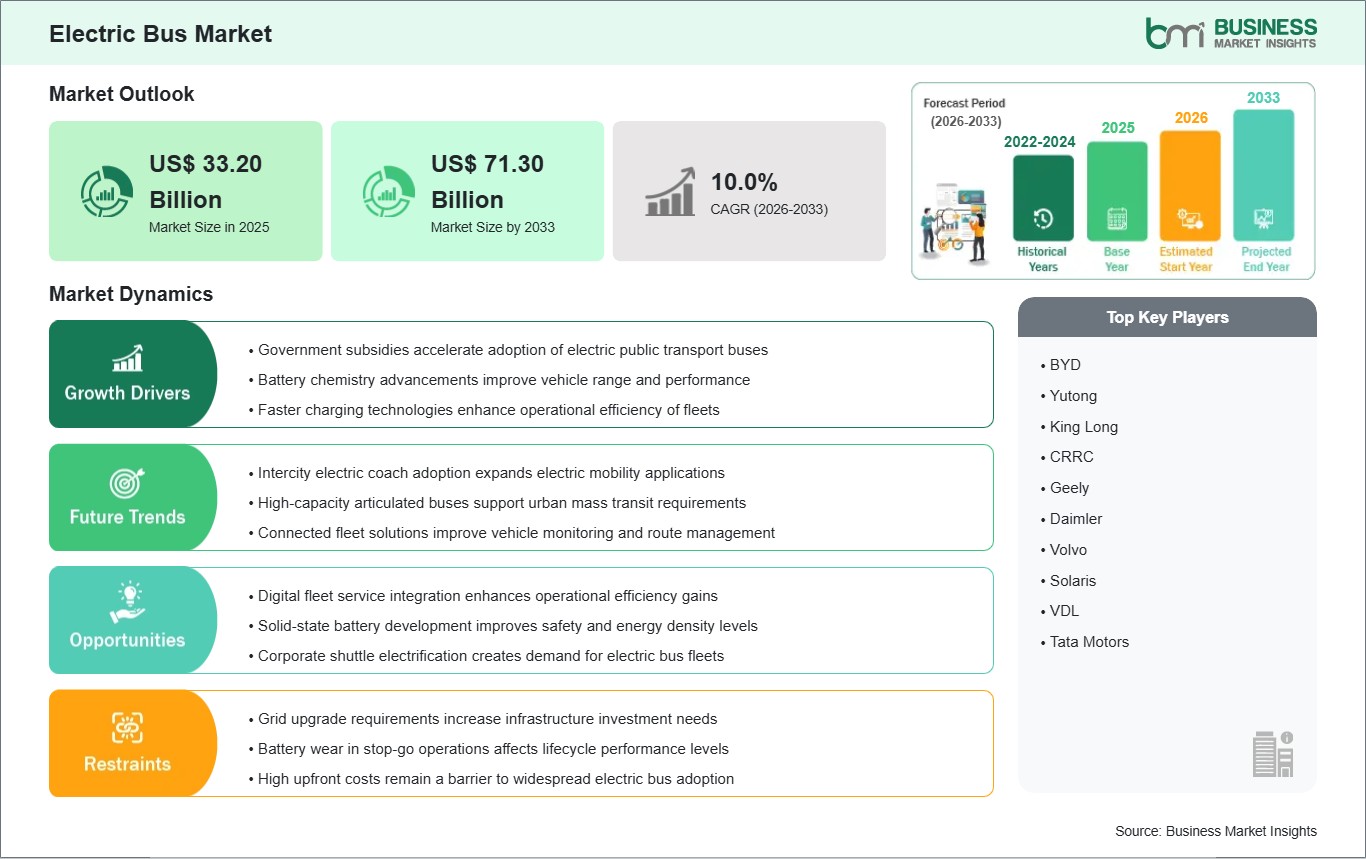
The need for environment-friendly transportation modes is prompting a rapid rise in the adoption of electric buses in transit systems across cities around the world. Transit authorities are opting for electrification in order to minimize their cost of operation and meet stringent emission standards. With increasing population density, there is an increased demand for public transport services, which is promoting fleet renewal among transit operators.
Market segmentation takes place depending on battery type, range, and consumer type, as per the needs that arise out of different transit scenarios. LFP batteries have dominated because of safety and cost benefits, while NMC batteries provide high energy densities suitable for long-range applications. Batteries that are solid-state hold a lot of promise in the future. Range segments include less than 300 miles and above 300 miles. Consumers are government agencies and individual operators.
Innovations and technology changes are likely to affect the market dynamics through improvements in battery chemistries, systems of vehicle electrification, and charging technologies. Competitive dynamics will be related to range enhancement and battery innovations, along with the adoption of intelligent mobility systems.
Segment Analysis
Electric Bus Market Segmentation
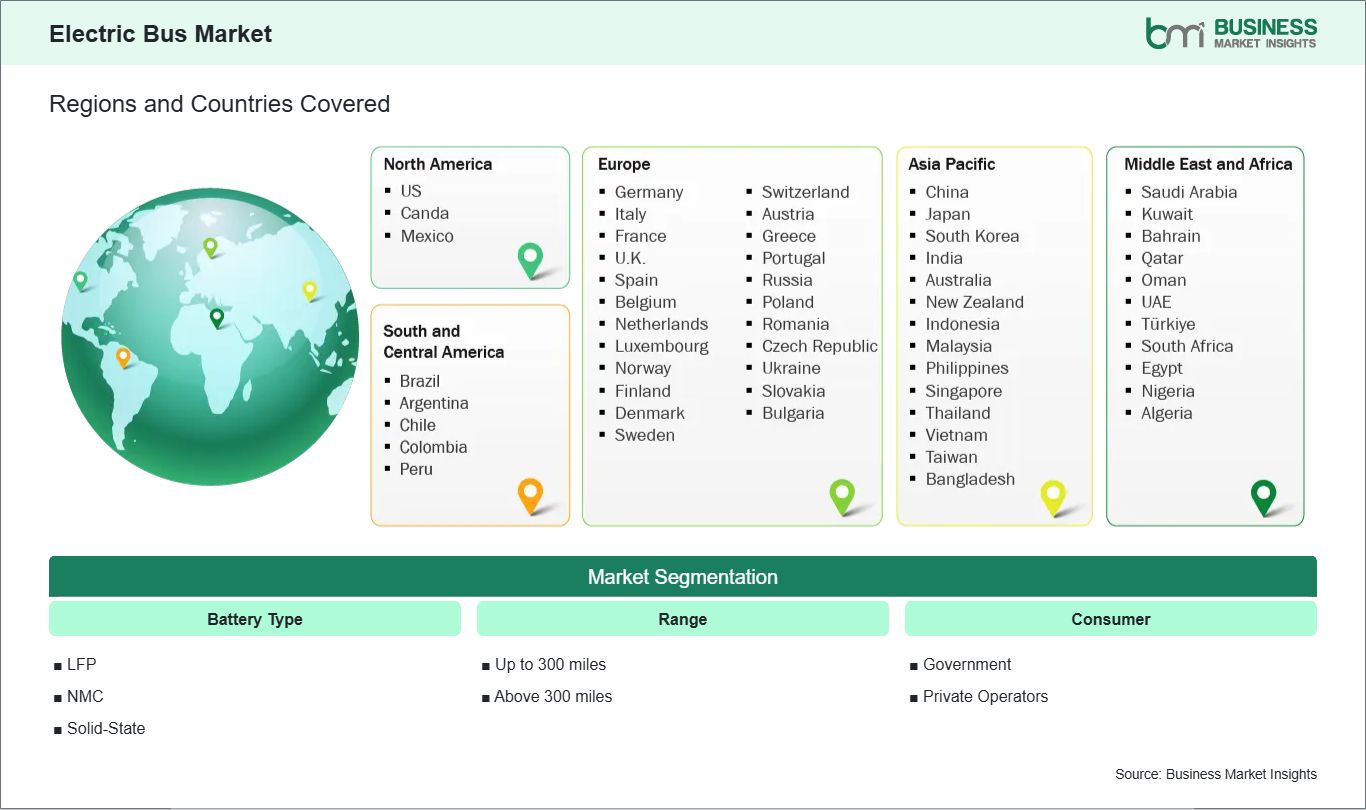
The electric bus market is segmented based on battery type, range, and consumer, reflecting performance requirements, operational efficiency needs, and fleet procurement strategies across public transportation systems.
By Battery Type
- LFP – Offers high safety, long cycle life, and cost efficiency for urban transit operations.
- NMC – Provides higher energy density, supporting longer routes and improved operational range.
- Solid-State – Emerging technology offering enhanced safety and higher energy storage potential.
By Range
- Up to 300 miles – Suitable for intra-city routes and short-distance public transport operations.
- Above 300 miles – Designed for long-distance routes requiring extended operational efficiency.
By Consumer
- Government – Public transport authorities leading large-scale fleet electrification initiatives.
- Private Operators – Commercial transit providers adopting electric buses for cost efficiency and sustainability goals.
Market Forces
Electric Bus Market Drivers and Opportunities
Government subsidies boosting adoption
Government grants are serving an essential purpose in promoting the rapid proliferation of electric buses in the public transport system. Economic support in the form of purchase grants, tax relief, and infrastructure investments is reducing the economic burden associated with the purchase of electric buses by transport agencies. The economic benefit associated with government subsidies is making electric buses more economically attractive than diesel buses, which in turn is motivating organizations to develop electric bus fleets.
There are also government policies facilitating the establishment of charging facilities and domestic production capacity. Governments are undertaking various measures to enhance clean mobility and cut carbon emissions in highly populated areas through electric buses. Consequently, these policies will motivate transport agencies to invest in electric buses and help build up their presence in the market.
Integration of digital fleet services
Integration of smart fleet services represents an important chance for the electric bus market in terms of increasing operational efficiency and managing services better. The introduction of smart fleet management software enables the monitoring in real-time of vehicles' activity, batteries' status, routing and preventive maintenance services. Thus, it allows operators to minimize the number of downtimes, achieve accuracy when organizing trips and optimize the use of energy resources among electric buses.
In the future, the adoption of connectivity technology is projected to result in a shift towards data-based transportation services. The application of telematics technology, cloud-based fleet management, and AI-supported analysis will facilitate better decision-making and operation management. Within the framework of the increasing digitalization of urban transport, the development of smart fleet services for electric buses will play an instrumental part.
Size and Share Analysis
Electric Bus Market Size and Share Analysis
The electric bus market is projected to grow from US$ 33.20 billion in 2025 to US$ 71.30 billion by 2033, registering a CAGR of 10.0% from 2026 to 2033.
By battery type, LFP (Lithium Iron Phosphate) dominates the market due to its lower cost, enhanced safety, and superior thermal stability, which are critical for continuous, high-frequency operations in public transportation fleets. Its long cycle life and ability to withstand repeated charging and discharging cycles make it the most economically viable option for large-scale deployment by transit authorities.
By range, up to 300 miles accounts for a significant share, as most electric buses are deployed in urban and suburban routes where daily travel distances are relatively limited. This range offers an optimal balance between battery size, cost efficiency, and operational feasibility, while also aligning well with depot-based charging infrastructure widely used by fleet operators.
By consumer, government leads the market due to strong policy support, subsidies, and large-scale electrification programs aimed at decarbonizing public transport. Government transit agencies are the primary purchasers and operators of electric buses, enabling bulk procurement and faster adoption compared to private operators.
Report Coverage
Electric Bus Market Report Coverage and Deliverables
The "Electric Bus Market Size and Forecast (2022–2033)" report provides a detailed analysis of the market covering below areas:
- Market size and forecast at global, regional, and country levels for all key market segments covered under the scope
- Market trends, along with market dynamics such as drivers, restraints, and key opportunities
- Market analysis covering key trends, global and regional frameworks, major players, regulations, and recent developments
- Industry landscape and competitive analysis covering market concentration, heat map analysis, prominent players, and recent developments
- Detailed company profiles, including SWOT analysis
Geographic Insights
Electric Bus Market Geographic Insights
Adoption in the electric bus market is seen in various regions according to the degree of government policy backing, urbanization, infrastructure development, and environment-friendly goals. Public transport electrification has been a vital way to achieve emission reductions and improve air quality in major cities worldwide.
North America is witnessing increasing adoption as a result of government schemes and public transportation modernization initiatives. The USA and Canada are focusing on electric buses for their public transportation needs. Government incentives and improved charging infrastructure have facilitated electric bus operations in the region.
The Asia Pacific region accounts for the maximum number of electric bus deployments owing to an extensive public transportation network and government policies favoring electric vehicles. Countries including China, India, Japan, and South Korea are witnessing active use of electric buses in their public transportation system. China dominates the industry in terms of electric bus adoption and production capacity.
Europe continues to perform impressively in terms of growth, thanks to stringent emission laws and sustainable practices. Countries like Germany, France, the United Kingdom, and the Netherlands have been adding more electric buses to comply with their environmental goals. Latin American and Middle Eastern countries are making gradual efforts toward the adoption of electric buses.
Industry Activity
Recent Developments
The electric bus market is evaluated by gathering qualitative and quantitative data post primary and secondary research, which includes important corporate publications, association data, and databases. Recent developments and news in the market include:
- In September 2025, BYD announced that it had launched its e-Bus Platform 3.0 and unveiled the new C11 electric bus, introducing a 1000V high-voltage architecture and integrated cell-to-chassis battery design to significantly improve efficiency, safety, and range for next-generation electric buses.
- In July 2025, Yutong announced that it had expanded its electric bus portfolio in Pakistan by launching its DMT & YEA technologies and securing a major order of 400 new energy buses, marking one of the largest electric bus deployments in the region and strengthening its presence in South Asia.
Trust & Transparency
Research Methodology
The market analysis combines proprietary research with secondary data from government agencies, company disclosures, regulatory filings, industry databases and expert interviews. Market estimates are validated through data triangulation, cross-market benchmarking and analyst
review.
View Full Research Methodology
Key Sources Referred:
U.S. Department of Transportation (USDOT) Federal Transit Administration (FTA) European Commission (EC) International Energy Agency (IEA) International Organization for Standardization (ISO) Society of Automotive Engineers (SAE International) United Nations Environment Programme (UNEP) Company Websites Company Annual Reports Company Investor Presentations