Market Summary
Executive Summary and Global Market Analysis
Electric vehicles refer to modes of transportation that run fully or partially using electric drives, as a viable alternative to traditional vehicles that operate with internal combustion engines. Electric vehicles employ advanced battery technology, electric drives, and energy control systems to provide energy-efficient transportation. Market adoption of electric vehicles has been growing in both passenger and commercial transportation sectors due to increased demand for sustainable transportation options and reduced reliance on fossil fuels.
Market growth in electric vehicles can be attributed to government policies, which include incentives and tax exemptions in order to encourage more people to buy electric vehicles. Increased environmental awareness, stringent emission policies, and better charging stations have played a significant role in encouraging more consumers and organizations to use electric vehicles.
Market demand fluctuates on the basis of vehicle type, powertrain, and usage. Passenger cars represent significant levels of volume because they have seen widespread adoption by consumers and an increase in model offerings. Electric cars have been showing promise owing to improvements in their charging networks and the relative reduction in the cost of batteries. There have also been many electric cars adopted by commercial players and fleets owing to better performance.
Competition is determined by advancements in battery, vehicle software, charging, and energy systems. All of these factors play a role in influencing competition by ensuring that vehicles have more range, shorter charging times, and increased connectedness.
Segment Analysis
Electric Vehicles Market Segmentation
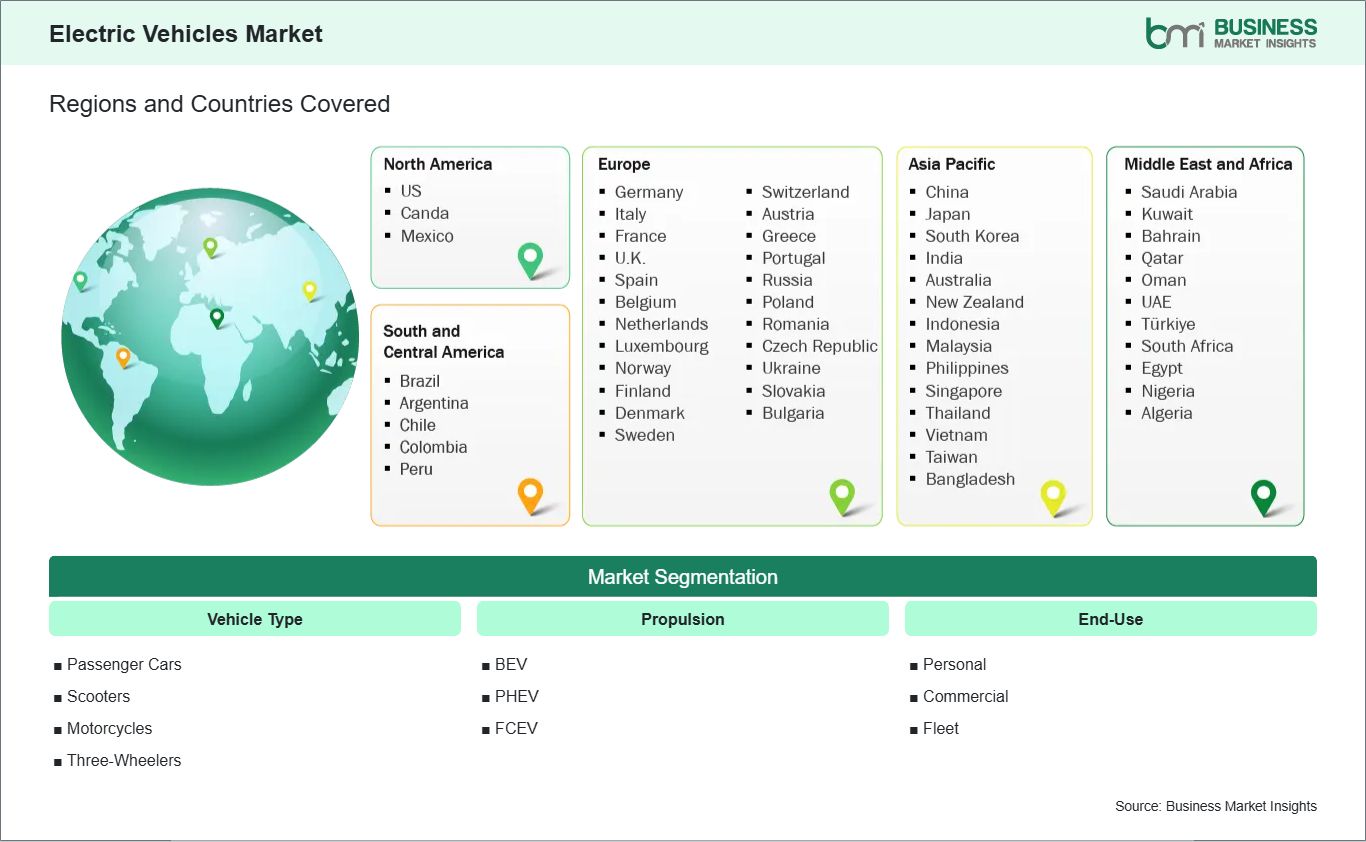
The electric vehicles market is segmented based on vehicle type, propulsion, and end-use, reflecting the expanding adoption of electrified mobility solutions across personal transportation, commercial operations, and fleet management applications.
By Vehicle Type
- Passenger Cars: Broad consumer acceptance and expanding model availability support strong market penetration.
- Scooters: Urban mobility requirements and cost-efficient transportation needs encourage widespread utilization.
- Motorcycles: Performance improvements and lower operating costs strengthen adoption among individual users.
- Three-Wheelers: Commercial transportation and last-mile mobility applications sustain significant deployment activity.
By Propulsion
- BEV: Zero-emission operation and advancing battery technologies reinforce market leadership.
- PHEV: Dual-power flexibility supports adoption in regions with developing charging infrastructure.
- FCEV: Extended driving range and rapid refueling capabilities enhance suitability for specialized applications.
By End-Use
- Personal: Consumer preference for sustainable and technologically advanced mobility solutions drives utilization.
- Commercial: Business operators adopt electric vehicles to improve efficiency and reduce operating expenses.
- Fleet: Large-scale fleet electrification initiatives support deployment across transportation and logistics services.
Market Forces
Electric Vehicles Market Drivers and Opportunities
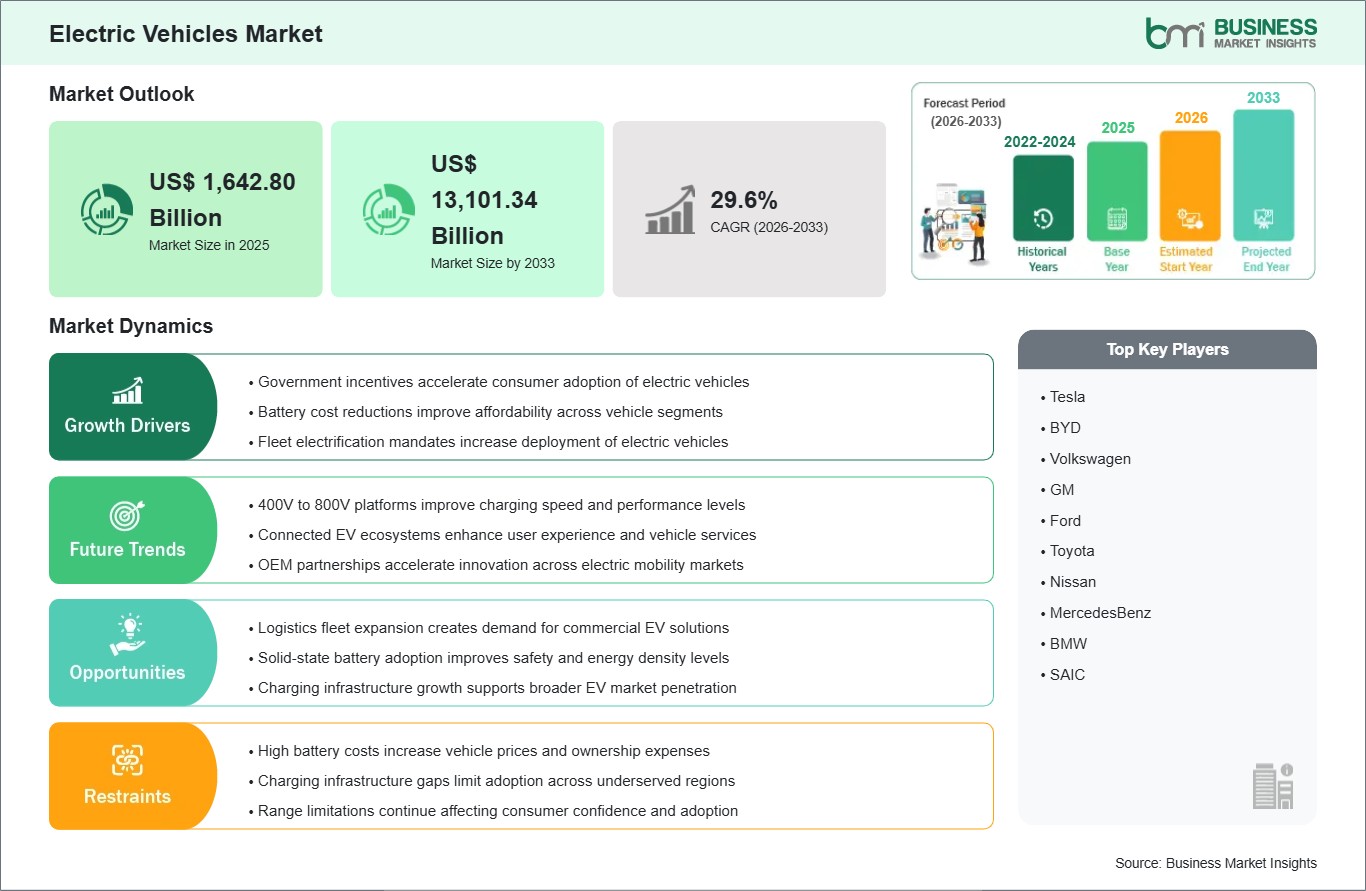
Government EV incentives
Incentive schemes are being used around the world to ensure a smooth transition from gasoline-powered vehicles to EVs. The financial incentives of reduced costs associated with purchasing vehicles, reduced taxes, reduced registration fees, and investments made in charging stations have contributed to the increased cost-efficiency of electric mobility. Such initiatives are encouraging people as well as businesses to choose EVs whenever they think of renewing their vehicle fleets.
Such measures not only facilitate the increased use of EVs but also help in creating conducive environments that are capable of encouraging investors to make long-term investments within the EV industry. In addition to helping meet national sustainability targets, these programs are proving instrumental in increasing the adoption of electric mobility around the world.
Expansion in logistics fleets
The logistics sector presents a substantial opportunity for electric vehicle deployment as transportation providers seek cost-effective and sustainable fleet solutions. Rising e-commerce activity and growing demand for efficient delivery services are encouraging operators to evaluate electrified alternatives for urban and regional transportation networks. Electric vehicles offer advantages such as lower operating expenses, reduced maintenance requirements, and compliance with emerging environmental regulations.
Future opportunities are expected to expand as battery technology improves and charging infrastructure becomes more accessible. Fleet operators are increasingly integrating electric vehicles into delivery, distribution, and service operations to optimize efficiency and support sustainability commitments. This transition is likely to accelerate the electrification of commercial transportation and strengthen demand for specialized fleet-oriented electric vehicle solutions.
Size and Share Analysis
Electric Vehicles Market Size and Share Analysis
The electric vehicles market is projected to grow from US$ 1,642.80 billion in 2025 to US$ 13,101.34 Billion by 2033, registering a CAGR of 29.6% from 2026 to 2033.
By vehicle type, the passenger cars accounts for a significant share due to widespread consumer adoption, expanding product availability, and strong policy support for personal electric mobility. Continuous advancements in vehicle range, charging convenience, and onboard technologies have reinforced the segment's market leadership.
By propulsion, the BEV leads the market owing to its fully electric operation, lower maintenance requirements, and alignment with global decarbonization objectives. Expanding charging infrastructure and improvements in battery performance have further strengthened adoption across personal and commercial transportation applications.
Report Coverage
Electric Vehicles Market Report Coverage and Deliverables
The "Electric Vehicles Market Size and Forecast (2022-2033)" report provides a detailed analysis of the market covering below areas:
- Market size and forecast at global, regional, and country levels for all key market segments covered under the scope
- Market trends, along with market dynamics such as drivers, restraints, and key opportunities
- Market analysis covering key trends, global and regional frameworks, major players, regulations, and recent developments
- Industry landscape and competitive analysis covering market concentration, heat map analysis, prominent players, and recent developments
- Detailed company profiles, including SWOT analysis
Geographic Insights
Electric Vehicles Market Geographic Insights
The Electric Vehicles market shows diverse regional adoption patterns influenced by government policies, charging infrastructure development, consumer preferences, and automotive manufacturing capabilities. Regional growth trajectories vary according to regulatory support, energy transition strategies, and investments in transportation electrification ecosystems.
North America maintains strong market activity due to expanding charging infrastructure, supportive policy initiatives, and increasing consumer acceptance of electric mobility. Automakers and fleet operators continue investing in electrification strategies to address evolving environmental regulations and changing transportation preferences.
Asia Pacific represents a major center of electric vehicle adoption, supported by large-scale manufacturing capacity, government-backed electrification programs, and rising urban mobility requirements. Strong domestic demand and investments in battery production are encouraging widespread deployment across passenger and commercial vehicle categories.
Europe continues to demonstrate significant adoption driven by stringent emission regulations, sustainability targets, and robust charging network expansion. Emerging markets in Latin America, the Middle East, and Africa are gradually increasing electric vehicle utilization as governments introduce supportive policies, infrastructure projects, and initiatives aimed at reducing transportation emissions and improving energy efficiency.
Industry Activity
Recent Developments
The electric vehicles market is evaluated by gathering qualitative and quantitative data post primary and secondary research, which includes important corporate publications, association data, and databases. Recent developments and news in the market include:
- June 2026, Tata Motors announced a strategic collaboration with Chery Automobile to utilize Chery's EV technology platform for its upcoming Avinya premium electric vehicle range, accelerating product development and strengthening Tata Motors' position in the global electric vehicle market.
- In March 2025, BYD launched the Super e-Platform, featuring flash-charging batteries, a 30,000 RPM motor, and new silicon carbide (SiC) power chips. The platform upgrades the core electric components, achieving a charging power of 1 megawatt (1000 kW) and a peak charging speed of 2 kilometers per second, making it the fastest for mass-produced vehicles - 5 minutes of charging for 400 kilometers of range.
Trust & Transparency
Research Methodology
The market analysis combines proprietary research with secondary data from government agencies, company disclosures, regulatory filings, industry databases and expert interviews. Market estimates are validated through data triangulation, cross-market benchmarking and analyst
review.
View Full Research Methodology
Key Sources Referred:
Society of Automotive Engineers Institute of Electrical and Electronics Engineers (IEEE) European Automobile Manufacturers' Association (ACEA) Japan Automobile Manufacturers Association (JAMA) China Association of Automobile Manufacturers (CAAM) Indian Automotive Component Manufacturers Association (ACMA) International Energy Agency (IEA) Electric Drive Transportation Association (EDTA) International Road Transport Union (IRU) Company Websites Company Annual Reports Company Investor Presentations