
Electric Cargo Bike Market Outlook: Size, Share, Trends, Growth Analysis, Competitive Landscape & Forecast, 2026-2033

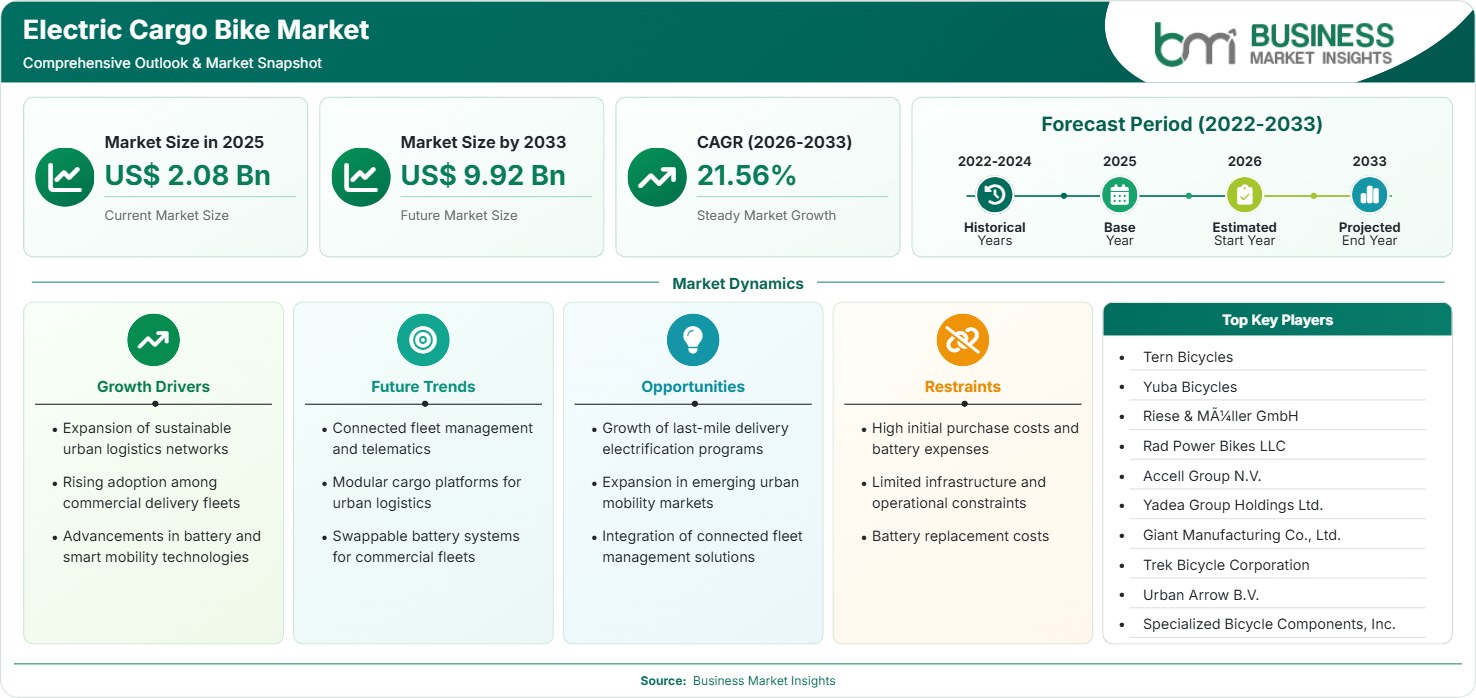
The Electric Cargo Bike Market size was valued at US$2.08 billion in 2025 and is projected to reach US$9.92 billion by 2033, growing at a CAGR of 21.56% during 2026–2033. Growth is supported by expanding urban logistics, increasing adoption of zero-emission delivery fleets, favourable government incentives for e-mobility, and sustained investments in cycling infrastructure and connected fleet technologies.

Report Coverage
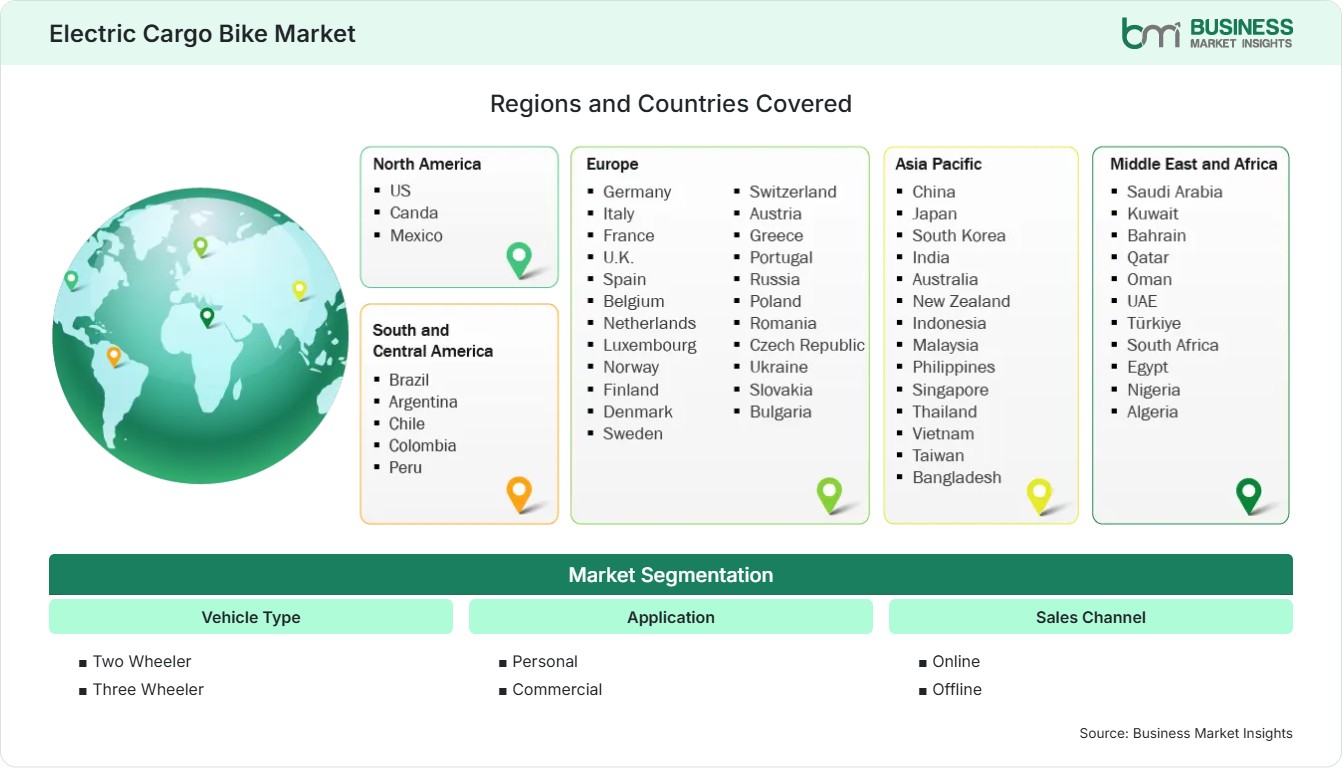
  • Vehicle Type: Two Wheeler, Three Wheeler
  • Application: Personal, Commercial
  • Sales Channel: Online, Offline
US$ 2.08 Bn Market size in 2025
US$ 9.92 Bn Market Size by 2033
21.56% CAGR, 2026 - 2033
2026-2033 Forecast Period

01 AI Overview

Electric Cargo Bike Market Summary

  • North America Region: North America accounts for 18%–21% of the global market in 2025 and is projected to expand at a 20%–22% CAGR through 2033. Commercial fleet electrification, municipal sustainability initiatives, and rapid e-commerce expansion continue to stimulate demand. The U.S. Electric Cargo Bike Market benefits from corporate fleet investments and growing urban cycling infrastructure.
  • Fastest Growing Region: Asia Pacific represents 30%–33% of global demand in 2025 while advancing at a 23%–25% CAGR. Strong manufacturing capacity, government EV incentives, expanding logistics networks, and increasing urban congestion support accelerated adoption and electric cargo bike market growth.
  • Leading Segment: Commercial application holds approximately 60%–64% market share during 2025 and is forecast to grow at 22%–24% CAGR, supported by parcel delivery, food logistics, and last-mile transportation requirements.
  • High Growth Segment: The online sales channel represents 32%–35% market share while expanding at 24%–26% CAGR, driven by direct-to-consumer sales, digital product customization, and wider availability of financing options.
  • Key Market Opportunity: Expansion of zero-emission urban logistics hubs, battery-swapping ecosystems, and municipal incentive programs creates attractive long-term investment opportunities across commercial fleet deployments.
  • Major Market Players: Tern Bicycles Pte. Ltd., Yuba Bicycles LLC, Riese & Müller GmbH, Rad Power Bikes Inc., Accell Group N.V., Yadea Group Holdings Ltd., Giant Manufacturing Co., Ltd., Trek Bicycle Corporation, Urban Arrow B.V., Specialized Bicycle Components, Inc.
02 Strategic Insights

Electric Cargo Bike Market: Strategic Insights

Electric Cargo Bike Market Strategic Framework
FREE PDF
Request your free sample
Request free sample
03 Stakeholder View

Key Takeaways

  • Supply chains are becoming increasingly regionalized as manufacturers diversify battery sourcing, drivetrain suppliers, and assembly facilities to improve resilience against geopolitical and logistics disruptions.
  • Commercial logistics continues offering the strongest revenue opportunity because retailers and parcel operators increasingly replace light commercial vans with electrically assisted cargo bicycles in dense urban centers.
  • Innovation is shifting toward smart fleet management platforms, predictive maintenance, integrated GPS tracking, IoT connectivity, modular cargo configurations, and higher energy-density lithium-ion battery systems.
  • Asia Pacific presents one of the strongest investment opportunities owing to expanding manufacturing ecosystems, favorable industrial policies, growing urban populations, and rapidly increasing e-commerce deliveries.
  • Strategic acquisitions and partnerships increasingly focus on battery technologies, digital mobility platforms, urban logistics software, and direct-to-business fleet solutions to strengthen competitive positioning.
  • Sustainability regulations across major metropolitan regions continue accelerating procurement decisions among logistics operators seeking lower emissions, reduced congestion costs, and improved delivery efficiency.
04 Geographic Outlook

Electric Cargo Bike Market Regional Highlights

North America Electric Cargo Bike Market

North America held a 18%–21% share in 2025 and is projected to expand at a 20%–22% CAGR from 2026–2033. The region benefits from rising urban freight electrification, corporate sustainability targets, and increasing adoption among delivery operators. The Electric Cargo Bike Market share reflects growing demand from metropolitan logistics networks, especially where congestion and emission regulations influence fleet decisions.

  • Growing demand from last-mile delivery providers is increasing adoption as businesses seek lower operating costs, reduced delivery emissions, and alternatives to traditional urban commercial vehicles.
  • Government incentives, cycling infrastructure investments, and municipal clean transportation programs are improving consumer and commercial acceptance across major North American cities.
  • Fleet operators are integrating connected tracking systems and advanced batteries to improve utilization rates, route planning efficiency, and operational visibility.
  • Increasing availability of specialized cargo models from domestic and international manufacturers is expanding product choices for households, businesses, and institutional buyers.

US Electric Cargo Bike Market

The U.S. market represented approximately 15%–18% share in 2025 and is expected to register a 20%–22% CAGR between 2026–2033. Growth is supported by urban logistics transformation, increasing retailer adoption, and demand for sustainable transportation solutions. The Electric Cargo Bike Market forecasts indicate strong potential from commercial delivery applications and expanding consumer interest in family-oriented cargo transportation.

  • Major cities are encouraging cargo bike adoption through mobility programs, dedicated cycling lanes, and policies aimed at reducing urban transportation emissions.
  • E-commerce growth continues driving demand among logistics companies seeking efficient solutions for short-distance delivery operations and dense metropolitan routes.
  • Product innovation in battery capacity, safety features, and modular cargo designs is improving acceptance among residential and commercial users.

Europe Electric Cargo Bike Market

Europe accounted for 35%–38% share in 2025 and is forecast to grow at a 21%–23% CAGR during 2026–2033. The region remains a mature adoption hub due to strong cycling culture, environmental regulations, and established urban mobility frameworks. Germany, the Netherlands, France, and the United Kingdom represent leading markets, while Germany and the Netherlands are projected to maintain strong growth momentum.

  • Germany continues to support commercial fleet adoption through logistics modernization programs and increasing investment in sustainable urban transportation systems.
  • The Netherlands benefits from established cycling infrastructure, high consumer acceptance, and strong integration of cargo bikes into daily mobility patterns.
  • France is expanding adoption through urban decarbonization policies and incentives encouraging low-emission delivery solutions in metropolitan areas.
  • The United Kingdom is experiencing rising demand from retailers and courier companies implementing alternative last-mile delivery strategies.

Asia Pacific Electric Cargo Bike Market

Asia Pacific represented 30%–33% share in 2025 and is expected to achieve a 23%–25% CAGR from 2026–2033, making it the fastest-growing regional market. Strong manufacturing capabilities, expanding e-commerce ecosystems, and government-backed electrification initiatives support rapid adoption. China, Japan, India, and Southeast Asian economies are emerging as important growth centers.

  • China maintains a dominant production ecosystem with extensive battery supply chains, large-scale manufacturing capacity, and increasing domestic logistics applications.
  • India is witnessing rising interest from delivery companies due to growing urban commerce, lower operating costs, and government support for electric mobility.
  • Japan is adopting cargo bikes through compact urban mobility solutions designed for aging populations and efficient neighborhood transportation.
  • Southeast Asian markets are gaining traction as online commerce growth increases demand for flexible delivery vehicles.

Rest of World Electric Cargo Bike Market

Rest of World accounted for 8%–10% share in 2025 and is projected to grow at a 18%–21% CAGR between 2026–2033. South and Central America are gradually adopting cargo bikes through urban logistics initiatives, while Middle East and Africa markets are developing through sustainability programs and smart city investments.

Countries including Brazil, Mexico, the UAE, and South Africa are emerging opportunities due to growing interest in low-emission transportation.

  • Brazil is experiencing gradual commercial adoption as logistics operators explore affordable electric mobility options for urban delivery routes.
  • Mexico benefits from expanding e-commerce activity and increasing demand for efficient transportation solutions in metropolitan regions.
  • The UAE is promoting sustainable mobility through smart city programs and investments in environmentally responsible transportation infrastructure.
  • South Africa is developing adoption opportunities through urban mobility initiatives and increasing awareness of alternative delivery systems.
  • Latin American and Middle Eastern markets continue attracting investment as businesses evaluate cost-efficient solutions for urban freight challenges.
Global Market Geography
FREE PDF
Request your free sample
Request free sample
05 Segment Analysis

Electric Cargo Bike Market Segmentation

Vehicle Type

The Vehicle Type segment accounted for a significant portion of the Electric Cargo Bike Market in 2025, supported by increasing demand for flexible urban transportation and commercial delivery solutions. The segment held approximately 70%–73% share in 2025 and is projected to grow at a 21%–23% CAGR from 2026–2034. Adoption is influenced by payload requirements, route efficiency, infrastructure availability, and evolving consumer preferences for sustainable mobility alternatives.

  • Two Wheeler: Two-wheeler cargo bikes are widely adopted for personal mobility, small business deliveries, and urban commuting due to compact designs, manoeuvrability, and lower operating costs.
  • Three Wheeler: Three-wheeler cargo bikes support higher payload transportation requirements for commercial logistics, retail deliveries, and businesses requiring improved stability and cargo capacity.

Application

The Application segment represents a critical growth area within the Electric Cargo Bike Market, driven by increasing use across household transportation and commercial logistics operations. The segment held approximately 60%–64% share in 2025 and is expected to expand at a 22%–24% CAGR from 2026–2034. Rising urban congestion, delivery demand, and sustainability commitments are encouraging wider deployment across multiple end-use scenarios.

  • Personal: Personal applications are increasing as families and urban residents adopt cargo bikes for transportation, childcare mobility, shopping, and recreational activities.
  • Commercial: Commercial applications are expanding rapidly due to demand from parcel delivery companies, retailers, food delivery operators, and businesses seeking efficient last-mile transportation solutions.

Sales Channel

The Sales Channel segment category indicates the change in buying behavior, where manufacturers integrate their traditional channels of distribution with the online distribution strategy. This category was responsible for growth in adoption in 2025 and is expected to register a 24%-26% CAGR between 2026 and 2034. The Electric Cargo Bike Market trends indicate increasing preference for online purchasing due to broader product availability, customization options, and direct manufacturer engagement.

  • Online: Online sales channels are gaining momentum through direct-to-consumer platforms, digital financing options, virtual product consultations, and simplified purchasing experiences for residential and commercial buyers.
  • Offline: Offline channels remain important for customers requiring physical product evaluation, professional guidance, servicing support, and dealer-based maintenance networks.
06 Market Forces

Electric Cargo Bike Market Dynamics

Key Market Drivers

Expansion of Sustainable Urban Logistics Networks

The movement towards lower-emission urban transport is contributing to the increase in the growth of the Electric Cargo Bike Market, with logistics companies looking for other means apart from traditional delivery vehicles. The International Energy Agency notes that transport is among the highest emitters of energy emissions, and this has led to cities adopting more sustainable modes of transportation. More deliveries through e-commerce, congestion restrictions, and the creation of zero-emission zones in European and North American cities are boosting the market.

Rising Adoption Among Commercial Delivery Fleets

Deployment of commercial fleets is rapidly emerging as a critical driver of growth, as companies consider total cost of ownership, flexibility, and sustainability targets. Electric cargo bicycles have an edge in areas with high congestion and where parking for other modes of transportation is difficult. Logistics companies are gradually incorporating electric cargo bicycles into their delivery systems as part of a hybrid approach to goods delivery. Online retailing and food delivery services, coupled with local distribution services, will drive demand for commercial applications.

Advancements in Battery and Smart Mobility Technologies

Advancements in technology are increasing product efficacy and expanding the use of electric cargo bikes. This includes the development of high-capacity lithium-ion batteries, motor efficiency, connectivity, and cargo modularity. The developments will help to make sure that the travel distance increases and the maintenance costs decrease. In addition to this, the inclusion of GPS tracking, diagnostics, and application controls has added more value to businesses using such products.

Key Market Opportunities

Growth of Last-Mile Delivery Electrification Programs

The growing emphasis on sustainable delivery infrastructure will provide many chances for the expansion of the Electric Cargo Bike Market. The logistics industry, retailers, and local governments are opting for more environmentally friendly alternatives to conventional delivery vans due to issues related to urban congestion and carbon emissions. The creation of low-emission zones in cities all across Europe is driving companies to consider using electric cargo bikes for their delivery needs in short distances.

Expansion in Emerging Urban Mobility Markets

Developing countries have high growth potential due to urbanization and the development of transport systems. Asian, Pacific, Latin American, and Middle Eastern markets are seeing growing demand for affordable and efficient modes of transportation. The increasing volume of digital commerce, the development of charging networks, and governmental electrification programs provide favorable prerequisites for implementation. Electric cargo bikes can solve transportation problems in densely populated cities with challenging infrastructure. Companies that expand their distribution and production network will be able to capitalize on these new market potentials.

Integration of Connected Fleet Management Solutions

Digitization is an emerging opportunity that will arise from the integration of electric cargo bikes with fleet analytics, telematics, and automated monitoring tools. Businesses are beginning to demand information regarding their vehicle use, battery performance, optimal routing, and maintenance. These digital systems could help enhance efficiency and minimize operational costs within the logistics industry that handles several vehicles. Cooperation among bicycle producers, software developers, and mobility operators is projected to produce innovative business models. The emergence of fleet subscription and data-powered mobility platforms may create additional business opportunities in the commercial transport sector.

Market Restraints and Challenges

High Initial Purchase Costs and Battery Expenses

Factor: Higher up-front costs as compared to the costs of traditional bicycles still constitute an adoption obstacle, especially where there is a concern about price-sensitive customers and small business entities. The high cost is mainly attributed to the use of advanced batteries, motor power systems, and specially designed frame systems.

Impact: The high cost may delay the decision-making process, making adoption difficult for some commercial users without financing options. The low cost of maintenance, however, is an advantage.

Limited Infrastructure and Operational Constraints

Factor: Lack of infrastructure, inadequate charging infrastructure, and regulations that vary from place to place make it difficult to implement the technology widely. Most cities do not have proper lanes or parking facilities for cargo cycles.

Impact: Infrastructure limitations can affect route efficiency and hamper logistics companies' implementation. Regulations on cargo size, road access, and other parameters could also play an important role in implementation. Expansion of urban mobility plans will be crucial for implementing electric cargo bicycles.

07 Company Analysis

Competitive Landscape

The Electric Cargo Bike Market analysis indicates a competitive environment shaped by established bicycle manufacturers, specialized cargo bike developers, and mobility solution providers. Companies are focusing on expanding product portfolios, improving battery efficiency, developing commercial fleet solutions, and strengthening regional distribution networks. Leading participants compete through innovation, brand recognition, customization capabilities, and partnerships with logistics operators and urban mobility ecosystems.

Company Name

Overview

Products and Services relevant to this market

Tern Bicycles Pte. Ltd.

Global urban mobility company specializing in compact and cargo bicycles with a strong sustainability focus.

Electric cargo bikes, family mobility solutions, modular accessories, and urban transportation products.

Yuba Bicycles LLC

Cargo bicycle specialist developing practical solutions for families, businesses, and urban riders.

Electric cargo bikes, long-tail models, cargo accessories, and transportation-focused bicycle systems.

Riese & Müller GmbH

Premium German manufacturer recognized for innovative electric mobility and cargo bicycle engineering.

Electric cargo bikes, dual-battery systems, smart connectivity, and premium urban mobility solutions.

Rad Power Bikes Inc.

North American e-bike company offering accessible electric mobility products for consumers and businesses.

Electric cargo bikes, delivery-focused models, accessories, replacement components, and fleet solutions.

Accell Group N.V.

European bicycle manufacturer operating multiple established brands across electric mobility categories.

Electric cargo bicycles, urban e-bikes, commuter solutions, and integrated mobility products.

Yadea Group Holdings Ltd.

Global electric mobility manufacturer with extensive experience in electric two-wheelers.

Electric cargo bikes, battery-powered mobility products, smart vehicle technologies, and urban transportation solutions.

Giant Manufacturing Co., Ltd.

Major bicycle manufacturer with global production capabilities and advanced engineering expertise.

Electric cargo bicycles, e-bike systems, performance components, and mobility solutions.

Trek Bicycle Corporation

International bicycle brand expanding electric mobility offerings across consumer segments.

Electric cargo bikes, e-bike platforms, cycling accessories, and dealer-based mobility services.

Urban Arrow B.V.

Dutch cargo bike manufacturer focused on urban logistics and family transportation applications.

Electric cargo bikes, commercial delivery models, modular cargo systems, and fleet-oriented solutions.

Specialized Bicycle Components, Inc.

Premium bicycle manufacturer developing advanced electric cycling technologies.

Electric cargo bicycles, integrated motor systems, battery solutions, and performance cycling products.

08 Industry Activity

Recent Developments

June 2026

Movaria unveiled its latest generation of integrated e-bike and L6e drive systems for commercial cargo bikes at Eurobike 2026, featuring a chainless architecture with a generator, central control unit, optional 8-inch touchscreen HMI, 4G connectivity, and IoT-enabled fleet telematics for enhanced commercial fleet operations.

June 2026

Bajaj Auto and Delhivery partnered to deploy approximately 1,500 Bajaj RIKI electric cargo three-wheelers across Delhivery's logistics network over the next two years. The rollout supports the expansion of electric last-mile delivery services, with initial deployment beginning in smaller cities beyond major metropolitan markets.

April 2026

HOVSCO announced its 2026 HovCart electric cargo bike, featuring a 450 lb (204 kg) certified payload capacity, UL-certified Samsung and LG battery cells, and a riding range of up to 60 miles per charge, strengthening its portfolio for commercial and utility cargo transportation.

April 2026

JackRabbit Mobility launched the JackRabbit MG Cargo, an ultra-lightweight electric cargo bike weighing 55 lbs while supporting payloads of up to 500 lbs. The company also introduced ModRabbit, a modular accessory marketplace that enables users to customize cargo bikes with compatible third-party equipment for diverse commercial and personal applications.

10 Trust & Transparency

Research Methodology

The market analysis combines proprietary research with secondary data from government agencies, company disclosures, regulatory filings, industry databases and expert interviews. Market estimates are validated through data triangulation, cross-market benchmarking and analyst review.

View Full Research Methodology

11 Questions Answered

Frequently Asked Questions

What is covered in the Electric Cargo Bike Market Report?

The Market Report covers market sizing, segmentation analysis, competitive landscape, regional trends, growth factors, challenges, and future industry opportunities through 2033.

What role do government policies play in market development?

Government incentives, cycling infrastructure investments, and low-emission transportation policies are encouraging adoption by reducing barriers and supporting sustainable urban mobility initiatives.

Which technology developments are influencing future adoption?

Battery improvements, connected fleet systems, lightweight materials, advanced motors, and digital monitoring platforms are shaping future product development and operational efficiency.

How are businesses using electric cargo bicycles?

Businesses are deploying electric cargo bikes for parcel delivery, food distribution, retail logistics, maintenance services, and short-distance transportation in dense urban areas.

What factors are accelerating market adoption?

Urban congestion, stricter emission regulations, rising delivery demand, and improved battery technologies are accelerating adoption among commercial operators and consumers seeking efficient transportation alternatives.

Access the Full Electric Cargo Bike Market Report

Get segment-level forecasts, regional estimates, competitive benchmarking, company profiles and downloadable Excel datasets.

Access the full Electric Cargo Bike Market Report
350 pages PDF & Excel | 2026-07-30