
Cargo Bike Tire Market Outlook: Size, Share, Trends, Growth Analysis, Competitive Landscape & Forecast, 2026-2033

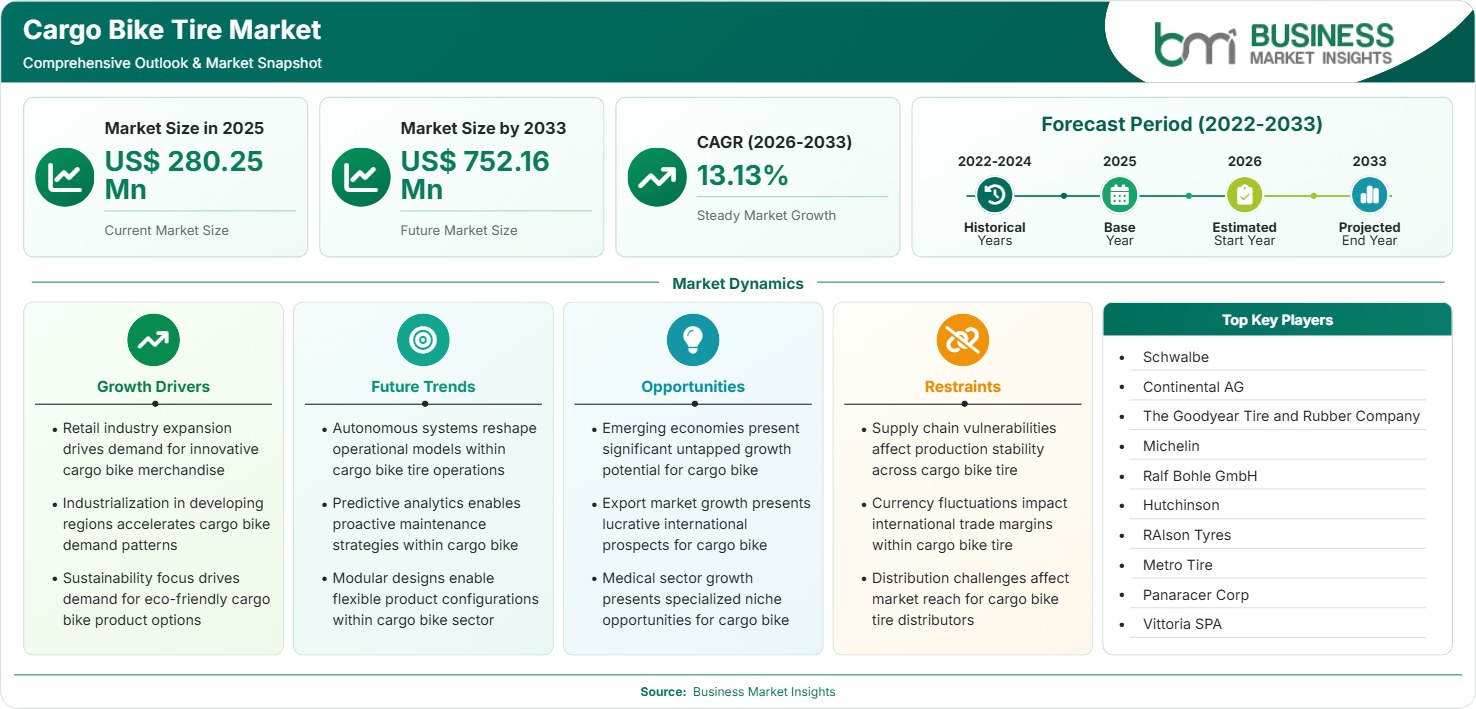
The Cargo Bike Tire Market size was valued at US$ 280.25 Million in 2025 and is projected to reach US$ 752.16 Million by 2033, growing at a CAGR of 13.13% during 2026–2033. Increasing demand for sustainable urban logistics, electric cargo bike adoption, e-commerce expansion, and low-emission transportation solutions are accelerating market growth opportunities.

Report Coverage
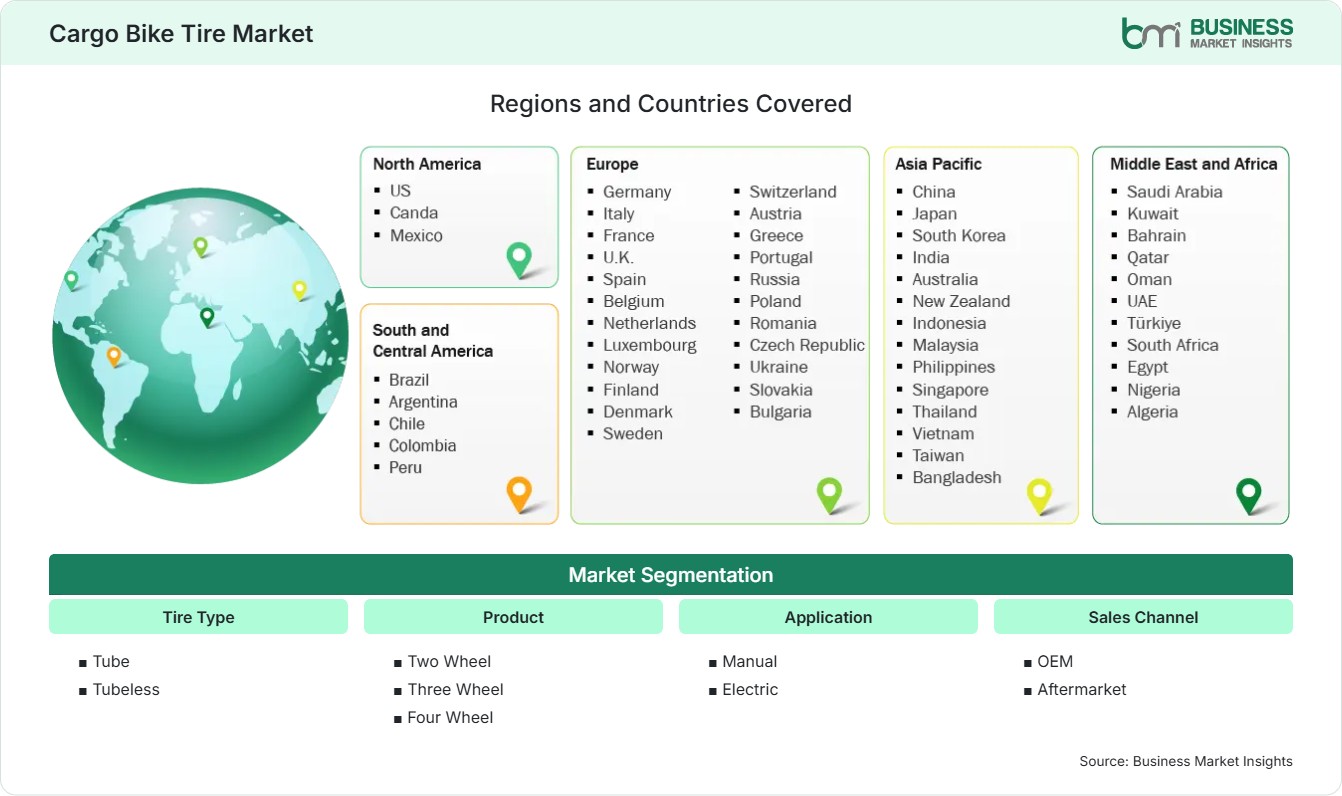
  • Tire Type: Tube, Tubeless
  • Product: Two Wheel, Three Wheel, Four Wheel
  • Application: Manual, Electric
  • Sales Channel: OEM, Aftermarket
US$ 280.25 Mn Market size in 2025
US$ 752.16 Mn Market Size by 2033
13.13% CAGR, 2026 - 2033
2026-2033 Forecast Period

AI Overview

Cargo Bike Tire Market Summary

  • North America Region: North America accounted for 28%–31% market share in 2025 and is projected to grow at a CAGR of 12.5%–13.2% during 2026–2033. The region is driven by commercial fleet adoption, sustainable delivery initiatives, and expanding urban mobility programs. The U.S. market remains the major contributor due to increasing e-commerce logistics demand, growing electric cargo bike usage, and investments in cycling infrastructure, registering a CAGR of 12.6%–13.3%.
  • Fastest Growing Region: Asia Pacific held 33%–36% market share in 2025 and is expected to expand at a CAGR of 14.2%–14.9%. Urbanization, rising online commerce, electric mobility adoption, and strong bicycle manufacturing capabilities are supporting regional expansion.
  • Leading Segment: Tubeless tires represented 55%–58% market share in 2025 and are projected to grow at a CAGR of 13.5%–14.1%. Better puncture resistance, reduced maintenance requirements, and improved durability support adoption across commercial applications.
  • High Growth Segment: Electric cargo bike applications are expected to record a CAGR of 15.0%–15.7% due to increasing fleet electrification, higher payload requirements, and demand for efficient urban delivery solutions.
  • Key Market Opportunity: Growth opportunities are emerging through electric fleet expansion, advanced tire technologies, aftermarket replacement demand, and partnerships between tire manufacturers and cargo bike producers.
  • Major Market Players: Schwalbe, Continental AG, The Goodyear Tire and Rubber Company, Michelin, Ralf Bohle GmbH, Hutchinson, Ralson Tyres, Metro Tyres Limited, Panaracer Corporation, Vittoria S.p.A., Hwa Fong Rubber Co., Ltd., Trelleborg AB, and Kenda Rubber Industrial Co., Ltd.
Strategic Insights

Cargo Bike Tire Market: Strategic Insights

Cargo Bike Tire Market Strategic Framework
FREE PDF
Request your free sample
Request free sample
Stakeholder View

Key Takeaways

  • The market ecosystem is supported by collaboration between tire manufacturers, cargo bike producers, logistics companies, mobility providers, and infrastructure developers focused on sustainable transportation.
  • Electric cargo bike adoption represents the strongest growth opportunity as commercial operators seek efficient, low-emission alternatives for last-mile delivery activities.
  • Tire innovation is shifting toward tubeless technologies, reinforced construction, puncture resistance, and advanced materials designed for heavier loads and longer operating cycles.
  • Asia Pacific provides significant expansion potential due to urban population growth, manufacturing strength, e-commerce development, and increasing electric mobility adoption.
  • Strategic partnerships between tire suppliers and cargo bike manufacturers are becoming important for improving product compatibility, vehicle efficiency, and long-term operational reliability.
Geographic Outlook

Cargo Bike Tire Market Regional Highlights

North America Cargo Bike Tire Market

North America accounted for 28%–31% share in 2025 and is expected to grow at a CAGR of 12.5%–13.2% during 2026–2033. Increasing commercial delivery demand, urban congestion challenges, and sustainability initiatives are supporting regional adoption. The U.S. and Canada are investing in cycling infrastructure and low-emission transportation systems. The Cargo Bike Tire Market share is strengthening as logistics providers increasingly use cargo bikes for efficient last-mile delivery and reduced transportation costs.

  • Commercial logistics companies are adopting cargo bikes to improve urban delivery efficiency and reduce dependence on traditional vehicles.
  • Electric cargo bike deployment is increasing due to fleet electrification programs and demand for sustainable transportation solutions.
  • Manufacturers are introducing reinforced tires with improved durability, puncture protection, and higher load-bearing capabilities.
  • Government initiatives supporting clean mobility and cycling infrastructure are encouraging broader market adoption.

US Cargo Bike Tire Market

The United States represented 82%–85% of the North American Cargo Bike Tire Market revenue in 2025 and is projected to expand at a CAGR of 12.6%–13.3% through 2033. Growth is supported by increasing e-commerce deliveries, commercial fleet adoption, and demand for efficient urban transportation. Businesses are adopting cargo bikes for short-distance logistics, while manufacturers are focusing on durable tire solutions suitable for electric models and intensive operating conditions.

  • Urban delivery operators are integrating cargo bikes to overcome congestion and improve transportation efficiency.
  • Electric cargo bike fleets are increasing demand for durable tires designed for higher weight and longer operating cycles.
  • Online distribution channels are improving access to specialized cargo bike tire products across consumer and commercial markets.

Europe Cargo Bike Tire Market

Europe accounted for 30%–33% Cargo Bike Tire Market share in 2025 and is anticipated to grow at a CAGR of 13.0%–13.7% during 2026–2033. The region remains a major adoption center due to established cycling infrastructure, environmental regulations, and strong urban mobility planning. Germany, the Netherlands, Denmark, France, and the United Kingdom are key markets. Increasing investment in zero-emission logistics is supporting demand for durable and high-performance cargo bike tires.

  • Germany and the Netherlands lead adoption due to advanced cycling infrastructure and strong commercial cargo bike usage.
  • Low-emission zones across European cities are encouraging businesses to replace conventional delivery vehicles.
  • Electric cargo bikes are gaining popularity among retailers, logistics providers, and municipal service operators.
  • Tire manufacturers are developing products suited for varied weather conditions and intensive urban applications.

Asia Pacific Cargo Bike Tire Market

Asia Pacific represented 33%–36% share in 2025 and is projected to register the fastest CAGR of 14.2%–14.9% from 2026–2033. The region benefits from rapid urbanization, expanding e-commerce activities, bicycle manufacturing capabilities, and increasing adoption of electric mobility. China, India, Japan, and Southeast Asian economies are emerging as important markets. The Cargo Bike Tire Market growth in Asia Pacific is supported by demand for efficient, affordable, and sustainable transportation solutions.

  • China maintains a leading position through large-scale bicycle production and expanding urban delivery networks.
  • India is witnessing increasing adoption due to e-commerce growth, urban logistics demand, and affordable mobility requirements.
  • Japan and South Korea are investing in advanced compact transportation solutions for urban environments.
  • Southeast Asian markets are benefiting from population growth, online commerce expansion, and sustainable mobility initiatives.

Rest of World Cargo Bike Tire Market

The Rest of World region accounted for 7%–9% market share in 2025 and is forecast to grow at a CAGR of 11.8%–12.6% during 2026–2033. South and Central America, along with the Middle East and Africa, are gradually adopting cargo bikes due to increasing urban delivery needs and sustainability programs. Improving transportation infrastructure and awareness of alternative mobility solutions are creating opportunities for market participants.

  • Brazil and Mexico are emerging markets due to growing retail networks, urban delivery demand, and interest in sustainable logistics.
  • Middle Eastern cities are exploring cargo bikes as part of smart city and environmental mobility strategies.
  • South Africa is developing opportunities through urban transportation improvements and commercial delivery applications.
  • Regional distributors are expanding availability through partnerships with international tire manufacturers.
  • Businesses are evaluating cargo bikes to reduce operating expenses and improve delivery efficiency.
Global Market Geography
FREE PDF
Request your free sample
Request free sample
Segment Analysis

Cargo Bike Tire Market Segmentation

Tire Type

The Tire Type segment influences cargo bike efficiency, safety, durability, and maintenance requirements. Tubeless tires held the leading position with 55%–58% share in 2025 and are expected to expand at a CAGR of 13.5%–14.1% during 2026–2033. Increasing commercial usage, electric cargo bike adoption, and demand for reduced downtime are accelerating preference for advanced tire solutions. The Cargo Bike Tire Market trends indicate stronger adoption of puncture-resistant technologies and high-performance designs.

  • Tube: Tube tires maintain demand due to affordability, easy replacement, widespread availability, and suitability for entry-level cargo bikes and cost-sensitive applications requiring simple maintenance.
  • Tubeless: Tubeless tires are gaining traction due to improved puncture resistance, enhanced stability, lower maintenance requirements, and better performance under heavy-load commercial cargo bike operations.

Product

The Product segment includes Two Wheel, Three Wheel, and Four Wheel cargo bike configurations serving different transportation needs. Two Wheel cargo bikes represented the largest category with 48%–51% share in 2025 and are projected to grow at a CAGR of 12.8%–13.5% through Cargo Bike Tire Market Forecasts. Their maneuverability, compact design, and suitability for urban logistics support strong adoption among businesses and consumers. Increasing delivery requirements are strengthening demand across product categories.

  • Two Wheel: Two-wheel cargo bikes remain widely adopted because of efficient navigation, lower operating costs, flexible usage, and compatibility with urban delivery requirements.
  • Three Wheel: Three-wheel cargo bikes are expanding due to improved stability, increased load capacity, and suitability for commercial applications requiring reliable transportation performance.
  • Four Wheel: Four-wheel cargo bikes are gaining attention for specialized logistics operations where maximum stability, higher payload capability, and enhanced safety are required.

Application

The Application segment is experiencing significant transformation due to increasing demand for sustainable mobility and efficient delivery systems. Electric applications accounted for 62%–65% share in 2025 and are expected to grow at a CAGR of 15.0%–15.7% during 2026–2033. Rising fleet electrification, improved battery technology, and growing demand for low-emission logistics are accelerating electric cargo bike adoption. The Cargo Bike Tire scope continues expanding with increasing commercial applications.

  • Manual: Manual cargo bikes continue serving small businesses and individual users due to lower purchase costs, simple operation, and minimal maintenance requirements.
  • Electric: Electric cargo bikes are growing rapidly because of higher carrying capacity, reduced rider effort, improved efficiency, and suitability for commercial delivery operations.

Sales Channel

The Sales Channel segment consists of OEM and Aftermarket distribution networks supporting original equipment supply and replacement demand. Aftermarket channels accounted for 58%–61% Cargo Bike Tire Market share in 2025 and are projected to grow at a CAGR of 12.9%–13.6% during 2026–2033. Increasing cargo bike utilization, replacement cycles, and fleet maintenance requirements are driving aftermarket expansion. OEM partnerships remain essential for delivering compatible tire solutions with newly manufactured cargo bikes.

  • OEM: OEM channels are expanding through collaborations between tire manufacturers and cargo bike producers developing customized solutions for electric and commercial mobility applications.
  • Aftermarket: Aftermarket demand is increasing through replacement needs, online availability, specialty retailers, and growing requirements for durable cargo bike tire solutions.
Market Forces

Cargo Bike Tire Market Dynamics

Key Market Drivers

Expansion of Sustainable Urban Logistics Networks

Increasing urban congestion, rising e-commerce deliveries, and emission reduction targets are encouraging logistics providers to adopt cargo bikes for last-mile transportation. Businesses are replacing conventional delivery methods with compact mobility solutions to improve efficiency and reduce operating expenses. This shift is supporting Cargo Bike Tire Market growth as commercial users require durable tires capable of handling frequent usage, heavier loads, and diverse road conditions. Manufacturers are developing reinforced sidewalls, improved tread patterns, and advanced rubber compounds to improve reliability. The expansion of urban logistics networks, combined with sustainability-focused transportation policies, is creating long-term demand for specialized cargo bike tire solutions across developed and emerging markets.

Increasing Adoption of Electric Cargo Bikes

The rapid adoption of electric cargo bikes is creating strong demand for specialized tires designed for higher vehicle weight, increased payload capacity, and extended operating cycles. Electric models enable businesses to improve delivery productivity while reducing physical effort and operational costs. The transition toward battery-powered transportation is influencing Cargo Bike Tire Market trends as manufacturers focus on stronger construction, puncture resistance, and enhanced stability. Fleet operators increasingly require tires that can withstand intensive commercial usage while maintaining safety and efficiency. Advancements in tire materials, manufacturing processes, and performance engineering are supporting product development targeted toward electric cargo bike applications across logistics, retail, and service sectors.

Growth of Cycling Infrastructure and Low-Emission Mobility Policies

Government initiatives supporting cycling infrastructure and sustainable transportation are improving the adoption potential of cargo bikes worldwide. Investments in dedicated bicycle lanes, smart mobility programs, and emission reduction strategies are encouraging businesses to integrate cargo bikes into urban transportation systems. These developments are increasing the need for reliable tires capable of supporting commercial and personal applications. Improved infrastructure enhances operational safety, encourages higher vehicle utilization, and strengthens market acceptance. Tire manufacturers are responding by developing products optimized for different climates, road conditions, and usage patterns. Continued policy support for clean transportation is expected to create favorable conditions for cargo bike tire adoption.

Key Market Opportunities

Commercial Fleet Electrification and Logistics Transformation

The electrification of delivery fleets creates significant opportunities for cargo bike tire manufacturers. Logistics providers, retailers, and food delivery companies are adopting electric cargo bikes to improve efficiency, lower transportation costs, and achieve sustainability objectives. These vehicles require durable tires capable of supporting higher loads and longer operating hours. Manufacturers offering advanced tubeless designs, reinforced structures, and application-specific solutions can benefit from increasing commercial demand. Partnerships with cargo bike manufacturers and fleet operators can strengthen market positioning by enabling integrated mobility solutions. As urban delivery networks continue evolving, demand for high-performance tires designed specifically for electric cargo bikes is expected to increase.

Innovation in Advanced Tire Materials and Designs

Technological advancements in tire compounds, manufacturing methods, and product engineering are creating new growth opportunities. Companies are investing in puncture-resistant materials, lightweight construction, improved grip technologies, and extended-life tire designs to address commercial user requirements. Advanced materials help reduce maintenance frequency while improving safety and performance. Smart tire technologies with monitoring capabilities may provide additional opportunities by improving fleet management and operational visibility. Manufacturers focusing on research and development can differentiate their offerings by delivering solutions that improve durability and efficiency. These innovations are expected to support wider cargo bike adoption across logistics, commercial transportation, and urban mobility applications.

Expansion of Aftermarket Replacement Demand

The increasing installed base of cargo bikes is generating long-term opportunities in replacement tire demand. Commercial operators using cargo bikes regularly require maintenance and replacement products due to higher operating intensity compared with personal bicycles. Online marketplaces, specialty retailers, and service networks are improving product accessibility for customers. Manufacturers expanding aftermarket distribution and offering application-specific tire options can capture recurring revenue opportunities. As cargo bikes become increasingly integrated into urban transportation systems, replacement demand will continue growing. Strong aftermarket networks, broad product availability, and efficient supply chains will become important competitive factors for companies seeking sustainable revenue growth.

Market Restraints and Challenges

High Production Costs of Specialized Cargo Bike Tires

Factor: Cargo bike tires require reinforced structures, advanced rubber compounds, higher load capacity, and specialized manufacturing processes compared with conventional bicycle tires.

Impact: An increase in the cost of production may result in price hikes and limit usage by small-scale firms and price-sensitive consumers. Companies need to strike a balance between improved functionality and reduced cost, all the while preserving the reliability of the products. Efficient material selection, local production, and effective supply chain management should be implemented in order to alleviate cost concerns. This problem is especially important for emerging economies where the initial costs of purchase play a key role in decision-making processes.

Limited Infrastructure Development and Market Awareness

Factor: Cargo bike adoption remains influenced by insufficient cycling infrastructure, limited consumer awareness, and uneven urban mobility planning in several developing regions.

Impact: The deficiency in the infrastructure can hinder the market growth by reducing the usefulness of cargo bikes. Businesspeople would hesitate to invest in the presence of no cycling infrastructure, no maintenance options and no favorable policies. There is a need for more awareness campaigns, investment in infrastructure and incentives from the government in order to enhance the adoption rate. Better urban planning and sustainable mobility can resolve such obstacles and even provide chances for growth in cargo bike tire manufacturers.

Company Analysis

Competitive Landscape

The competitive environment is influenced by product innovation, sustainable mobility strategies, advanced tire technologies, and partnerships with cargo bike manufacturers. The Cargo Bike Tire Market analysis highlights that companies are focusing on durable materials, tubeless technologies, reinforced designs, and expanded distribution networks to support growing demand from commercial and electric cargo bike applications.

Company Name

Overview

Products and Services Relevant to this Market

Schwalbe

Bicycle tire specialist offering premium mobility solutions with strong focus on durability and performance.

Cargo bike tires, puncture-resistant tires, tubeless systems, bicycle tire solutions, and replacement products.

Continental AG

Global mobility technology company providing advanced tire solutions across transportation segments.

Bicycle tires, cargo bike tires, rubber technologies, performance compounds, and protection systems.

The Goodyear Tire and Rubber Company

Global tire manufacturer developing mobility solutions and advanced tire technologies.

Bicycle tires, specialty mobility products, rubber compounds, and sustainable tire solutions.

Michelin

International tire company focused on sustainable mobility and high-performance technologies.

Bicycle tires, advanced rubber solutions, durable tire technologies, and mobility products.

Ralf Bohle GmbH

Bicycle component company operating Schwalbe brand tire solutions globally.

Cargo bike tires, tubes, bicycle systems, accessories, and specialty mobility products.

Hutchinson

French manufacturer specializing in bicycle and mobility tire technologies.

Bicycle tires, puncture-resistant solutions, rubber technologies, and performance products.

Ralson Tyres

Indian tire manufacturer producing bicycle and mobility tire products.

Bicycle tires, specialty tires, tubes, and replacement solutions.

Metro Tyres Limited

Manufacturer supplying bicycle tires and mobility products across international markets.

Bicycle tires, tubes, mobility tires, and aftermarket products.

Panaracer Corporation

Japanese bicycle tire manufacturer known for performance-oriented products.

Bicycle tires, utility tires, cargo bike compatible solutions, and advanced compounds.

Vittoria S.p.A.

Italian bicycle tire company focused on premium tire technologies.

Bicycle tires, tubeless systems, advanced compounds, and performance solutions.

Hwa Fong Rubber Co., Ltd.

Taiwan-based manufacturer producing bicycle tires and rubber products.

Bicycle tires, tubes, OEM manufacturing, and specialty rubber solutions.

Trelleborg AB

Global engineered polymer company serving industrial and mobility applications.

Advanced rubber solutions, engineered materials, and mobility components.

Kenda Rubber Industrial Co., Ltd.

Global tire manufacturer offering bicycle and specialty mobility products.

Cargo bike tires, bicycle tires, tubes, OEM solutions, and mobility products.

Trust & Transparency

Research Methodology

The market analysis combines proprietary research with secondary data from government agencies, company disclosures, regulatory filings, industry databases and expert interviews. Market estimates are validated through data triangulation, cross-market benchmarking and analyst review.

View Full Research Methodology

Questions Answered

Frequently Asked Questions

What opportunities will shape future cargo bike tire development?

The Cargo Bike Tire Market Report highlights that future opportunities include advanced materials, smart tire technologies, fleet partnerships, aftermarket expansion, and increasing adoption of cargo bikes within sustainable urban transportation networks.

What factors influence cargo bike tire purchasing decisions?

Buyers evaluate durability, load capacity, puncture protection, rolling efficiency, maintenance requirements, weather performance, and compatibility with different cargo bike configurations.

Which application segment has stronger growth potential?

Electric cargo bike applications have stronger growth potential due to fleet electrification, improved battery performance, higher payload capability, and increasing use among logistics operators.

Why are tubeless tires gaining adoption in cargo bike applications?

Tubeless tires provide improved puncture resistance, reduced maintenance needs, enhanced stability, and better durability, making them suitable for commercial and electric cargo bike operations.

What is the increasing demand for the Cargo Bike Tire Market globally?

Growing urban logistics requirements, e-commerce expansion, electric cargo bike adoption, sustainability policies, and demand for efficient last-mile transportation are driving increased demand for specialized cargo bike tires.

Access the Full Cargo Bike Tire Market Report

Get segment-level forecasts, regional estimates, competitive benchmarking, company profiles and downloadable Excel datasets.

Access the full Cargo Bike Tire Market Report
350 pages PDF & Excel | 2026-08-17