
Cargo Vans Market Outlook: Size, Share, Trends, Growth Analysis, Competitive Landscape & Forecast, 2026-2033

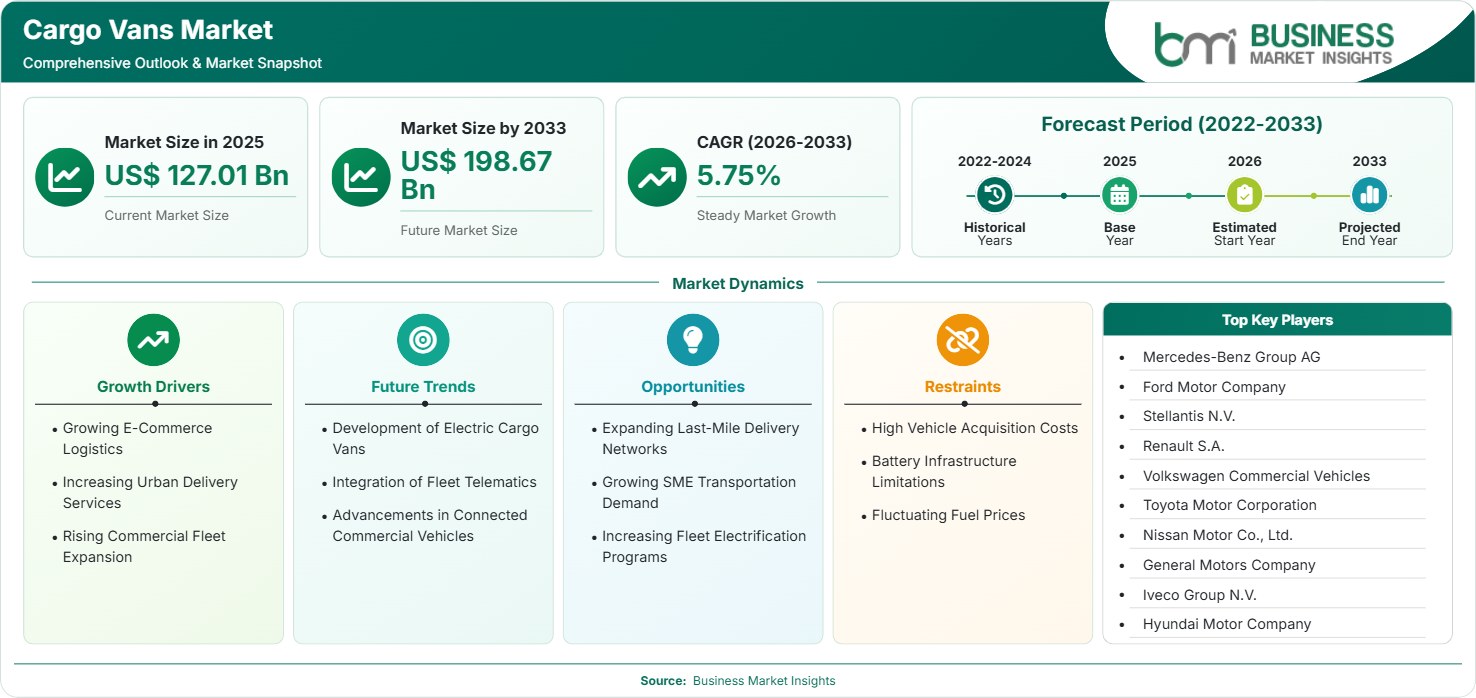
The Cargo Vans Market size was valued at US$ 127.01 Billion in 2025 and is projected to reach US$ 198.67 Billion by 2033, growing at a CAGR of 5.75% during 2026–2033. Rising e-commerce deliveries, fleet modernization, urban freight demand, and electric commercial vehicle adoption are creating new growth opportunities for manufacturers, logistics providers, and fleet operators.

Report Coverage
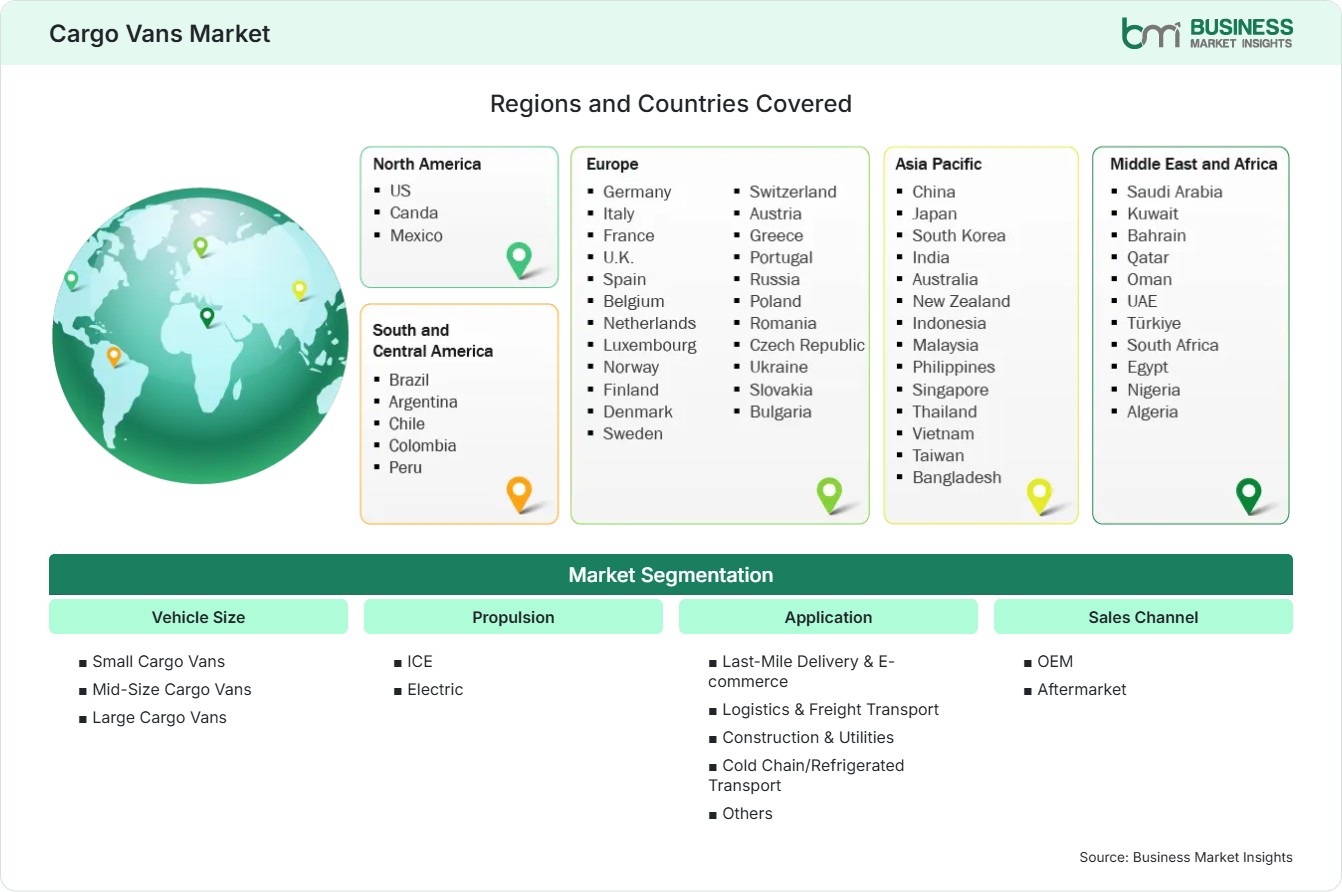
  • Vehicle Size: Small Cargo Vans, Mid-Size Cargo Vans, Large Cargo Vans
  • Propulsion: ICE, Electric
  • Application: Last-Mile Delivery & E-commerce, Logistics & Freight Transport, Construction & Utilities, Cold Chain/Refrigerated Transport, Others
  • Sales Channel: OEM, Aftermarket
US$ 127.01 Bn Market size in 2025
US$ 198.67 Bn Market Size by 2033
5.75% CAGR, 2026 - 2033
2026-2033 Forecast Period

AI Overview

Cargo Vans Market Summary

  • North America Region: North America holds 34%–37% market share in 2025 and is expected to grow at a 5.2%–5.8% CAGR during 2026–2033. Strong e-commerce activity, commercial fleet replacement, and investments in connected logistics continue supporting demand. The U.S. remains the region's largest market, expanding at a 5.3%–5.9% CAGR, supported by parcel delivery growth, infrastructure investment, and increasing adoption of electric commercial fleets.
  • Fastest Growing Region: Asia Pacific accounts for 27%–30% market share in 2025 and is projected to expand at a 6.8%–7.5% CAGR through 2033. Rapid urbanization, manufacturing growth, logistics expansion, and rising online retail activity continue driving commercial vehicle demand.
  • Leading Segment: Mid-Size Cargo Vans represent 41%–45% market share in 2025 and are projected to grow at a 5.6%–6.2% CAGR through 2033. Their versatility, cargo capacity, operating efficiency, and suitability for urban deliveries make them the preferred choice across multiple industries.
  • High Growth Segment: Electric propulsion holds 17%–21% market share in 2025 and is forecast to register a 12.4%–13.2% CAGR during 2026–2033. Fleet electrification programs, government incentives, lower operating costs, and stricter emissions regulations continue accelerating adoption.
  • Key Market Opportunity: Expanding last-mile delivery networks, connected fleet technologies, electric commercial vehicles, and digital fleet management platforms are creating attractive long-term opportunities across logistics, retail, and transportation industries.
  • Major Market Players: Mercedes-Benz Group AG, Ford Motor Company, Stellantis N.V., Renault S.A., Volkswagen Commercial Vehicles, Toyota Motor Corporation, Nissan Motor Co., Ltd., General Motors Company, Iveco Group N.V., and Hyundai Motor Company.
Strategic Insights

Cargo Vans Market: Strategic Insights

Cargo Vans Market Strategic Framework
FREE PDF
Request your free sample
Request free sample
Stakeholder View

Key Takeaways

  • The industry is becoming more integrated as automakers, battery suppliers, software companies, charging providers, and logistics firms work together to build smarter and more efficient commercial transportation ecosystems.
  • Last-mile delivery remains the strongest growth opportunity, supported by rising online shopping, same-day delivery services, and increasing demand for flexible commercial vehicles in densely populated urban areas.
  • Innovation is shifting toward connected fleet technologies, electric powertrains, lightweight vehicle platforms, predictive maintenance, and advanced driver assistance systems that improve safety while lowering operating costs.
  • Asia Pacific offers one of the most attractive investment opportunities because of rapid industrialization, expanding logistics infrastructure, growing manufacturing activity, and increasing commercial vehicle demand across developing economies.
  • Strategic partnerships, localized manufacturing, charging infrastructure investments, and acquisitions focused on commercial mobility technologies are strengthening competitive positioning among global vehicle manufacturers.
Geographic Outlook

Cargo Vans Market Regional Highlights

North America Cargo Vans Market

North America accounted for 34%–37% of the global market in 2025 and is projected to expand at a 5.2%–5.8% CAGR through 2033. The region benefits from a mature logistics network, high e-commerce penetration, and steady commercial fleet replacement. The Cargo Vans Market share remains the highest in North America because businesses increasingly prioritize delivery efficiency, fleet connectivity, and lower operating costs.

  • Strong parcel delivery volumes continue encouraging logistics companies to expand their fleets with fuel-efficient and electric cargo vans that improve delivery speed while lowering maintenance and operating expenses.
  • Fleet operators increasingly adopt connected vehicle technologies, including real-time tracking, predictive maintenance, and route optimization, helping improve utilization rates while reducing downtime across commercial transportation networks.
  • Government incentives supporting cleaner transportation and commercial vehicle electrification encourage businesses to replace aging fleets with modern vans that comply with evolving environmental regulations.
  • Growth in construction, utilities, healthcare services, and mobile maintenance businesses continues generating steady demand for versatile cargo vans capable of operating efficiently in both urban and suburban environments.

US Cargo Vans Market

The United States represented 74%–78% of North America's market in 2025 and is forecast to grow at a 5.3%–5.9% CAGR through 2033. Rising online retail sales, expanding same-day delivery services, and investments in smart logistics continue supporting vehicle demand. Commercial fleet operators are increasingly adopting electric vans, connected fleet platforms, and advanced safety technologies to improve operating efficiency while reducing long-term ownership costs.

  • Major logistics providers continue expanding regional fulfillment centers, increasing demand for reliable cargo vans capable of handling high delivery volumes across metropolitan and suburban markets.
  • Federal and state incentives supporting zero-emission commercial vehicles encourage businesses to accelerate fleet replacement while improving sustainability performance and reducing fuel expenses.
  • Small businesses increasingly prefer mid-size cargo vans because they offer a practical balance between payload capacity, maneuverability, and overall ownership costs for daily operations.
  • Digital fleet management platforms help operators monitor vehicle health, optimize delivery routes, reduce idle time, and improve driver productivity across commercial transportation networks.

Europe Cargo Vans Market

Europe held 27%–30% of the global Cargo Vans Market in 2025 and is expected to register a 5.5%–6.1% CAGR through 2033. Tight emission standards, urban low-emission zones, and growing investments in electric mobility continue driving fleet modernization. Germany remains the largest regional market, while Poland is among the fastest-growing countries with a CAGR between 6.4%–7.0%, supported by manufacturing expansion and logistics investments.

  • European manufacturers continue introducing electric cargo vans with improved battery range, higher payload capacity, and advanced driver assistance systems for commercial fleet operators.
  • Expanding cross-border trade and integrated logistics networks continue supporting demand for efficient commercial transportation across manufacturing, retail, and distribution industries.
  • Businesses are increasingly replacing older diesel fleets with lower-emission vehicles to comply with stricter environmental regulations while reducing long-term operating costs.
  • Growth in urban delivery services creates sustained demand for compact and mid-size cargo vans designed for congested city environments.

Asia Pacific Cargo Vans Market

Asia Pacific Cargo Vans Market accounted for 27%–30% in 2025 and is projected to grow at a 6.8%–7.5% CAGR through 2033, making it the fastest-growing regional market. Rapid urbanization, manufacturing expansion, infrastructure development, and rising e-commerce activity continue supporting commercial vehicle demand. China leads the regional market, while India is expected to record one of the fastest growth rates with a CAGR between 7.4%–8.0%.

  • Expanding online retail platforms continue increasing demand for delivery fleets capable of serving growing urban populations and rapidly evolving consumer purchasing patterns.
  • Domestic manufacturers are introducing competitively priced electric cargo vans designed specifically for urban logistics, municipal services, and regional freight transportation.
  • Government investments in industrial corridors, highways, and logistics parks continue strengthening commercial transportation infrastructure throughout the region.
  • Small and medium-sized enterprises increasingly invest in modern cargo vans to improve delivery reliability, expand customer reach, and reduce maintenance expenses.

Rest of World Cargo Vans Market

The Rest of the World represented 10%–13% of global demand in 2025 and is projected to grow at a 5.8%–6.4% CAGR through 2033. South & Central America benefit from expanding retail distribution and agricultural transportation, while the Middle East & Africa are experiencing higher demand from construction, logistics, and infrastructure development. Brazil leads South & Central America, whereas the UAE remains one of the fastest-growing Middle Eastern markets.

  • Logistics modernization and warehouse development continue improving commercial transportation demand across major metropolitan areas in Latin America.
  • Construction projects, energy investments, and industrial diversification support increasing purchases of cargo vans across Gulf Cooperation Council countries.
  • Fleet operators increasingly seek durable vehicles capable of operating efficiently across challenging road conditions while maintaining lower ownership costs.
  • Growing investments in regional distribution centers and cold-chain logistics continue expanding commercial vehicle demand across healthcare, food, and retail industries.
  • International manufacturers continue strengthening dealer networks, financing programs, and aftersales services to improve market penetration across developing economies.
Global Market Geography
FREE PDF
Request your free sample
Request free sample
Segment Analysis

Cargo Vans Market Segmentation

Vehicle Size

Vehicle Size accounted for the largest contribution to the industry, with Mid-Size Cargo Vans leading at 41%–45% market share in 2025 and projected to grow at a 5.6%–6.2% CAGR through 2033. Businesses value these vehicles for their balance of cargo capacity, maneuverability, and operating efficiency. The Cargo Vans Market scope continues expanding as companies seek versatile vehicles capable of serving urban deliveries, regional distribution, and service-based operations.

  • Small Cargo Vans: Compact dimensions make these vehicles ideal for urban deliveries, service technicians, and small businesses. Their lower operating costs and excellent maneuverability support increasing adoption in densely populated cities.
  • Mid-Size Cargo Vans: This segment remains the preferred choice for logistics providers because it combines flexible cargo space, fuel efficiency, and dependable performance across retail distribution, parcel delivery, and commercial services.
  • Large Cargo Vans: Businesses transporting heavy equipment, industrial goods, and oversized shipments favor large cargo vans for their higher payload capacity, extended cargo space, and suitability for long-distance commercial operations.

Propulsion

The ICE segment held the dominant position in 2025 with 76%–80% market share and is expected to register a 4.4%–5.0% CAGR through 2033. Meanwhile, electric cargo vans continue recording the fastest expansion as governments strengthen emissions policies and businesses focus on lowering fuel costs and improving fleet sustainability.

  • ICE: Internal combustion cargo vans continue serving long-haul transportation, rural delivery routes, and heavy-duty applications where established refueling infrastructure and longer driving ranges remain operational priorities.
  • Electric: Electric cargo vans are gaining momentum among urban fleet operators because they reduce fuel expenses, lower maintenance requirements, and help companies meet sustainability targets while complying with emission regulations.

Application

The Last-Mile Delivery & E-commerce segment captured 36%–40% market share in 2025 and is projected to grow at a 6.8%–7.4% CAGR through 2033. Continued Cargo Vans Market growth of online shopping, same-day delivery services, and fulfillment centers is increasing demand for efficient commercial vehicles capable of frequent urban operations while maintaining lower ownership costs.

  • Last-Mile Delivery & E-commerce: Growing online retail activity continues increasing demand for dependable cargo vans capable of supporting fast deliveries, flexible routing, and frequent stop-and-go operations across urban markets.
  • Logistics & Freight Transport: Distribution companies rely on cargo vans for regional freight movement, warehouse transfers, and commercial deliveries that require dependable performance, operational flexibility, and efficient fuel consumption.
  • Construction & Utilities: Contractors, maintenance providers, and utility companies use cargo vans to transport equipment, tools, and materials while improving workforce mobility and job-site productivity.
  • Cold Chain/Refrigerated Transport: Refrigerated cargo vans support pharmaceutical, healthcare, food, and beverage deliveries by maintaining consistent temperature control throughout transportation and distribution operations.
  • Others: Specialty commercial applications, including municipal services, mobile workshops, telecommunications, facility maintenance, and field services, continue supporting steady demand for configurable cargo van platforms.

Sales Channel

The OEM channel represented 72%–76% market share in 2025 and is forecast to grow at a 5.5%–6.1% CAGR through 2033. Businesses increasingly purchase directly from manufacturers to benefit from warranty coverage, customized fleet solutions, financing packages, and integrated telematics. The aftermarket remains essential for replacement parts, maintenance, fleet upgrades, and vehicle customization.

  • OEM: Direct purchases allow commercial fleet operators to access factory-built configurations, advanced safety technologies, connected fleet solutions, and comprehensive aftersales support tailored to business requirements.
  • Aftermarket: Independent service providers and parts suppliers continue supporting fleet reliability through maintenance services, replacement components, cargo modifications, telematics upgrades, and repair solutions for aging commercial vehicles.
Market Forces

Cargo Vans Market Dynamics

Key Market Drivers

Growing E-Commerce Logistics

The rapid expansion of online retail has become a major force shaping commercial transportation demand. Increasing parcel volumes, faster delivery expectations, and the growth of fulfillment networks are encouraging businesses to expand their vehicle fleets. The Cargo Vans Market growth is directly linked to the requirement of logistics firms to have effective means of delivering products on a regular basis. The advent of e-commerce channels has resulted in the increasing investment in last-mile transport solutions. There have been instances where companies have used connected fleet technology for route optimization and effective delivery performance.

Increasing Urban Delivery Services

Increased urbanization has resulted in higher demand for smaller and versatile commercial vehicles that work efficiently in urban settings. Increased population, shifting demands of consumers, and need for same day deliveries have prompted organizations to use cargo vans that make a lot of stops. Companies and service providers are adding more vehicles to their urban fleets so that they can cover more deliveries and respond to customers’ demands quickly. Governments are also introducing policies on urban mobility, which encourage clean commercial transport solutions.

Rising Commercial Fleet Expansion

Companies from sectors such as logistics, construction, utilities, healthcare, and services have been increasing their commercial fleets to facilitate business growth and enhance the ability to deliver better customer service in Cargo Vans Market. Fleets are upgrading old vehicles for new ones that can offer more reliability and safety features in addition to low maintenance needs. The requirement for adaptable solutions is leading the producers to offer many different sizes of vehicles and power sources. Big organizations are even considering fleet management software to evaluate the performance of their fleet and eliminate inefficiencies.

Key Market Opportunities

Expanding Last-Mile Delivery Networks

Development of regional distribution centers, urban delivery centers, and digital commerce is providing substantial opportunities to cargo van makers as well as fleet solution providers. The Cargo Vans Market Forecasts indicate increasing opportunities created due to investments made by companies into delivery networks, routing optimization, and sustainable transport solutions. Companies are looking for vehicles that can help in increasing the frequency of deliveries without increasing costs. In addition, electric cargo vans, connected technologies, and customized fleet solutions are also gaining importance from an investment perspective.

Growing SME Transportation Demand

Cargo vans have increasingly been favored by small and medium-sized enterprises (SMEs) due to their ability to help enhance mobility and improve delivery demands. The need for such vehicles among SMEs is due to the fact that there are many companies that need cost-effective and versatile transport vehicles for the purpose of retail deliveries, maintenance activities, construction, and other local mobility needs. Producers are taking advantage of such growing needs by providing financing facilities and even making cost-efficient models of their vehicles.

Increasing Fleet Electrification Programs

Commercial fleet electrification programs are creating new opportunities for manufacturers, battery suppliers, and charging infrastructure companies. Businesses are increasingly evaluating electric cargo vans because of lower energy costs, reduced maintenance requirements, and the ability to meet sustainability commitments. Incentives by governments and goals for reducing emissions are pushing businesses towards switching from fossil fuel-powered cars to greener options. Fleet owners are also spending on charging infrastructure, energy management software, and fleet management systems that would help them move towards electrification.

Market Restraints and Challenges

High Vehicle Acquisition Costs

Factor: Advanced vehicle technologies, premium safety systems, and electric powertrain components increase upfront purchase prices for commercial vehicles. Impact: High acquisition costs may hinder decisions on replacing fleets, especially when it comes to small companies with scarce financial resources. While electric cargo vans offer substantial savings in terms of reduced fuel and maintenance costs, the first cost is an important factor that needs to be considered by many operators. Financing options, tax credits, and leasing arrangements are becoming increasingly popular ways to address high costs.

Battery Infrastructure Limitations

Factor: Limited charging infrastructure availability and inconsistent charging networks create operational concerns for electric cargo van users. Impact: Range anxiety, longer recharge times, and lack of access to charging stations in commercial areas may pose constraints on their adoption where consistent vehicle availability is needed for operations. It may be important for fleets to have a reliable recharging system so that they are able to stick to their schedules and maximize vehicle utilization.

Company Analysis

Competitive Landscape

The Cargo Vans Market analysis highlights increasing competition among global automotive manufacturers as companies focus on vehicle electrification, connected mobility solutions, fleet customization, and advanced commercial transportation technologies. Leading players are strengthening their market positions through new product launches, strategic partnerships, manufacturing expansion, and investments in sustainable mobility solutions.

Company Name

Overview

Products and Services relevant to this market

Mercedes-Benz Group AG

Global automotive leader offering premium commercial vehicles with strong presence across logistics and fleet transportation markets.

Provides Sprinter and Vito cargo vans featuring diesel, electric, connected technologies, and customized commercial mobility solutions.

Ford Motor Company

Major commercial vehicle manufacturer known for extensive fleet solutions and strong global commercial transportation presence.

Offers Transit cargo vans, electric E-Transit models, fleet management services, and business-focused vehicle configurations.

Stellantis N.V.

International automotive group with broad commercial vehicle operations across multiple global markets.

Provides ProMaster, Ducato, and electric commercial vans designed for logistics, delivery, and professional applications.

Renault S.A.

European automotive manufacturer specializing in commercial mobility solutions and urban transportation vehicles.

Offers Master, Trafic, and electric cargo van platforms supporting delivery, fleet, and business transportation needs.

Volkswagen Commercial Vehicles

Commercial vehicle division focused on innovative transportation solutions for businesses and fleet operators worldwide.

Provides Transporter, Crafter, and electric ID. Buzz Cargo models with connected fleet technologies.

Toyota Motor Corporation

Global mobility company investing in diverse powertrain technologies and commercial transportation solutions.

Offers commercial van platforms, hybrid technologies, fleet mobility services, and sustainable transportation solutions.

Nissan Motor Co., Ltd.

Automotive manufacturer with significant expertise in electric vehicles and commercial mobility applications.

Provides Nissan NV series, electric commercial vans, and advanced vehicle technologies for business users.

General Motors Company

Major automotive corporation developing commercial vehicle solutions through traditional and electric mobility platforms.

Offers BrightDrop electric delivery vans, fleet management services, and commercial EV solutions for logistics operators.

Iveco Group N.V.

Commercial vehicle specialist focused on transportation solutions across logistics, industrial, and urban applications.

Provides Daily vans, electric commercial vehicles, and fleet solutions designed for professional transportation requirements.

Hyundai Motor Company

Global automaker expanding commercial vehicle capabilities through electrification and mobility innovation.

Offers commercial vehicle platforms, electric mobility technologies, and fleet transportation solutions for business applications.

Trust & Transparency

Research Methodology

The market analysis combines proprietary research with secondary data from government agencies, company disclosures, regulatory filings, industry databases and expert interviews. Market estimates are validated through data triangulation, cross-market benchmarking and analyst review.

View Full Research Methodology

Questions Answered

Frequently Asked Questions

What information is included in a Cargo Vans Market Report?

A report provides insights into industry size, growth factors, segmentation, competitive landscape, regional trends, technology developments, and future opportunities.

How important are connected technologies in modern cargo vans?

Connected technologies help fleet operators monitor vehicle performance, optimize routes, track assets, and schedule predictive maintenance.

Which industries use cargo vans most frequently?

Cargo vans are widely used in e-commerce delivery, logistics, construction, utilities, healthcare distribution, refrigeration services, and professional maintenance operations.

How are electric cargo vans changing commercial transportation?

Electric cargo vans are helping businesses reduce fuel expenses, lower maintenance requirements, and meet sustainability targets. Improvements in battery technology, charging infrastructure, and government incentives are making electric models more suitable for urban deliveries and short-distance commercial operations.

What factors are influencing cargo van adoption among businesses?

Businesses are increasingly adopting cargo vans because of rising delivery volumes, fleet replacement needs, urban logistics expansion, and demand for efficient transportation solutions. Vehicle flexibility, lower operating costs, and connected fleet technologies are also improving adoption among logistics companies and small businesses.

Access the Full Cargo Vans Market Report

Get segment-level forecasts, regional estimates, competitive benchmarking, company profiles and downloadable Excel datasets.

Access the full Cargo Vans Market Report
350 pages PDF & Excel | 2026-08-18