
Tubeless Tire Market Outlook: Size, Share, Trends, Growth Analysis, Competitive Landscape & Forecast, 2026-2033

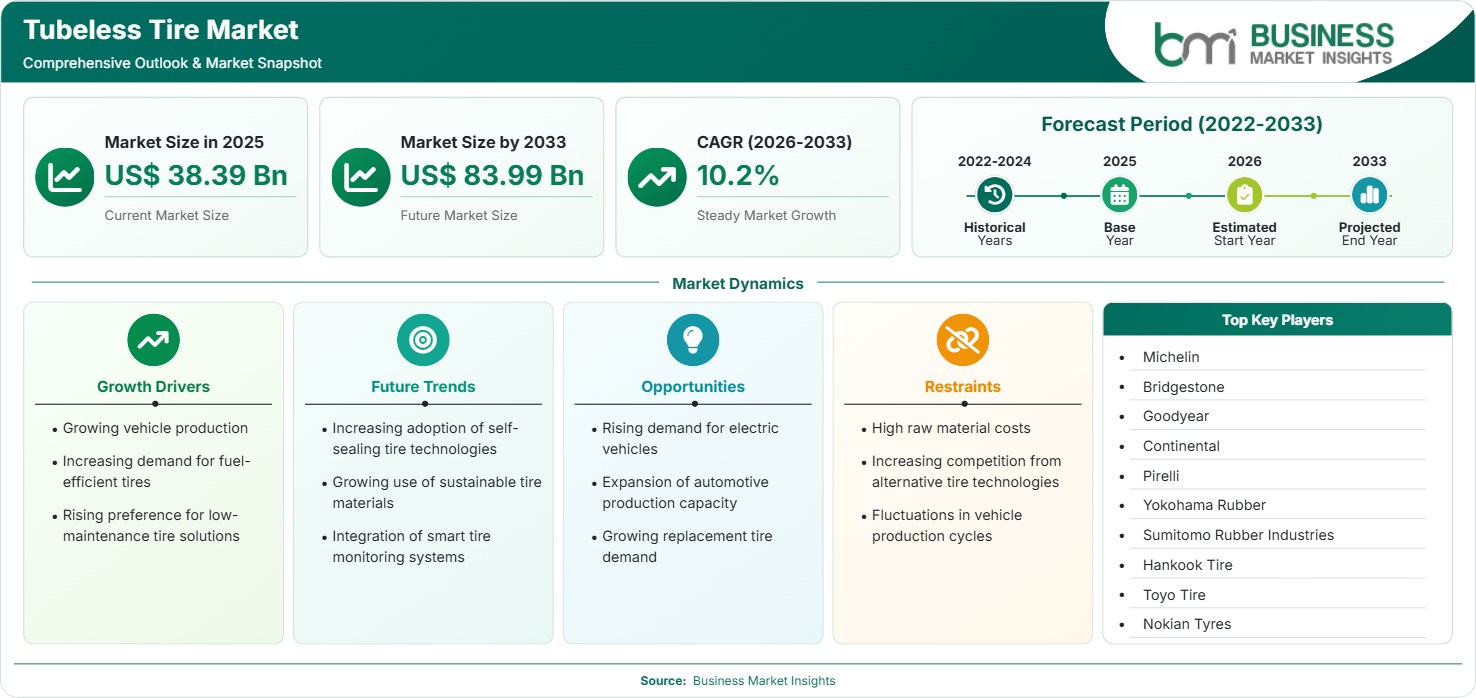
The Tubeless Tire Market size was valued at US$ 38.39 Billion in 2025 and is projected to reach US$ 83.99 Billion by 2033, growing at a CAGR of 10.2% from 2026 to 2033. Growth is driven by rising vehicle production, demand for fuel-efficient tire solutions, increasing adoption of electric vehicles, expansion of automotive manufacturing capacity, and replacement tire demand across global transportation sectors.

Report Coverage
  • Rim Size: 13''-15'', 16-18'', 19-21'', Above 21''
  • Design: Radial, Bias
  • Vehicle Type: Passenger Cars, Light Commercial Vehicle, Heavy Commercial Vehicle
US$ 38.39 Bn Market size in 2025
US$ 83.99 Bn Market Size by 2033
10.2% CAGR, 2026 - 2033
2026-2033 Forecast Period

AI Overview

Tubeless Tire Market Summary

  • North America Region: North America holds a market share of 24%–27% in 2025 and is projected to grow at a CAGR of 9.4%–10.2% during 2026–2033, supported by vehicle electrification, premium tire adoption, replacement demand, and advanced automotive infrastructure. The US market is expected to register a CAGR of 9.6%–10.4% through 2033, driven by passenger vehicle demand, EV adoption, and commercial fleet expansion.
  • Fastest Growing Region: Asia Pacific represents 42%–45% share in 2025 and is forecast to expand at a CAGR of 10.8%–11.6% during 2026–2033, supported by increasing automobile production, expanding manufacturing capacity, rising middle-class vehicle ownership, infrastructure development, and growing demand for advanced tire technologies across emerging economies.
  • Leading Segment: Radial tires account for a market share of 82%–85% in 2025 and are projected to grow at a CAGR of 10.0%–10.8% during 2026–2033, supported by superior durability, fuel efficiency advantages, improved handling performance, and widespread adoption across passenger and commercial vehicles.
  • High Growth Segment: Above 21'' rim size tires represent a high-growth segment with a market share of 10%–13% in 2025 and are expected to grow at a CAGR of 11.2%–12.0% during 2026–2033, driven by premium vehicles, SUVs, performance vehicles, and increasing consumer preference for advanced automotive designs.
  • Key Market Opportunity: Rising electric vehicle adoption, automotive production expansion, and increasing replacement tire demand are creating opportunities for manufacturers developing durable, efficient, and application-specific tubeless tire solutions.
  • Major Market Players: Michelin, Bridgestone, Goodyear, Continental, Pirelli, Yokohama Rubber, Sumitomo Rubber Industries, Hankook Tire, Toyo Tire, Nokian Tyres.
Strategic Insights

Tubeless Tire Market: Strategic Insights

Tubeless Tire Market Strategic Framework
FREE PDF
Request your free sample
Request free sample
Stakeholder View

Key Takeaways

  • The tire value chain is shifting toward advanced material development, digital monitoring solutions, and sustainable manufacturing practices as companies focus on improving efficiency and reducing environmental impact.
  • Electric vehicles, premium passenger cars, and commercial fleets represent major growth opportunities as these applications require durable tire solutions with improved performance characteristics and lower maintenance requirements.
  • Innovation is increasingly focused on smart tire technologies, low rolling resistance compounds, lightweight designs, and sustainable materials to improve vehicle efficiency and safety.
  • Asia Pacific provides strong investment opportunities due to expanding automotive manufacturing, increasing vehicle ownership, and growing adoption of advanced tire technologies in emerging economies.
  • Competitive strategies are centered on production expansion, technology partnerships, sustainability initiatives, and product diversification to address rising demand across automotive segments.
  • Replacement tire demand remains a critical growth factor as global vehicle populations increase and consumers prioritize reliable, longer-lasting tire solutions.
Geographic Outlook

Tubeless Tire Market Regional Highlights

North America Tubeless Tire Market

North America accounted for a 24%–27% share of the Tubeless Tire Market in 2025 and is projected to grow at a CAGR of 9.4%–10.2% during 2026–2033. The region benefits from strong automotive demand, expanding electric vehicle adoption, premium vehicle sales, and a mature replacement tire ecosystem. The US represents the largest contributor due to high vehicle ownership, advanced automotive manufacturing capabilities, and increasing demand for fuel-efficient and durable tire technologies.

  • The US market benefits from increasing EV adoption, passenger vehicle demand, commercial fleet expansion, and replacement tire consumption across multiple automotive segments.
  • Tire manufacturers are investing in advanced compounds, smart tire technologies, and sustainable materials to improve vehicle efficiency and performance.
  • Growing preference for premium SUVs and electric vehicles is increasing demand for larger rim sizes and advanced tubeless tire solutions.
  • Strong aftermarket distribution networks are supporting replacement tire sales and improving accessibility for consumers across regional markets.

US Tubeless Tire Market

The US represented a 20%–23% share of the Tubeless Tire Market in 2025 and is expected to grow at a CAGR of 9.6%–10.4% from 2026–2033. Growth is supported by increasing vehicle production, rising electric vehicle penetration, and strong replacement tire demand. Automotive manufacturers and tire companies are focusing on fuel-efficient, durable, and technologically advanced products to address changing consumer expectations and regulatory requirements related to vehicle efficiency.

  • Electric vehicle production growth is increasing demand for specialized tires designed for improved efficiency, durability, and performance.
  • Commercial vehicle operators are adopting advanced tubeless tires to reduce maintenance requirements and improve operational reliability.
  • Premium vehicle sales are supporting demand for larger rim sizes and high-performance tire solutions.

Europe Tubeless Tire Market

Europe held a 21%–24% share of the Tubeless Tire Market in 2025 and is forecast to expand at a CAGR of 9.1%–9.9% during 2026–2033. The region benefits from strict vehicle efficiency regulations, strong automotive manufacturing, and increasing electric mobility adoption. Germany, France, the United Kingdom, Italy, and Spain are key markets, with Germany leading due to its automotive manufacturing ecosystem and technology-focused vehicle development.

  • Germany maintains strong demand through automotive production, premium vehicle manufacturing, and adoption of advanced tire technologies.
  • France is expanding electric mobility adoption, supporting demand for efficient and durable tire solutions.
  • The United Kingdom is experiencing replacement tire growth due to increasing vehicle usage and aftermarket demand.
  • Italy and Spain are supporting market development through automotive manufacturing and increasing consumer preference for performance tires.

Asia Pacific Tubeless Tire Market

Asia Pacific accounted for 42%–45% of the market in 2025 and is the fastest-growing region, with a CAGR of 10.8%–11.6% across the Tubeless Tire Market forecasts. The region benefits from large-scale automotive production, rising vehicle ownership, expanding manufacturing capacity, and increasing adoption of advanced mobility solutions. China, India, Japan, South Korea, and Southeast Asian countries are major contributors due to growing demand for passenger and commercial vehicles.

  • China leads regional growth through large automotive production capacity, EV manufacturing expansion, and increasing demand for advanced tire solutions.
  • India is witnessing higher adoption due to rising vehicle ownership, infrastructure development, and expanding automotive manufacturing capabilities.
  • Japan and South Korea are supporting demand through technology-driven vehicle production and premium automotive applications.
  • Southeast Asian markets are growing through increasing mobility demand, manufacturing investments, and expanding automotive supply chains.

Rest of World Tubeless Tire Market

Rest of World represented a 8%–11% of the Tubeless Tire Market share in 2025 and is projected to grow at a CAGR of 9.8%–10.6% during 2026–2033. Latin America, the Middle East, and Africa are experiencing gradual market expansion due to rising vehicle ownership, infrastructure improvements, and increasing demand for reliable transportation solutions. Growth in commercial transportation and aftermarket services is supporting regional tire adoption.

  • Middle Eastern countries are increasing premium vehicle adoption and infrastructure investments, supporting demand for advanced tubeless tire products.
  • Latin American markets are expanding through automotive sector growth, replacement tire demand, and improving distribution networks.
  • African markets are developing through increasing vehicle imports, transportation expansion, and improved access to tire products.
  • Regional suppliers are strengthening partnerships with manufacturers and distributors to improve product availability and market reach.

Global Market Geography
FREE PDF
Request your free sample
Request free sample
Segment Analysis

Tubeless Tire Market Segmentation

Rim Size

The rim size segment represents a key classification within the Tubeless Tire Market, covering 13''-15'', 16-18'', 19-21'', and Above 21'' categories. The segment accounted for the complete market revenue base in 2025 and is projected to grow at a CAGR of 10.2% during 2026–2033. Increasing vehicle diversification, premium vehicle adoption, and demand for specialized tire solutions are influencing rim size preferences. Manufacturers are developing optimized tire designs to support changing vehicle platforms, including electric vehicles, SUVs, and performance-oriented automobiles.

  • 13''-15'': These tires maintain demand through compact passenger vehicles, urban mobility applications, affordability advantages, and widespread adoption across emerging automotive markets.
  • 16-18'': This category experiences strong demand due to passenger cars, crossover vehicles, and increasing consumer preference for balanced performance and durability.
  • 19-21'': Larger rim sizes are gaining adoption through premium vehicles, SUVs, luxury models, and performance applications requiring enhanced handling characteristics.
  • Above 21'': This segment is expanding due to luxury vehicles, high-performance automobiles, customization trends, and increasing preference for premium automotive designs.

Design

The design segment plays an important role in determining tire performance, durability, handling capability, and application suitability within the Tubeless Tire Market. Radial and Bias designs serve different vehicle requirements based on performance expectations, operating conditions, and cost considerations. The segment accounted for the complete market revenue base in 2025 and is expected to grow at a CAGR of 10.2% during 2026–2033. Manufacturers are focusing on improving tread patterns, material compositions, and structural designs to enhance efficiency and safety.

  • Radial: Radial tires dominate due to improved fuel efficiency, better road contact, enhanced durability, and widespread adoption across passenger and commercial vehicles.
  • Bias: Bias tires continue serving specific applications requiring robust construction, cost efficiency, and suitability for certain commercial and specialized vehicle conditions.

Vehicle Type

The vehicle type segment defines major application areas for tubeless tires across passenger cars, light commercial vehicles, and heavy commercial vehicles. The segment accounted for the complete market revenue base in 2025 and is projected to expand at a CAGR of 10.2% during 2026–2033. Increasing vehicle production, commercial transportation growth, and electric mobility expansion are shaping demand patterns. Tire manufacturers are developing application-specific products to improve efficiency, durability, and performance across diverse vehicle categories.

  • Passenger Cars: Passenger cars represent significant demand due to increasing vehicle ownership, consumer preference for safety, and adoption of advanced tire technologies.
  • Light Commercial Vehicle: Light commercial vehicles drive demand through logistics growth, urban delivery services, and requirements for durable tires with reduced maintenance needs.
  • Heavy Commercial Vehicle: Heavy commercial vehicles support market expansion through freight transportation growth, fleet modernization, and demand for reliable long-distance tire performance.
Market Forces

Tubeless Tire Market Dynamics

Key Market Drivers

Growing Vehicle Production

Growing vehicle production is a major driver of the market growth, as increasing automotive manufacturing directly expands demand for original equipment tires. Global vehicle production growth, particularly across Asia Pacific, is supporting tire manufacturers through higher OEM requirements and supply contracts. Automotive companies are increasingly adopting tubeless tire technology due to improved safety, durability, and performance advantages. The Tubeless Tire Market trends indicate that rising passenger vehicle, commercial vehicle, and electric vehicle production will continue influencing tire demand. Manufacturers are expanding production capacity and improving technology capabilities to supply advanced tire solutions for evolving automotive platforms.

Increasing Demand for Fuel-Efficient Tires

Increasing demand for fuel-efficient tires is supporting market expansion as consumers and automotive manufacturers focus on reducing fuel consumption and improving vehicle efficiency. Tubeless tires contribute to lower rolling resistance, improved handling, and optimized vehicle performance compared with traditional tire systems. Initiatives by regulatory bodies seeking to cut down on pollution have led to the promotion of tire technologies that have better energy-saving features. Rubber companies are developing rubber technology that incorporates lighter and more aerodynamic designs in order to improve their performance. This has been driven by an increased interest in sustainability and cost reduction.

Rising Preference for Low-Maintenance Tire Solutions

Rising preference for low-maintenance tire solutions is accelerating adoption as vehicle owners seek products offering improved reliability, longer service life, and reduced maintenance requirements. Tubeless tires provide advantages such as reduced puncture-related downtime, improved air retention, and enhanced driving convenience. Commercial fleets have begun to use such measures in order to avoid disruptions in their operations and to make themselves cost-efficient. The consumers are becoming aware of issues like safety and durability of products, thereby adding to the demand for better tire solutions. The manufacturers have been answering by coming up with better designs and incorporating new technologies.

Key Market Opportunities

Rising Demand for Electric Vehicles

Rising demand for electric vehicles is creating significant opportunities for Tubeless Tire Market participants as EV manufacturers require specialized tire solutions designed for increased vehicle weight, lower rolling resistance, and improved efficiency. Electric vehicles generate different performance requirements due to battery weight distribution, instant torque delivery, and range optimization needs. The tire manufacturing industry is investing in developing advanced compounds, reinforced structures, and low resistance designs that will enhance the performance of EVs. Collaborations between car manufacturers and the tire manufacturers have resulted in innovations in technology to develop tires for EVs. The adoption of electric mobility around the world will open up opportunities for companies with robust tubeless tires.

Expansion of Automotive Production Capacity

Expansion of automotive production capacity is creating opportunities for tire manufacturers as increasing vehicle assembly volumes generate additional original equipment demand. Manufacturing capacities in the region, especially of electric vehicles and advanced mobility technologies, are being developed by automakers in the Asia Pacific, North America, and Europe. This trend is motivating tire makers to increase their manufacturing capacity, set up regional facilities, and develop supply chain links with vehicle makers. Organizations with agile manufacturing processes and sophisticated products can take advantage of increasing demand from OEMs. Increasing investments in the automotive supply chain networks are also enabling collaborations based on technological innovation and sustainability.

Growing Replacement Tire Demand

Growing replacement tire demand is creating opportunities as increasing global vehicle populations require regular tire replacement to maintain safety, efficiency, and performance. Rising vehicle ownership, longer vehicle usage periods, and expanding aftermarket networks are supporting replacement sales across passenger and commercial vehicle categories. Consumers are increasingly selecting premium replacement tires that provide durability, improved fuel efficiency, and lower maintenance requirements. Manufacturers are strengthening retail distribution channels, digital sales platforms, and service partnerships to capture replacement demand. The aftermarket segment provides consistent revenue opportunities as vehicle fleets continue expanding across developed and emerging automotive markets.

Market Restraints and Challenges

High Raw Material Costs

Factor: High raw material costs create challenges for tubeless tire manufacturers due to dependence on natural rubber, synthetic rubber, carbon black, steel, and other essential inputs required for tire production. Impact: Rising material prices can increase manufacturing expenses, pressure profit margins, and influence final product pricing for consumers and automotive manufacturers. Commodity price fluctuations and supply chain uncertainties can affect production planning and operational efficiency. Companies are addressing these challenges through material optimization, supplier diversification, recycling initiatives, and improved manufacturing processes. However, raw material cost volatility remains a key challenge affecting pricing strategies and competitiveness across the global tire industry.

Increasing Competition from Alternative Tire Technologies

Factor: Increasing competition from alternative tire technologies, including advanced airless tires and emerging next-generation mobility solutions, creates pressure on conventional tubeless tire manufacturers. Impact: Competitive technologies may influence future investment decisions, research priorities, and consumer adoption patterns within the tire industry. Companies must continuously improve performance, durability, sustainability, and cost efficiency to maintain market relevance. Tire manufacturers are investing in smart tire technologies, advanced materials, and innovative designs to strengthen their competitive position. Although tubeless tires remain widely adopted, evolving mobility requirements require continuous innovation and adaptation from industry participants.

Company Analysis

Competitive Landscape

The Tubeless Tire Market analysis indicates a highly competitive automotive components landscape dominated by global tire manufacturers with extensive production networks, strong OEM relationships, and advanced research capabilities. Companies are competing through product innovation, sustainable manufacturing, electric vehicle tire development, and expansion of distribution networks. Leading players are focusing on improving fuel efficiency, durability, and smart tire integration to address evolving mobility requirements. Strategic partnerships with automotive manufacturers and investments in advanced materials are becoming important approaches for strengthening market positions.

Company Name

Overview

Products and Services relevant to this market

Michelin

Michelin is a global tire manufacturer known for advanced mobility solutions.

Passenger tires, commercial tires, EV-compatible tires, and performance tire technologies.

Bridgestone

Bridgestone develops tire and mobility solutions for global automotive markets.

Tubeless tires, premium tires, fleet solutions, and smart tire technologies.

Goodyear

Goodyear manufactures tires for passenger, commercial, and specialty vehicles.

Tubeless tires, fuel-efficient tires, commercial tire solutions, and mobility products.

Continental

Continental provides automotive technologies and tire solutions worldwide.

Passenger tires, commercial tires, smart tire systems, and advanced mobility solutions.

Pirelli

Pirelli specializes in premium tires for automotive and performance applications.

High-performance tubeless tires, premium vehicle tires, and specialty tire solutions.

Yokohama Rubber

Yokohama Rubber produces tires and mobility products across global markets.

Passenger tires, commercial tires, performance tires, and sustainable tire technologies.

Sumitomo Rubber Industries

Sumitomo Rubber Industries develops tire products for diverse vehicle categories.

Tubeless tires, automotive tires, sports tires, and advanced rubber solutions.

Hankook Tire

Hankook Tire manufactures innovative tire solutions for global vehicle manufacturers.

Passenger tires, EV tires, commercial tires, and high-performance products.

Toyo Tire

Toyo Tire develops tires for passenger, commercial, and specialty vehicles.

Tubeless tires, SUV tires, truck tires, and performance solutions.

Nokian Tyres

Nokian Tyres specializes in tires designed for challenging driving conditions.

Passenger tires, commercial tires, seasonal tires, and durable tire solutions.

Industry Activity

Recent Developments

March 2025

Continental launched the Grand Prix TR, a new road bicycle tire featuring tubeless-ready technology, BlackChili compound, puncture protection, and hookless compatibility. The launch expanded Continental’s tubeless tire portfolio by bringing advanced tubeless performance technology to a broader range of cyclists.

March 2025

Continental introduced the Terra Adventure gravel tire, incorporating tubeless-ready technology, Trail Casing protection, Grip Compound, and hookless compatibility. The product launch strengthened Continental’s position in the growing adventure cycling and off-road tubeless tire segment.

January 2025

Bridgestone launched the BATTLAX SPORT TOURING T33 premium sport touring motorcycle tire, a next-generation radial motorcycle tire designed for improved mileage and wet/dry performance. The tire range includes tubeless (TL) motorcycle tire applications, supporting Bridgestone’s premium motorcycle tire portfolio expansion.

November 2024

Bridgestone announced a US$85 million investment to expand premium passenger car tire production capacity and technology capabilities in India. The investment will increase output at the Pune plant and strengthen advanced tire manufacturing capabilities, including premium tubeless passenger vehicle tire production.

Trust & Transparency

Research Methodology

The market analysis combines proprietary research with secondary data from government agencies, company disclosures, regulatory filings, industry databases and expert interviews. Market estimates are validated through data triangulation, cross-market benchmarking and analyst review.

View Full Research Methodology

Questions Answered

Frequently Asked Questions

What does this Tubeless Tire Market Report cover?

This Tubeless Tire Report provides analysis of market size, regional performance, segmentation trends, competitive landscape, recent developments, growth factors, opportunities, and industry challenges shaping future expansion.

What are the major challenges faced by tubeless tire manufacturers?

Manufacturers face challenges from fluctuating raw material prices, increasing production costs, evolving alternative tire technologies, and the need for continuous investment in advanced materials and manufacturing processes.

How are electric vehicles influencing tire demand?

Electric vehicles are increasing demand for specialized tires with lower rolling resistance, higher load capacity, improved durability, and optimized performance to support battery weight and efficiency requirements.

Which design segment dominates the market?

Radial tires dominate due to their superior durability, fuel efficiency, improved handling characteristics, and extensive adoption across passenger cars, commercial vehicles, and electric vehicle applications.

What factors are driving the Tubeless Tire Market growth?

The market is driven by increasing vehicle production, electric vehicle adoption, demand for fuel-efficient solutions, growing replacement tire requirements, and consumer preference for durable, low-maintenance tire technologies.

Access the Full Tubeless Tire Market Report

Get segment-level forecasts, regional estimates, competitive benchmarking, company profiles and downloadable Excel datasets.

Access the full Tubeless Tire Market Report
350 pages PDF & Excel | 2026-08-03