
Automotive Tire Market Outlook: Size, Share, Trends, Growth Analysis, Competitive Landscape & Forecast, 2026-2033

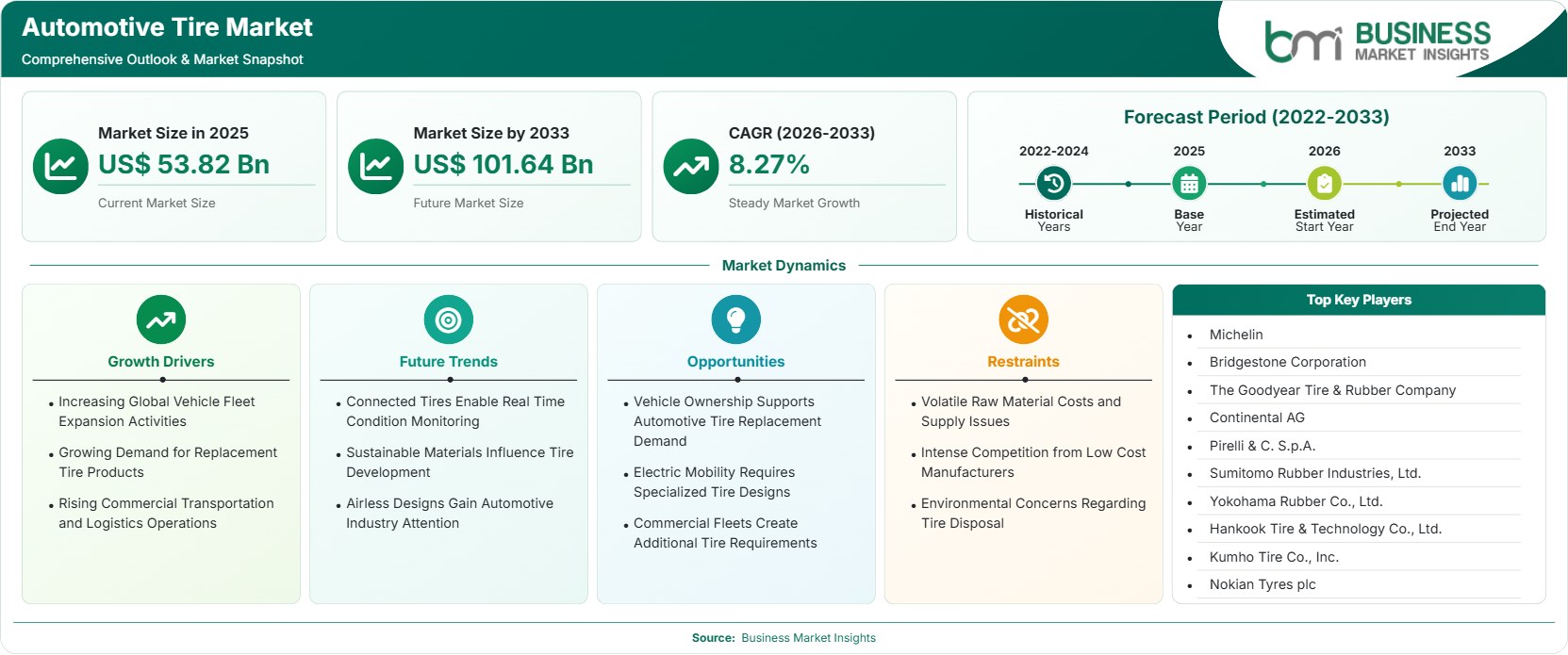
The Automotive Tire Market size was valued at US$ 53.82 Billion in 2025 and is projected to reach US$ 101.64 Billion by 2033, growing at a CAGR of 8.27% during 2026–2033. Rising vehicle parc expansion, EV adoption, premium tire demand, smart tire technologies, fleet modernization, and sustainable materials development continue creating strong revenue opportunities across OEM and replacement channels.

Report Coverage
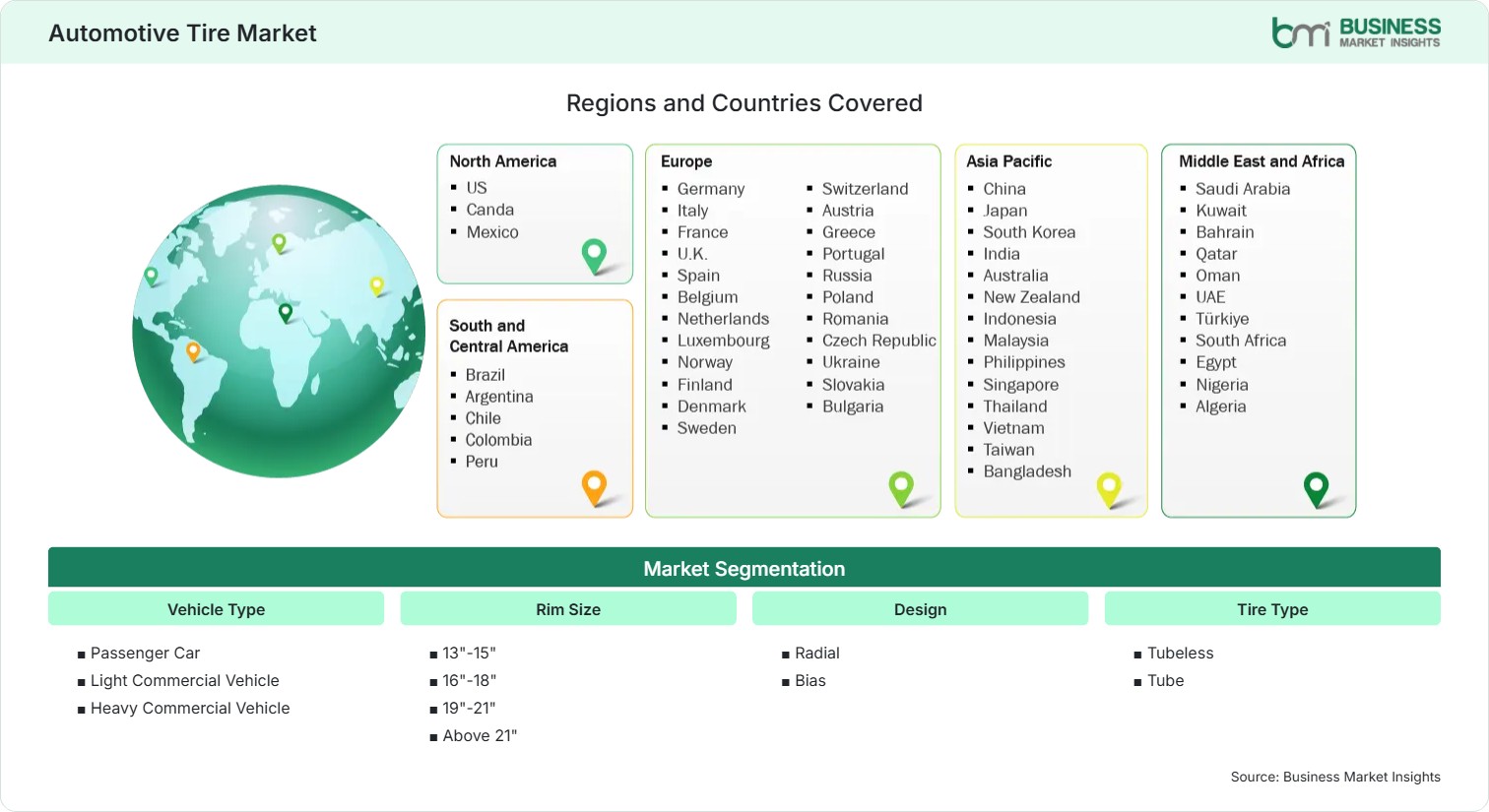
  • Vehicle Type: Passenger Car, Light Commercial Vehicle, Heavy Commercial Vehicle
  • Rim Size: 13"-15", 16"-18", 19"-21", Above 21"
  • Design: Radial, Bias
  • Tire Type: Tubeless, Tube
US$ 53.82 Bn Market size in 2025
US$ 101.64 Bn Market Size by 2033
8.27% CAGR, 2026 - 2033
2026-2033 Forecast Period

AI Overview

Automotive Tire Market Summary

  • North America Region: Holds a market share of 24%–27% in 2025, growing at a CAGR of 7.0%–7.8% during 2026–2033. Demand is supported by replacement tire volumes, SUV ownership, EV penetration, connected mobility technologies, fleet upgrades, winter tire replacement cycles, premiumization, e-commerce distribution, advanced manufacturing investments, and sustainability initiatives. The U.S. accounts for 78%–82% of regional demand and is projected to grow at 7.2%–8.0% CAGR through 2033.
  • Fastest Growing Region: Asia Pacific holds a market share of 39%–43% in 2025, growing at a CAGR of 9.2%–10.0% during 2026–2033. Growth stems from vehicle production expansion, rising ownership rates, industrial logistics development, replacement demand growth, EV manufacturing leadership, urbanization, infrastructure investments, increasing exports, domestic manufacturing capacity, and policy support.
  • Leading Segment: Passenger Car holds a market share of 58%–62% in 2025, growing at a CAGR of 7.8%–8.6% during 2026–2033. Demand benefits from expanding vehicle fleets, replacement purchases, premium tire adoption, safety awareness, EV passenger vehicle growth, digital retail channels, mobility expansion, and advanced tread technologies worldwide.
  • High Growth Segment: Tubeless holds a market share of 72%–76% in 2025, growing at a CAGR of 8.8%–9.6% during 2026–2033. Adoption accelerates through fuel-efficiency advantages, puncture resistance, vehicle safety improvements, OEM preferences, maintenance reduction, lightweight construction benefits, EV compatibility, fleet operating savings, and performance enhancement requirements.
  • Key Market Opportunity: Advanced sustainable tire platforms integrating recycled materials, bio-based feedstocks, connected monitoring systems, and EV-specific performance characteristics create attractive opportunities for manufacturers seeking premium margins and regulatory compliance.
  • Major Market Players: Michelin, Bridgestone Corporation, The Goodyear Tire & Rubber Company, Continental AG, Pirelli & C. S.p.A., Sumitomo Rubber Industries, Ltd., Yokohama Rubber Co., Ltd., Hankook Tire & Technology Co., Ltd., Kumho Tire Co., Inc., and Nokian Tyres plc.
Strategic Insights

Automotive Tire Market: Strategic Insights

Automotive Tire Market Strategic Framework
FREE PDF
Request your free sample
Request free sample
Stakeholder View

Key Takeaways

  • The value chain remains heavily influenced by natural rubber sourcing, synthetic rubber producers, carbon black suppliers, OEM channels, replacement distributors, and digital retail platforms.
  • EV-compatible passenger tires and premium replacement categories present the strongest upside due to higher performance requirements and recurring replacement demand.
  • Tire innovation is shifting toward intelligent monitoring systems, sustainable materials, lower rolling resistance designs, and enhanced durability for electric mobility platforms.
  • Asia Pacific offers the most compelling investment case due to manufacturing scale, vehicle production leadership, and expanding replacement demand.
  • Strategic acquisitions increasingly focus on distribution networks, specialty tire capabilities, and sustainability technologies that enhance competitiveness.
  • Digital retail ecosystems and fleet management partnerships are transforming aftermarket engagement and strengthening recurring revenue opportunities.
Geographic Outlook

Automotive Tire Market Regional Highlights

North America Automotive Tire Market

North America accounts for a 24%–27% share in 2025 and is projected to expand at a 7.0%–7.8% CAGR through 2033. Regional demand is anchored by a large replacement market, strong SUV ownership, commercial transportation activity, and EV adoption. The Automotive Tire Market share within the region continues benefiting from growing premiumization and digital sales channels. Investments in advanced production facilities and sustainable tire technologies strengthen long-term competitiveness while fleet modernization supports replacement demand.

  • Premium replacement tires generate substantial revenue as consumers prioritize durability and fuel efficiency.
  • Growth in EV sales increases demand for specialized low-noise and high-load products.
  • Fleet operators deploy predictive maintenance technologies to reduce downtime and improve utilization.
  • Manufacturing localization initiatives support supply resilience and reduce import dependence.

US Automotive Tire Market

The United States represents 78%–82% of North American demand and advances at 7.2%–8.0% CAGR. Strong vehicle ownership levels, extensive road transportation activity, and replacement cycles support sustained demand. Commercial fleet modernization and increasing EV penetration further strengthen consumption patterns. E-commerce tire retailing is improving market accessibility while advanced mobility solutions create opportunities for premium products.

  • Replacement channels remain the principal revenue source across passenger and commercial vehicle categories.
  • EV adoption encourages development of quieter and more durable tire technologies.
  • Fleet digitization supports predictive maintenance and operating cost optimization.
  • Logistics expansion reinforces commercial vehicle replacement requirements.

Europe Automotive Tire Market

Europe holds a 22%–25% share in 2025 and grows at 7.5%–8.3% CAGR. Stringent environmental standards, advanced automotive manufacturing, and premium vehicle penetration support demand. Germany leads regional consumption while Poland and Romania emerge as manufacturing centers. The region emphasizes sustainability, circular economy initiatives, and recycled-content tire development. EV adoption continues influencing product design priorities.

  • Germany remains the leading market supported by strong automotive production.
  • Spain and Italy maintain substantial replacement tire consumption.
  • Eastern European manufacturing investments improve regional export competitiveness.
  • Sustainability regulations accelerate development of recycled and bio-based materials.

Asia Pacific Automotive Tire Market

Asia Pacific maintains a 39%–43% share in 2025 and records the fastest expansion at 9.2%–10.0% CAGR. China dominates regional production and consumption, while India represents one of the highest-growth opportunities. Automotive Tire Market growth across the region is supported by urbanization, industrialization, rising vehicle ownership, and logistics expansion. Large-scale manufacturing ecosystems provide significant cost advantages and support exports worldwide.

  • China leads demand through vehicle production and replacement consumption.
  • India records among the strongest regional growth trajectories.
  • Southeast Asian manufacturing hubs attract international investments.
  • EV manufacturing leadership strengthens demand for specialized tire platforms.
  • Expanding middle-class populations support passenger vehicle ownership.

Rest of World Automotive Tire Market

Rest of World holds a market share of 10% to 13% by 2025 and is expected to grow at 8.0% to 8.8% CAGR. Rest of World countries, including South and Central America, see gains through replacement demand and an increase in their vehicle fleets, while the Middle East and Africa receive a boost from infrastructure development and logistics development. Brazil leads Latin American consumption, while Saudi Arabia and the UAE contribute notably to regional demand growth.

  • Brazil remains the largest Latin American market due to vehicle fleet size.
  • Mexico benefits from automotive manufacturing integration and exports.
  • GCC countries support commercial transport and premium vehicle demand.
  • Infrastructure development enhances logistics-related tire consumption.
  • Mining and industrial applications support specialty tire requirements.
Global Market Geography
FREE PDF
Request your free sample
Request free sample
Segment Analysis

Automotive Tire Market Segmentation

Vehicle Type

The Vehicle Type contributed considerably to the industry’s performance, with Passenger Cars as the leading segment. The segment had a market share of approximately 58%–62% in 2025 and is growing at a CAGR of 7.8%–8.6%. The scope of the Automotive Tire Market in this segment is expanding due to factors such as rising vehicle numbers, replacement demand, fleet growth, and EV adoption.

  • Passenger Car: Dominates demand due to large global vehicle fleets, replacement purchasing behavior, and increasing consumer preference for premium performance and safety-focused tire products.
  • Light Commercial Vehicle: Benefits from e-commerce logistics expansion, urban freight transportation growth, and increasing fleet utilization rates across developed and emerging markets.
  • Heavy Commercial Vehicle: Demand is supported by construction activity, mining operations, long-haul logistics, and infrastructure development across industrial economies.

Rim Size

Larger rim sizes are gaining traction as premium vehicles and SUVs increase market penetration. The segment reflects growing consumer preference for enhanced aesthetics, handling, and performance characteristics.

  • 13-15: Remains important in economy vehicles where affordability and replacement frequency drive purchasing decisions.
  • 16-18: Represents a broad mainstream category across passenger vehicles and crossovers with balanced performance requirements.
  • 19-21: Supported by premium SUVs and luxury vehicles demanding superior handling characteristics.
  • Above 21: Expands alongside luxury-performance vehicles and specialty automotive applications.

Design

Radial technology continues dominating industry demand owing to efficiency, durability, and ride comfort advantages. The category demonstrates continued transition from conventional alternatives.

  • Radial: Widely adopted across passenger and commercial segments due to lower rolling resistance and extended service life.
  • Bias: Maintains relevance within selected agricultural, industrial, and off-road applications requiring robust structural characteristics.

Tire Type

The type of tire still constitutes one of the crucial factors affecting maintenance needs, safety, and efficiency. The tubeless segment accounts for around 72%-76% of the market and posts a CAGR of 8.8%-9.6%, reflecting Automotive Tire Market trends toward advanced vehicle compatibility.

  • Tubeless: Preferred because of puncture resistance, safety enhancement, weight reduction benefits, and compatibility with modern mobility platforms.
  • Tube: Continues serving cost-sensitive markets and selected specialty vehicle applications.
Market Forces

Automotive Tire Market Dynamics

Key Market Drivers

Expansion of Global Vehicle Parc and Replacement Demand

The continued rise in global car ownership generates recurring replacement opportunities. Fleet cars, logistics vehicles, and commercial transport require repeatable tire replacements regardless of new-car cycles. Increased urbanization, greater individual mobility, and increased freight mobility on roadways make aftermarket demand more robust. The tire companies receive recurring replacement revenue, which at times surpasses OEM sales volumes. Expansion in emerging countries provides wider access to the customer base. The replacement market is quite resilient to economic changes since vehicle upkeep is mandatory for safety and operational continuity.

Electric Vehicle Adoption Driving Product Innovation

The rapid adoption of electric vehicles (EVs) is spurring innovation in the automotive tire industry. EVs produce high torque, have greater weight due to battery packs, and are more energy-efficient than traditional vehicles, necessitating tire solutions. In response to the above, manufacturers are incorporating innovative rubber formulations, tread patterns, and low-noise tires to improve performance, durability, and comfort. Some trends in the automotive tire industry include products designed for electric vehicles that offer improved energy efficiency and longer range. The products mentioned above contribute to increased producer profitability, strengthen relationships with OEMs, and enable technology differentiation, helping companies strengthen their competitive position in evolving mobility ecosystems.

Safety Regulations and Efficiency Standards

Governments around the world are continuously strengthening regulations related to fuel efficiency, carbon emissions, and vehicle safety. Such changing rules have motivated tire producers to innovate products with low rolling resistance, good wet-grip performance, and environmentally friendly materials. Tire labeling regulations have promoted competition among tire makers by providing information on their performance levels. There is a need for such alignment to promote investment in innovation and the manufacture of sustainable products with regard to performance, safety, durability, and overall sustainability.

Key Market Opportunities

Sustainable Material Integration and Circular Production

Automotive tire manufacturers are now turning to sustainable raw materials, such as bio-based resins, recycled carbon black, and renewable feedstocks, as well as sustainable production methods. This has helped ensure that circular production processes have become more popular, leading to less waste, better resource conservation, and reduced greenhouse gas emissions during production. Consumer and regulatory pressures have helped accelerate the adoption of the technology. The Automotive Tire Market Forecasts have consistently highlighted sustainability as the primary differentiator, enabling early adopters to build strong relationships with OEMs, increase brand value, and capture growth opportunities across global markets.

Connected Tires and Predictive Maintenance Platforms

Tires with embedded sensors and telematics, along with data analytics, are revolutionizing fleet management. The sensors and telematics allow fleet managers to monitor tire pressure, temperature, wear levels, and performance at any time, helping ensure proactive maintenance is carried out and thereby minimizing the risk of failures. Fleet owners are increasingly turning to platforms for predictive maintenance to reduce downtime, save costs, and improve safety. Furthermore, connected tires generate revenue streams for tire makers while strengthening customer relationships through data-driven insights, enhanced operational efficiency, and improved asset utilization.

Premiumization Across Passenger and Commercial Segments

When choosing tires, consumers are now focusing on factors such as durability, comfort, fuel economy, safety, and performance. By producing premium tires, manufacturers can increase profits, improve brand positioning, and create differentiation in the market. Fleet operators are now paying more attention to the total cost of ownership than to simply buying a tire at a lower price, considering durability and maintenance costs. The increasing use of advanced rubber, advanced tread designs, and electric-vehicle tires is opening up significant growth potential. There is also increased disposable income and awareness in developing countries, driving demand for high-performance and premium tire products.

Market Restraints and Challenges

Raw Material Price Volatility

Prices of natural rubber, synthetic rubber, steel cords, and energy remain volatile, posing difficulties for tire and rubber manufacturers. This increases the costs of product procurement and manufacturing, while reducing profit margins. Profitability and competitive pricing in the market need to be balanced by manufacturers. There are further risks associated with supply chain interruptions, political instability, and volatility in the commodity markets. Volatility in costs will delay investment and expansion decisions, resulting in poor financial performance, especially for small and under-resourced companies.

Intense Pricing Competition in Replacement Channels

Increased imports, coupled with many regional suppliers, have made competition in the replacement market very tough, thus putting constant pressure on manufacturers to cut costs. Such competition results in a margin squeeze for common products, reducing the bottom line. In addition, brand differentiation is difficult because customers prefer cost over brands. Manufacturers, therefore, have to innovate their products through technologies and other means to stay relevant. However, such measures become less effective when manufacturers employ cost-cutting, which may hinder expansion amid market fragmentation and price sensitivity.

Company Analysis

Competitive Landscape

The Automotive Tire Market analysis indicates competition centered on technology leadership, global manufacturing scale, distribution reach, sustainability initiatives, and OEM partnerships.

Company Name

Overview

Products and Services relevant to this market

Michelin

Global tire leader with strong OEM presence and sustainability focus across multiple vehicle categories.

Passenger, commercial, EV, specialty, replacement, and performance tire solutions.

Bridgestone Corporation

Major multinational emphasizing premium products and digital mobility services.

Passenger tires, truck tires, fleet solutions, and connected tire technologies.

The Goodyear Tire & Rubber Company

Leading U.S. manufacturer with broad aftermarket and fleet presence.

Passenger, commercial, performance, and intelligent tire management solutions.

Continental AG

Technology-focused producer emphasizing innovation and efficiency.

Premium passenger tires, commercial products, and digital tire technologies.

Pirelli & C. S.p.A.

Premium and luxury tire specialist with strong performance positioning.

Ultra-high-performance, premium EV, and specialty tire offerings.

Sumitomo Rubber Industries, Ltd.

Major global supplier serving OEM and aftermarket customers.

Passenger, commercial, and high-performance tire products.

Yokohama Rubber Co., Ltd.

Diversified manufacturer with growing international operations.

Consumer, commercial, industrial, and off-road tire solutions.

Hankook Tire & Technology Co., Ltd.

Expanding global producer with advanced R&D capabilities.

Passenger, EV-focused, and commercial vehicle tires.

Kumho Tire Co., Inc.

International tire manufacturer with broad product portfolio.

Passenger, commercial, and replacement tire offerings.

Nokian Tyres plc

Specialist recognized for winter and all-weather technologies.

Winter tires, all-season products, and premium replacement solutions.

Trust & Transparency

Research Methodology

The market analysis combines proprietary research with secondary data from government agencies, company disclosures, regulatory filings, industry databases and expert interviews. Market estimates are validated through data triangulation, cross-market benchmarking and analyst review.

View Full Research Methodology

Questions Answered

Frequently Asked Questions

What does an Automotive Tire Market Report typically evaluate?

A Market Report assesses demand drivers, regional trends, segmentation performance, competitive positioning, technology developments, and future growth opportunities.

How does rim size influence industry value creation?

Larger rim sizes generally command higher average selling prices and are increasingly associated with premium SUVs and luxury vehicles.

What sustainability technologies are gaining traction?

Manufacturers are increasingly adopting recycled carbon black, bio-based feedstocks, renewable materials, and circular production approaches to reduce environmental footprints.

Why are EV-specific tires becoming important?

Electric vehicles require tires capable of handling higher torque, heavier loads, lower noise targets, and improved range efficiency.

Which demand channel generates the largest revenue for tire manufacturers?

Replacement demand generates the largest revenue because tires require recurring replacement throughout vehicle lifecycles, creating more consistent volumes than original equipment sales.

Access the Full Automotive Tire Market Report

Get segment-level forecasts, regional estimates, competitive benchmarking, company profiles and downloadable Excel datasets.

Access the full Automotive Tire Market Report
350 pages PDF & Excel | 2026-09-16
Similar Research

Related Market Reports