
Run Flat Tire Market Outlook: Size, Share, Trends, Growth Analysis, Competitive Landscape & Forecast, 2022-2033

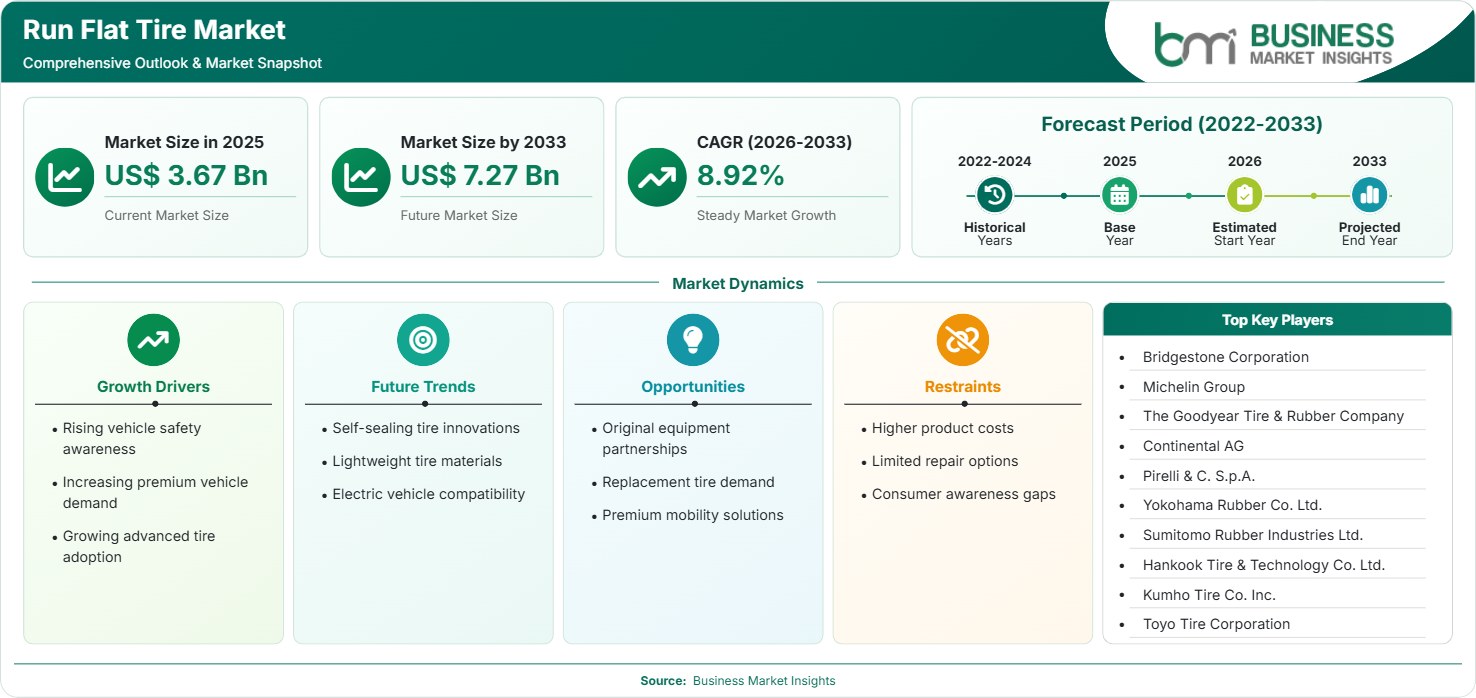
The Run Flat Tire Market size was valued at US$ 3.67 billion in 2025 and is projected to reach US$ 7.27 billion by 2033, growing at a CAGR of 8.92% during 2026–2033. Rising vehicle safety awareness, increasing premium vehicle demand, and growing adoption of advanced tire technologies are driving industry expansion. OEM partnerships and replacement tire demand continue creating attractive long-term opportunities for manufacturers.

Report Coverage
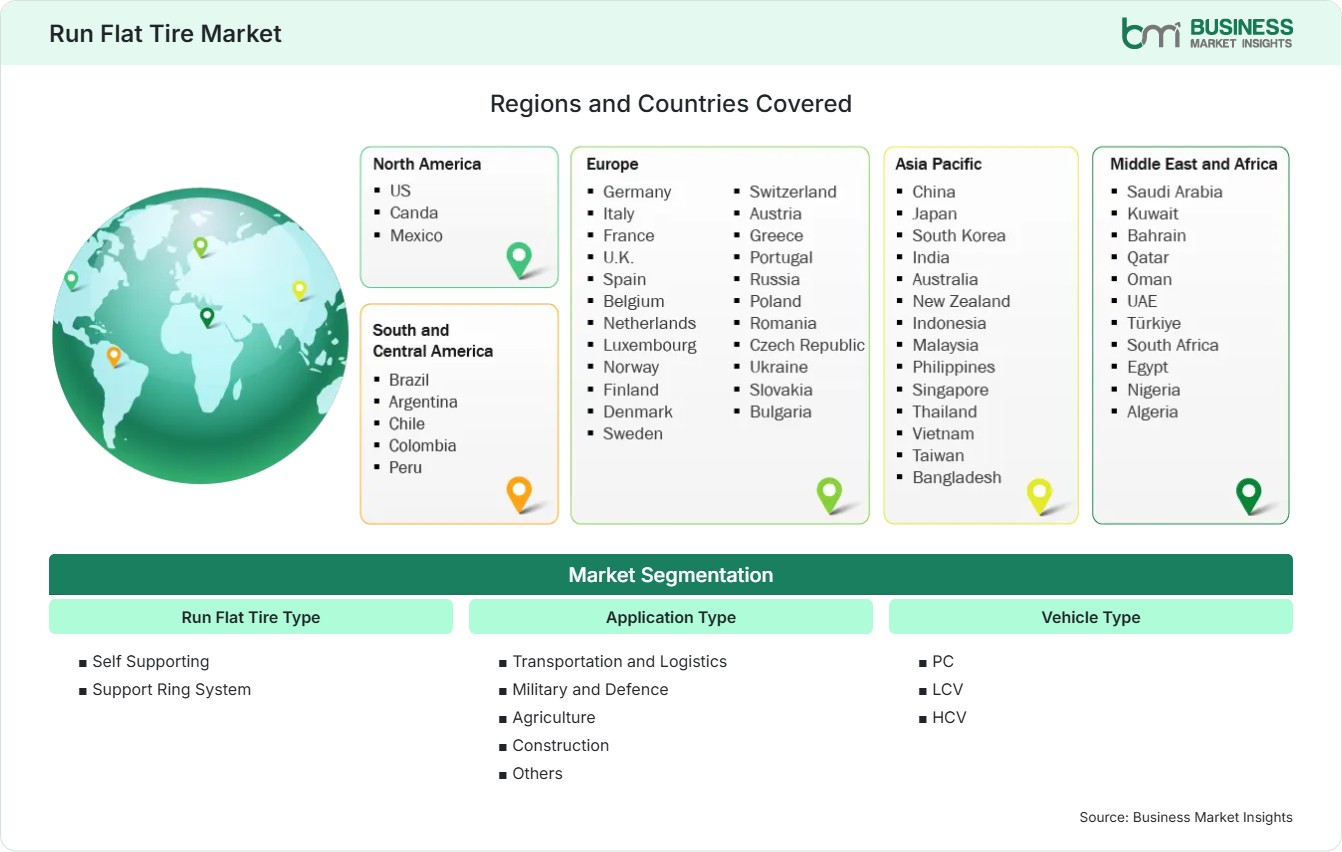
  • Run Flat Tire Type: Self Supporting, Support Ring System
  • Application Type: Transportation and Logistics, Military and Defence, Agriculture, Construction, Others
  • Vehicle Type: PC, LCV, HCV
US$ 3.67 Bn Market size in 2025
US$ 7.27 Bn Market Size by 2033
8.92% CAGR, 2026 - 2033
2026-2033 Forecast Period

AI Overview

Run Flat Tire Market Summary

  • North America Region: North America accounts for 33%–36% market share in 2025 and is projected to grow at a CAGR of 8.3%–8.8% during 2026–2033. Premium vehicle ownership, stringent safety regulations, and strong OEM adoption continue supporting regional demand. The U.S. market is expected to register a CAGR of 8.4%–8.9% through 2033, supported by luxury vehicle production and replacement demand.
  • Fastest Growing Region: Asia Pacific holds 28%–31% market share in 2025 while expanding at a CAGR of 9.5%–10.1% during 2026–2033. Rising automobile production, increasing disposable income, and growing premium vehicle ownership continue driving regional growth.
  • Leading Segment: Self Supporting accounts for 68%–71% market share in 2025 and is expected to grow at a CAGR of 9.0%–9.5%. Its compatibility with conventional wheels, lower manufacturing complexity, and widespread OEM adoption support continued leadership.
  • High Growth Segment: Passenger Cars (PC) contribute 58%–61% market share in 2025 while growing at a CAGR of 9.3%–9.8%. Rising luxury vehicle sales, increasing consumer safety awareness, and expanding electric vehicle production continue supporting demand.
  • Key Market Opportunity: Expanding OEM collaborations, premium electric vehicle production, and replacement tire demand are creating significant opportunities for manufacturers developing lightweight and durable run flat tire technologies.
  • Major Market Players: Bridgestone Corporation, Michelin Group, The Goodyear Tire & Rubber Company, Continental AG, Pirelli & C. S.p.A., Yokohama Rubber Co., Ltd., Sumitomo Rubber Industries, Ltd., Hankook Tire & Technology Co., Ltd., Kumho Tire Co., Inc., Toyo Tire Corporation.
Strategic Insights

Run Flat Tire Market: Strategic Insights

Run Flat Tire Market Strategic Framework
FREE PDF
Request your free sample
Request free sample
Stakeholder View

Key Takeaways

  • OEM partnerships remain the primary growth engine, enabling tire manufacturers to integrate advanced run flat technologies into premium and electric vehicle platforms.
  • Passenger cars offer the largest commercial opportunity due to increasing premium vehicle production and growing consumer preference for enhanced safety features.
  • Lightweight materials, reinforced sidewalls, and smart tire pressure monitoring systems are improving product performance while reducing rolling resistance.
  • Asia Pacific provides the strongest long-term investment opportunity through expanding automotive manufacturing, premium vehicle ownership, and infrastructure development.
  • Manufacturers continue prioritizing product innovation, capacity expansion, and sustainable tire technologies to strengthen their competitive position globally.
Geographic Outlook

Run Flat Tire Market Regional Highlights

North America Run Flat Tire Market

North America remains the leading regional market owing to strong premium vehicle sales, mature automotive manufacturing, and strict safety regulations. The region accounts for 33%–36% Run Flat Tire Market share in 2025 and is expected to grow at a CAGR of 8.3%–8.8% through 2033. Strong OEM partnerships and replacement demand continue supporting market expansion.

  • Luxury vehicle manufacturers increasingly install run flat tires as standard equipment to improve safety and eliminate spare tire requirements.
  • Rising aftermarket replacement demand is driven by increasing premium vehicle ownership and consumer awareness of advanced tire technologies.
  • Continuous investments in sustainable tire materials and manufacturing technologies improve product durability and fuel efficiency.
  • Tire pressure monitoring integration and vehicle safety regulations continue supporting Run Flat Tire Market growth across passenger and commercial vehicles.

US Run Flat Tire Market

The United States represents the largest country-level market in North America, accounting for 26%–29% global market share in 2025 while registering a CAGR of 8.4%–8.9% through 2033. Premium vehicle production, electric vehicle adoption, and a strong replacement market continue driving demand.

  • Premium automotive brands continue expanding factory-installed run flat tire offerings.
  • Electric vehicle production supports demand for lightweight and energy-efficient tire technologies.
  • Strong dealership and aftermarket networks ensure stable replacement tire sales.

Europe Run Flat Tire Market

Europe captures 27%–30% market share in 2025 and is expected to grow at a CAGR of 8.6%–9.1% during the forecast period. Germany remains the leading market, while Poland records one of the fastest growth rates at 9.3%–9.8% through expanding automotive manufacturing.

  • Germany leads regional demand through premium automotive production and strong OEM collaborations.
  • Poland benefits from growing automotive component manufacturing and export activity.
  • Sustainability initiatives encourage development of low rolling resistance and recyclable tire technologies.
  • Electric mobility expansion continues supporting demand for premium run flat tire solutions.

Asia Pacific Run Flat Tire Market

Asia Pacific is the fastest-growing regional market, accounting for 28%–31% market share in 2025 while expanding at a CAGR of 9.5%–10.1% through 2033. China dominates regional demand, whereas India records the fastest growth at 10.2%–10.8% due to expanding automotive production and premium vehicle adoption.

  • China remains the largest manufacturing and consumption hub for advanced automotive tires.
  • India benefits from increasing premium passenger vehicle sales and domestic automotive production.
  • Japanese and South Korean manufacturers continue investing in lightweight tire technologies.
  • Growing electric vehicle production creates long-term opportunities for advanced run flat tire solutions.

Rest of World Run Flat Tire Market

The Rest of World region contributes 8%–10% market share in 2025 and is projected to register a CAGR of 8.8%–9.4% through 2033. Brazil leads South & Central America, while the United Arab Emirates demonstrates strong growth at 9.4%–9.9% supported by premium vehicle demand.

  • Brazil benefits from improving automotive production and expanding aftermarket distribution.
  • The UAE experiences rising demand driven by luxury vehicle ownership and premium mobility trends.
  • Infrastructure development supports increasing adoption of advanced automotive safety technologies.
  • Global manufacturers continue expanding regional distribution partnerships to strengthen market penetration.
Global Market Geography
FREE PDF
Request your free sample
Request free sample
Segment Analysis

Run Flat Tire Market Segmentation

Run Flat Tire Type

The market continues evolving as vehicle manufacturers increasingly prioritize tire technologies capable of maintaining mobility after punctures while reducing dependence on spare wheels. Continuous improvements in reinforced sidewall engineering, lightweight construction, optimized rubber compounds, and structural durability have enhanced overall product performance. Self-supporting tires accounted for 74%–77% of global revenue in 2025 and are projected to register a CAGR of 8.9%–9.5% during 2026–2033. The Run Flat Tire Market scope continues expanding through wider OEM integration, premium passenger vehicle production, and technological advancements that improve ride quality, fuel efficiency, and operational reliability.

  • Self Supporting: The market segment dominates the entire industry owing to reinforced sidewall design, which facilitates continued operation of vehicles without air pressure. Compatibility with passenger vehicles, ease of installation, simplicity of the system, and increasing usage by luxury carmakers support sustained commercial demand for the product.
  • Support Ring System: Use of the support ring system is becoming more common in military transporters, armored vehicles, special-purpose trucks, and security systems where mobility needs to be maintained without fail. Load carrying capacity, stability in difficult conditions, and reliability are all contributing towards increased use of this technology.

Application Type

Growing emphasis on operational continuity, vehicle safety, and reduced downtime is expanding run flat tire adoption across multiple end-use industries. Fleet operators increasingly recognize the value of technologies that minimize unexpected roadside failures while improving driver safety and transportation efficiency. Transportation and Logistics represented 45%–48% of market revenue in 2025 and is expected to expand at a CAGR of 9.0%–9.6% during 2026–2033. Current Run Flat Tire Market trends demonstrate increasing investments in fleet modernization, commercial vehicle safety, and intelligent mobility technologies designed to reduce maintenance costs and improve operational productivity.

  • Transportation and Logistics: This segment continues to be the most prevalent use case due to constant fleet growth, rising e-commerce shipments, long-haul freight transportation, and increased focus on minimizing any interruptions. Operators are becoming more concerned about tires that will keep vehicles mobile even after being punctured.
  • Military and Defence: The use of advanced run-flat tire systems in defense continues to grow in application to tactical vehicles, armored personnel carriers, reconnaissance vehicles, and defense logistics convoys. The capability to remain mobile while operating in an adversary environment greatly improves operational readiness and mission success.
  • Agriculture: Modern agricultural tires have become highly sophisticated to enable operations on uneven surfaces without requiring any time for maintenance. Mechanization, bigger farms, and higher use of machinery ensure high demand for tough tires in agriculture.
  • Construction: There is an increasing need by construction equipment operators to have reliable tires that can handle weight and provide stability to the construction machines. The ever-increasing investments in infrastructure around the world will further fuel the growth in demand for such tires.

Vehicle Type

Rapid expansion of premium passenger vehicles, luxury SUVs, electric vehicles, and technologically advanced commercial vehicles continues driving demand across vehicle categories. Automotive manufacturers increasingly integrate run flat tires into factory-installed safety packages while consumers recognize their convenience and enhanced driving security. Passenger Cars (PC) accounted for 60%–63% of global market revenue in 2025 and are projected to grow at a CAGR of 9.3%–9.9% during 2026–2033. Rising premium vehicle ownership, stricter vehicle safety standards, and increasing OEM partnerships continue strengthening long-term segment growth worldwide.

  • PC: Passenger cars remain the dominant vehicle category due to strong adoption among luxury sedans, premium SUVs, sports utility vehicles, electric vehicles, and executive automobiles. OEM integration, rising consumer awareness regarding vehicle safety, and expanding premium automotive production continue supporting sustained market leadership.
  • LCV: Light commercial vehicles increasingly adopt run flat tire technologies to improve fleet efficiency, minimize transportation delays, and enhance operational continuity. Growth in urban logistics, last-mile delivery services, and commercial fleet modernization supports expanding adoption across this vehicle segment.
  • HCV: Heavy commercial vehicles demonstrate steady adoption, particularly in specialized transportation, defense logistics, mining operations, and industrial applications where uninterrupted vehicle mobility provides substantial operational and economic advantages. Growing infrastructure development and industrial transportation activities continue supporting long-term commercial demand.
Market Forces

Run Flat Tire Market Dynamics

Key Market Drivers

Rising vehicle safety awareness

The rising consciousness about road safety issues coupled with the toughening safety regulations concerning automobiles is still fueling the adoption of run-flat tires all around the world. There has been increased concern about cars that possess safety features which can help decrease accidents resulting from tire blow-outs. Run-flat tires ensure that cars can still be driven for some time even after a puncture, thus avoiding breakdowns and increasing safety. There have been increased efforts on the part of regulatory bodies in North America and Europe to increase vehicle safety standards while premium automotive manufacturers are incorporating run-flat tires into new car models.

Increasing premium vehicle demand

Sales in the global market for luxury cars, premium SUVs, executive cars, and high-performance vehicles continue growing due to increasing disposable income levels and desire for better ride experience. There is an increased trend among the leading premium automotive companies to include run flat tires as standard equipment in their newly introduced vehicles for better safety, improved luggage space utilization, and optimal vehicle performance. Even in the electric vehicle segment, there is a trend for using advanced tire technologies which are suitable to support heavier batteries with reduced rolling resistance and efficient driving performance. Expansion of premium automotive manufacturing in both the developed and developing markets increases the demand for technologically advanced tires.

Growing advanced tire adoption

Innovation continues to drive the development of tire technology that will improve strength, durability, comfort, performance, and reliability. The use of reinforced side walls, high-tech rubber blends, silica technology, weight-reducing techniques, and tire pressure monitoring systems is being developed by manufacturers to improve product performance. The incorporation of a tire pressure monitoring system in addition to this will improve safety and predictability of maintenance needs. Development and research funds are increasing towards the commercialization of new tire technology that will be useful for future automobiles, self-driving cars, and electric mobility.

Key Market Opportunities

Original equipment partnerships

Long-term strategic collaborations between tire manufacturers and automotive original equipment manufacturers continue creating significant commercial opportunities across global vehicle markets. Vehicle manufacturers increasingly seek advanced tire technologies capable of improving safety, driving performance, and customer convenience while reducing overall vehicle weight. Run Flat Tire Market Forecasts indicate sustained OEM demand as premium passenger vehicles, electric vehicles, luxury SUVs, and autonomous mobility platforms increasingly integrate factory-installed run flat tires. Joint development programs also accelerate product innovation, shorten commercialization timelines, and improve manufacturing efficiency, allowing suppliers to strengthen competitive positioning while securing long-term supply agreements with leading automotive manufacturers.

Replacement tire demand

The expanding installed base of vehicles equipped with run flat tires continues generating strong aftermarket opportunities. As premium vehicles reach replacement cycles, demand for compatible tire technologies is increasing across dealerships, authorized service centers, specialty tire retailers, and digital automotive sales platforms. Consumers increasingly recognize the convenience, safety, and reliability offered by run flat tires, encouraging repeat purchases despite higher initial costs. Growth in vehicle ownership, expanding automotive service infrastructure, and improved consumer awareness regarding premium tire performance continue supporting stable aftermarket revenue streams while creating attractive business opportunities for manufacturers and distributors worldwide.

Premium mobility solutions

Rapid development of connected vehicles, autonomous driving technologies, shared mobility services, and intelligent transportation ecosystems presents substantial opportunities for advanced tire manufacturers. Smart tires equipped with sensors capable of monitoring pressure, temperature, wear conditions, and road performance are becoming increasingly valuable for predictive maintenance and fleet optimization. Tire manufacturers are integrating digital technologies with premium mobility solutions to improve safety, reduce maintenance costs, and enhance operational efficiency. Increasing investment in intelligent transportation infrastructure and connected automotive ecosystems is expected to accelerate commercialization of advanced run flat tire technologies over the forecast period.

Market Restraints and Challenges

Higher product costs

Factor: Run flat tires require reinforced sidewalls, advanced rubber compounds, precision engineering, and specialized manufacturing processes that significantly increase production costs compared with conventional tire technologies. Additional investments in research, development, quality assurance, and performance testing further elevate manufacturing expenses.

Impact: Higher acquisition costs reduce affordability for price-sensitive consumers and limit penetration across economy vehicle segments, particularly in emerging markets where vehicle purchasing decisions remain strongly influenced by overall ownership costs. Manufacturers must continuously balance technological innovation with competitive pricing to expand broader market adoption.

Limited repair options

Factor: Unlike conventional tires, many run flat tires cannot be safely repaired after operating under low or zero air pressure because structural damage may compromise long-term performance and safety. Service procedures also require specialized inspection methods and trained technicians.

Impact: Complete tire replacement increases maintenance expenses for vehicle owners while limiting consumer acceptance in regions where replacement costs remain a major purchasing consideration. Limited-service availability in certain developing markets may further slow adoption despite the significant safety and operational benefits provided by advanced run flat tire technologies.

Company Analysis

Competitive Landscape

The competitive environment is characterized by continuous investment in reinforced tire technologies, lightweight materials, smart tire integration, and OEM partnerships. The Run Flat Tire Market analysis indicates that leading manufacturers are strengthening production capabilities, expanding premium product portfolios, and investing in sustainable tire technologies to meet the evolving requirements of passenger vehicles, commercial fleets, and defense applications.

Company Name

Overview

Products and Services Relevant to this Market

Bridgestone Corporation

Global tire manufacturer with a broad portfolio serving passenger, commercial, and specialty vehicle markets worldwide.

Run flat tires, passenger vehicle tires, commercial tires, premium mobility solutions, smart tire technologies, OEM tire supply.

Michelin Group

Leading global tire company recognized for innovation, sustainable mobility, and premium automotive tire technologies.

Self-supporting run flat tires, premium passenger tires, commercial tires, mobility services, connected tire solutions.

The Goodyear Tire & Rubber Company

International tire manufacturer delivering advanced mobility solutions for consumer and commercial transportation.

Run flat tires, replacement tires, commercial fleet tires, intelligent tire technologies, OEM tire solutions.

Continental AG

Automotive technology company providing advanced tire systems and intelligent mobility solutions worldwide.

Premium run flat tires, tire pressure monitoring technologies, passenger tires, commercial tires, automotive safety systems.

Pirelli & C. S.p.A.

Premium tire manufacturer specializing in high-performance and luxury vehicle applications.

High-performance run flat tires, luxury vehicle tires, motorsport technologies, premium replacement tires, OEM partnerships.

Yokohama Rubber Co., Ltd.

Japanese tire manufacturer serving global passenger, commercial, and industrial vehicle markets.

Passenger vehicle tires, run flat tire solutions, commercial tires, performance tires, sustainable tire technologies.

Sumitomo Rubber Industries, Ltd.

Global tire producer focusing on advanced engineering and environmentally efficient mobility products.

Run flat tires, passenger tires, commercial tires, advanced rubber compounds, OEM tire manufacturing.

Hankook Tire & Technology Co., Ltd.

International tire manufacturer emphasizing innovation, premium mobility, and advanced manufacturing capabilities.

Passenger vehicle run flat tires, EV tires, commercial tires, performance tires, original equipment supply.

Kumho Tire Co., Inc.

South Korean tire company supplying advanced tire products for global automotive manufacturers.

Run flat tires, passenger vehicle tires, commercial tires, replacement tire solutions, OEM products.

Toyo Tire Corporation

Tire manufacturer known for high-performance and durable tire technologies across global automotive markets.

Run flat tires, SUV tires, commercial tires, premium replacement tires, advanced tread technologies.

Industry Activity

Recent Developments

December 2025

Bridgestone Corporation announced the launch of the new POTENZA RE-71RZ and POTENZA Adrenalin RE005 premium passenger car tires, featuring enhanced driving performance and safety for high-performance vehicles, including applications requiring advanced run-flat tire technologies.

October 2025

Goodyear Tire & Rubber Company introduced the Eagle F1 All Season tire for sports cars, performance sedans, and premium crossovers, expanding its ultra-high-performance tire portfolio with enhanced year-round driving capabilities for premium vehicle applications.

June 2025

Bridgestone Americas launched the Bridgestone Turanza EverDrive touring tire, featuring the company's longest 80,000-mile limited warranty and advanced tread technology for premium passenger vehicles, further strengthening its premium tire portfolio that includes run-flat technologies.

March 2025

Michelin announced that it would continue trials of its airless Uptis tire technology with logistics partners while advancing puncture-proof tire solutions for future mobility applications, supporting innovation in run-flat and non-pneumatic tire technologies.

Trust & Transparency

Research Methodology

The market analysis combines proprietary research with secondary data from government agencies, company disclosures, regulatory filings, industry databases and expert interviews. Market estimates are validated through data triangulation, cross-market benchmarking and analyst review.

View Full Research Methodology

Questions Answered

Frequently Asked Questions

What future opportunities are expected in the market?

Future opportunities include expanding OEM partnerships, increasing replacement tire demand, premium electric vehicle production, intelligent tire monitoring integration, sustainable tire materials, and advanced mobility solutions supporting safer and more efficient transportation.

Which companies are leading the Run Flat Tire Market Report?

Leading participants include Bridgestone Corporation, Michelin Group, The Goodyear Tire & Rubber Company, Continental AG, Pirelli & C. S.p.A., Yokohama Rubber Co., Ltd., Sumitomo Rubber Industries, Ltd., Hankook Tire & Technology Co., Ltd., Kumho Tire Co., Inc., and Toyo Tire Corporation.

Which run flat tire type dominates the market?

Self Supporting run flat tires dominate the market because they offer compatibility with conventional wheel systems, lower manufacturing complexity, high durability, reduced maintenance requirements, and widespread adoption across passenger vehicles.

Which region is expected to witness the fastest growth?

Asia Pacific is expected to record the highest growth owing to expanding automotive manufacturing, rising premium vehicle ownership, increasing disposable income, rapid electric vehicle adoption, and continuous investments in advanced automotive technologies.

What are the major factors driving the Run Flat Tire Market?

The market is driven by rising vehicle safety awareness, increasing production of premium and luxury vehicles, expanding adoption of advanced tire technologies, stronger OEM integration, and growing consumer preference for uninterrupted mobility after tire punctures.

Access the Full Run Flat Tire Market Report

Get segment-level forecasts, regional estimates, competitive benchmarking, company profiles and downloadable Excel datasets.

Access the full Run Flat Tire Market Report
350 pages PDF & Excel | 2026-07-31