
Connected Tire Market Outlook: Size, Share, Trends, Growth Analysis, Competitive Landscape & Forecast, 2026-2033

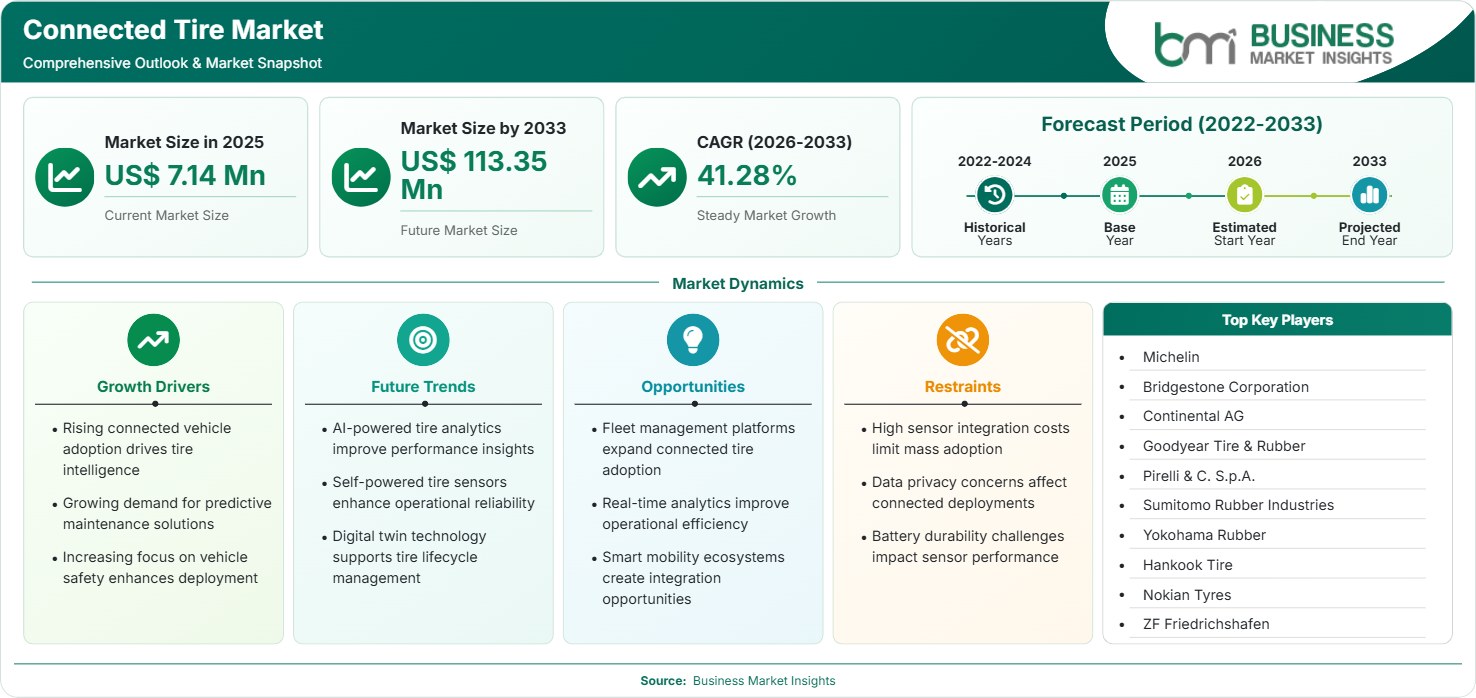
The Connected Tire Market size was valued at US$ 7.14 billion in 2025 and is projected to reach US$ 113.35 billion by 2033, growing at a CAGR of 41.28% during 2026–2033. Rising connected vehicle adoption, predictive maintenance solutions, and intelligent tire technologies are driving market expansion, while fleet digitization and smart mobility ecosystems create new opportunities.

Report Coverage
  • Vehicle Type: Passenger Cars, Commercial Vehicles
  • Rim Size: 12-17, 18-21, More than 22
US$ 7.14 Mn Market size in 2025
US$ 113.35 Mn Market Size by 2033
41.28% CAGR, 2026 - 2033
2026-2033 Forecast Period

AI Overview

Connected Tire Market Summary

  • North America Region: North America accounts for 32%–35% market share in 2025 and is projected to expand at a CAGR of 40.5%–42.0% during 2026–2033. Connected vehicle penetration, advanced fleet management systems, and safety regulations support adoption. The U.S. represents the regional leader with a CAGR of 40.8%–42.3%, driven by commercial fleet connectivity and intelligent transportation investments.
  • Fastest Growing Region: Asia Pacific holds 38%–41% market share in 2025 and is expected to register a CAGR of 42.5%–44.0% during 2026–2033. Rapid electric vehicle adoption, automotive technology investments, and smart mobility initiatives are accelerating connected tire deployment.
  • Leading Segment: Commercial Vehicles represent 55%–58% market share in 2025 and are expected to grow at a CAGR of 41.5%–43.0% due to fleet optimization requirements, operational efficiency improvements, and predictive maintenance adoption.
  • High Growth Segment: Passenger Cars account for 42%–45% market share in 2025 and are projected to achieve a CAGR of 43.0%–44.5%, supported by connected vehicle integration, premium vehicle demand, and increasing consumer safety awareness.
  • Key Market Opportunity: Integration of connected tires with fleet platforms, telematics systems, and artificial intelligence-based analytics is creating opportunities for real-time monitoring, predictive maintenance, and improved vehicle performance.
  • Major Market Players: Michelin, Bridgestone Corporation, Continental AG, Goodyear Tire & Rubber Company, Pirelli & C. S.p.A., Sumitomo Rubber Industries, Yokohama Rubber Company Limited, Hankook Tire & Technology Co., Ltd., Nokian Tyres plc, and ZF Friedrichshafen AG.
Strategic Insights

Connected Tire Market: Strategic Insights

Connected Tire Market Strategic Framework
FREE PDF
Request your free sample
Request free sample
Stakeholder View

Key Takeaways

  • Connected tires are becoming an essential component of the automotive digital ecosystem by linking tire performance data with vehicle systems, telematics platforms, and fleet management solutions.
  • Commercial fleets represent a major growth opportunity as operators increasingly adopt predictive maintenance technologies to reduce downtime, optimize fuel efficiency, and improve asset utilization.
  • Sensor miniaturization, wireless communication technologies, and AI-driven analytics are accelerating the development of intelligent tire systems with enhanced monitoring capabilities.
  • Asia Pacific provides strong investment potential due to expanding automotive production, electric vehicle adoption, and government-backed smart mobility programs.
  • Strategic collaborations between tire manufacturers, automotive technology companies, and software providers are increasing innovation and accelerating connected tire commercialization.
  • The market is moving toward integrated mobility solutions where tire intelligence contributes to autonomous driving, safety enhancement, and vehicle lifecycle management.
Geographic Outlook

Connected Tire Market Regional Highlights

North America Connected Tire Market

North America accounted for 32%–35% Connected Tire Market share in 2025 and is projected to register a CAGR of 40.5%–42.0% during 2026–2033. The region benefits from strong commercial fleet adoption, advanced telematics infrastructure, and increasing demand for predictive maintenance technologies. The U.S. remains the primary contributor due to high vehicle connectivity penetration and investments in intelligent transportation systems. Tire manufacturers are collaborating with technology providers to improve connected mobility solutions.

  • Fleet operators increasingly adopt smart tire monitoring systems to reduce maintenance costs and improve vehicle uptime.
  • Advanced telematics adoption supports integration between connected tires and fleet management platforms.
  • Automotive manufacturers are incorporating intelligent tire technologies into premium vehicle models.
  • Safety regulations encourage deployment of real-time tire monitoring solutions across transportation networks.

US Connected Tire Market

The U.S. represents 82%–85% of North American demand and is expected to expand at a CAGR of 40.8%–42.3% during 2026–2033. Strong commercial transportation activity, advanced automotive technology adoption, and increasing fleet digitalization continue supporting market development. Automotive companies are investing in connected vehicle platforms that incorporate tire intelligence for improved safety and operational performance.

  • Large logistics operators are adopting predictive tire monitoring to minimize vehicle downtime.
  • Electric vehicle growth is increasing demand for advanced tire performance monitoring technologies.
  • Connected mobility investments are supporting integration between tires, vehicles, and cloud platforms.
  • Technology partnerships are accelerating development of intelligent automotive solutions.

Europe Connected Tire Market

Europe represents 21%–24% market share in 2025 and is expected to grow at a CAGR of 39.8%–41.5% during 2026–2033. Strong sustainability initiatives, advanced automotive manufacturing capabilities, and strict vehicle safety requirements are supporting adoption. Germany remains the leading market, while France and the Netherlands are witnessing increasing deployment through smart mobility programs and connected transportation investments.

  • European automakers are integrating intelligent tire systems into next-generation vehicle platforms.
  • Sustainability regulations encourage technologies improving vehicle efficiency and lifecycle management.
  • Fleet companies are investing in digital maintenance solutions to reduce operating expenses.
  • Connected tire partnerships are increasing across automotive and technology industries.

Asia Pacific Connected Tire Market

Asia Pacific holds 38%–41% market share in 2025 and is projected to achieve the highest CAGR of 42.5%–44.0% during 2026–2033. Automotive manufacturing expansion, electric vehicle growth, and smart city initiatives are accelerating adoption across China, Japan, South Korea, and India. Increasing vehicle connectivity and government support for intelligent transportation infrastructure continue creating favorable market conditions.

  • China leads regional adoption through large-scale electric vehicle and automotive technology investments.
  • India is experiencing rising demand due to expanding commercial fleets and mobility services.
  • Japanese manufacturers continue developing advanced tire sensing and connectivity technologies.
  • Smart transportation projects are increasing demand for connected vehicle solutions.

Rest of World Connected Tire Market

The Rest of World region accounts for 5%–8% connected tire market share in 2025 and is expected to grow at a CAGR of 40.0%–41.5% during 2026–2033. Latin America, the Middle East, and Africa are gradually adopting connected tire technologies through fleet modernization, logistics expansion, and smart transportation initiatives. Commercial vehicle operators remain key adopters due to efficiency and maintenance benefits.

  • Brazil supports regional growth through expanding logistics networks and commercial transportation demand.
  • Middle Eastern countries are investing in smart mobility and connected infrastructure projects.
  • African markets are adopting fleet monitoring solutions to improve transportation efficiency.
  • Regional technology partnerships are supporting connected mobility deployment.
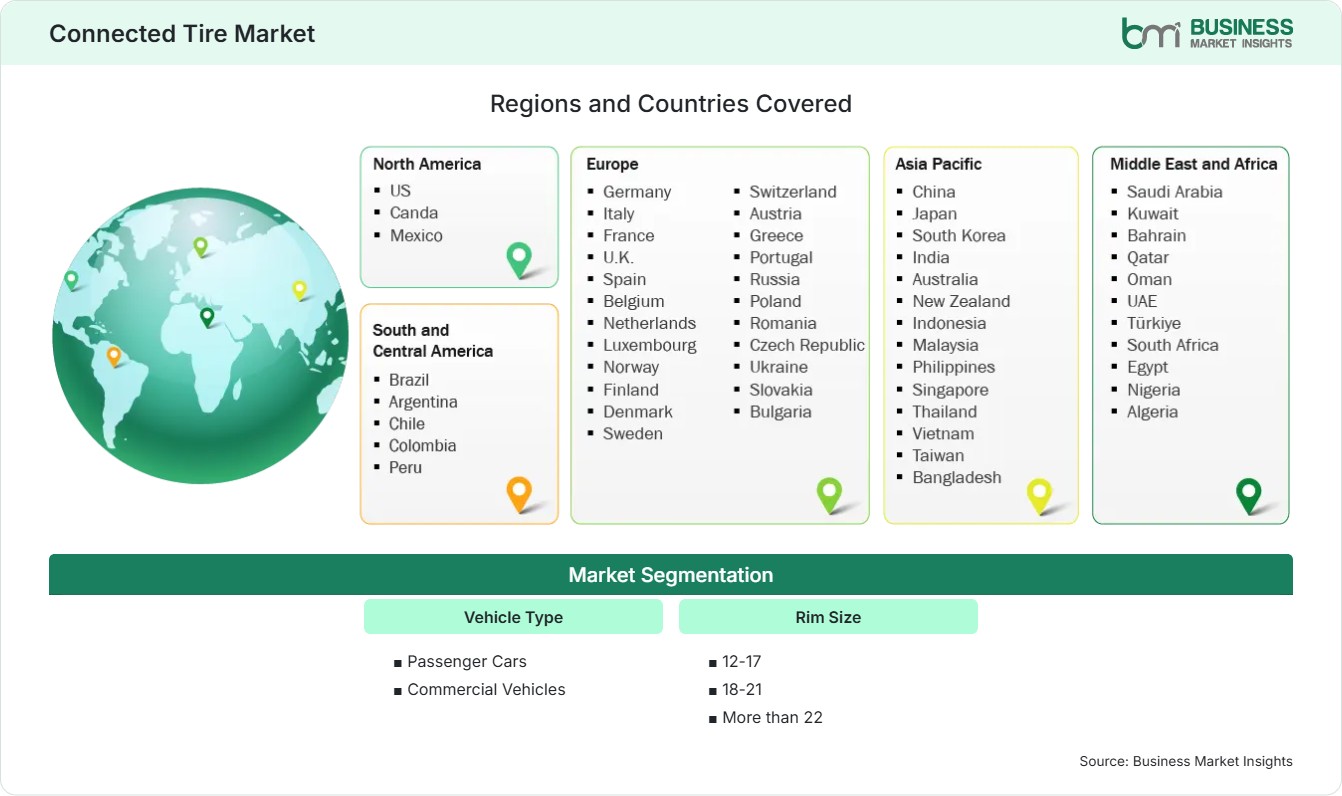
Global Market Geography
FREE PDF
Request your free sample
Request free sample
Segment Analysis

Connected Tire Market Segmentation

Vehicle Type

The vehicle type segment represents a major component of the industry as connected tire technologies are increasingly integrated across passenger and commercial transportation platforms. This segment accounted for 55%–58% market share in 2025 and is projected to expand at a CAGR of 41.5%–43.0% during 2026–2033. Rising adoption of smart mobility solutions, fleet monitoring systems, and vehicle safety technologies continues supporting demand. The Connected Tire Market scope is expanding as manufacturers develop solutions compatible with diverse vehicle categories.

  • Passenger Cars: Adoption is increasing through premium vehicle integration, electric vehicle expansion, and consumer demand for enhanced safety features, real-time monitoring, and improved driving efficiency.
  • Commercial Vehicles: This segment dominates due to fleet operators requiring predictive maintenance, reduced downtime, improved tire lifecycle management, and operational cost optimization through connected tire data analytics.

Rim Size

The rim size segment is influenced by changing vehicle designs, increasing premium vehicle production, and growing demand for advanced tire technologies across different automotive categories. It accounted for 42%–45% market share in 2025 and is expected to register a CAGR of 43.0%–44.5% during 2026–2033. Larger rim sizes are gaining adoption in premium vehicles and electric vehicles, where connected tire solutions improve performance monitoring and driving safety.

  • 12-17: Widely used in compact cars and entry-level vehicles, this category benefits from high production volumes and increasing adoption of basic connected tire monitoring technologies.
  • 18-21: Experiences strong demand from premium passenger vehicles, SUVs, and electric vehicles requiring advanced tire intelligence, performance monitoring, and enhanced safety capabilities.
  • More than 22: Gains adoption in luxury vehicles, high-performance cars, and specialized applications where advanced tire monitoring supports improved handling, efficiency, and vehicle control.
Market Forces

Connected Tire Market Dynamics

Key Market Drivers

Rising connected vehicle adoption drives tire intelligence

Increased use of connected vehicle technology is driving the requirement for tire systems that can collect and communicate real-time data regarding their performance. Tire manufacturers are incorporating various sensors and communication technologies in the car to make them safer, more efficient, and more enjoyable to drive. The connected tire allows the manufacturer or fleet manager to monitor various aspects of the tire such as pressure, temperature, wear and tear, and the way it interacts with the road. These developments are strengthening Connected Tire Market growth as tire manufacturers focus on developing integrated solutions that connect vehicle components with digital mobility ecosystems.

Growing demand for predictive maintenance solutions

Fleet operators and automotive companies are increasingly adopting predictive maintenance technologies to reduce unexpected failures, improve vehicle availability, and optimize operating costs.Tire connected systems offer continuous performance data, allowing problems in tires to be detected before they start impacting the functioning of vehicles. Transportation firms are adopting the use of such solutions in order to increase tire life span, improve maintenance scheduling and boost the efficiency of their fleets. As telematics and cloud analytics become incorporated into tire systems, more effective maintenance models are being created in logistics, transportation and mobility services. The importance of efficiency is leading tire manufacturers to create better monitoring technologies.

Increasing focus on vehicle safety enhances deployment

The safety requirement in vehicles is also making the need for the connected tires which can inform about the condition of the tire and driving performance in real time. The problems related to the tires are also responsible for making them a very important area to consider from the point of view of safety, and that is why there is a need for the system which can monitor the pressure level, temperature changes, and the tread wear in tires. These factors continue shaping Connected Tire Market trends by encouraging innovation in sensor technology, data analytics, and vehicle integration.

Key Market Opportunities

Fleet management platforms expand connected tire adoption

The incorporation of connected tire technology with fleet management systems is creating many opportunities for both the manufacturers and the technology providers. Fleet managers are looking for systems that integrate information about tires with other elements such as vehicle location, maintenance schedules, and fleet performance analysis in order to increase efficiency. The use of connected tire technology can make it possible to have better maintenance schedules, less downtime, and greater fleet productivity. The Connected Tire Market Forecasts indicate that collaboration between tire manufacturers, telematics providers, and fleet management companies will create new commercial opportunities across transportation and logistics sectors.

Real-time analytics improve operational efficiency

Advanced analytics platforms are enabling companies to convert connected tire data into actionable insights for better decision-making. Real-time monitoring capabilities allow fleet managers and automotive manufacturers to evaluate tire performance, identify maintenance requirements, and optimize vehicle operations. Integration of artificial intelligence and cloud-based systems is improving the accuracy of predictive models and enhancing operational efficiency. These capabilities are becoming increasingly valuable for commercial fleets managing large vehicle volumes. Companies investing in data-driven tire solutions can differentiate their offerings by providing improved performance monitoring, reduced maintenance costs, and enhanced vehicle lifecycle management.

Smart mobility ecosystems create integration opportunities

The development of smart mobility ecosystems is creating opportunities for connected tires to become an integrated component of future transportation networks. Connected tire data can support vehicle communication systems, autonomous driving technologies, and intelligent transportation infrastructure. Partnerships between tire manufacturers, automotive OEMs, and software companies are expanding the role of tires beyond traditional mobility components. Growing investments in connected vehicles and digital transportation solutions are encouraging innovation in sensor technology, wireless connectivity, and data platforms. These developments are expected to support wider adoption of intelligent tire solutions across passenger vehicles, commercial fleets, and emerging mobility services.

Market Restraints and Challenges

High sensor integration costs limit mass adoption

The implementation of advanced sensors, communication modules, and data processing systems increases the overall cost of connected tire solutions. Factor: High component costs, complex manufacturing requirements, and additional integration processes create financial challenges for tire manufacturers and vehicle producers. Impact: Higher product pricing can limit adoption among cost-sensitive consumers and fleet operators, slowing widespread deployment in entry-level vehicles and emerging markets. Companies are focusing on improving sensor affordability, manufacturing scalability, and integration efficiency to reduce cost barriers and expand market accessibility.

Data privacy concerns affect connected deployments

Connected tire systems generate continuous streams of vehicle and operational data, creating concerns regarding data ownership, cybersecurity, and privacy management. Factor: Increased connectivity between tires, vehicles, cloud platforms, and external applications requires strong data protection measures and regulatory compliance. Impact: Privacy concerns and cybersecurity risks may delay adoption among fleet operators and consumers concerned about information security. Industry participants are investing in secure communication technologies, encryption systems, and data governance frameworks to improve confidence in connected tire solutions and support broader deployment.

Company Analysis

Competitive Landscape

The competitive environment is shaped by tire manufacturers, automotive technology providers, and mobility solution companies investing in intelligent tire platforms, sensor technologies, and connected vehicle ecosystems. Connected Tire Market analysis highlights increasing collaborations between tire producers and digital technology companies to develop real-time monitoring solutions, predictive maintenance platforms, and data-driven mobility services. Leading companies are focusing on product innovation, strategic partnerships, and integration with fleet management systems to strengthen their position in the evolving connected mobility landscape.

Company Name

Overview

Products and Services Relevant to this Market

Michelin

Global tire manufacturer developing connected mobility solutions through digital technologies and intelligent tire platforms.

Connected tire solutions, tire monitoring systems, fleet management technologies, predictive maintenance platforms, and digital mobility services.

Bridgestone Corporation

Leading tire and mobility solutions company focusing on advanced tire technologies and connected vehicle applications.

Intelligent tires, sensor-based monitoring systems, fleet solutions, tire management platforms, and digital mobility technologies.

Continental AG

Automotive technology provider integrating tire intelligence with vehicle connectivity and safety systems.

ContiConnect digital tire monitoring, sensor technologies, fleet solutions, intelligent tire systems, and automotive connectivity platforms.

Goodyear Tire & Rubber Company

Tire manufacturer developing smart tire technologies for commercial fleets and connected mobility applications.

Intelligent tire systems, real-time tire monitoring, predictive maintenance solutions, and fleet management technologies.

Pirelli & C. S.p.A.

Premium tire manufacturer investing in sensor-enabled tire technologies and connected driving solutions.

Cyber Tyre technology, smart tire sensors, digital tire monitoring, and performance data solutions.

Sumitomo Rubber Industries

Japanese tire manufacturer advancing digital tire technologies and smart mobility solutions.

Sensing Core technology, intelligent tire systems, tire data analytics, and connected vehicle applications.

Yokohama Rubber Company Limited

Global tire producer focusing on advanced tire technologies and digital monitoring solutions.

Smart tire technologies, tire performance monitoring systems, commercial tire solutions, and mobility services.

Hankook Tire & Technology Co., Ltd.

Tire manufacturer developing future mobility solutions through digital innovation and connected technologies.

Smart tire systems, sensor technologies, tire data solutions, and advanced mobility platforms.

Nokian Tyres plc

Tire company focusing on safety-oriented tire technologies and digital tire solutions.

Intelligent tire concepts, tire monitoring solutions, connected mobility technologies, and safety-focused products.

ZF Friedrichshafen AG

Automotive technology company providing vehicle systems and digital mobility solutions supporting connected transportation.

Vehicle connectivity systems, sensor technologies, predictive maintenance platforms, and intelligent mobility solutions.

Trust & Transparency

Research Methodology

The market analysis combines proprietary research with secondary data from government agencies, company disclosures, regulatory filings, industry databases and expert interviews. Market estimates are validated through data triangulation, cross-market benchmarking and analyst review.

View Full Research Methodology

Questions Answered

Frequently Asked Questions

What does the Connected Tire Market Report cover?

The Market Report provides insights into market dynamics, technology advancements, competitive developments, segmentation analysis, regional trends, investment opportunities, and future growth prospects across automotive and mobility applications.

What factors are limiting connected tire adoption?

High sensor costs, integration complexity, cybersecurity requirements, and concerns regarding data management remain major challenges. Manufacturers are addressing these issues through cost reduction strategies, improved security systems, and scalable technology development.

What role does artificial intelligence play in connected tire systems?

Artificial intelligence helps analyze tire performance data, identify potential failures, predict maintenance requirements, and optimize vehicle operations. AI-based analytics improve decision-making for fleet operators and automotive manufacturers.

Which vehicles are adopting connected tire technologies faster?

Commercial vehicles are adopting connected tire technologies rapidly because fleet operators benefit from reduced downtime, improved maintenance scheduling, and lower operating costs. Passenger vehicles are also increasingly integrating these systems through connected and electric vehicle platforms.

How do connected tires improve vehicle performance?

Connected tires improve vehicle performance by collecting real-time information about pressure, temperature, wear, and road conditions. This data enables predictive maintenance, improves safety, enhances fuel efficiency, and supports better fleet management decisions.

Access the Full Connected Tire Market Report

Get segment-level forecasts, regional estimates, competitive benchmarking, company profiles and downloadable Excel datasets.

Access the full Connected Tire Market Report
350 pages PDF & Excel | 2026-08-24