
Connected Motorcycle Market Outlook: Size, Share, Trends, Growth Analysis, Competitive Landscape & Forecast, 2026-2033

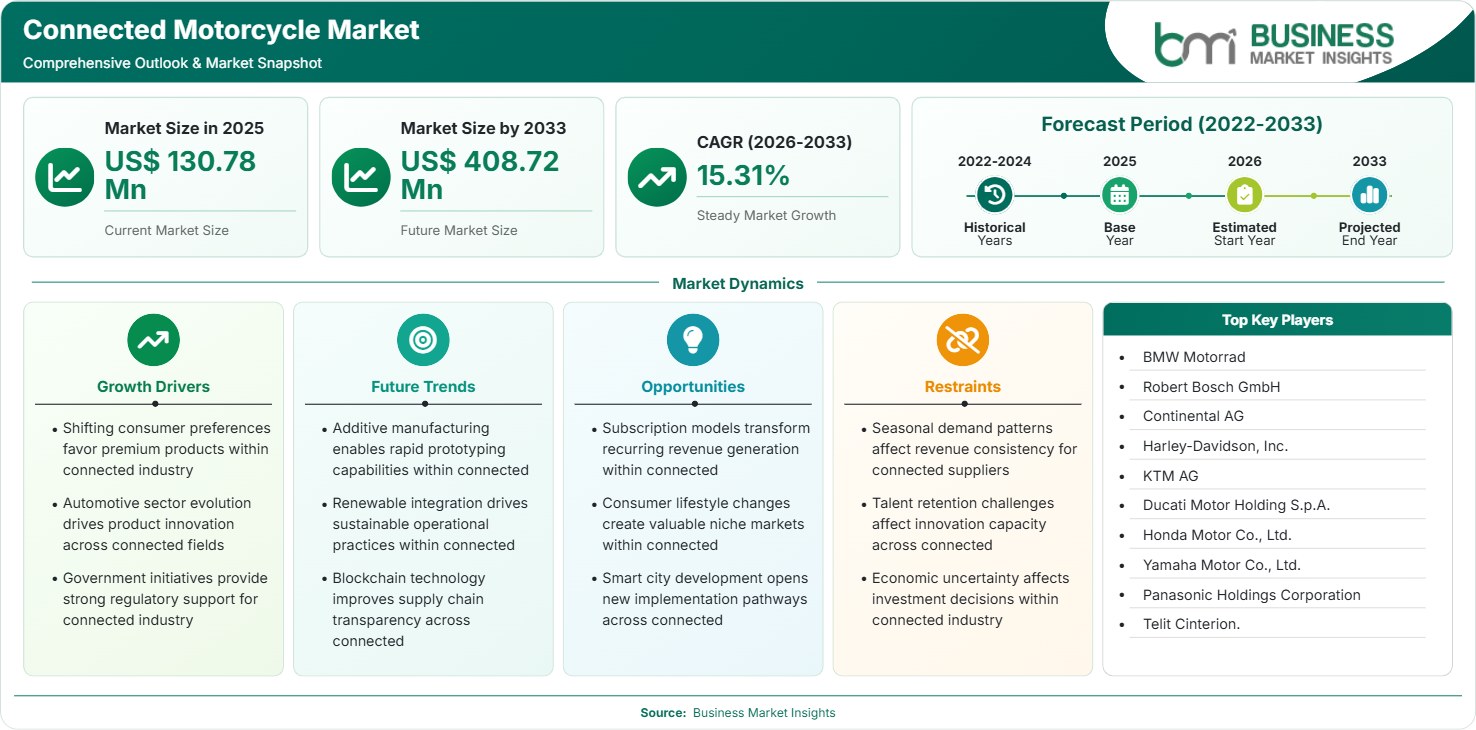
The Connected Motorcycle Market size was valued at US$ 130.78 Million in 2025 and is projected to reach US$ 408.72 Million by 2033, growing at a CAGR of 15.31% during 2026–2033. Key drivers include V2X safety adoption, increasing premium motorcycles, embedded telematics deployment, regulatory focus on road safety, and 5G expansion. Opportunities stem from connected electric motorcycles, predictive maintenance, and subscription-based digital services.

Report Coverage
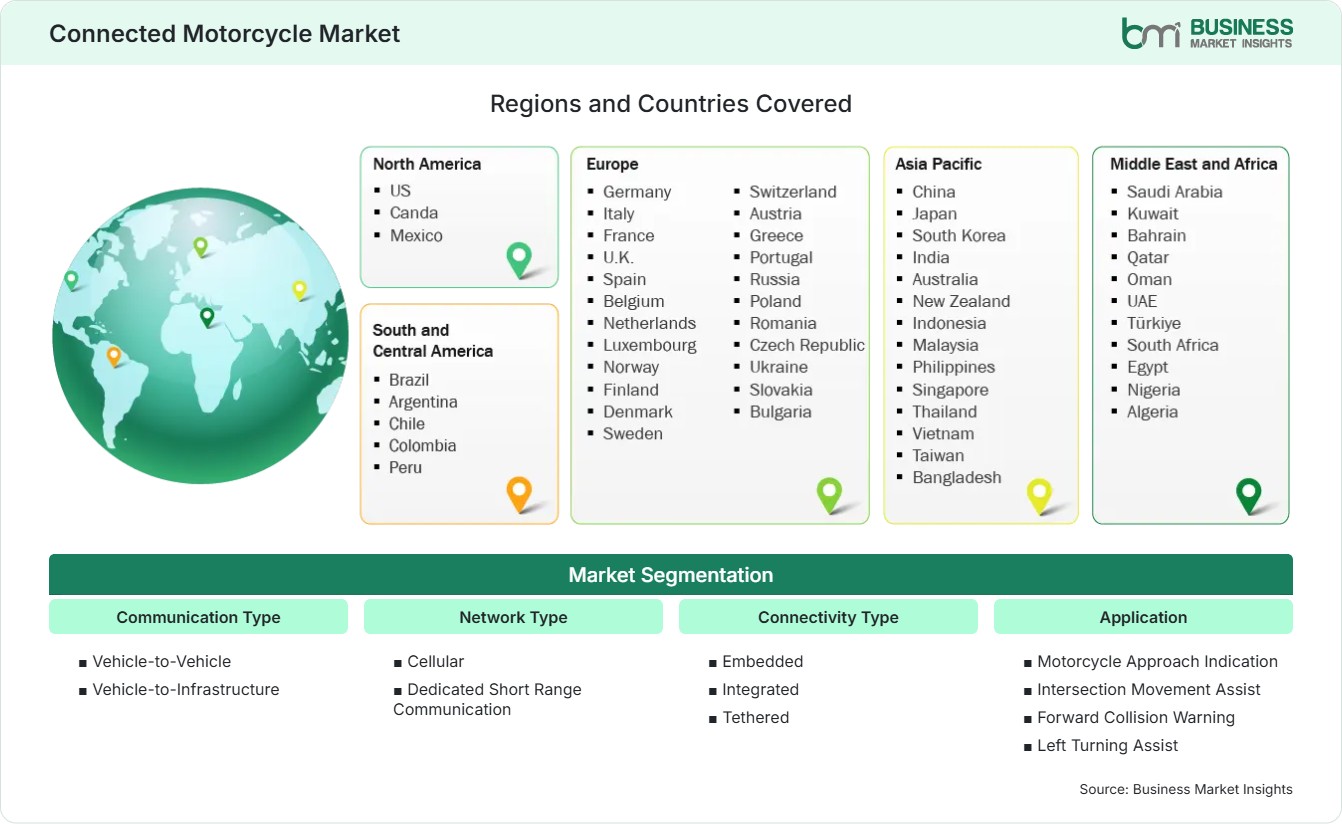
  • Communication Type: Vehicle-to-Vehicle, Vehicle-to-Infrastructure
  • Network Type: Cellular, Dedicated Short Range Communication
  • Connectivity Type: Embedded, Integrated, Tethered
  • Application: Motorcycle Approach Indication , Intersection Movement Assist , Forward Collision Warning , Left Turning Assist
US$ 130.78 Mn Market size in 2025
US$ 408.72 Mn Market Size by 2033
15.31% CAGR, 2026 - 2033
2026-2033 Forecast Period

AI Overview

Connected Motorcycle Market Summary

  • North America Region: Holds a market share of 34%–37% in 2025, growing with a CAGR of 14.0%–15.5% during 2026–2033. Growth is supported by premium motorcycle ownership, strong telematics ecosystems, expanding cellular connectivity, advanced safety mandates, and OEM investments in rider-assistance technologies and digital service monetization. US market benefits from premium touring motorcycles, safety technology integration, and a CAGR of 14.5%–16.0%.
  • Fastest Growing Region: Asia Pacific holds a market share of 27%–30% in 2025, growing with a CAGR of 17.0%–18.5% during 2026–2033. Expansion is driven by electric two-wheeler adoption, smartphone penetration, connected mobility initiatives, rising disposable income, urban mobility demand, and increasing investments from domestic manufacturers.
  • Leading Segment: Vehicle-to-Vehicle communication accounts for 58%–61% share in 2025 and advances at 14.5%–16.0% CAGR. Adoption is encouraged by collision avoidance requirements, rider safety enhancement, cooperative awareness applications, interoperability improvements, and development of intelligent transportation infrastructure.
  • High Growth Segment: Embedded connectivity represents 41%–44% of the Connected Motorcycle Market share in 2025 and grows at 16.5%–18.0% CAGR. Growth is supported by factory-installed telematics, real-time diagnostics, OTA updates, emergency communication services, cybersecurity enhancements, and seamless smartphone-independent functionality.
  • Key Market Opportunity: Integration of connected services with electric motorcycles creates recurring revenue streams through diagnostics, battery analytics, insurance telematics, navigation subscriptions, remote monitoring capabilities, and data-driven fleet management platforms.
  • Major Market Players: BMW Motorrad, Robert Bosch GmbH, Continental AG, Harley-Davidson, Inc., KTM AG, Ducati Motor Holding S.p.A., Honda Motor Co., Ltd., Yamaha Motor Co., Ltd., Panasonic Holdings Corporation, Telit Cinterion.
Strategic Insights

Connected Motorcycle Market: Strategic Insights

Connected Motorcycle Market Strategic Framework
FREE PDF
Request your free sample
Request free sample
Stakeholder View

Key Takeaways

  • The value chain increasingly combines OEMs, telecom providers, cloud platform operators, sensor suppliers, and map-service companies, creating a broader ecosystem beyond conventional motorcycle manufacturing.
  • Intersection Movement Assist and Forward Collision Warning applications present attractive upside because urban accident reduction remains a major policy priority in developed and emerging markets.
  • Product innovation is shifting toward embedded telematics, OTA software updates, AI-enabled predictive maintenance, cybersecurity layers, and sensor fusion technologies integrating radar and camera systems.
  • India, China, Indonesia, and Thailand offer compelling investment potential due to large two-wheeler fleets, expanding digital infrastructure, and growing acceptance of connected mobility services.
  • Strategic partnerships between motorcycle OEMs and technology providers are increasing as companies seek faster deployment of V2X systems, cloud analytics, and advanced rider-assistance functions.
  • Connected data monetization through insurance telematics, navigation subscriptions, maintenance analytics, and fleet management services is emerging as a critical profitability driver.
Geographic Outlook

Connected Motorcycle Market Regional Highlights

North America Connected Motorcycle Market

North America accounted for 34%–37% of the Connected Motorcycle Market share in 2025 and is projected to expand at a CAGR of 14.0%–15.5% during 2026–2033. Strong demand for premium touring motorcycles, mature telecommunications infrastructure, growing V2X pilot programs, and adoption of advanced safety technologies support regional expansion. OEMs increasingly integrate embedded connectivity services and cloud-based diagnostics. Insurance telematics adoption and high consumer spending on vehicle technology further strengthen regional demand dynamics.

  • Premium motorcycle brands continue expanding connected safety portfolios to address rider protection and digital convenience requirements.
  • Cellular network coverage enables reliable communication functions, supporting deployment of navigation, diagnostics, and OTA software capabilities.
  • Commercial fleet operators increasingly adopt connected systems to improve route visibility, maintenance planning, and asset utilization.
  • Growing regulatory discussions around road safety contribute to technology investment and ecosystem collaboration across the region.

US Connected Motorcycle Market

The United States is one of the dominant players in North America, accounting for 78%–82% of the market share and growing at a CAGR of 14.5%–16.0% till 2033. A high level of adoption of telematics solutions is observed in premium touring, cruiser, and adventure bikes, where riders require navigation, communication, and safety solutions. Strong OEM presence and software ecosystem maturity support continued investment.

  • Higher penetration of premium models accelerates adoption of embedded communication and rider-assistance technologies.
  • Strong consumer preference for connected mobility experiences supports subscription-based digital service demand.
  • Technology partnerships between manufacturers and telecommunications firms accelerate commercialization of advanced connected solutions.
  • Insurance-linked telematics applications receive increasing attention for risk assessment and rider behavior analysis.

Europe Connected Motorcycle Market

Europe accounted for 28%-31% market share in 2025 and is projected to grow at a CAGR of 14.5%-16.0%. Strict safety considerations in vehicles, development in intelligent transportation systems, and the presence of many premium motorcycle producers are expected to fuel demand. Germany is the dominant country, whereas Spain and Italy are the markets with high growth potential. Connected diagnostics, emergency communication functions, and regulatory focus on accident prevention continue driving adoption.

  • Germany leads regional revenue generation, benefiting from advanced manufacturing capabilities and strong premium motorcycle demand.
  • Italy supports innovation through performance motorcycle brands integrating digital riding technologies.
  • Spain exhibits one of the fastest growth trajectories, supported by urban mobility initiatives and connected infrastructure investment.
  • V2X testing programs encourage collaborative development among OEMs, suppliers, and public transportation authorities.
  • Growing electric motorcycle penetration creates additional demand for remote monitoring and battery analytics.

Asia Pacific Connected Motorcycle Market

Asia-Pacific holds the largest market share, at 27% to 30% in 2025, and registers the highest CAGR, at 17.0% to 18.5%, between 2026 and 2033. Factors such as increasing ownership of two-wheelers, improved digital connectivity, and adoption of electric mobility drive regional growth. In the region, China dominates revenue contributions, whereas India offers high growth potential. Increasing smartphone integration, urban mobility solutions, and local manufacturing capacity support sustained expansion in demand.

  • China remains the largest regional contributor due to extensive manufacturing ecosystems and connected vehicle investments.
  • India demonstrates strong adoption potential as digital services become integrated into mass-market motorcycles.
  • Southeast Asian countries benefit from large two-wheeler populations and increasing mobile connectivity penetration.
  • Electric motorcycle adoption stimulates demand for embedded connectivity, fleet monitoring, and diagnostics platforms.
  • Local OEMs increasingly partner with software providers to strengthen competitive differentiation.

Rest of World Connected Motorcycle Market

Rest of World accounts for 8%–10% share and is projected to grow at a CAGR of 15.0%–16.5%. South and Central America benefit from urban mobility modernization and increasing digital penetration. Middle East and Africa markets remain comparatively early-stage but demonstrate improving prospects through smart city investments and transportation digitization programs.

  • Brazil leads South and Central America due to sizeable motorcycle ownership and rising adoption of digital mobility solutions.
  • Mexico presents attractive opportunities through manufacturing integration and telecommunications development.
  • United Arab Emirates drives Middle East demand through smart mobility and connected transportation initiatives.
  • South Africa remains a key African market supported by improving digital infrastructure and commercial fleet requirements.
  • Emerging economies increasingly evaluate telematics-based safety solutions for accident prevention and operational visibility.
Global Market Geography
FREE PDF
Request your free sample
Request free sample
Segment Analysis

Connected Motorcycle Market Segmentation

Communication Type

Communication Type accounted for a significant portion of industry revenues. The segment benefits from increasing deployment of cooperative mobility technologies, safety communication standards, and intelligent transportation networks. The Connected Motorcycle Market scope continues expanding as V2X systems become central to collision avoidance strategies. The segment represented approximately a 58%–61% share in 2025 and grows at 14.5%–16.0% CAGR.

  • Vehicle-to-Vehicle: Enables real-time exchange of movement and hazard information between motorcycles and nearby vehicles, improving situational awareness and supporting proactive collision prevention capabilities.
  • Vehicle-to-Infrastructure: Facilitates communication with traffic signals and road systems, enhancing navigation efficiency, traffic management functionality, and broader smart mobility integration.

Network Type

The network-type development segment is spurred by demand for efficient, secure data transmission to enable sophisticated rider-assistance applications. While cellular network technology is gaining popularity in new investments, special-purpose communication protocols have value for safety-related functions. The market accounted for around a 52%-55% share in 2025 and grew at 15.0%-16.5% CAGR.

  • Cellular: Supports cloud connectivity, OTA updates, navigation services, diagnostics, and broader integration with digital mobility ecosystems and subscription-based service architectures.
  • Dedicated Short Range Communication: Provides highly responsive communication performance suited for safety-critical alerts, cooperative awareness messages, and localized transportation applications.

Connectivity Type

Connectivity Type remains an essential element of competitive advantage as manufacturers juggle cost, functionality, and usability. Preinstalled technologies become increasingly preferred among premium customers. The segment accounted for 41%–44% market share in 2025 and is expected to grow at 16.5%–18.0% CAGR. Connected Motorcycle Market trends indicate accelerating adoption of embedded connectivity.

  • Embedded: Delivers integrated communication hardware, enabling continuous connectivity, diagnostics, emergency services, and software update functionality without smartphone dependence.
  • Integrated: Combines motorcycle systems with external devices to enhance navigation, communication, and digital service accessibility while maintaining strong interoperability.
  • Tethered: Relies on smartphone connectivity and offers cost-effective access to navigation, communication, entertainment, and basic telematics capabilities for budget-conscious riders.

Application

The demand for the application will be influenced by the increasing focus on safety. There will be a greater preference for safety-related applications when manufacturers and technology providers develop products. The segment accounted for 47% to 50% of market share in 2025 and is projected to grow at a 15.5% to 17.0% CAGR through the forecast period.

  • Motorcycle Approach Indication: Alerts nearby road users regarding motorcycle presence, enhancing visibility and reducing accident risks within congested transportation environments.
  • Intersection Movement Assist: Supports safer intersection navigation by identifying conflicting vehicle trajectories and providing timely rider notifications.
  • Forward Collision Warning: Delivers proactive alerts regarding potential frontal impacts, strengthening rider reaction time and accident prevention effectiveness.
  • Left Turning Assist: Helps identify collision risks during turning maneuvers, improving situational awareness and supporting safer urban mobility experiences.
Market Forces

Connected Motorcycle Market Dynamics

Key Market Drivers

Expansion of V2X Safety Ecosystems

Transportation authorities and vehicle manufacturers are becoming increasingly concerned about vehicle connectivity to minimize accidents involving vulnerable road users. In road safety analyses conducted by international transportation bodies, motorcycle riders account for a high proportion of traffic deaths, prompting efforts to develop connected warning solutions. For the Connected Motorcycle Market, the availability of V2X technology allows motorcycles to send and receive danger data. Communication among vehicles, cyclists, and infrastructure leads to faster responses in difficult traffic situations. As smart mobility programs expand across developed and emerging economies, the integration of cooperative safety technologies continues to strengthen market demand while creating measurable operational and public-safety value.

Growth of Premium and Adventure Motorcycle Segments

Connected touring, sport touring, and adventure bikes are increasingly common in the standard feature sets of premium motorcycles. Motorcyclists in these segments prefer digital navigation, communication, and diagnostics on their bikes. Companies employ connectivity features to make a product competitive by persuading customers not only to focus on performance but also to try new features. The Connected Motorcycle Market's growth is also fueled by consumers' willingness to spend on improved safety, convenience, and a customized riding experience. Companies continue to implement subscription-based services in their vehicles to generate recurring revenue. A higher penetration rate of electronic systems in premium motorcycles will hasten market growth while facilitating the diffusion of technology to mid-tier vehicles in the long run.

Advances in Embedded Telematics and 5G Connectivity

The fast advancement of telematics solutions, cloud computing, and sophisticated communications networks provides favorable grounds for the growth of connected mobility. Embedded modules provide continuous diagnostics, OTA updates, vehicle tracking, emergency assistance, and predictive maintenance. Connected Motorcycle Market trends are increasingly focused on native vehicle intelligence rather than device-related integration. With telecom providers' expansion of 5G networks, reduced latency improves the performance of connected safety applications. The combination of software, connectivity, and analytics boosts product efficiency while enabling carmakers to implement scalable digital business models based on operational data.

Key Market Opportunities

Connected Electric Motorcycle Ecosystems

There is an excellent opportunity to create integrated systems for electric motorcycles, driven by the need to monitor battery performance, optimize charging processes, and conduct remote diagnostics, all of which involve a continuous exchange of information. Companies are integrating electrification and cloud-based services and creating additional revenue streams beyond just selling a product. Connected Motorcycle Market Forecasts show a strong correlation between the adoption of connected technologies and the development of electric motorcycles. Investors pay attention to solutions that extend battery life, help to optimize routes, manage energy resources, and monitor fleet performance. There is an opportunity for developing predictive maintenance services, software subscriptions, and insurance based on telematics.

Subscription-Based Digital Service Monetization

Manufacturers increasingly view connectivity as a revenue platform rather than just another feature within their product portfolio. It is possible to charge users for services such as navigation, predictive maintenance, security, performance, and personalized rider experience through subscription models. Ease of access to digital services for customers facilitates the adoption of monthly or annual subscriptions. There is potential in collaborations with the insurance industry, telecom companies, and software companies as well. Digital monetization is set to play a major role in profitability and competitiveness going forward.

Commercial Fleet and Last-Mile Mobility Integration

A commercial motorcycle fleet needs to have real-time visibility, maintenance management, route optimization, and analytics capabilities. Connected technology helps fleet owners to enhance efficiency while minimizing maintenance costs and downtime. The rapid expansion of urban delivery services contributes to the growing need for connected telematics solutions. Connectivity-enabled fleet applications collect valuable operational insights to optimize asset usage. Countries with emerging economies and motorcycle delivery networks present an especially promising investment opportunity. Growing emphasis on operational transparency and service quality further expands the addressable market for connected fleet management platforms.

Market Restraints and Challenges

Cybersecurity and Data Privacy Risks

Factor: Increasing connectivity exposes motorcycles to cybersecurity vulnerabilities involving unauthorized access, software manipulation, and data breaches. Impact: Security concerns may delay adoption among consumers, fleet operators, and regulators. As motorcycles become more dependent on digital communication systems, manufacturers must invest heavily in encryption, authentication, and software security frameworks. Compliance requirements continue evolving across major markets, increasing development complexity. Failure to adequately protect rider information or operational data can affect brand reputation and create legal liabilities. Consequently, cybersecurity remains a significant challenge requiring continuous investment and long-term risk management strategies.

High Integration Costs and Infrastructure Gaps

Factor: Advanced sensors, telematics modules, connectivity hardware, and software development requirements increase system costs. Impact: Higher vehicle prices can limit adoption, particularly within price-sensitive markets. Infrastructure readiness also varies considerably across regions, affecting the effectiveness of connected mobility applications. Limited roadside communication assets and inconsistent network coverage may reduce functional value in certain operating environments. Manufacturers must balance affordability and technological sophistication while maintaining profitability. These constraints are particularly relevant in emerging markets where cost considerations strongly influence purchasing behavior and technology adoption decisions.

Company Analysis

Competitive Landscape

The competitive environment is characterized by technology partnerships, safety innovation, and integrated digital ecosystems. Recent Connected Motorcycle Market analysis indicates growing collaboration between telecom providers, telematics specialists, and motorcycle manufacturers.

Company Name

Overview

Products and Services relevant to this market

BMW Motorrad

Premium motorcycle manufacturer recognized for advanced rider-assistance and connected mobility innovations.

ConnectedRide platform, navigation systems, telematics, safety alerts, and digital rider ecosystems.

Robert Bosch GmbH

Global automotive technology company supplying connectivity and safety electronics.

Radar systems, connectivity modules, V2X solutions, telematics, and rider-assistance technologies.

Continental AG

Mobility technology supplier with strong expertise in connected vehicle platforms.

Telematics units, connectivity control modules, safety electronics, and communication technologies.

Harley-Davidson, Inc.

Major motorcycle manufacturer focused on premium connected riding experiences.

Connected infotainment, telematics functions, navigation services, and rider engagement platforms.

KTM AG

Performance motorcycle manufacturer expanding advanced digital functionality.

Connected motorcycle applications, diagnostics, navigation integration, and safety solutions.

Ducati Motor Holding S.p.A.

Premium sports motorcycle producer emphasizing technology-led differentiation.

Connectivity suites, rider analytics, navigation integration, and advanced safety platforms.

Honda Motor Co., Ltd.

Global mobility company with extensive two-wheeler portfolio.

Smartphone connectivity, telematics systems, connected services, and safety technologies.

Yamaha Motor Co., Ltd.

Leading motorcycle OEM investing in intelligent mobility platforms.

Connected applications, vehicle monitoring, communication tools, and rider-assistance features.

Panasonic Holdings Corporation

Technology provider supporting connected mobility infrastructure.

Connectivity hardware, communication components, cloud integration, and electronics solutions.

Telit Cinterion

Specialized IoT and communications company.

Cellular modules, IoT connectivity platforms, telematics infrastructure, and data management services.

Trust & Transparency

Research Methodology

The market analysis combines proprietary research with secondary data from government agencies, company disclosures, regulatory filings, industry databases and expert interviews. Market estimates are validated through data triangulation, cross-market benchmarking and analyst review.

View Full Research Methodology

Questions Answered

Frequently Asked Questions

Why is this Connected Motorcycle Market Report important for investors?

The report highlights revenue opportunities linked to connected services, software subscriptions, electrification, telematics analytics, and strategic partnerships shaping future competitive positioning.

Which industries benefit beyond motorcycle manufacturing?

Telecommunications providers, cloud platform companies, insurers, software developers, mapping companies, fleet operators, and IoT component suppliers all benefit from ecosystem expansion.

How does embedded connectivity differ from tethered connectivity?

Embedded systems include factory-installed communication hardware operating independently, while tethered systems primarily rely on smartphones for connectivity, data access, and navigation functionality.

What application area is expected to generate the strongest demand?

Safety-oriented functions such as Forward Collision Warning and Intersection Movement Assist are likely to attract substantial investment because they directly address accident prevention and regulatory road-safety priorities.

What differentiates connected motorcycles from conventional motorcycles?

Connected motorcycles integrate communication networks, telematics, diagnostics, navigation, software updates, and safety applications that enable continuous digital interaction between the vehicle, rider, and external infrastructure.

Access the Full Connected Motorcycle Market Report

Get segment-level forecasts, regional estimates, competitive benchmarking, company profiles and downloadable Excel datasets.

Access the full Connected Motorcycle Market Report
350 pages PDF & Excel | 2026-08-31
Similar Research

Related Market Reports