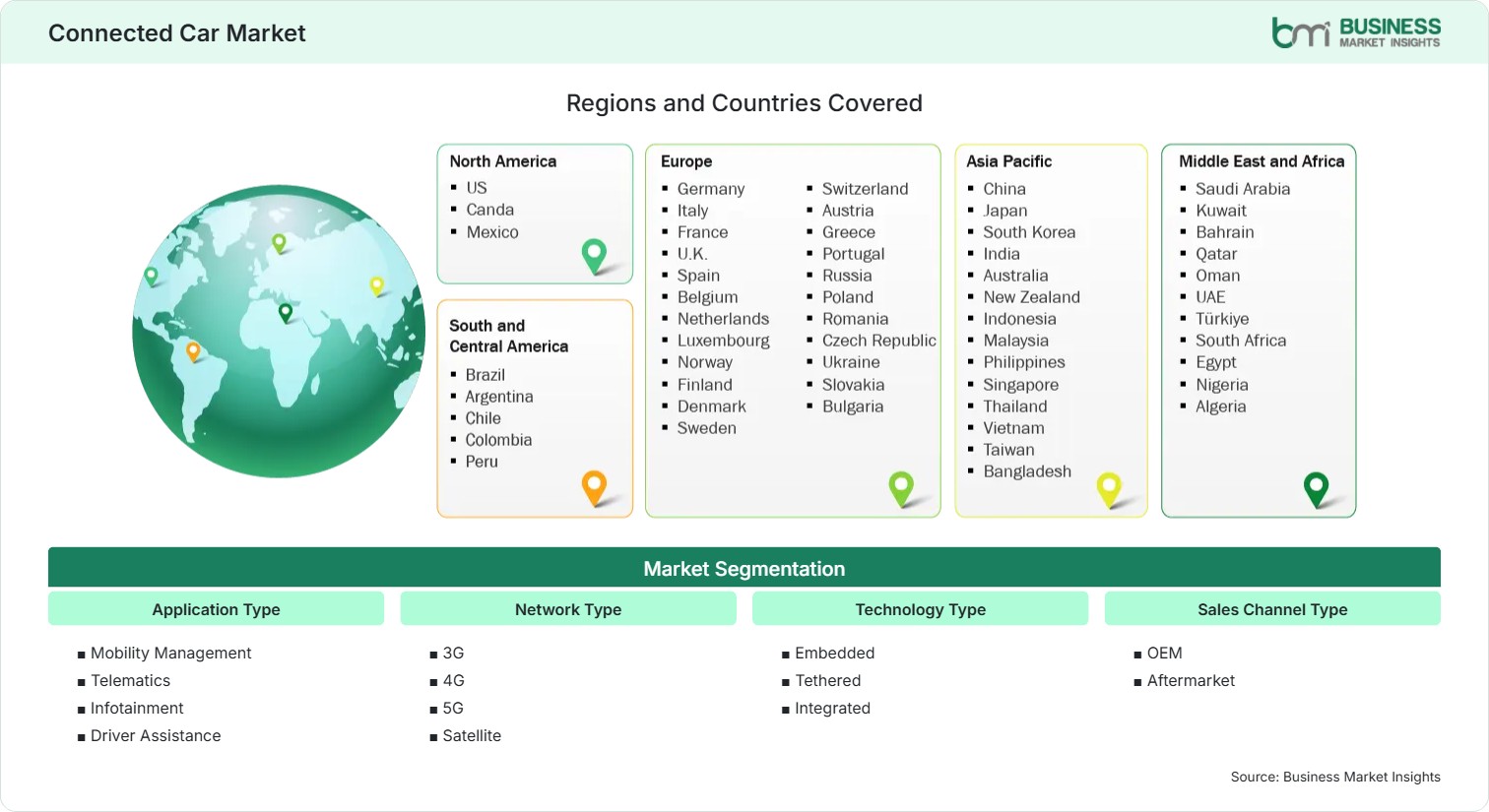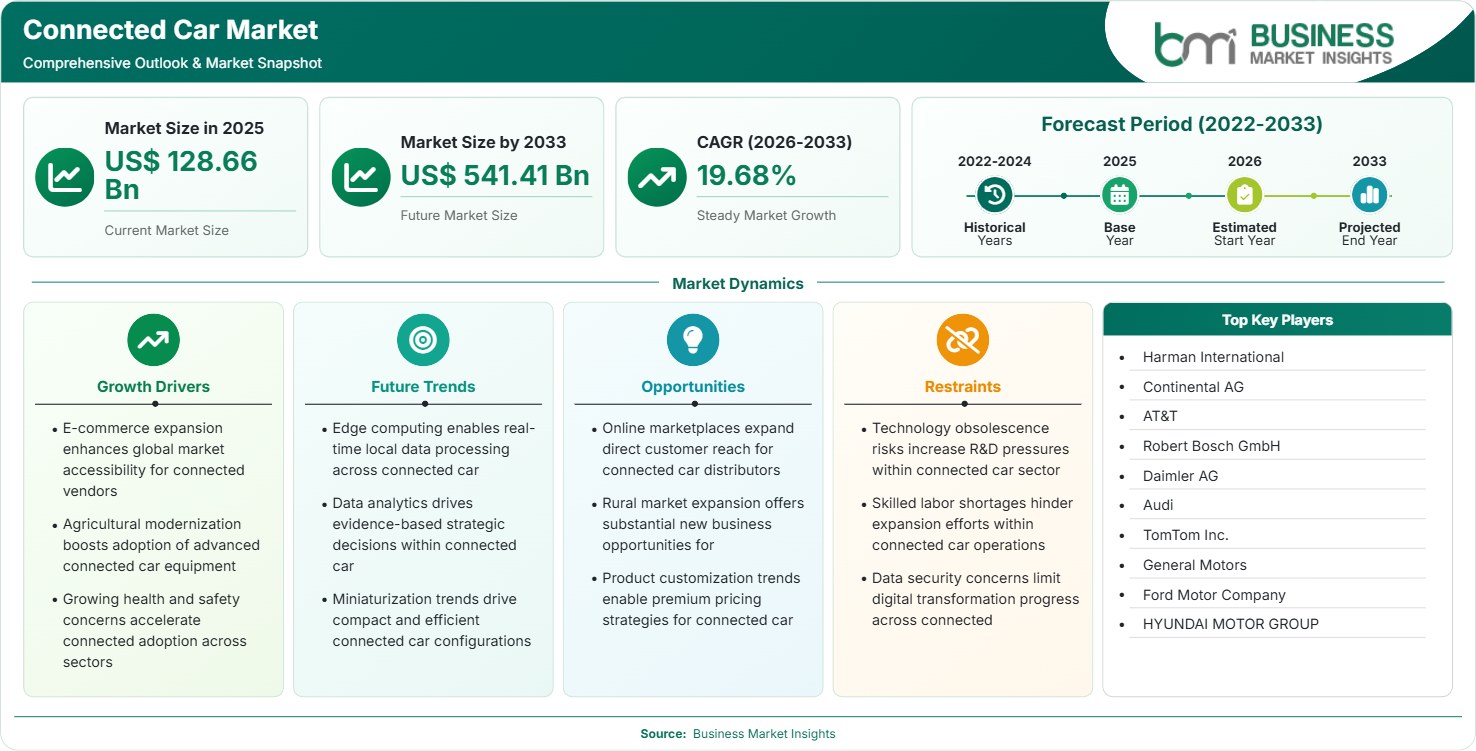
Connected Car Market Regional Highlights
North America Connected Car Market
North America accounted for 34%–37% of the global market share in 2025 and is projected to register a 17.8%–18.6% CAGR during 2026–2033. Strong deployment of 5G infrastructure, high penetration of connected mobility services, increasing investments in autonomous vehicle technologies, and stringent automotive cybersecurity regulations continue to strengthen regional competitiveness. Major OEMs, semiconductor companies, cloud providers, and telecommunications operators are accelerating software-defined vehicle initiatives. The Connected Car Market share remains the highest globally due to mature digital infrastructure, favorable regulatory frameworks, and sustained investments in intelligent transportation systems.
- Expansion of commercial fleet telematics and predictive maintenance platforms enables logistics companies to reduce operational costs while improving fleet visibility, fuel efficiency, regulatory compliance, and real-time vehicle monitoring across North American transportation networks.
- Increasing adoption of software-defined vehicles allows manufacturers to deliver over-the-air software updates, cybersecurity enhancements, digital cockpit services, and subscription-based features that improve customer engagement throughout vehicle ownership.
- Growing investments in vehicle-to-everything communication corridors support autonomous driving research, intelligent traffic management, emergency response systems, and infrastructure modernization through collaboration between public agencies and automotive technology providers.
- Rising consumer demand for premium infotainment, connected navigation, AI-enabled voice assistants, and personalized mobility applications encourages automakers to integrate cloud-based digital ecosystems into new passenger vehicle platforms.
- Continuous collaboration between telecommunications operators, semiconductor manufacturers, automotive OEMs, and hyperscale cloud providers accelerates innovation in edge computing, vehicle analytics, cybersecurity, and connected mobility services.
US Connected Car Market
The United States represented approximately 74%–77% of the North American Connected Car Market in 2025 and is anticipated to expand at a 18.0%–18.8% CAGR through 2033. Strong technology innovation, advanced telecommunications infrastructure, significant software investment, and extensive autonomous vehicle testing programs continue supporting sustained expansion. Federal transportation initiatives, increasing EV adoption, and partnerships between automakers and cloud platform providers reinforce the country's leadership in connected mobility technologies.
- Automotive manufacturers increasingly deploy AI-powered digital cockpit platforms integrating navigation, entertainment, cybersecurity, and cloud services, enhancing customer experience while creating recurring software-based revenue opportunities.
- Large commercial fleet operators adopt predictive maintenance and telematics platforms to optimize vehicle utilization, improve driver safety, lower maintenance expenses, and strengthen supply chain visibility across nationwide logistics operations.
- Growing investments in autonomous driving technologies encourage collaboration between automotive companies, semiconductor firms, telecommunications providers, and research institutions developing next-generation connected transportation ecosystems.
- Regulatory focus on vehicle cybersecurity, privacy protection, and intelligent transportation infrastructure continues supporting innovation while improving public confidence in connected mobility technologies.
Europe Connected Car Market
Europe captured approximately 26%–29% of the global Connected Car Market in 2025 and is forecast to grow at a 18.5%–19.3% CAGR during 2026–2033. Strong automotive manufacturing capabilities, expanding EV adoption, mandatory vehicle safety regulations, and increasing deployment of connected transportation infrastructure support regional expansion. Germany remains the leading national market, while Eastern European economies demonstrate faster technology adoption through automotive manufacturing investments and digital infrastructure modernization.
- Germany leads regional revenue generation through advanced automotive engineering, premium vehicle manufacturing, software innovation, and significant investments in connected mobility platforms supporting intelligent transportation systems.
- France and the United Kingdom continue strengthening connected vehicle ecosystems through smart city initiatives, digital road infrastructure, and increasing deployment of vehicle-to-infrastructure communication technologies.
- Poland records one of the fastest regional growth rates owing to expanding automotive component manufacturing, foreign direct investment, and modernization of transportation infrastructure supporting digital mobility services.
- European Union cybersecurity regulations encourage automakers to integrate advanced security architectures protecting connected vehicles against increasingly sophisticated cyber threats and software vulnerabilities.
- Strategic collaborations among automotive OEMs, cloud providers, telecommunications operators, and semiconductor companies accelerate development of software-defined vehicle platforms across the region.
Asia Pacific Connected Car Market
Asia Pacific accounted for approximately 28%–31% of global revenue in 2025 and is projected to expand at a 21.8%–22.7% CAGR during 2026–2033, representing the fastest-growing regional market. Rapid urbanization, expanding electric vehicle production, government-backed smart mobility initiatives, semiconductor manufacturing leadership, and extensive 5G deployment continue accelerating regional adoption. China dominates regional revenue while India demonstrates one of the fastest growth trajectories due to expanding digital infrastructure and connected mobility investments.
- China leads regional deployment through large-scale EV manufacturing, smart transportation infrastructure, autonomous driving development, and integrated digital ecosystems supported by domestic technology companies.
- India records one of the fastest growth rates as automotive digitization, connected fleet management, intelligent road infrastructure, and government digital transformation initiatives encourage broader deployment of connected vehicle technologies.
- Japan continues advancing high-value connected mobility through premium automotive manufacturing, robotics integration, advanced semiconductor capabilities, and collaborative autonomous driving research programs.
- South Korea strengthens regional competitiveness through rapid commercialization of 5G-enabled connected vehicles, software innovation, and strong cooperation among automotive manufacturers and telecommunications companies.
- Rising investments in intelligent transportation systems, cloud connectivity, AI-powered mobility platforms, and cybersecurity continue supporting long-term Connected Car Market growth throughout Asia Pacific.
Rest of World Connected Car Market
South & Central America and the Middle East & Africa collectively represented 8%–10% of global Connected Car Market revenue in 2025 and are expected to register a 19.2%–20.1% CAGR during 2026–2033. Increasing digital infrastructure investments, expanding mobile broadband coverage, smart city development, and growing automotive modernization initiatives support regional opportunities. Brazil leads South & Central America, while the United Arab Emirates demonstrates the fastest regional expansion through intelligent mobility investments.
The Middle East continues investing heavily in autonomous transportation pilots, intelligent road infrastructure, and connected public transportation systems. African markets are gradually expanding connected mobility adoption through improving telecommunications infrastructure, commercial fleet modernization, and increasing demand for digital transportation management solutions.
- Brazil maintains regional leadership through expanding automotive production, fleet telematics adoption, connected insurance solutions, and increasing digital transformation across commercial transportation sectors.
- The United Arab Emirates demonstrates the fastest regional expansion supported by smart city investments, autonomous mobility programs, intelligent transportation infrastructure, and advanced 5G deployment strategies.
- Saudi Arabia accelerates connected mobility investments through Vision 2030 initiatives, digital infrastructure modernization, and deployment of intelligent transportation systems supporting urban development.
- South Africa continues adopting fleet management technologies, telematics solutions, predictive maintenance platforms, and connected commercial vehicles across logistics, mining, and industrial transportation operations.
- Telecommunications expansion, affordable connected services, and increasing collaboration between governments and automotive technology providers continue improving long-term regional market competitiveness.