
Connected Construction Equipment Market Outlook: Size, Share, Trends, Growth Analysis, Competitive Landscape & Forecast, 2026-2033

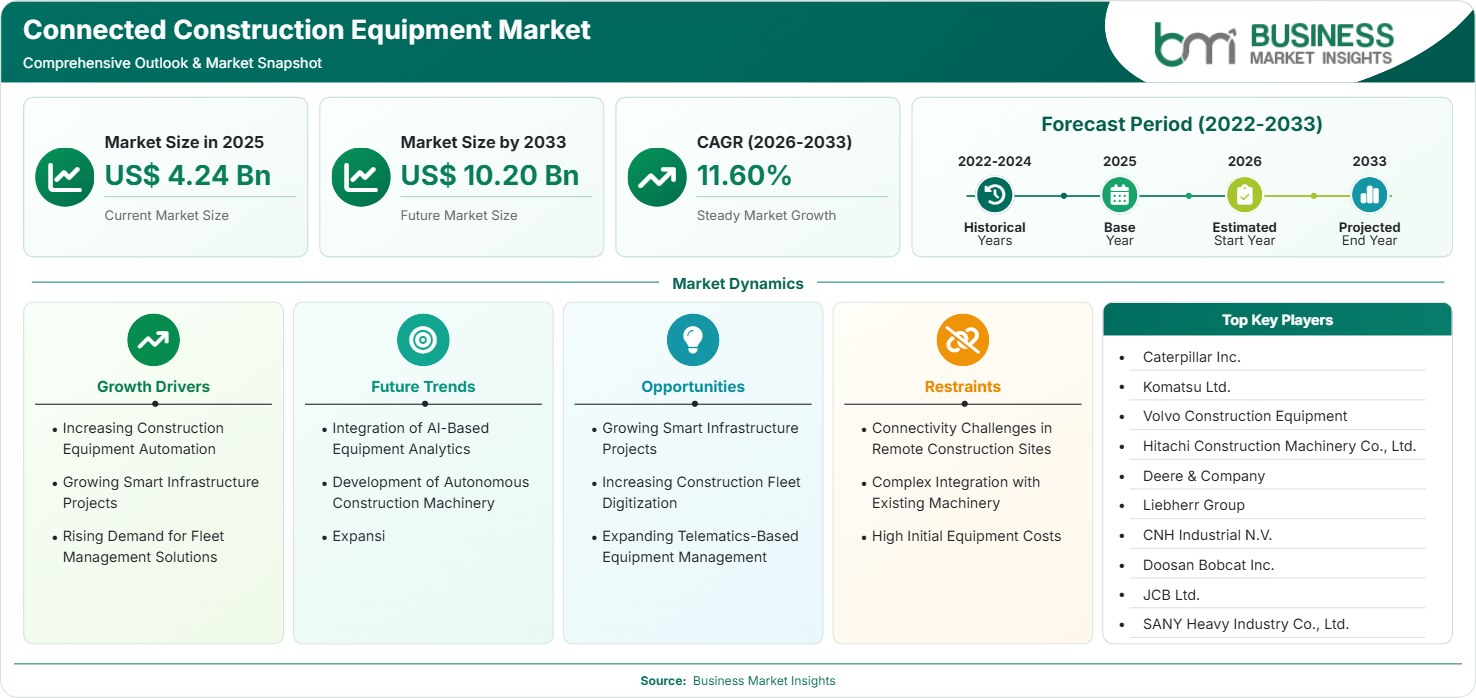
The Connected Construction Equipment Market size was valued at US$ 4.24 Billion in 2025 and is projected to reach US$ 10.20 Billion by 2033, growing at a CAGR of 11.60% during 2026–2033, driven by equipment automation, digital fleet management adoption, predictive maintenance technologies, smart infrastructure investments, and opportunities from IoT-enabled construction ecosystems.

Report Coverage
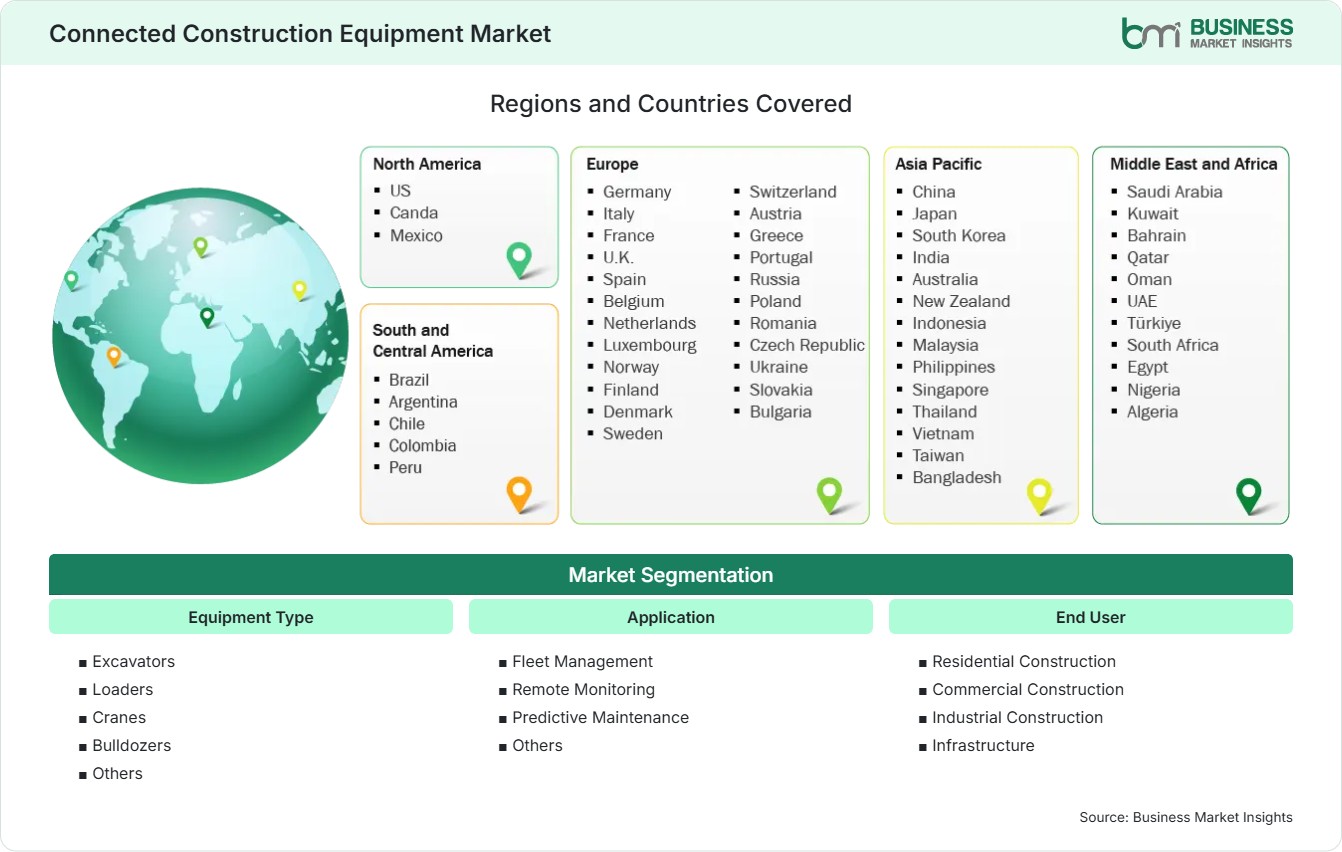
  • Equipment Type: Excavators, Loaders, Cranes, Bulldozers, Others
  • Application: Fleet Management, Remote Monitoring, Predictive Maintenance, Others
  • End User: Residential Construction, Commercial Construction, Industrial Construction, Infrastructure
US$ 4.24 Bn Market size in 2025
US$ 10.20 Bn Market Size by 2033
11.60% CAGR, 2026 - 2033
2026-2033 Forecast Period

AI Overview

Connected Construction Equipment Market Summary

  • North America Region: North America holds a 34%–37% share in 2025, growing with a CAGR of 10.80%–11.70% during 2026–2033, supported by connected machinery adoption, infrastructure modernization, telematics expansion, and autonomous equipment investments. The U.S. market is advancing through digital construction platforms with a CAGR of 10.90%–11.80% during the forecast period.
  • Fastest Growing Region: Asia Pacific maintains a 28%–31% share in 2025, expanding at a CAGR of 12.40%–13.50% during 2026–2033, supported by urban development, smart city initiatives, infrastructure spending, construction automation, and rising demand for efficient equipment monitoring solutions.
  • Leading Segment: Excavators represent a 32%–35% share in 2025, growing at a CAGR of 11.20%–12.20% during 2026–2033, driven by extensive infrastructure usage, advanced telematics integration, remote diagnostics capabilities, and demand for productivity optimization across construction projects.
  • High Growth Segment: Predictive Maintenance applications account for a 24%–27% share in 2025, recording a CAGR of 13.20%–14.40% during 2026–2033, supported by artificial intelligence analytics, equipment uptime improvement, reduced maintenance costs, and increasing digital transformation initiatives.
  • Key Market Opportunity: Connected construction equipment providers can capture opportunities through AI-based analytics, autonomous operation technologies, cloud platforms, and integrated fleet solutions that enhance productivity, safety, equipment utilization, and operational decision-making across global construction projects.
  • Major Market Players: Caterpillar Inc., Komatsu Ltd., Volvo Construction Equipment, Hitachi Construction Machinery Co., Ltd., Deere & Company, Liebherr Group, CNH Industrial N.V., Doosan Bobcat Inc., JCB Ltd., and SANY Heavy Industry Co., Ltd.
Strategic Insights

Connected Construction Equipment Market: Strategic Insights

Connected Construction Equipment Market Strategic Framework
FREE PDF
Request your free sample
Request free sample
Stakeholder View

Key Takeaways

  • The ecosystem is shifting from traditional equipment sales toward integrated digital solutions, where manufacturers, software providers, component suppliers, and construction firms collaborate to deliver connected machinery platforms with lifecycle-based service offerings.
  • Excavators, loaders, and infrastructure-focused equipment provide substantial growth potential because these categories operate across diverse construction environments requiring enhanced monitoring, operational efficiency, and remote management capabilities.
  • Artificial intelligence, IoT connectivity, and predictive analytics are becoming central innovation areas as equipment manufacturers develop automated diagnostics, machine performance optimization tools, and semi-autonomous construction capabilities.
  • Asia Pacific presents a strong investment opportunity due to rapid urbanization, infrastructure expansion, and government-supported digital construction initiatives across China, India, Japan, and Southeast Asian economies.
  • Strategic partnerships, technology collaborations, and acquisitions are increasing as traditional equipment manufacturers seek software capabilities, cloud infrastructure expertise, and advanced data analytics solutions to strengthen connected service portfolios.
Geographic Outlook

Connected Construction Equipment Market Regional Highlights

North America Connected Construction Equipment Market

North America accounted for a 34%–37% share in 2025 and is projected to expand at a CAGR of 10.80%–11.70% during 2026–2033. The region benefits from advanced construction technology adoption, strong equipment rental networks, and demand for productivity-enhancing digital solutions. The U.S. and Canada continue investing in connected equipment platforms to improve operational efficiency and reduce equipment downtime.

  • Equipment manufacturers are integrating telematics, GPS tracking, and cloud-based monitoring systems to support contractors managing large-scale construction fleets across commercial and infrastructure projects.
  • Government infrastructure investments are encouraging adoption of intelligent machinery solutions that improve project visibility, safety compliance, and resource utilization across transportation and public development initiatives.
  • Rental companies are expanding connected equipment fleets because digital monitoring enables better asset management, maintenance scheduling, and improved utilization rates throughout equipment rental cycles.
  • Technology partnerships between machinery producers and software providers are strengthening regional adoption through advanced analytics platforms, remote diagnostics, and automated reporting capabilities.

US Connected Construction Equipment Market

The U.S. market represented a 29%–32% share of North America in 2025 and is estimated to grow at a CAGR of 10.90%–11.80% between 2026–2033. Strong construction activity, infrastructure modernization programs, and increasing contractor demand for digital tools support adoption. The Connected Construction Equipment Market in the U.S. benefits from established OEM presence, technology-focused construction firms, and expanding use of fleet intelligence platforms across residential, commercial, and industrial projects.

  • Large construction contractors are adopting connected machinery solutions to enhance productivity tracking, improve safety standards, and optimize equipment deployment across multiple job sites.
  • Infrastructure investments in highways, bridges, and utility networks are accelerating demand for remotely monitored equipment capable of supporting complex project requirements.
  • U.S. equipment manufacturers are focusing on integrated digital ecosystems combining telematics, automation, and predictive analytics for improved machine performance.
  • Growing acceptance of subscription-based digital services is creating additional revenue opportunities for connected equipment providers and technology partners.

Europe Connected Construction Equipment Market

Europe held a 25%–28% share in 2025 and is expected to register a CAGR of 10.50%–11.60% during 2026–2033. The region benefits from strict sustainability targets, advanced construction standards, and increasing demand for efficient machinery operations. Germany, the United Kingdom, France, and Nordic countries are leading adoption through smart infrastructure initiatives. The Connected Construction Equipment Market growth in Europe is supported by automation investments, emission reduction goals, and digital transformation across construction industries.

  • Germany is strengthening connected equipment adoption through industrial automation expertise, advanced engineering capabilities, and demand for efficient construction management technologies.
  • The United Kingdom is increasing deployment of digital construction platforms to improve project coordination, equipment tracking, and operational transparency.
  • France is supporting intelligent machinery adoption through infrastructure modernization programs and increasing contractor focus on productivity improvement.
  • Nordic countries are adopting connected equipment solutions due to sustainability priorities, remote monitoring requirements, and harsh operating environment challenges.
  • European manufacturers are developing energy-efficient connected machines aligned with regulatory requirements for lower emissions and improved resource management.

Asia Pacific Connected Construction Equipment Market

Asia Pacific accounted for a 28%–31% share in 2025 and is forecast to expand at a CAGR of 12.40%–13.50% during 2026–2033. Rapid urbanization, infrastructure expansion, and smart city investments are accelerating regional adoption. China, India, Japan, and South Korea represent key markets due to construction modernization and technology integration. The Connected Construction Equipment Market trends in Asia Pacific reflect increasing demand for automated machinery, fleet management systems, and digital project monitoring solutions.

  • China is expanding connected equipment adoption through large infrastructure projects, construction automation initiatives, and domestic machinery technology development programs.
  • India is experiencing rising demand due to urban infrastructure development, transportation projects, and increasing contractor interest in equipment monitoring solutions.
  • Japan and South Korea are advancing smart construction practices through robotics integration, automation technologies, and advanced equipment management systems.
  • Southeast Asian economies are investing in digital construction capabilities as commercial and infrastructure projects increase across developing markets.
  • Equipment manufacturers are establishing regional technology partnerships to improve connectivity solutions and provide localized digital services.

Rest of World Connected Construction Equipment Market

Rest of World represented a 9%–12% share in 2025 and is projected to grow at a CAGR of 9.80%–10.90% during 2026–2033. South America, the Middle East, and Africa are adopting connected machinery solutions gradually through infrastructure investments and industrial development. Brazil, Saudi Arabia, UAE, and South Africa are key contributors. The Connected Construction Equipment Market share is expanding as contractors seek improved equipment utilization, operational visibility, and maintenance efficiency.

  • Brazil is supporting connected equipment demand through infrastructure upgrades, agricultural construction applications, and modernization of contractor fleets.
  • Saudi Arabia and UAE are adopting intelligent machinery solutions for mega infrastructure projects, smart city developments, and large-scale commercial construction programs.
  • South Africa is improving equipment management practices through digital monitoring solutions supporting mining, industrial, and infrastructure sectors.
  • Regional contractors are increasingly adopting cloud-based platforms to manage equipment performance, maintenance schedules, and project efficiency.
  • International equipment manufacturers are expanding partnerships across emerging economies to provide connected solutions tailored to regional construction requirements.
Global Market Geography
FREE PDF
Request your free sample
Request free sample
Segment Analysis

Connected Construction Equipment Market Segmentation

Equipment Type

Equipment Type remains a critical segmentation category as construction companies increasingly prioritize connected machinery capable of improving productivity, safety, and operational control. This segment accounted for a 48%–51% share in 2025 and is projected to grow at a CAGR of 11.30%–12.20% during 2026–2033. The Connected Construction Equipment Market scope expands as OEMs integrate sensors, telematics, automation, and remote diagnostics into different equipment categories.

  • Excavators: Excavators represent the largest connected equipment category due to extensive use in infrastructure, commercial, and residential projects requiring accurate monitoring, productivity optimization, and remote performance tracking.
  • Loaders: Connected loaders support material handling operations through improved machine utilization data, fuel efficiency monitoring, and digital fleet management solutions across construction environments.
  • Cranes: Connected cranes are gaining adoption through advanced safety monitoring, load management systems, and remote operational capabilities that enhance efficiency in complex construction projects.
  • Bulldozers: Bulldozers benefit from connectivity features including machine guidance systems, productivity analytics, and automated performance monitoring for large-scale earthmoving applications.
  • Others: Other equipment categories incorporate connectivity solutions to improve operational visibility, maintenance planning, and overall construction workflow coordination.

Application

Application-based adoption is increasing as construction companies utilize digital platforms for improving equipment efficiency and project management. This segment accounted for a 46%–49% share in 2025 and is estimated to expand at a CAGR of 12.00%–13.00% during 2026–2033. The Connected Construction Equipment Market trends indicate rising demand for intelligent applications that enable real-time monitoring, predictive decision-making, and improved asset lifecycle management.

  • Fleet Management: Fleet management applications enable contractors to monitor equipment location, utilization rates, fuel consumption, and operational performance across multiple construction sites.
  • Remote Monitoring: Remote monitoring solutions provide real-time equipment visibility, allowing operators and managers to identify performance issues, enhance safety, and reduce operational interruptions.
  • Predictive Maintenance: Predictive maintenance platforms use machine data analytics to forecast component failures, minimize downtime, and improve maintenance scheduling for connected construction fleets.

End User

End-user adoption is driven by increasing digital transformation across construction sectors seeking improved productivity and cost efficiency. This segment accounted for a 44%–47% share in 2025 and is expected to grow at a CAGR of 11.50%–12.50% during 2026–2033. The Connected Construction Equipment Market analysis highlights expanding demand from infrastructure developers, contractors, and industrial operators requiring advanced equipment management capabilities.

  • Residential Construction: Residential construction companies are adopting connected machinery to improve project timelines, enhance equipment coordination, and support efficient management of urban development activities.
  • Commercial Construction: Commercial projects utilize connected equipment for improved productivity monitoring, safety management, and optimized resource allocation across complex building developments.
  • Industrial Construction: Industrial construction applications require connected solutions for large-scale projects involving heavy machinery, operational monitoring, and improved maintenance planning.
  • Infrastructure: Infrastructure projects represent a major adoption area due to demand for efficient equipment utilization in transportation networks, utilities, and public development programs.
Market Forces

Connected Construction Equipment Market Dynamics

Key Market Drivers

Increasing Construction Equipment Automation

Automation in construction equipment is on the rise due to the high demand for increased efficiency, better safety measures, and less operational inefficiencies. Automated equipment controls, telematics systems, and artificial intelligence monitoring are revolutionizing equipment management procedures. The Connected Construction Equipment Market growth is being fueled by the increasing use of sensors, GPS technology, and computerized control systems in excavators, loaders, and other machines. Based on current market trends, construction businesses are focusing on automation to deal with the problem of lack of workers and project accuracy.

Growing Smart Infrastructure Projects

Smart infrastructure development is creating strong demand for digitally connected construction machinery as governments and private developers invest in intelligent transportation networks, urban development, and sustainable infrastructure. Connected machinery can help to monitor projects in real time, allocate resources more effectively, and improve collaboration between contractors and equipment operators. The development of smart cities and digital construction solutions leads to the popularity of advanced machinery solutions. In infrastructure projects, there is an increasing need for connected equipment that is able to transmit data about its operations via cloud solutions.

Rising Demand for Fleet Management Solutions

Construction management solutions are increasingly being seen as indispensable for construction firms running many machines at different geographic locations. They help in providing asset tracking, performance analytics, scheduling, and maintenance services. The growing emphasis on minimizing downtime and maximizing productivity is making construction firms opt for connected fleet solutions. Fleet management solutions can help construction firms in allocating and managing their construction equipment rental services. With construction becoming an information-driven activity, there is increasing need for integrated solutions.

Key Market Opportunities

Expanding Manufacturing Facilities

Expansion of manufacturing facilities across developing economies creates opportunities for connected equipment providers as industrial construction projects require advanced machinery management solutions. The equipment producers could profit from providing connected systems which would enable construction on a large scale, constant monitoring, and predictive maintenance. As per the Connected Construction Equipment Market Forecast, the development of industries would result in demand for smart equipment systems. There is a growing trend of collaboration between construction companies and technology suppliers.

Increasing Renewable Energy Projects

The growth of renewable energy is creating opportunities for connected construction equipment by the creation of large solar farms and wind energy projects and their related infrastructural developments. These projects would need proper machinery utilization, remote monitoring, and performance tracking due to complicated conditions in which they work. The use of connected equipment can assist in better coordination, lower down time, and higher productivity in the process of renewable energy constructions. Global shift towards renewable energy is making way for investments in the field of digital construction. The equipment vendors with special solutions for such projects can benefit.

Growing Process Industry Investments

Investments in process industries such as chemicals, mining, and industrial manufacturing are creating opportunities for connected machinery adoption. Large industrial projects require reliable equipment performance monitoring, efficient maintenance practices, and improved operational visibility. The use of connected construction machinery can help achieve all the above through analytics, diagnostics, and integrated project management systems. The application of digital solutions during the expansion of the process industries will foster cooperation between equipment makers and engineering services.

Market Restraints and Challenges

Connectivity Challenges in Remote Construction Sites

Factor: Limited network availability in remote construction locations restricts seamless data transmission and real-time equipment monitoring. Impact: Limitations in connectivity may compromise the efficiency of cloud platform services, remote diagnosis tools, and fleet management systems used in isolated project settings. Projects based in construction sites situated in rural, mining areas, or rugged terrain face the challenge of poor communication infrastructure.

Complex Integration with Existing Machinery

Factor: Compatibility issues between new connectivity technologies and existing construction machinery create implementation challenges. Impact: Integration becomes complicated and results in increased upgrade costs as well as delays in the implementation process due to contractors using mixed equipment fleets. Technology providers and equipment manufacturers need to come up with solutions that simplify the integration process without compromising reliability.

Company Analysis

Competitive Landscape

The Connected Construction Equipment Market analysis highlights increasing competition among global construction equipment manufacturers, technology innovators, and digital solution providers. Leading companies are focusing on telematics integration, autonomous capabilities, cloud-based monitoring platforms, and predictive analytics to strengthen their connected equipment portfolios.

Company Name

Overview

Products and Services relevant to this market

Caterpillar Inc.

Caterpillar is a global construction equipment manufacturer offering advanced machinery solutions with integrated digital technologies for diverse construction applications.

Provides Cat Connect technologies, telematics platforms, machine monitoring solutions, remote diagnostics, and connected construction equipment management services.

Komatsu Ltd.

Komatsu develops construction and mining equipment with advanced automation and connectivity features supporting productivity and operational efficiency.

Offers KOMTRAX telematics, autonomous equipment solutions, machine monitoring systems, and digital fleet management technologies.

Volvo Construction Equipment

Volvo Construction Equipment specializes in sustainable construction machinery with advanced connectivity and automation capabilities.

Provides Volvo CareTrack telematics, remote monitoring services, electric equipment connectivity, and productivity management solutions.

Hitachi Construction Machinery Co., Ltd.

Hitachi Construction Machinery delivers hydraulic excavators and digital solutions designed for efficient construction operations globally.

Offers ConSite remote monitoring, machine data analytics, fleet management tools, and connected equipment services.

Deere & Company

Deere develops intelligent construction machinery integrating precision technologies and digital platforms for improved productivity.

Provides JDLink connectivity, equipment monitoring solutions, precision construction technologies, and machine performance analytics.

Liebherr Group

Liebherr manufactures construction equipment with a focus on innovation, reliability, and advanced operational technologies.

Supplies connected machinery solutions, fleet management systems, telematics platforms, and digital service tools.

CNH Industrial N.V.

CNH Industrial provides construction machinery solutions through globally recognized brands focused on technology-enabled operations.

Offers telematics systems, fleet management platforms, remote monitoring capabilities, and connected equipment services.

Doosan Bobcat Inc.

Doosan Bobcat develops compact and heavy construction equipment supported by digital connectivity and productivity solutions.

Provides machine monitoring technologies, telematics systems, remote diagnostics, and connected equipment management solutions.

JCB Ltd.

JCB manufactures construction machinery with emphasis on innovation, efficiency, and operator-focused digital technologies.

Offers LiveLink telematics, machine tracking, maintenance monitoring, and connected fleet management services.

SANY Heavy Industry Co., Ltd.

SANY produces construction machinery supported by intelligent technologies and digital transformation initiatives.

Provides remote monitoring systems, intelligent equipment platforms, telematics solutions, and connected machinery services.

Trust & Transparency

Research Methodology

The market analysis combines proprietary research with secondary data from government agencies, company disclosures, regulatory filings, industry databases and expert interviews. Market estimates are validated through data triangulation, cross-market benchmarking and analyst review.

View Full Research Methodology

Questions Answered

Frequently Asked Questions

How will sustainability influence connected equipment development?

Sustainability goals will encourage manufacturers to develop connected machines that optimize fuel consumption, reduce unnecessary operating hours, improve maintenance efficiency, and support environmentally responsible construction practices through data-driven operational improvements.

What factors influence adoption of the Connected Construction Equipment Market Report findings?

The report identifies automation demand, infrastructure development, fleet optimization requirements, and digital transformation initiatives as major factors influencing adoption.

Why are equipment manufacturers investing in digital construction platforms?

Manufacturers are investing in digital platforms because connected services create new revenue opportunities beyond equipment sales. Software-enabled solutions improve customer engagement, provide lifecycle support, and help manufacturers differentiate products.

What technologies support modern connected construction equipment solutions?

Modern solutions rely on IoT sensors, GPS tracking, cloud computing, artificial intelligence, telematics, and machine learning analytics. These technologies allow equipment operators and managers to monitor performance, identify maintenance needs, and improve construction workflow management.

How does connected construction equipment improve project efficiency?

Connected construction equipment improves efficiency by enabling real-time machine monitoring, automated reporting, predictive maintenance scheduling, and optimized resource allocation. Contractors can reduce downtime, improve equipment utilization, and make faster operational decisions through digital insights collected from connected machinery.

Access the Full Connected Construction Equipment Market Report

Get segment-level forecasts, regional estimates, competitive benchmarking, company profiles and downloadable Excel datasets.

Access the full Connected Construction Equipment Market Report
350 pages PDF & Excel | 2026-08-25
Similar Research

Related Market Reports