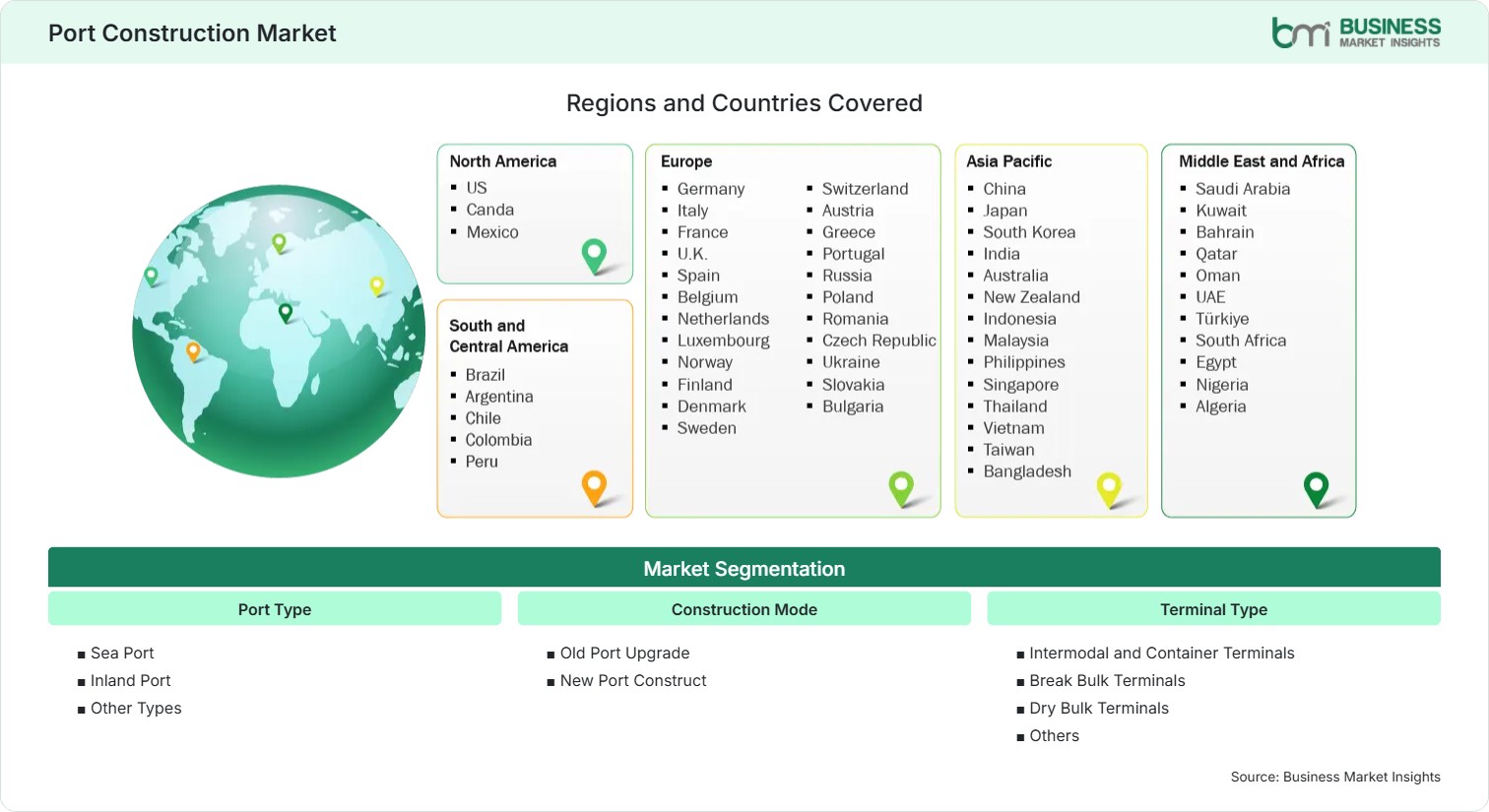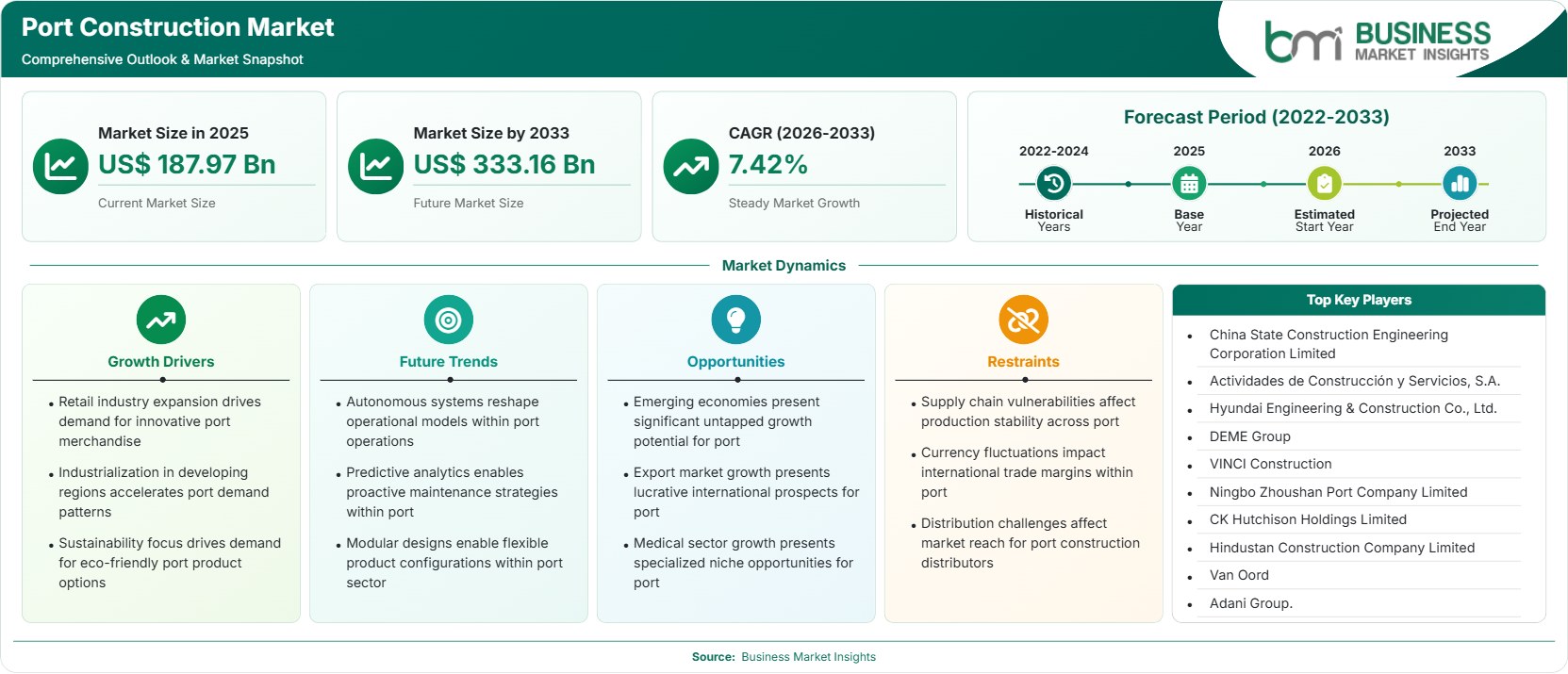
Port Construction Market Regional Highlights
North America Port Construction Market
North America holds a 20%–23% Port Construction Market share in 2025 and is projected to expand at a 6.4%–7.1% CAGR through 2033. The region prioritizes modernization over indiscriminate capacity expansion, with aging terminals, larger vessels, congestion reduction, dredging, automation, and rail connectivity shaping procurement. The United States remains the principal demand center, while Canada emphasizes resilient gateways serving energy, agricultural, and containerized trade. Investments increasingly combine berth rehabilitation with inland logistics and emissions-reduction infrastructure.
- U.S. gateway modernization is supported by container capacity, rail connectivity, automation, coastal resilience, and supply-chain security requirements.
- Canadian ports are prioritizing modernization, trade-corridor efficiency, environmental compliance, and climate adaptation across major Pacific and Atlantic gateways.
- Mexico benefits from nearshoring, manufacturing relocation, cross-border logistics demand, and expanding connections between ports and industrial corridors.
- Dredging and channel deepening remain essential as larger vessels require greater navigational depth and reliable year-round access.
US Port Construction Market
The U.S. represents the dominant national Port Construction Market within North America, holding a 15%–18% share of global 2025 demand and growing at a 6.5%–7.2% CAGR through 2033. Project priorities include berth reconstruction, channel deepening, automated cargo handling, rail connectivity, coastal resilience, and emissions reduction. Major gateway modernization increasingly targets lifecycle performance rather than standalone civil expansion, while strategic infrastructure policy emphasizes redundancy and domestic supply-chain resilience across Atlantic, Gulf, and Pacific corridors.
- Gulf Coast projects emphasize energy, petrochemical, bulk, and container infrastructure, with hurricane resilience and channel reliability influencing engineering specifications.
- Pacific gateways face land constraints, making automation, yard optimization, rail efficiency, and terminal densification particularly valuable for capacity growth.
- East Coast investment increasingly connects terminals with inland freight networks, supporting distribution centers, manufacturing corridors, and diversified import routes.
Europe Port Construction Market
Europe represents a 18%–21% Port Construction Market share in 2025 and is estimated to grow at a 5.8%–6.6% CAGR through 2033. Germany, the Netherlands, Spain, France, Italy, and Belgium remain leading markets, while Poland and Greece provide higher-growth opportunities. Decarbonization, inland-waterway connectivity, offshore wind logistics, alternative-fuel infrastructure, dredging, and climate adaptation shape project specifications. European contractors increasingly combine maritime civil engineering with environmental remediation and multimodal logistics integration.
- Germany and the Netherlands emphasize inland connectivity, automation, energy-transition logistics, and efficient container handling at established gateways.
- France is investing in river-port integration, including the €183 million La Chatière project connecting Port 2000 with the Seine basin.
- Poland and Greece offer higher-growth opportunities through expanding logistics corridors, deep-water facilities, and transshipment infrastructure.
- Offshore wind development creates demand for heavy-load quays, fabrication yards, assembly areas, and specialized maritime construction.
Asia Pacific Port Construction Market
Asia Pacific commands a 42%–46% Port Construction Market share in 2025 and is projected to grow at an 8.0%–8.8% CAGR through 2033, making it the fastest-growing regional market. China, India, Japan, South Korea, Singapore, Indonesia, and Vietnam anchor demand, while Bangladesh and the Philippines offer high-growth opportunities. Manufacturing expansion, transshipment, industrial corridors, deep-water gateways, automation, and public-private investment continue to support large project pipelines.
- China combines major gateway modernization with automated terminals, deep-water infrastructure, coastal logistics, and integrated industrial supply chains.
- India is developing new deep-water gateways and expanding established ports, while dedicated freight corridors strengthen inland connectivity.
- Bangladesh is developing Bay Terminal infrastructure with World Bank-backed financing, including a 6-kilometre climate-resilient breakwater.
- Southeast Asian economies are expanding container, bulk, energy, and transshipment facilities as manufacturing supply chains diversify.
Rest of World Port Construction Market
Rest of World represents a 12%–16% share in 2025 and is projected to grow at a 6.8%–7.7% CAGR through 2033. South and Central America are supported by agricultural exports, mining, energy logistics, and transshipment, while the Middle East and Africa benefit from strategic corridors, industrial diversification, and connectivity investment. Brazil, Chile, Panama, UAE, Saudi Arabia, Egypt, Morocco, and South Africa provide leading or high-growth opportunities.
Latin American projects increasingly prioritize bulk export efficiency, container connectivity, climate resilience, and integration with inland transport corridors. Middle Eastern and African developments focus on deep-water gateways, logistics zones, transshipment, energy infrastructure, and strategic trade routes, with public-private structures helping mobilize capital for large marine works.
- Brazil and Chile benefit from agricultural, mineral, energy, and containerized export infrastructure requirements.
- Panama and regional Caribbean gateways remain strategically important for transshipment and interoceanic logistics.
- Saudi Arabia and the UAE are developing integrated ports and logistics ecosystems linked with industrial diversification strategies.
- Egypt and Morocco offer gateway opportunities connecting Mediterranean, Atlantic, African, and Middle Eastern trade flows.