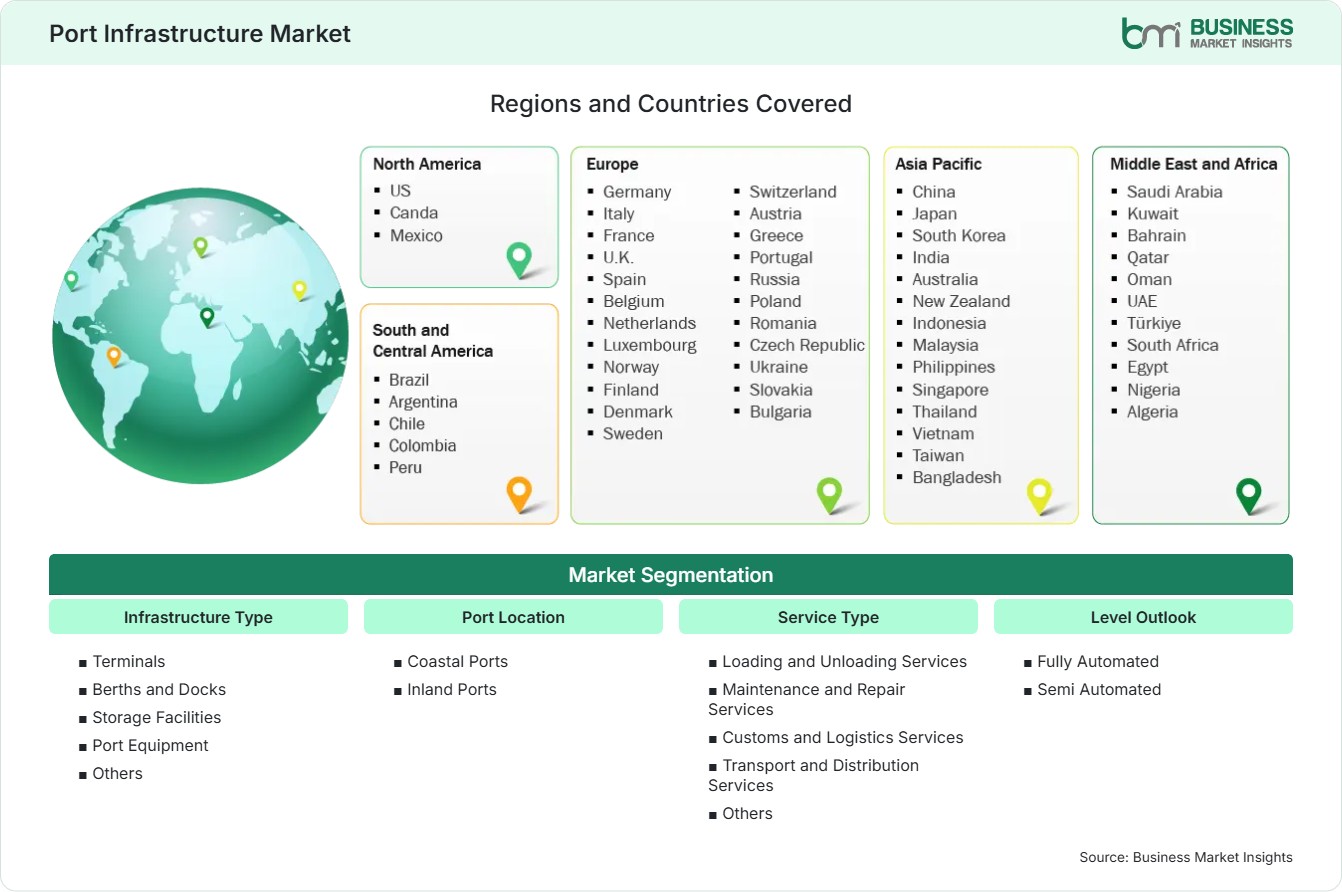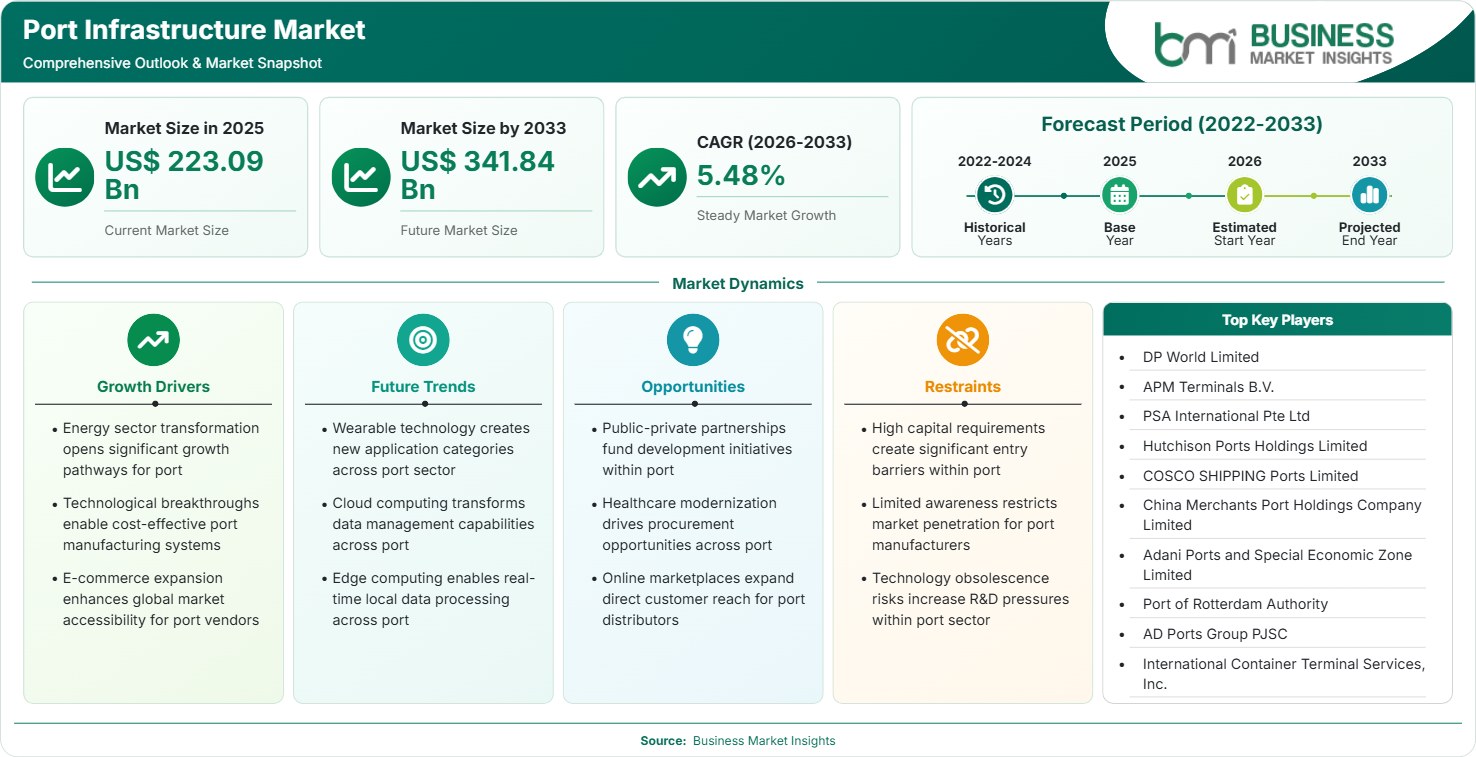
Port Infrastructure Market Regional Highlights
North America Port Infrastructure Market
North America accounted for 24%–27% of global demand in 2025 and is projected to expand at a CAGR of 4.8%–5.3% through 2033. The region benefits from strong federal infrastructure programs, increasing automation deployment, and strategic upgrades at major container gateways. Port Infrastructure Market share remains supported by large import volumes, extensive inland transportation networks, and investments designed to improve resilience against supply chain disruptions. Modernization programs across coastal facilities continue to strengthen operational efficiency and cargo handling capacity.
- U.S. and Canadian ports continue expanding terminal capacity while investing in electrified cargo equipment, automated gate systems, and digital freight visibility technologies, improving operational reliability and throughput efficiency.
- Supply chain diversification strategies are encouraging cargo redistribution toward Gulf Coast and East Coast facilities, supporting berth expansion projects and logistics infrastructure upgrades across multiple transport corridors.
- Energy exports, industrial goods shipments, and increasing container traffic are sustaining capital expenditure programs focused on dredging, quay reinforcement, and intermodal connectivity enhancement.
- Environmental compliance requirements are accelerating adoption of shore power systems, clean energy integration, and emissions reduction technologies throughout leading maritime gateways.
US Port Infrastructure Market
The United States dominates the North American region, with the highest market share estimated at 76%-80% in 2025, with a projected CAGR of 4.9%-5.4%. Investment in infrastructure, construction of container ports, and a high volume of trade are contributing factors to its steady growth. The priorities are automated cargo handling, cybersecurity, maximized port efficiency, and resilience. Its role as an important trading nation ensures the continued development of port infrastructure, both coastal and inland.
- Major gateways including Los Angeles, Long Beach, Savannah, and New York-New Jersey continue investing in terminal automation and cargo flow optimization technologies.
- Federal infrastructure support encourages modernization of berths, rail connections, storage areas, and freight distribution networks surrounding strategically important ports.
- Growing e-commerce imports and industrial cargo traffic support continuous investment in logistics integration and advanced handling systems.
Europe Port Infrastructure Market
The Europe region had a market share of approximately 22% - 25% in the Port Infrastructure Market in 2025 and is estimated to grow at a CAGR of 4.7% - 5.2% up to 2033. The investments within the region will be concentrated around sustainability, digitization, and multimodal transportation connectivity. The Netherlands is currently the leader in this region, and Poland is showing one of the highest growth rates, close to 6.0%-6.5%, owing to its logistics development and trade corridors. Regulatory emphasis on emissions reduction is accelerating deployment of electrified port technologies and smart infrastructure solutions.
- Green port strategies encourage installation of shore power, renewable energy systems, and carbon-reduction technologies across major maritime hubs.
- Digital freight platforms and automated cargo management systems improve vessel scheduling accuracy and terminal productivity.
- The Netherlands maintains leadership through advanced logistics infrastructure, while Germany continues investing in container handling modernization.
- Poland experiences rapid growth supported by trade diversification, infrastructure expansion, and strategic Baltic Sea logistics positioning.
Asia Pacific Port Infrastructure Market
Asia Pacific accounted for 38%–42% of global demand in 2025 and is expected to register a CAGR of 6.3%–6.9% through 2033. The region leads global container throughput, manufacturing exports, and infrastructure investment activity. China remains the largest market, while India records among the highest growth rates near 7.0%–7.6%. Strong Port Infrastructure Market growth across regional trade corridors is supported by expanding industrialization, smart port deployment, and maritime connectivity initiatives.
- China continues expanding automated terminals, deep-water port facilities, and international trade connectivity supporting large-scale cargo movement.
- India benefits from logistics modernization, private sector investment, and government programs aimed at increasing port efficiency and capacity.
- Southeast Asian economies are strengthening maritime infrastructure to accommodate manufacturing relocation and rising export activity.
- Automation, AI-enabled planning tools, and smart logistics platforms are improving operational productivity throughout regional gateways.
Rest of World Port Infrastructure Market
The Rest of World contributed 11% to 14% to total global demand in 2025 and is expected to witness a CAGR of 5.8% to 6.4% until 2033. The Middle East holds investment potential due to trade diversification policies and its role as a logistical hub. Commodity exports and expansion are the key factors driving growth in South and Central America. Saudi Arabia is the lead contributor to development in the region, whereas the UAE and Brazil maintain strong infrastructure investment pipelines.
- Gulf countries continue funding mega-port projects, free-zone developments, and multimodal logistics networks supporting international trade growth.
- Brazil invests in terminal modernization and cargo efficiency improvements to enhance agricultural and industrial export competitiveness.
- African coastal economies pursue deep-water port construction initiatives to strengthen regional connectivity and maritime trade access.
- Public-private partnership models remain critical for financing large infrastructure developments across emerging markets.